Part 1: The Bright Future and the Dark Moon
In the future, space felt close, like a neighbor you could wave to.
Cities on Earth glittered with roof gardens and clean sky rails. Quiet drones carried fruit and letters. People wore thin wrist screens that could call a friend, check the weather on Mars, or translate whale songs. At night, the oceans shone with floating lights that helped lost boats find home.
Up above, there were even more lights.
There were ring stations that spun like silver hoops. There were long cargo ships that moved slowly, like sleepy whales, pushing crates of water ice and metal through the dark. There were kind robots that fixed solar sails and told jokes nobody asked for.
And there were independent astronauts, too—people who worked alone, but never truly alone, because space was full of voices on the radio.
Mara Kline was one of them.
She lived inside her small ship, the Pebble, which was round and sturdy and painted a cheerful orange. The Pebble was not the fastest ship, but it was careful. It had a warm bunk, a tiny kitchen, and a window that made the stars look like sprinkled sugar.
Mara was flying toward a polar base on a moon called Nox.
Nox was a dark moon that circled a gas giant with swirling purple clouds. Nox did not have bright days. It had dim glows and long shadows. Its poles held frozen craters where sunlight almost never reached. That was why the base was there: to study the ice, to listen for deep moonquakes, and to test new tools.
Mara's new tool sat in a padded box beside her seat.
LIDAR.
Mara patted the box as if it were a sleepy pet. “All right,” she said. “You and me. We'll do this properly.”
Her ship's gentle voice, called Jun, spoke from the dashboard. “Checklist ready.”
Mara smiled. “Read it to me.”
Jun's voice was calm and friendly. “Approach speed steady. Heat shield set. Landing legs locked. Lidar unit secured.”
Mara nodded at each line. She liked lists. Lists were little ladders for your brain. You could climb them one step at a time and not get lost.
Outside, Nox grew larger. It looked like a smooth black marble, with a few pale scars where ice peeked through.
Mara took a slow breath. “Pebble,” she whispered. “Let's be brave and boring.”
Jun replied, “Brave and boring is the best kind of safe.”
Mara laughed. “Exactly.”
Part 2: The Polar Base and the First Scan
The polar base appeared as a cluster of soft lights on the dark. Its domes were white and round, tucked near the rim of a crater. Tall antennas stood like thin trees. A landing pad blinked green dots in a circle.
Mara guided the Pebble down.
The ship hummed, the landing legs touched, and there was a gentle bump. Then quiet.
Mara waited for the dust to settle. On Nox, dust did not float like on Earth. It drifted slowly, like it was thinking about it.
She put on her suit—lightweight, flexible, and the color of sunny lemons. A small lamp sat on her shoulder. She checked her air, checked her seals, then checked them again.
Jun asked, “Ready to exit?”
Mara lifted her visor. “Ready.”
The base door opened with a soft sigh. Warm air reached for her like a blanket.
Inside, the base smelled faintly of tea and clean metal. The floor was springy to help tired legs. A wall screen showed a simple map: crater edges, ice pockets, and safe paths marked in blue.
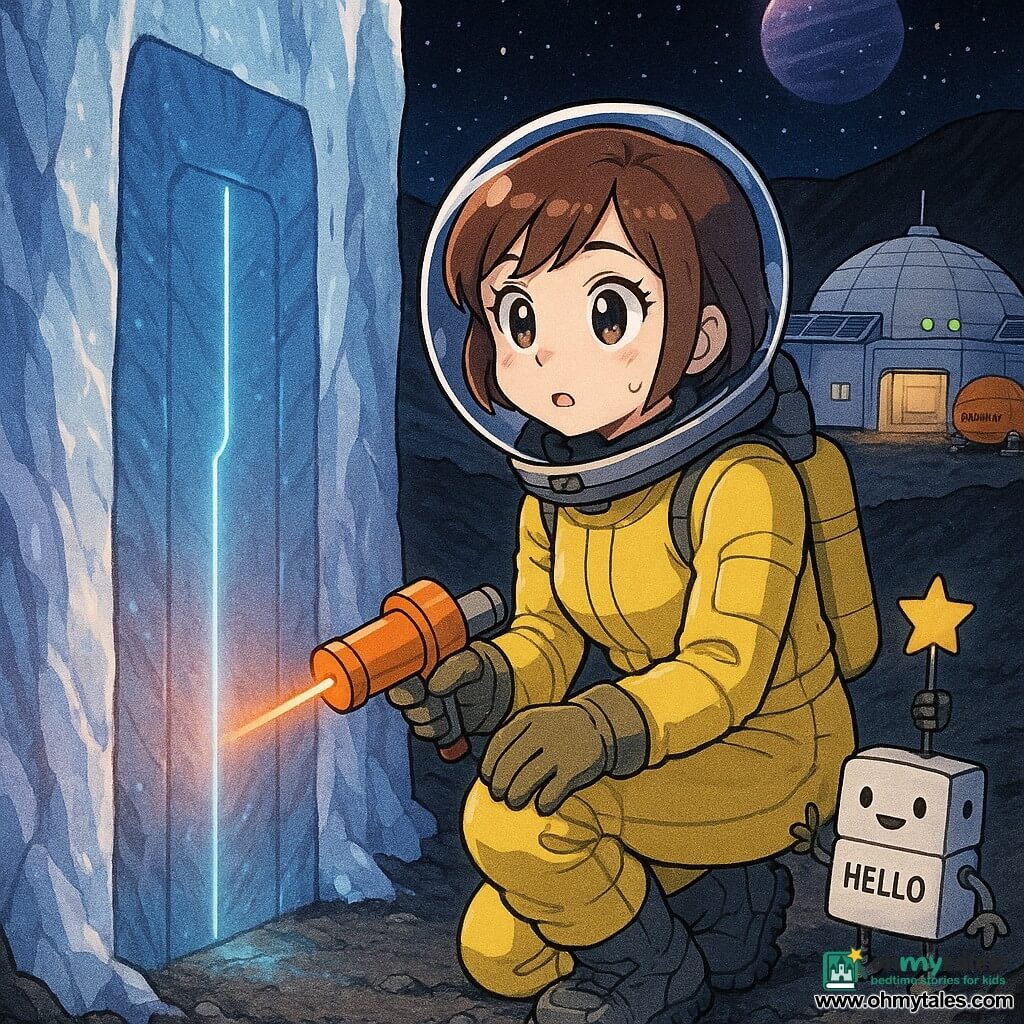
A small service robot rolled up. It was the size of a toaster and wore a sticker that said HELLO.
“Welcome, Astronaut Mara,” it beeped. “I am Pip. Your boots are dusty.”
Mara looked down. “That's true.”
Pip extended two tiny brushes and began to clean her boots with great seriousness.
Mara chuckled. “Thank you, Pip. You're very dedicated.”
“I am programmed for dedication,” Pip said. “Also for fun facts. Would you like a fun fact?”
“Always.”
“Nox has tiny sparkles in its ice,” Pip said. “They look like stars trapped in a freezer.”
Mara's eyes softened. “That's a very good fact.”
She set her lidar case on a work table. The lidar was a smooth tube with a little square window. It would send out safe light pulses—tiny, quick flashes—and then listen for the light that bounced back. Like calling “Hello!” in a cave and hearing your own voice return. The time it took would help Mara measure distance and map shapes.
Pip watched. “Is it a laser?”
Mara held up one finger. “Almost. It uses light like a laser, but it's made for measuring, not for cutting. And it's careful. We are always careful.”
Jun's voice came through Mara's suit earpiece. “Procedure: calibrate in the airlock corridor.”
“The corridor,” Mara repeated. “Good. A straight line. No surprises.”
They moved to a long corridor that connected the main dome to a storage dome. It was quiet and bright, with handrails and little arrows on the floor.
Mara placed the lidar on a small tripod. She set up three target panels at different distances: one near, one medium, one far. Each panel had bold stripes so the lidar could “see” them easily.
Pip held a clipboard almost as big as itself. “I can be your assistant,” it said.
Mara nodded. “Perfect. Write down what you notice.”
Pip's pen clicked. “I am noticing excitement.”
Mara smiled. “Me too. But we don't let excitement skip steps.”
She pressed the power button. The lidar made a soft ping. A tiny light blinked inside the square window.
Jun said, “Pulse rate stable.”
Mara watched the readout. “Panel one: two meters. Panel two: seven meters. Panel three: fifteen meters.”
Pip tilted its head. “That seems correct.”
Mara's eyes narrowed. “Seems correct is not the same as is correct.”
Pip's pen paused. “Oh.”
Mara walked to the far panel and measured the distance with a simple tape line on the floor. “Fifteen meters,” she said. “Good.”
She checked the others. Two. Seven. All good.
Mara let out a small breath. “Okay. Now the real work.”
She would take the lidar outside to scan the crater rim. The scientists wanted a map of tiny cracks in the ice, because cracks could be dangerous, but also useful. Cracks could show where warm pockets hid below, and where the ice was thick and strong.
Mara clipped the lidar to her suit. “Pip, you stay inside.”
Pip's voice grew proud. “I will guard the tea.”
“Excellent,” Mara said. “That's a vital task.”
Part 3: The Shadow in the Ice
Outside, the world was dark and wide.
Mara's shoulder lamp made a small pool of light. Beyond it, the crater edge curved away, a smooth black line against a sky filled with stars. The gas giant hung above like a giant marble with purple swirls.
Mara planted her boots carefully. “Step, check, step,” she murmured.
Jun spoke in her ear. “Tether line attached. Heart rate normal.”
“Thank you,” Mara said. “Let's keep it that way.”
She raised the lidar and began to scan.
Ping. Ping. Ping.
A thin beam of invisible light swept over the ground. On Mara's wrist screen, a simple picture grew: dots and lines forming a map. The ice pockets showed up as pale shapes. The rocks showed up as darker lumps.
Mara walked slowly along the marked safe path. Every few steps, she stopped to scan again, making sure the map matched the ground.
Then the lidar showed something strange.
On the screen, a long shape appeared ahead—like a hallway carved into the ice. It was too straight. Nature could make smooth curves, yes, and sharp cracks, yes, but this looked… neat. Like someone had drawn it with a ruler.
Mara stopped.
She looked with her own eyes. She saw only darkness and a small slope of ice.
Jun asked, “Anomaly detected?”
Mara swallowed. “Maybe. Or maybe it's a mistake.”
Pip's voice crackled from the base radio. “Do you need tea?”
Mara laughed once, a short puff of sound. “Not yet, Pip.”
She made herself do the boring thing first.
“Jun,” she said, “reduce pulse rate. Switch to short range. I want a closer scan.”
“Confirmed,” Jun replied.
Mara scanned again, tighter and slower.
Ping. Ping.
The hallway shape stayed.
Mara tried a different angle. She stepped sideways and scanned from the left.
Still there.
Her stomach fluttered, but her mind stayed steady. “All right,” she told herself. “Evidence first, stories later.”
She walked closer, careful as a cat. Her boots crunched softly on the frozen dust.
At the base of the slope, her lamp caught something pale—a smooth edge, like a doorway half-buried in ice.
Mara's breath fogged her visor. “Okay,” she whispered. “That's real.”
Jun asked, “Proceed?”
Mara thought. She was alone, but she was not careless. The base was close. The path behind her was safe. She could retreat any time.
“I will approach to five meters,” Mara said. “Then stop and scan.”
Jun replied, “Limit acknowledged.”
Mara approached. At five meters, she stopped. She scanned the doorway.
The lidar showed a flat plane with a sharp border. It was not rock. It was not ice.
Mara crouched and brushed away a little frost with her glove.
Underneath was a smooth panel the color of moonlight. It had no buttons. No words. Just a faint line down the middle, like two doors meeting.
Pip's voice came again. “Mara? Your silence is long.”
Mara kept her voice calm. “I found something. It might be an old structure.”
Pip gasped in a very robotic way. “Oh!”
Jun asked, “Risk assessment?”
Mara spoke slowly. “Unknown. But it's stable. No cracks. No heat. No movement. I think it's safe to observe.”
She leaned close. “Hello?” she said, feeling a little silly.
Nothing answered.
Then, softly, the line down the middle glowed.
Not bright. Not scary. Just a gentle blue, like a night-light.
Mara froze.
Jun said, “Light detected. No radiation spike. No sound.”
Mara's heart thumped once, hard. She put one hand on the ice beside the door, steadying herself. “I did not touch it,” she whispered.
Pip said, “Maybe it heard you.”
Mara made herself think. “Maybe it noticed my lamp. Or my lidar pulses.”
She lifted the lidar carefully. “If it reacted to light,” she said, “we can test that.”
She pointed the lidar away and turned it off.
The glow faded.
Mara turned it on again, just for one gentle ping near the door.
The glow returned.
Mara felt a warm spark of wonder in her chest. “It's responding,” she said. “Like a friend waving back.”
Jun asked, “Open?”
Mara shook her head, then remembered Jun could not see. “Not yet. Critical thinking, Mara. We don't open unknown doors on lonely moons.”
Pip sounded impressed. “That is very wise.”
Mara smiled behind her visor. “Thank you.”
She took pictures. She recorded the lidar map. She marked the location on the base map with a bright yellow dot.
Then she did something small and kind.
She placed a little reflective marker on the ice beside the door, so she could find it again without guessing. It was shaped like a tiny star.
“See you later,” she told the door, feeling even sillier now.
The door did not answer, but the blue line glowed once, slow and calm, then faded like a wink.
Mara turned back toward the base.
Halfway home, the ground gave a soft creak.
Mara stopped so fast she almost tipped.
She looked down. A thin crack ran across the path, hairline and new.
“Jun,” she said, voice steady but tight, “I have a crack forming under me.”
Jun replied at once. “Do not step forward. Shift weight back. One slow step.”
Mara listened.
One slow step back. The crack did not widen.
Another slow step back. Still fine.
Mara's shoulders loosened a little. “The ice is changing,” she said. “Maybe the door warmed it. Or maybe the moon is moving.”
Jun said, “Recommendation: return to base. Report anomaly. Avoid crater edge.”
Mara nodded. “Agreed.”
She followed the safer blue-marked path, even though it was longer. Boring. Safe. Good.
Part 4: The Calm Corridor
Back inside the base, warmth wrapped around Mara again.
Pip rolled up at top speed, which was still not very fast. “You are intact!”
“I am,” Mara said, and she meant it. She took off her helmet and shook out her hair. “And I have a mystery.”
In the main dome, Mara connected the lidar to a wall screen. The map spread out in clean lines and dots. The doorway shape looked even clearer now.
Pip stared. “It looks like a secret.”
Mara nodded. “It does. But we don't guess. We check.”
Jun's voice came from the base speakers now, gentle and present. “Data saved in three places.”
“Thank you, Jun,” Mara said. She turned to Pip. “Next step: we tell the polar team. We ask for more sensors. We plan a careful visit with more people.”
Pip lifted its clipboard. “I wrote down what I noticed. First: excitement. Second: you did not skip steps. Third: you did not open the door.”
Mara laughed. “That third one is important.”
Pip added, “Also, the tea is guarded. No tea thieves detected.”
Mara poured two cups anyway—one for her, and one tiny cup that Pip liked to hold even though it could not drink. She sat at the corridor table, the long hallway stretching quiet and bright beside her.
The corridor felt safe. It was simple: straight walls, soft lights, and a steady hum from the air system. After the dark outside, it was like sitting inside a gentle song.
Mara sipped her tea. “You know,” she said softly, “space is big. Sometimes it makes you feel small.”
Pip rolled closer. “Do you feel small?”
“A little,” Mara admitted. “But not in a bad way. Small can mean careful. Small can mean curious. Small can mean you notice things.”
Jun added, “You noticed a hazard and avoided it.”
Mara nodded. “And I noticed a door, and I did not let my imagination run faster than my feet.”
Pip said, “Your imagination can still have fun later.”
“It can,” Mara agreed. “After the facts.”
They sat together in the calm corridor. Mara listened to the steady base sounds: a soft fan, a distant click, the tiny roll of Pip's wheels.
Outside, Nox stayed dark and quiet, holding its icy secrets close.
Inside, Mara felt something bright and strong.
Not fear. Not only wonder.
Confidence.
Tomorrow, she would send her report. Tomorrow, a careful team would come. Tomorrow, they would learn what the door was—old, or new, or something nobody had named yet.
But for now, Mara rested in the corridor's gentle light.
She had done her job well.
She had been brave and boring.
And in the wide, star-filled future, that was something to feel proud of.