Part One — The Plain and the Humming
Lyra walked the ruined plain with the wind in her cloak. The grass was torn and the sky held grey clouds. Once, bright banners waved here. Now the ground held quiet sounds. Lyra listened.
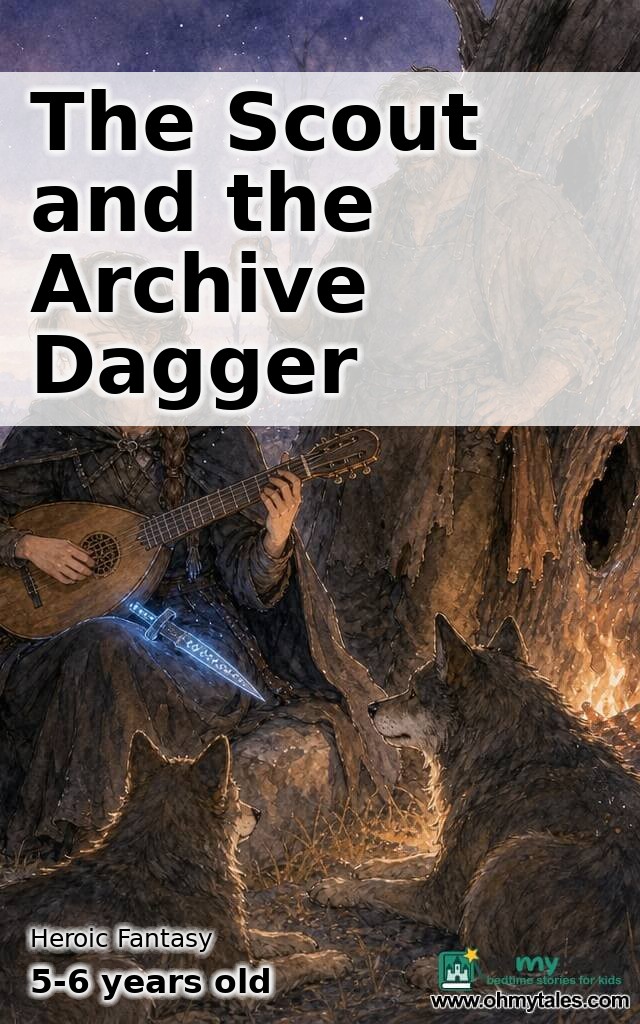
At her belt hung a small dagger. It hummed like a bee. She had found it under a broken stone near a burned cart. The metal was warm and the runes did a soft glow. Lyra was a scout. She knew things that others did not. The dagger did not belong to the road. It belonged in Grayhall.
"Grayhall keeps memory," her teacher had said. "Things that remember must be returned."
Lyra touched the dagger. It thrummed against her palm. She had a bundle of bread and a small lute. She put the lute over her shoulder and began the walk toward the north, where Grayhall lifted its towers above the fog.
A crow watched from a ruined tower. Wolves moved in the low grass. Storms raced over the plain. Lyra moved like a small steady light. Her footfalls were soft. Her voice was soft too.
She sang sometimes. The song was low and kind. The dagger always hummed with her tune. It seemed to like the music. When Lyra played, the hum grew finer, like a bell.
"Why go alone?" a thin voice asked.
A child peered from the doorway of a shattered house. Her hair was full of ash.
"I must," Lyra said. "This does not belong on the road. It must go home."
The child stepped closer. "Will you sing?"
Lyra smiled and played. The song made the child's eyes soften. She brought Lyra a cup of water. "Come by tonight," she said. "We'll listen to the stars."
Lyra nodded and walked on.
Part Two — The Storm and the Wolves
The sky grew angry by noon. Clouds boiled like a kettle on fire. Rain came hard, like thrown stones. Lyra pulled her cloak tight and kept walking. Her boots sank in mud. The dagger sang against her ribs.
Wolves joined her path when the road grew thin. They were wary and hungry. Their eyes shone as green coals. Lyra stopped and set her bundle between two rocks. She took out a piece of bread.
"Go on," she said softly. "This is for the wolves."
One wolf came near. It sniffed the bread and then looked at Lyra. The wolf's fur had scars. Lyra placed the bread on the ground and backed away. The wolf ate, slow and careful. The rest watched. Then they loped off together, bodies low like the wind.
The dagger had a new sound. It hummed like rain on a drum. Lyra felt the hum in her chest. The storm soon grew worse. Thunder rolled like distant drums. Lightning cut the sky.
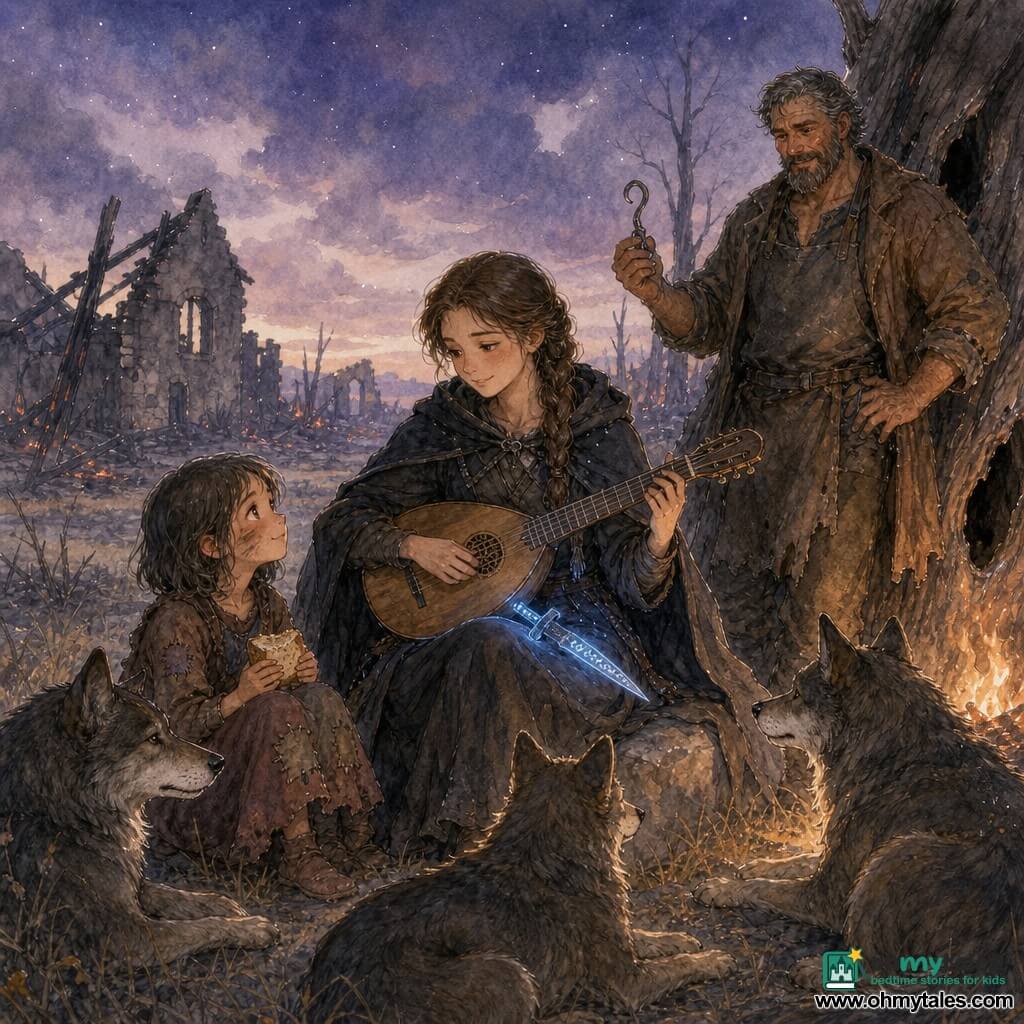
She found shelter in a hollowed tree. Inside, a man sat with a torn cloak. His face was tired. He was a smith. "You are brave," he said without looking up.
"I am small," Lyra answered.
"Kindness is brave," the smith said. "Will you mend my cloak?" He spoke as if the simplest thing might be impossible.
Lyra took her needle and thread. "I will mend it," she said.
By the light of a thin fire, Lyra sewed. Her fingers were quick and calm. The smith watched the humming dagger on her belt.
"That blade hums like a story," he said. "It wants a place."
"It wants Grayhall," Lyra whispered.
He nodded. "Then you must go with it."
When the rain eased, Lyra left. The smith handed her a small iron hook. "For your lute," he said. "So you may play on the road."
Lyra fastened the hook. The dagger hummed a thankful tune.
Part Three — The Stranger and the Bridge
A bridge crossed a dark river. Waters were fast. Fog curled over the stones. A stranger stood on the bridge. He wore a hood and his hands were white with cold.
"Who goes there?" Lyra asked.
The stranger lifted his head. He was young but his eyes looked older. "I guard the crossing," he said. "No one passes without coin."
Lyra opened her empty hand. "I have no coin."
The stranger laughed. "Then how will you pay?"
Lyra rested her lute against her knee. "I will play," she said.
He did not answer. She plucked a string. The song was small at first. Then the humm of the dagger joined like a second voice. The fog softened. The river slowed in a small bend. The stranger's face changed. He dropped the hood. Tears ran quietly.
"I used to come here," he said. "I used to listen to songs when my mother was a child. I forgot the sound of kindness."
"Then remember," Lyra said.
She played until the stranger could breathe easier. He reached into his cloak and pulled out a coin. It was not for passage. It was an old coin with the mark of Grayhall.
"This belonged to my father," he said. "He took it to Grayhall for safekeeping. I will carry you across, because you carry memory."
They stepped onto the bridge together. Wind tried to push them, but Lyra held the dagger close and hummed. The hum made the stones steady underfoot. When they reached the other bank, the stranger handed Lyra his coin.
"Keep it," he said. "So you may know you are not alone."
Lyra bowed her thanks and moved on.
Part Four — The Gate and the Archive
Grayhall rose at last. Its towers were pale as bone. Flags flew like slow birds. Guards stood at the gate with spears that caught the light. Lyra felt small beneath the walls. The dagger buzzed like a nest of bees.
A sentry stepped forward. He looked at the dagger and at Lyra. "What brings you to Grayhall?" he asked.
"A dagger," Lyra said. "It belongs in the archive. I found it on the plain."
The sentry frowned. "Many things belong in the archive," he said. "All are weighed. Are you sure?"
Lyra set the dagger on the stones between them. It hummed and the runes blinked blue. The guards watched the light like moths.
A sound came from inside the hall. A woman in old robes came out. Her hair was silver and her voice remembered old chants. "That dagger," she said. "I read its name."
Lyra kept silent. She had crossed storms and given bread and sung on a bridge for this moment. Her heart was a drum.
"The Archive Dagger," the old woman said. "It remembers songs and paths. It keeps small truths safe. It must be home."
The sentry bowed. The gate opened like the mouth of a cave. Inside, the Archive was warm. Shelves rose like trees. Scrolls slept like rolled leaves. The air smelled of dust and honey.
Lyra walked to a table. The old woman smiled. "You brought it to us," she said. "Why did you carry it so far?"
Lyra touched the dagger's hilt. "I thought it lonely," she said. "I thought it would forget."
The old woman nodded. "Things that remember need gentle hands," she said. "You listened."
She led Lyra to a shelf. It held small iron things with runes. The dagger fit a gap like a hand in a glove. When Lyra set it down, the hum softened and then blended into the walls. The Archive let out a long, quiet sound—like many doors closing in comfort.
A young apprentice came forward. "We keep stories," he said. "May I learn one from you?"
Lyra smiled and took her lute. She sat by the fire in the Archive. The old woman, the apprentice, the sentry, even the smith's coin lay on the table like a little map. Lyra played the songs of the plain, of wolves and rain and the bridge. She told of the child and the smith and the stranger. Each tale was small and brave.
The apprentice listened with wide eyes. "You are a scout," he said. "You carry more than a blade."
"We all carry things," Lyra said. "We carry care."
Part Five — Home and the Promise
When night fell, the Archive shared its chamber with Lyra. A bed of soft straw held her. The old woman covered her with a blanket that smelled of lavender and old paper.
"You will go again," the old woman said. "The plain will need you."
Lyra touched the dagger one last time. It hummed faintly in the walls. She felt a warmth like a small thank you.
"I will go," Lyra said. "I will sing."
Outside, the wind had calmed. The stars were many and bright. Lyra thought of the child who had shared water, of the wolves who had eaten bread, of the smith and his cloak, of the stranger on the bridge. She thought of the coin that was a promise.
In the morning she walked back to the plain. Her steps were steady. Her lute was over her shoulder. The dagger was safe where it belonged. Inside her heart, something hummed still—the soft song of having done what was right.
She met the child again by the burned house. The child ran into her arms. "You came back!" she said.
"I always come," Lyra answered.
They sat and ate bread and listened to Lyra play. The wolves watched from a distance like sleeping hills. The storms were farther now. The plain kept its scars, but there was music between them.
Lyra looked at the sky and then at the child. "We will remember," she said.
"How?" asked the child.
"By being kind," Lyra said. "By listening. By returning what belongs to those who keep memory."
The child nodded and held Lyra's hand. Together they hummed a tiny tune. It was soft and bright. It traveled over the plain like a brave bird. The world felt a little safer. Lyra walked forward, a small hero in a large land, and the song she carried touched every quiet thing she passed. The end.