Chapter 1: The Drawer That Wouldn't Behave
Milo Hart was ten years old, and he smiled at strangers the way some kids smiled at puppies. He was the kind of boy who held doors open, even when the door was heavier than his backpack.
On a rainy Saturday, Milo helped his grandma clean the attic. The attic smelled like old books, cedar, and a little bit like secrets.
“Careful with that trunk,” Grandma said. “It's been up here since before I had gray hair. Which is… a very long time.”
Milo crouched beside the trunk. It was scratched and dusty, with a brass handle shaped like a fish. The lock was already broken, as if someone had tried to open it a hundred years ago and then gave up to go eat cookies.
Inside, there were folded blankets, a cracked compass, and—at the very bottom—a small wooden drawer. Just a drawer, all by itself, with no desk attached. That was odd enough to make Milo's eyebrows climb.
He tugged on the knob.
The drawer didn't open.
Milo pulled harder. The drawer stayed shut, stubborn as a cat pretending not to hear its name.
Grandma peered over his shoulder. “Oh,” she said, and her voice got quieter. “I forgot that was here.”
“What is it?”
“A piece of trouble,” Grandma murmured, then softened. “A piece of history, really.”
Milo tried again, gentler this time, like he was asking instead of demanding. The drawer gave a tiny click—just one. He stopped and listened.
From somewhere inside the drawer, there came a faint sound: a rustle, like paper turning its own pages.
Milo's stomach did a small flip, the kind you get before a roller coaster or a spelling test.
Grandma reached into her pocket and pulled out a thin key on a red string. “This belonged to my father,” she said. “He told me never to lose it. But he never told me why.”
Milo held his breath as Grandma slid the key into a keyhole Milo hadn't noticed. It was hidden in the wood grain like a wink.
Click.
The drawer slid open by itself, smooth and quiet.
Inside lay a rolled-up map tied with blue ribbon, and a coin the size of a cookie. The coin wasn't gold, not exactly. It looked like moonlight had been hammered into a circle.
Milo touched it. Cold, but not unpleasant—like holding a snowball when you're wearing mittens.
On the map, in curling ink, were the words: RETURN WHAT WAS TAKEN.
Below the words was a sketch of their town, Bramblewick, and a path leading to the old clock tower by the river. A tiny drawing of a laughing fox sat at the corner as if it knew something Milo didn't.
Grandma's face tightened, then softened again. “Long ago,” she said, “someone took something precious from Bramblewick. They called it a treasure, but it wasn't meant to be stolen. And people were hurt because of it.”
Milo looked at the coin and the map and felt a warm, brave feeling spread in his chest, like a lantern being lit. “Then we should put it back,” he said.
Grandma nodded. “That's what your great-grandfather hoped someone would do.”
Milo swallowed. “Okay. I'll do it.”
The attic seemed to lean closer, listening.
Chapter 2: The Clock Tower's Secret
By late afternoon, the rain had turned into a mist that made the world look like it was thinking.
Milo tucked the map into his hoodie pocket. Grandma insisted he take a flashlight, a granola bar, and a small umbrella “in case the sky gets emotional again.”
The clock tower stood near the river, tall and narrow, with ivy climbing up its sides like green fingers. It hadn't worked in years. The hands were frozen at 3:17, as if time had stopped to gossip.
Milo pushed open the creaky door. Inside, it smelled like wet stone and dust. His footsteps echoed up the spiral stairs.
At the first landing, he found something that made him grin: a painted sign that read, PLEASE DO NOT FEED THE PIGEONS ANYTHING FANCY.
“Too late,” Milo whispered. “They look like they've eaten cake.”
He climbed higher, following the map's little marks: a star, then a crescent, then a tiny fox.
At the second landing, the air grew cooler. Milo's flashlight beam slid across bricks—until it caught on a metal plate set into the wall. There were three coin-shaped dents.
Milo pulled out the moonlit coin. It fit perfectly into the middle dent, like it had been waiting.
The plate clicked. A narrow panel in the bricks shifted open, revealing a small space inside the wall. Milo's heart hammered as he reached in.
His fingers brushed paper—old, but dry. He pulled out an envelope sealed with wax, stamped with the same laughing fox.
He broke the seal carefully, as if the envelope might bite.
Inside was a letter written in neat handwriting:
TO THE ONE WITH A WARM HEART,
THE TREASURE YOU SEEK IS NOT FOR KEEPING.
IT IS FOR MENDING.
FOLLOW THE FOX'S GRIN TO THE PLACE WHERE STORIES SLEEP.
BRING COURAGE. BRING IMAGINATION.
AND PLEASE—WATCH OUT FOR THE GEESE.
Milo blinked. “Geese?”
A honk echoed from outside, loud and offended.
Milo hurried to a narrow window and looked down. In the misty grass near the tower, a line of geese marched like tiny, angry soldiers. The leader stretched its neck and glared up at Milo as if he had personally insulted its ancestors.
“Okay,” Milo said. “Noted.”
He studied the map again. A new line had appeared, drawn in faint silver ink, leading from the tower toward the oldest building in town: Bramblewick Library.
“The place where stories sleep,” Milo whispered. “Of course.”
He tucked the letter away and started down the stairs.
Halfway down, the tower groaned—a deep, old sound—and dust puffed from the ceiling.
Milo froze. He could almost imagine the tower saying, Don't be silly. Be brave.
He continued, careful and steady. When he stepped outside, the geese honked again, flapping their wings dramatically.
“I'm just passing through,” Milo told them. “No fancy snacks involved.”
The leader goose waddled closer anyway.
Milo took one step back, then another, then decided that courage also meant knowing when to retreat with dignity.
He ran.
Behind him, the geese chased for a few seconds, then stopped, satisfied, as if they'd won a very important argument.
Milo slowed to a walk, laughing under his breath. His cheeks were cold, but his eyes were bright. The hunt was real. And it had rules.
Chapter 3: The Library That Whispered Back
The library was warm inside, smelling of paper, glue, and quiet. Milo loved it instantly, the way you love a blanket fresh from the dryer.
At the front desk sat Mrs. Pell, the librarian, who always wore sweaters that looked like they had been knitted by friendly clouds.
“Milo,” she said, peering over her glasses. “You look like someone chased you.”
“Technically,” Milo said, “a goose strongly disagreed with my existence.”
Mrs. Pell nodded seriously. “That happens. Try not to take it personally.”
Milo headed to the oldest part of the library, where the ceilings were higher and the shelves were darker wood. The map led him to a corner labeled LOCAL HISTORY: BRAMBLEWICK, STRANGE BUT TRUE.
On the shelf, he spotted a book with a laughing fox stamped on its spine. The title was faded, but he could read it: THE TALE OF THE RIVERLIGHT.
Milo pulled it out. Dust drifted like tiny ghosts of sneezes.
He opened the book. Most of the pages were blank—except one in the middle, where a little drawing of a drawer was inked beside a poem:
IN A DRAWER, A SKY IS FOLDED,
IN A COIN, A MOON IS HELD.
FIND THE BOX WHERE WRONG WAS BOLDED,
RETURN THE LIGHT THAT SOMEONE SWELLED.
Below the poem was a riddle:
I AM LOCKED BUT NOT WITH KEYS.
I OPEN WHEN YOU TELL ME PLEASE.
I LIVE WHERE CHILDREN LEARN TO DREAM.
WHAT AM I?
Milo thought hard. Locked but not with keys… opens when you say please… where children learn to dream…
He looked around. Kids sat on a rug in the children's section, listening to a volunteer read a story about a pirate who was allergic to gold.
A sign nearby read: STORYTIME NOOK.
Milo's imagination sparked. What if it wasn't a “thing” like a door? What if it was… a box? A chest? Or—
He noticed a small wooden cabinet beside the rug, painted with stars. It was used for puppets and props. The cabinet had no lock, just two doors with a brass knob. A little sign above it said: PLEASE ASK BEFORE OPENING.
Milo's mouth went dry. He walked over.
A little girl building a tower of blocks looked up. “Are you allowed to open that?” she asked.
Milo remembered the riddle. He remembered the letter. Bring courage. Bring imagination.
He nodded to the girl like a serious explorer. Then he faced the cabinet and said, clearly, “Please.”
The doors clicked—quietly—like they were happy to be asked.
Milo pulled them open.
Inside sat a small box made of dark wood, carved with a laughing fox. It looked old enough to have met a dinosaur, or at least to have heard rumors of one.
Milo lifted it out carefully. It was heavier than it looked. His hands trembled a little, but he didn't drop it.
Mrs. Pell appeared beside him as silently as a bookmark. “That shouldn't be there,” she said softly.
Milo glanced up. “Do you know about it?”
Mrs. Pell's eyes flicked to the fox carving. “I know there are stories Bramblewick doesn't like to tell. Stories about a light that belonged to everyone, and how someone hid it away. People argued. Friendships cracked. The town forgot how to laugh the same way.”
Milo swallowed. “I want to fix it.”
Mrs. Pell's face softened. “Then you'll need to take it to the river. To the place under the broken bridge stone. The old marker. But you must be careful.”
Milo nodded. “Careful is my second favorite thing,” he said.
“What's your first?”
“Granola bars,” Milo said, and Mrs. Pell made a small sound that might have been a laugh.
Milo tucked the box under his arm. As he turned to leave, the little girl called, “Good luck!”
Milo smiled at her. “Thanks. If a goose asks, tell it I moved to the moon.”
Outside, the mist thickened, and the river's whisper seemed louder, as if it was waiting for something to come home.
Chapter 4: Under the Bridge Stone
The river path was slick with wet leaves. Milo walked carefully, holding the box close. Every now and then, he checked the map, which now shimmered faintly, as if it liked being part of the adventure.
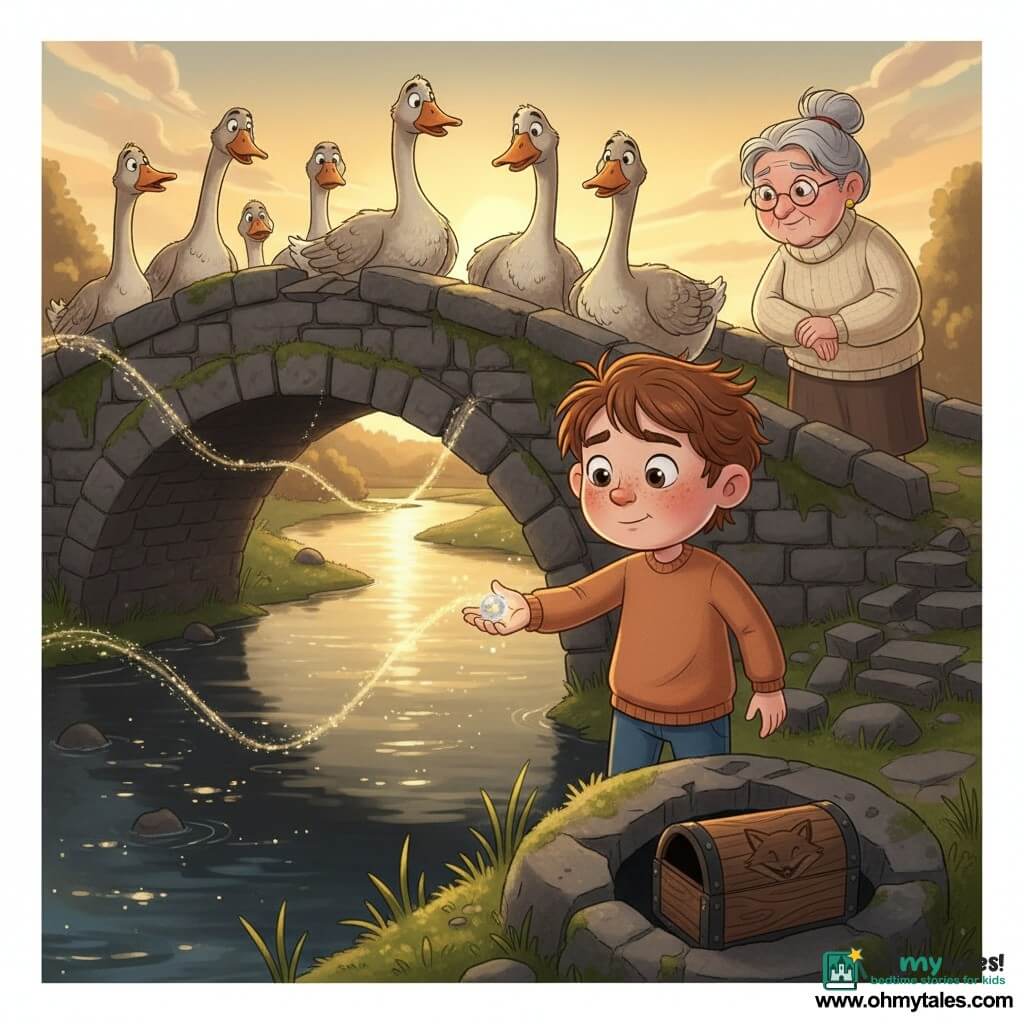
The broken bridge was just outside town, where the river bent like an elbow. One stone on the bridge's edge had cracked long ago, leaving a gap beneath it—a shadowy pocket beside the water.
Milo crouched and shone his flashlight. Something glinted inside: a metal ring set into a flat stone, like a handle.
He reached for it—and stopped.
The air felt different here. Not scary, exactly. More like the moment before a secret is told.
Milo took a slow breath. “Courage,” he whispered. “Imagination.”
He pulled the ring.
The stone lifted with a grunt, and a cold draft puffed out, smelling of river water and old moss. Beneath was a narrow space, just big enough for the fox-carved box.
Milo slid the box inside. It fit perfectly. His fingers brushed another object—smooth and round. He pulled it out.
It was a glass marble, but not an ordinary one. Inside it, a tiny swirl of light moved like a sleeping firefly.
Milo stared. The marble glowed softly in his palm, warming his skin.
This must be it, he thought. The Riverlight.
From behind him came a loud HONK.
Milo whirled around.
The geese were back.
Not just a few. A whole group stood on the path, blocking the way home. The leader goose stepped forward like it had practiced for this moment in a mirror.
Milo's heart jumped. He clutched the glowing marble and looked at the river, then at the geese.
He could run, but the path was narrow. He could shout, but that might only make them honk louder, and honestly, the geese already seemed to be doing their best.
Then Milo remembered something else Mrs. Pell had said: the town forgot how to laugh the same way.
Milo took a careful step forward and—because imagination is sometimes braver than muscles—he bowed politely to the geese.
“Excuse me,” he said, very formally. “Honored River Guardians.”
The leader goose blinked.
Milo continued, making his voice calm even though his knees wanted to wobble. “I have something that belongs to everyone. I'm returning it to fix an old wrong. I think… I think you're here to make sure I don't keep it.”
The geese stared, silent for a moment.
Milo held up the glowing marble. “See? I'm not stealing. I'm mending.”
A smaller goose tilted its head, as if considering.
Milo took out the granola bar from his pocket and held it up like a peace offering. “Also, I have a snack. Not fancy. No cake. Just oats.”
The leader goose took one cautious step, then another, and snatched the granola bar from Milo's hand with surprising speed.
Milo didn't move. He just smiled, warm and steady.
The leader goose chewed, looked satisfied, and then—very slowly—stepped to the side.
One by one, the other geese followed, opening a path.
Milo let out a breath he hadn't realized he was holding. “Thank you,” he whispered. “Truly.”
He turned back to the hidden space beneath the stone. The box was inside. But the marble—the light—was in his hand.
He understood now. The treasure wasn't the box. The treasure was what the box had held, and what it had kept from everyone.
Milo knelt by the river and held the marble over the water. The light inside swirled faster, like it recognized home.
“I'm sorry it took so long,” Milo said.
He opened his fingers.
The marble didn't sink. It broke apart into a ribbon of light that slipped into the river, weaving through the water like a joyful, glowing eel. The river brightened—just a little—like someone had turned up a dim lamp.
And Milo heard something strange and wonderful: laughter, carried on the water, soft as wind chimes.
Not spooky laughter. Happy laughter. The kind that makes you want to smile even if you don't know the joke.
The geese honked once, but it sounded less like an argument now and more like an announcement.
Milo stood, damp-kneed and grinning. The wrong had been repaired. The treasure had been returned.
All that was left was to make sure the story ended properly.
Chapter 5: The Right Place for a Secret
Back at Grandma's house, the attic felt less heavy, as if it had been holding its breath for years and finally let it out.
Grandma sat on an old chair while Milo set the map, the letter, and the moonlit coin on the floor between them. The map's silver lines had faded, as if the adventure had signed its name and walked away.
Milo told her everything: the clock tower, the whispering book, Mrs. Pell, the fox box, and—most importantly—the glowing Riverlight returning to the river.
Grandma listened with her hands folded, her eyes shining.
When Milo finished, she reached out and squeezed his shoulder. “Your great-grandfather would be proud,” she said. “You did what he couldn't. Not because you're stronger, but because you're kinder.”
Milo rubbed his nose. “Also because I had a granola bar.”
Grandma laughed, and it sounded lighter than Milo had heard in a long time.
He picked up the moonlit coin. It didn't feel as cold now. More like a smooth pebble warmed by sun.
“What do we do with all this?” Milo asked.
Grandma nodded toward the small wooden drawer from the trunk. It sat open on the blanket, looking ordinary again, like it had finished being magical for the day.
Milo understood. The treasure hunt was over, but the proof of it—the story—should be kept safe. Not hidden out of fear, but stored with care, like a special drawing you don't want to spill juice on.
He placed the coin back inside the drawer. Then the letter. Then the now-quiet map, folded carefully along its old creases.
For a moment, Milo paused, his fingers resting on the edge of the wood.
He imagined the river glowing softly at night, the town's laughter returning, kids dreaming brighter dreams in the library nook. He imagined the geese, still serious, but maybe a little less angry.
Imagination, he thought, wasn't just pretending. It was a way of seeing what could be fixed.
Milo took a breath and gently pushed the drawer closed.
It slid in smoothly, like it belonged.
Click.
The drawer stayed shut, peaceful at last.