Chapter 1: The Ship That Sang in Protocol
The research vessel Aster-Choir drifted through the black like a silver cathedral set loose in an endless night. Its hull was etched with runes that looked like circuit lines, and its antennae rose like spires. Inside, every door opened to a spoken liturgy, every system check was a hymn, and every warning light blinked like a candle asking for attention.
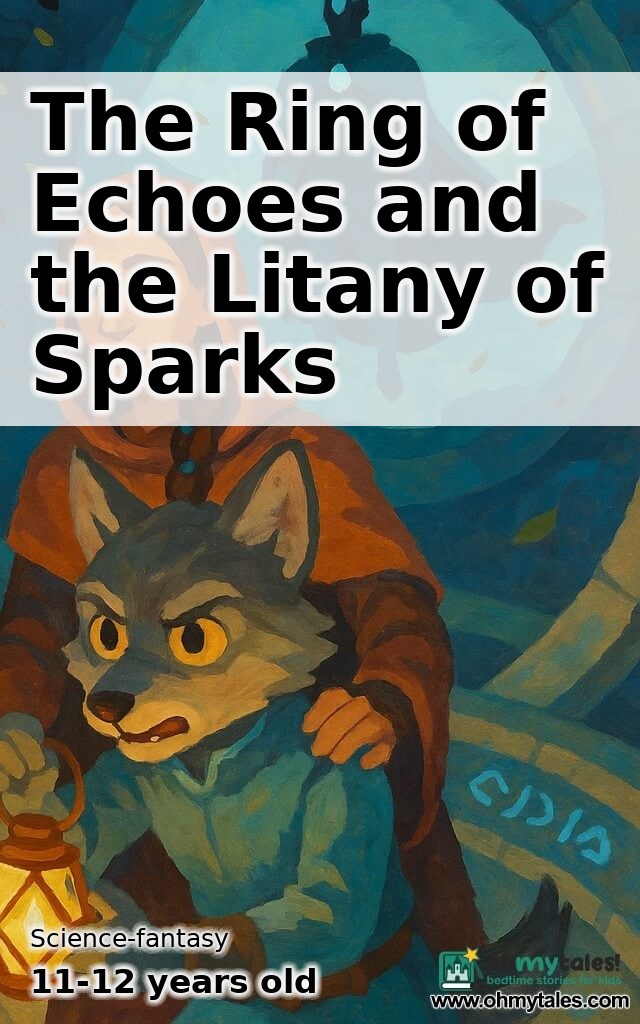
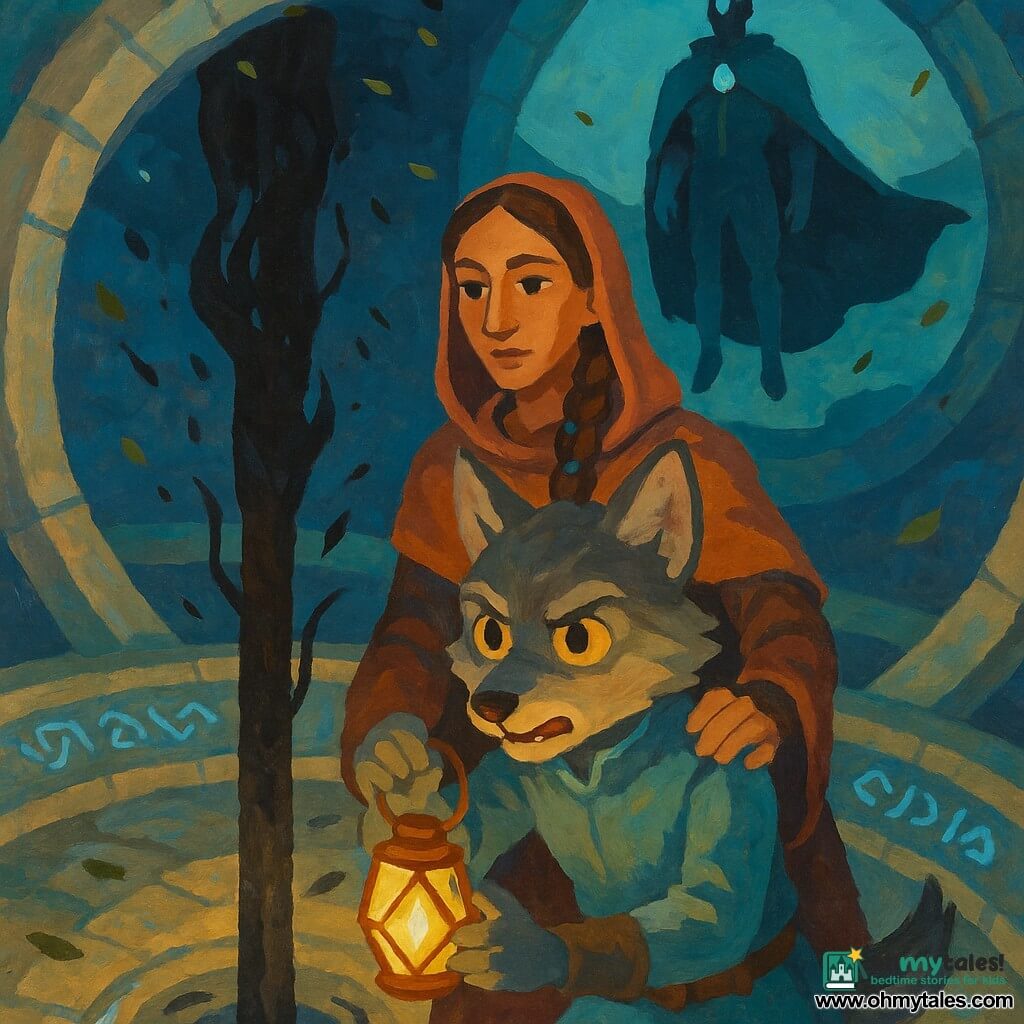
Pip was a small wolf—small enough that the crew called him “pup” even though he was nearly grown. His fur was the color of ash after a campfire, his eyes bright as polished amber. He wore a tool belt that clinked when he ran, because he ran everywhere. The Aster-Choir was too interesting to walk through slowly.
He skidded into the Engine Nave, where the ship's core hummed behind a lattice of crystal and metal. Floating screens showed equations braided with sigils. Warm air smelled of ozone and old incense.
Pip raised his paws like a conductor. “By the Fifth Litany of Ignition,” he said, trying to sound older than he felt, “may the coils remain steady and the runes not sulk.”
A soft voice answered from the ceiling vents. “Litany accepted. Apprentice Engineer Pip, your tone is enthusiastic and slightly off-key.”
“That's my specialty,” Pip said cheerfully. He pulled a small gadget from his belt: a brass ring with three rotating glass lenses and a wire tail. He'd made it from a broken star-mapper and a spoon. “I call this the Glimmer-Clip. It catches loose magic in the air and clips it into place, like—like a bookmark.”
The ship's main caretaker, Sister-Protocol Nema, entered with her robes tucked up so she wouldn't trip. She wasn't a sister in the family sense, but in the ship sense: a keeper of rules, rituals, and safe procedures. Her hair was braided with tiny data-beads that flashed whenever she frowned.
“Pip,” she said, “you cannot ‘bookmark' magic without a sanctioned rite and a written risk assessment.”
Pip's tail wagged anyway. “That's why I'm doing a test. For the assessment. Innovation needs evidence!”
Nema's eyes narrowed. “Responsibility needs permission.”
Before Pip could answer, the ship's lights dimmed. Not a gentle evening dim—an uh-oh dim. The hum of the core dropped to a low, uneasy note, like a choir forgetting the next verse.
A new sound threaded through the metal walls: a whispering chime, as if someone was tapping a glass with a fingernail from very far away.
On the main screen, a star map flickered. A point of light appeared where there should have been nothing.
A voice—the ship's central intelligence, called the Cantor—intoned, “Unscheduled phenomenon detected. Unknown beacon. Classification: mythic.”
“Mythic?” Pip echoed. His ears lifted. “That's not a normal category.”
“It is an old category,” Nema said quietly, and for once her voice didn't sound like a rulebook. “Older than our charts.”
The chime became a clear melody, pulling at Pip's bones like curiosity pulling at a loose thread.
The Cantor spoke again, solemn as a bell. “All hands, observe the Thirteenth Protocol: the Litany of Caution.”
Nema drew a small seal from her pocket, pressed it to the console, and recited, “By measured thought and steady paw, we approach the unknown with care.”
Pip repeated it, softer, because he meant it. Then he grinned. “And with a really good toolkit.”
Chapter 2: The Beacon of Broken Verses
They followed the beacon through a corridor called the Archive Spine, where shelves held glowing tablets and jars of stardust labeled in tidy script. The floor panels warmed under their feet, as if the ship itself was trying to be brave.
Captain Vela met them at the Observation Oriel. She was tall, broad-shouldered, and carried a staff that was half antenna, half wand. Its tip sparked with blue light every time she spoke a command.
“What have you found, pup?” she asked. She called everyone by something affectionate, but it still felt like a title when she said it.
Pip hopped onto a stool to see through the great window. Space rolled out like ink. Ahead hung something impossible: a fragment of a structure, like a ruined ring, floating alone. It was neither asteroid nor ship. Its edges glowed with a pale, shimmering script that crawled like living frost.
“It looks like… a spell carved into metal,” Pip breathed.
Nema's beads blinked fast. “Or metal carved into a spell.”
The Cantor projected a hologram: a rotating view of the ruin. “The beacon originates from within. Signal pattern resembles a prayer. Also resembles a distress call.”
Captain Vela's jaw tightened. “Distress calls get answered. But we will not leap into a myth with our eyes closed.”
Pip raised a paw. “Captain, permission to build a bridge? Not a real bridge—well, maybe later. A translator. The beacon is… singing. I think it's trying to talk.”
Nema made a small choking sound. “Build a translator in the middle of an unknown anomaly? That's exactly how legends begin, and most legends end badly.”
Pip tilted his head. “But if it's asking for help, and we ignore it, that ends badly too.”
Captain Vela studied him. Her gaze was sharp, but not unkind. “Responsibility cuts both ways,” she said. Then she pointed her staff at Pip's Glimmer-Clip. “Show me your device.”
Pip offered it with both paws, suddenly nervous. The captain turned it over, sniffed it—because everyone on the Aster-Choir trusted their senses—and tapped one lens. A faint sparkle leaped to her fingertip like a startled firefly.
“It's clever,” she admitted. “Dangerously clever.”
Pip's chest puffed up. “I can make it safer. With the right liturgy.”
Nema crossed her arms. “A liturgy is not a shield against bad ideas.”
“No,” Pip agreed. “But it's a promise to think before acting.”
Captain Vela nodded once. “We will approach within scanning distance. Pip will work under Sister-Protocol Nema's supervision. If the Cantor calls a retreat, we retreat. That is final.”
Pip saluted with a paw. “Final like… final-final?”
“Final like gravity,” Captain Vela said.
The Aster-Choir slid closer. The ruined ring grew huge in the window. The runes along its rim pulsed, and the chime-song became words in a language Pip almost understood, like hearing your name through water.
He swallowed. “It's lonely,” he whispered.
Nema heard him and didn't argue.
Chapter 3: Pip's Translator and the Liturgy of Sparks
They set up a station in the Logic Chapel, a room where equations were painted in gold on the walls and the ceiling was a dome of star glass. Tools hung beside prayer cords. The ship had been built by people who believed knowledge was sacred, and that safety was a form of respect.
Pip laid out his parts: copper coils, a prism shard, three sensor beads, and his Glimmer-Clip. Nema placed a thick protocol book beside them like a stern chaperone.
“You will document each step,” she said.
Pip dipped a stylus into ink that shimmered with nanites and wrote on a slate. “Step one: do not explode.”
Nema's mouth twitched. “Step two: actually follow step one.”
The Cantor's voice drifted from a wall speaker. “Reminder: probability of explosion reduced by 23% when Apprentice Engineer Pip is supervised.”
“Comforting,” Pip said.
He worked fast, paws moving with practiced confidence. He wasn't reckless; he was hungry—for solutions, for patterns, for the click of something working the way it should. Every time he solved a problem, his tail thumped like a drumroll.
He wrapped the copper coil around the prism shard, then clipped the Glimmer-Clip to it. The device looked like a lopsided lantern.
Nema watched, then surprised him by placing her seal-stamp on the table. “You will speak the Litany of Sparks before you power it.”
Pip's ears perked. “You know it?”
“I know all liturgies,” she said, as if that was a burden. “Begin.”
Pip took a breath. The words felt old in his mouth, but steady.
“By wire and will, by thought and flame,
Let power wake, but not untame.
Let light be servant, not our king—
And if it bites, we stop the thing.”
Nema added, “And we stop the thing.”
“And we stop the thing,” Pip echoed.
He turned the dial.
The lantern-device brightened. The prism shard filled with swirling light—half data stream, half mist. On the slate, symbols poured out, scrambling into different shapes like a puzzle trying to solve itself.
Then the room grew cold.
Not ship-cold. Deep-cold, like the shadow under a mountain.
A voice, thin and tired, came through the lantern in broken English, each word arriving as if it had to push through a heavy door.
“…Answer… at last.”
Pip froze, then leaned close. “Hello! We hear you. I'm Pip. This is Sister-Protocol Nema. Are you—are you alive?”
A pause. A faint laugh, like dust falling.
“Alive… enough. Trapped… in verse.”
Captain Vela's voice came through the intercom. “Report.”
Pip spoke quickly. “We've got contact. It says it's trapped.”
Nema touched the lantern with two fingers, careful. “Identify yourself,” she said firmly. “By what name are you bound?”
The voice hesitated, then said, “I was… called Auric. I was… the Architect of the Ring. Now I am… its echo.”
Pip's mind raced. Architect meant builder. Builder meant someone who understood systems. Someone who might be able to explain why the beacon had called them.
“What happened to the Ring?” Pip asked.
Auric's voice fluttered, like a candle in wind. “A breach. A hunger. A mistake… made clever.”
Nema's beads flashed a warning rhythm. “A mistake made clever,” she repeated. “That sounds like you, Pip.”
Pip looked wounded. “Hey!”
Captain Vela arrived, cloak snapping behind her like a sail. She listened, eyes dark and focused. “Auric,” she said, “what do you want from us?”
Auric's answer came softer than before. “A hand… to close the breach. Or… I will sing until the dark learns the song.”
The lantern flickered. The room's star glass ceiling showed a ripple, as if space itself had shivered.
Pip felt his fur rise. “Captain,” he whispered, “if the dark learns the song…”
“It will follow it,” Nema finished.
Captain Vela lifted her staff. “Then we act. Carefully. Pip, you wanted innovation. Here is your test.”
Pip swallowed, then nodded. “And responsibility,” he said. “I won't forget.”
Chapter 4: Crossing into the Ring of Echoes
They didn't dock the ship. The Ring was too unstable. Instead, they sent a small shuttle—an altar-shaped craft called a Skiff—guided by thrusters and warding glyphs.
Pip sat strapped into a seat that was much too big for him, his paws on the controls. Nema sat beside him, her protocol book clipped to her knee like a shield. Captain Vela stood behind them, steady as a mast.
As they approached the Ring, the runes along its rim brightened, responding to their presence like eyes opening.
Pip whispered, “I feel like we're being read.”
Nema flipped a page. “We are. The Ring's security is liturgical. It recognizes patterns of intention.”
“Good,” Pip said. “My intention is to not die.”
Captain Vela snorted. “An excellent intention.”
They passed through a broken archway. Inside, the Ring was hollow, full of floating debris and shimmering curtains of light. Panels of metal drifted like fallen leaves. Between them, threads of magic hung like spider silk, catching starlight and turning it into colors that didn't have names.
The chime-song was louder here. It came from everywhere and nowhere, wrapping around their thoughts.
Auric's voice crackled through the lantern Pip carried. “Welcome… to my ruin.”
Pip guided the Skiff toward a central dais—an island of machinery and stone. At its heart stood a column split down the middle, spilling a slow stream of dark glitter into space.
It was beautiful in a terrible way. Like watching ink spill into clear water.
Nema's voice went tight. “That is the breach.”
The dark glitter moved against the drift of the debris, crawling toward the Skiff as if it could smell heat.
Captain Vela's staff sparked. “Hold position.”
Pip's mind snapped into action. “It's attracted to energy,” he said. “Like a moth to a lamp.”
Auric whispered, “It feeds… on song and signal. On prayers… on power.”
Nema looked at Pip sharply. “If it feeds on signal, our ship's liturgies are a feast.”
Pip's ears flattened. He pictured the Aster-Choir, bright and singing in the dark, drawing the hunger closer.
“We need to seal it,” he said, “but not by blasting it. That's… more energy.”
Captain Vela pointed at the split column. “Auric, can it be closed?”
A pause. Then: “Yes… with the counter-verse. But the counter-verse… was never finished.”
Pip stared at the column. “We can finish it,” he said, surprising himself.
Nema's eyes widened. “Pip—”
“I know,” Pip rushed on. “It's risky. But the Ring is a machine-spell. It needs a pattern to complete. If we can create the missing part… we can lock it.”
Captain Vela's gaze flicked to Nema. “Can he?”
Nema's jaw worked, as if chewing a hard truth. “He is inventive,” she said. “And he listens. Sometimes.”
“Always,” Pip lied.
Nema raised an eyebrow. “Under supervision,” she added.
Captain Vela nodded. “Then do it. But remember the rule that keeps heroes alive: when the plan changes, you say so.”
Pip took a steadying breath. “Plan: finish the counter-verse without feeding the breach.”
“And?” Nema prompted.
“And if I get excited,” Pip said, “you pull me back by the tail.”
“I will,” Nema said, entirely serious.
Pip almost laughed. Almost.
Chapter 5: The Counter-Verse of Copper and Moonlight
They landed on the dais. Pip's paws touched strange stone that felt warm, as if it remembered hands working on it long ago. Above them, the breach spilled its dark glitter. The particles drifted close, then recoiled from Captain Vela's staff-light, hissing softly like sand on hot metal.
Pip knelt by the split column. Inside were grooves where something had been inserted—something like a circuit, something like a stanza.
“It's missing a conductor,” Pip murmured. “A bridge between logic and spell.”
Nema held out her protocol book. “The Ring's original rites are recorded in fragments. We do not improvise sacred machinery.”
Pip glanced at the drifting dark. “Then we'll innovate responsibly.”
Captain Vela kept watch, staff raised. “Work.”
Auric's echo spoke from the lantern. “The counter-verse… must be humble. Not a shout. A hush.”
Pip closed his eyes, thinking. A hush. A pattern that didn't broadcast power, but organized it. Like folding a loud cloth into neat layers so it couldn't flap in the wind.
He took out his Glimmer-Clip and the copper coil. “If the breach eats signal,” he said, “we use a signal that cancels itself. Two waves opposite. Like… two voices singing the same note, but one is upside down.”
Nema blinked. “Destructive interference,” she said, surprised.
Pip grinned. “Exactly! But with runes.”
He worked quickly, winding two coils in opposite directions, threading them through a ring of etched silver. He whispered the Litany of Sparks again, but softer, turning it into a promise instead of a performance.
Nema watched his paws, then began to read from her book, voice steady. The words were old and solemn:
“By measured mind and careful hand,
We mend what broke, we understand…”
Pip matched the rhythm with his coil turns. Captain Vela's staff-light pulsed in time, as if even the captain had become part of the ritual circuit.
The dark glitter crept closer, drawn by the activity. Pip felt it like a cold itch at the edge of his thoughts, a temptation to hurry, to make it bigger, brighter, faster.
He clenched his jaw. “Not today,” he muttered.
He fitted the ring into the column's grooves. It clicked into place with a satisfying finality.
Nothing happened.
Pip's stomach dropped. “Oh no. Did I—”
Auric whispered urgently, “The verse… needs a vow. A living voice.”
Nema's beads flashed. “A vow is a binding,” she said. “You cannot offer vows lightly.”
Pip's heart hammered. He thought of the ship's singing corridors, the careful rituals, the rules that kept them safe. He thought of curiosity, that bright engine inside him, and how it could light the way—or burn the map.
He lifted his muzzle and spoke clearly, not as a joke, not as a dare, but as a choice.
“I vow,” Pip said, “to use what I invent to protect, not to show off. I vow to ask before I risk others. And if I'm wrong, I will stop and fix it.”
The ring in the column glowed—moon-pale, not flashy. Two opposite currents spun, meeting and canceling with a gentle shiver.
The breach's dark glitter slowed. It trembled, then began to draw inward, as if someone had opened a drain in the center of the void.
Nema exhaled. “It's working.”
Captain Vela's shoulders loosened slightly, but her eyes stayed sharp. “Hold it steady.”
Pip kept his paws on the ring, feeling the vibration of the counter-verse. It was like holding a purring animal that could still bite if startled.
The dark glitter pulled faster, sucked back toward the split column. The chime-song twisted into a strained note, then softened.
Auric's voice grew clearer, warmer. “Yes… yes… that is the sound… of closure.”
But as the breach narrowed, it fought back. A sudden surge of cold swept over the dais, and the dark glitter lashed out like a wave.
Pip yelped as it brushed his forearm. For a heartbeat, he saw—not with his eyes, but with his mind—a thousand shining inventions, all half-finished, all hungry to be more. He felt the urge to push the power higher, to overwhelm the breach with brilliance.
“Pip!” Nema shouted, grabbing his shoulder. “Look at me!”
Her grip was firm. Her eyes were fierce. “Responsibility,” she said, like a spell.
Pip blinked hard. The temptation shattered like thin ice. He nodded, jaw trembling. “Responsibility,” he repeated.
Captain Vela slammed her staff into the stone. “By the Captain's Seal and the Litany of Boundaries—hold!”
A ring of light flared around them, not feeding the breach, but fencing it. The surge faltered.
Pip steadied his paws, kept the counter-verse quiet. The column's glow deepened into a calm, steady sheen.
With a final inward sigh, the breach sealed. The dark glitter vanished, leaving only a faint scar of shadow across the column—like a memory, not a wound.
The silence afterward was enormous.
Then Auric spoke, and his voice was almost human again. “You have… finished my verse.”
Pip's knees went wobbly. “We did it,” he whispered, amazed.
Nema squeezed his shoulder once. “You did not do it alone.”
“I know,” Pip said. And he meant it.
Chapter 6: The Echo That Became a Map
As the Ring steadied, its runes shifted from frantic pulsing to a slow, dignified glow. Debris that had drifted wildly began to orbit in gentle, orderly paths, like iron filings finding a magnet.
Auric's lantern-light brightened. “The hunger… is gone,” he said. “But I… am still bound. An echo tied to this place.”
Pip looked at the lantern, feeling a tug of sympathy. “Do you want to come with us?” he asked. “We can store your patterns in the Archive Spine. Give you a safe—”
Nema cut in softly. “A safe place, yes. But not as a trophy.”
Pip nodded quickly. “Not as a trophy. As… as a rescued voice.”
Auric's laugh was gentle now. “You are a strange crew,” he said. “Scientists who pray. Priests who calculate.”
Captain Vela lifted her staff-tip toward the lantern. “We are responsible for what we awaken,” she said. “If we can carry your echo safely, we will.”
Nema consulted her book, flipping pages with careful speed. “There is a rite for housing a sentient pattern,” she said. “But it requires consent.”
“Consent granted,” Auric said, and the words sounded like relief.
They performed the rite right there on the dais. Nema spoke the formal lines. Captain Vela sealed the transfer with her staff. Pip adjusted his lantern-device, turning it into a stable containment prism—one that would not broadcast like a beacon.
When the last line was spoken, the lantern's light settled into a steady glow, warm as a hearth. Auric's voice came through, clear and calm.
“I am… lighter,” he said. “Thank you.”
Pip's ears drooped with tired happiness. “You're welcome. Also, sorry about the spoon I used in the translator. It was… probably not sacred.”
Nema huffed. “Nothing is more sacred than using what you have wisely.”
Pip blinked at her. “Did you just say something encouraging?”
“I said ‘wisely,'” she corrected, but her eyes had softened.
Back on the Skiff, as they lifted off, Pip looked out at the Ring. Without the breach, it no longer felt like a trap. It felt like a book someone had dropped and forgotten.
Auric spoke quietly. “The Ring was meant to be a library of paths,” he said. “It mapped hidden corridors of space. But when I tried to make it think faster—when I made my mistake clever—it opened a door I could not close.”
Pip hugged his tool belt with one paw. “I almost did that,” he admitted. “I almost pushed too hard.”
“But you stopped,” Auric said. “That is the difference between an inventor and a disaster.”
Captain Vela glanced back. “And you remembered to say when the plan changed,” she added.
Pip grimaced. “I… sort of did.”
Nema's voice was dry. “Next time, do it before the universe tries to eat your arm.”
Pip examined his forearm. A faint dark smudge remained, like charcoal. It didn't hurt, but it reminded him how close “exciting” could get to “terrible.”
Back aboard the Aster-Choir, the Cantor welcomed them with a soft chord. “Return acknowledged. Hazard decreased. Apprentice Engineer Pip's supervision rating increased.”
Pip beamed. “Finally, a rating I like.”
Nema pointed at him. “Do not let that go to your head.”
Too late, his head was already floating.
In the Archive Spine, they placed Auric's prism in a special cradle. The shelves around it glimmered as if greeting a new story.
Auric spoke one last time that day. “I will help,” he promised. “I will show you what I mapped… and what I fear.”
Pip leaned close to the prism. “Then we'll explore responsibly,” he said. “And creatively.”
“Both,” Nema agreed, surprising him again.
That night, as Pip padded through the ship's corridors, the protocol hymns sounded different. Not stricter. Not looser. Just… deeper. Like rules weren't cages, but rails—so you could run fast without falling off the world.
He paused by a window. The Ring of Echoes drifted behind them, quiet now, no longer crying into the dark.
Pip touched his smudged forearm and made a silent promise to himself: to keep building, yes—but to build with care, with consent, with a mind wide enough to hold wonder and caution together.
The Aster-Choir sailed onward, a cathedral of science and magic, singing its liturgies into the star-sea.
And somewhere in its Archive, an old architect's echo began to draw a new map—one that led not just to hidden places, but to wiser ways of reaching them.