The Bubble on the Shelf
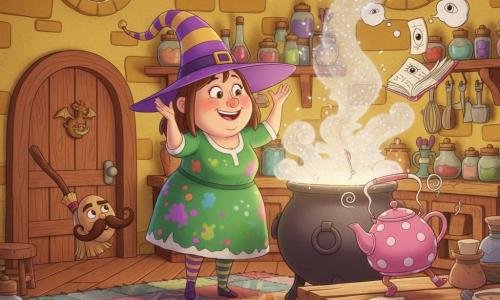
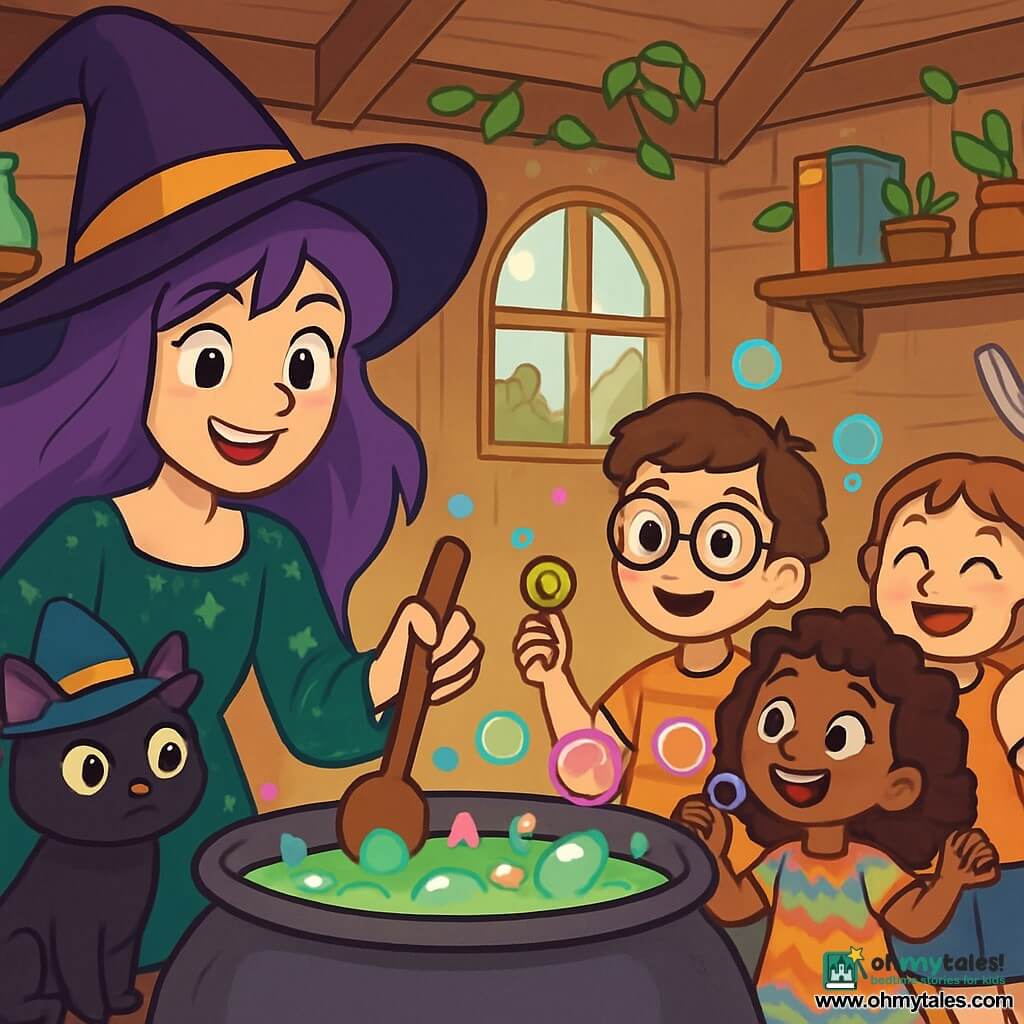
Mira the witch stirred her whisk with the concentration of a cat watching a spinning ribbon. Her cottage smelled of toasted chamomile and the faint pop of tiny star-sparks. Shelves climbed the walls like curious ladders, each one crowded with jars that clicked and hummed like a village of sleepy mice. Mira's goal sat on the middle shelf in a notebook with a daisy ribbon: she wanted a potion that laughed—a potion that could giggle and chuckle on command, brightening damp afternoons and making grumpy gargoyles grin. But not explode. Definitely not explode. Bangs were for fireworks, and Mira preferred her fireworks wrapped in confetti and marshmallows, not soot.
She mixed moon-milk and a pinch of giggle-grass, which rustled like silk, but the potion only made a sound like a cough that remembered a song. "Nope," Mira declared, tapping her chin. She tasted a drop on her finger; it fizzed, then burped a tiny tune. "That sounds like a kazoo after a nap." Her whisk sighed, and a small bubble climbed out of the cauldron, bobbing toward the ceiling like a soap opera star. It popped gently against a beam and rained down sparkling dust that smelled suspiciously of sticky-sweet muffins.
Her cat, Nimbus, who wore a hat that made him look like a miniature captain, pawed at the dust and squeaked. "Mira, what if it laughs too loudly? What if it wakes the oaks?" Mira squinted at Nimbus as if he had just suggested they knit a sweater for the moon. "Quiet, Captain," she said. "This potion must be joyful, not a trumpet."
At the window, the village bell tower chimed. It sounded like someone practicing the alphabet with their toes. Outside, other witches and friends walked by, carrying armfuls of odd things—one had a hedgehog wearing socks, another balanced a teapot on her head. Mira smiled; she liked the village like a bowl liked a spoon. But the potion was stubborn. It bounced between being too flat, too bubbly, or sounding like an orchestra of hiccups.
Mira opened her notebook and scribbled: Potion that laughs. No bangs. Kind giggles. Then she underlined it three times, because underlining was the polite way to plead with a recipe. "Tomorrow," she promised Nimbus, "we try again." Nimbus curled into a crescent, dreaming of fish-shaped clouds, and Mira blew on the embers of the cauldron, sending a puff of lavender-smoke into the sky like a polite ghost.
The Great Snort-and-Sizzle
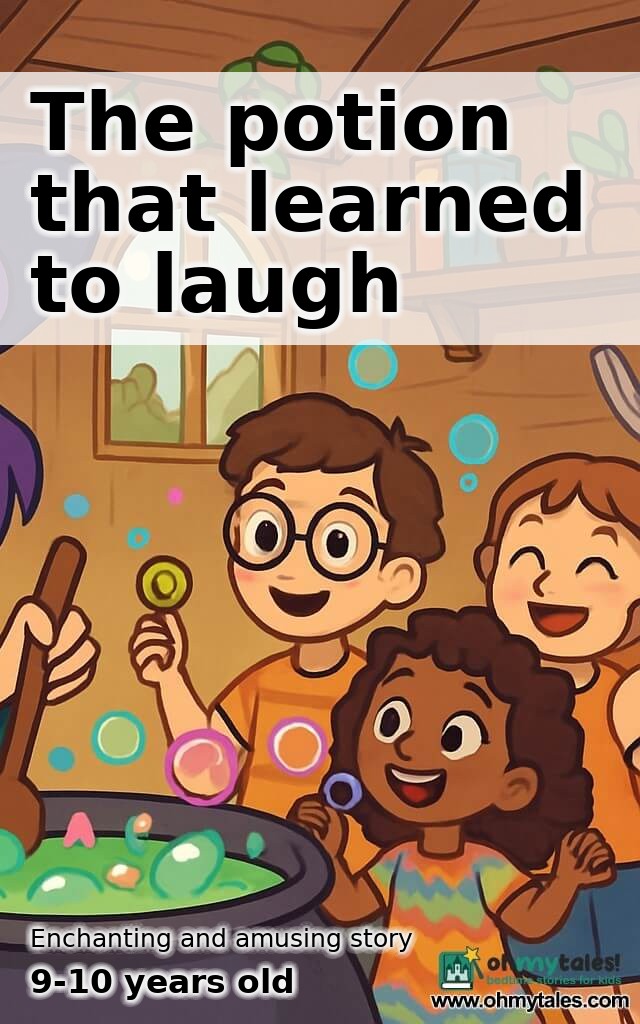
The next morning, Mira decided to invite friends for a testing party—potions were more fun with witnesses, and witnesses could also shout "Eureka!" or "Whoa, that smell!" which helped one measure success. Friends arrived wearing the sort of shoes that left musical tracks: click-click in C major, tap-tap in a sad trombone. There was Finn, who fixed doors that argued with their hinges; Poppy, who taught broomsticks to do the polka; and Lolo, whose laugh could tangle with its own echo and come out wearing polka dots.
They gathered around the cauldron like detectives peeking into a treasure chest. Mira read out ingredients in a voice that sounded like spoons telling each other secrets. "A dribble of dew-drop, three flakes of feather-mint, one wink of tardy moon." Poppy dropped a feather in and the cauldron sneezed in a tiny soprano. Finn fished out a pebble of sun and polished it until it shone like a tiny librarian. Lolo, of course, added a laugh—just a pinch, not a whole concert.
Mira stirred clockwise, then backwards because sometimes inventions liked to think about both directions. The potion rippled, then shivered like a child before a jump into cold puddles. The top of the potion shimmered with a face, and the face smiled and made the sound of someone practicing giggles underwater. Everyone clapped politely. Then the potion inhaled. It inhaled like a vacuum that had read a book about how to be dramatic.
The potion exhaled such a snort that the whole cottage hiccupped. The snort bounced off the teacups, ricocheted off the broom closet, and knocked Nimbus's hat askew. Then it sizzled and stretched like chewing gum that had discovered a beatbox. Strawberries rolled out of a jar and performed a tiny chorus line. Poppy laughed so hard her broomstick did the polka alone. Finn's shoes played a tune that could make a soup dance. For a shining second, everything was perfectly joyful.
Then the potion hiccupped. One hiccup becomes a hiccup festival when you have a potion that laughs, and this hiccup had plans. It hiccupped with the force of a loaf of bread being startled, and the cauldron rattled like a drum. A small puff of glitter flew up, stuck to the cobwebs, and descended like an overexcited confetti storm. The potion sneezed, and out popped a tiny puff that smelled like cinnamon, lifting the curtains and setting Nimbus's whiskers into a very disapproving curl.
"Too loud," said Mira, pinching the bridge of her nose. Finn offered a muff, Poppy offered a muff with ribbons, and Lolo offered a muff that giggled when you patted it. They laughed together, then looked at one another, all of them thinking the same thing: if a laughing potion could hiccup into a mini-storm, what would happen if it truly liked to laugh?
Mira scribbled again: Control the laughter. Calm the snort. Keep the lavender. They tried a soft lullaby, then a feather to tickle the potion, then a polite note of apology. The potion calmed to a contented purr but kept sneaking tiny snickers like a kid hiding cookies under a hat. "We are close," Mira said. "We need a something that keeps giggles in their place, like a seatbelt for mirth."
The Door That Wouldn't Listen
On the third day, the potion's giggles grew more clever. They learned to rhyme, which is impressive for a potion, but not always safe. The potion started composing limericks about socks, which made Nimbus blush in his fur. Mira decided it was time to fetch an ingredient that lived in the Ironwood—the Key of Tidy Hums, a small brass key that could close tantrums and fasten floppy giggles. Finn offered to lead the way.
The path into Ironwood was lined with trees that told jokes they found on their back doors. "Why did the acorn refuse to sing?" they asked each other, and the answer would ripple through the branches like someone flipping a pancake. "Because it couldn't handle the drumstick," they'd groan, and the leaves would clap. It was a cheerful wood, if occasionally punny. Mira held her hat tight, because hats here liked to fly off to greet old friends.
They reached an old door that stood alone in a clearing—tall, painted many colors, and decidedly stubborn. It was the kind of door that held a grudge against having its hinges touched. The sign above read: Doors Are For Doors, Not For Questions. Mira knocked politely. "One gentle rapping for a brass key, please." The door refused to budge. "No keys today," it said in a voice like a cough that had learned to roll its r's. "I'm on holiday."
Finn, who specialized in doors that argued with people, tried a polite negotiation. He offered the door tea, a foot massage, and a song written in alphabet soup. The door listened for the song because music tends to soften stubbornness, but it liked its stubbornness well-done. Poppy tried tickling the hinges with a feather, and Lolo told a joke about a broom that loved to ballet. The door considered for a long time, then offered a condition: "I will give the key if you can make me giggle without opening me."
Mira blinked. A door that wouldn't open unless made to laugh was almost worse than a cat that demanded opera before breakfast. "We can make you giggle," she said, because the truth was, her cottage was full of giggles, and she really needed that key. Lolo hopped forward and began a performance so silly the butterflies paused mid-flight just to watch. Poppy made bubbles that smelled like tickled pears. Finn recited the alphabet backward while hopping on one foot. Mira told a story about a spoon who wanted to be a hat; the spoon's dreams were modest and tasteful.
The door tried to stay stern, then crinkled like paper thinking hard. It clenched its paint and then, suddenly, it snorted. It wasn't a big snort—just enough to loosen its screws. The key slid out like a shy beetle. "Fine," the door sighed, smiling as if it had secretly liked the spoon's ambition all along. "Take the key, but promise me you will not let anyone glue my knob."
Mira bowed, Finn winked, Poppy fluffed her broomstick's hair, and Lolo puffed a small celebratory laugh that did a backflip. They clutched the Key of Tidy Hums and hurried back, because the potion at home was probably composing haikus about shoes and might require an immediate intervention.
The Perfect Practice of Gentle Giggles
Back at the cottage, the cauldron hummed like a band that had found a good rhythm. The friends gathered around with the key, which was smaller than a walnut and shone like a pirate's promise. Mira turned it over and over, admiring the tiny teeth that seemed to be smiling. "This will help keep laughter in a polite place," she said. "A sort of leash for glee."
They fitted the key into a brass jar labeled Heart-of-Giggle. The jar clicked awake and leaned in as if it wanted to hear the secrets of the world. Mira whispered that she wanted a laugh that would cheer, not startle; a laugh that warmed like a woolen mitten. The jar promised to do its best, because jars have good manners, especially brass ones.
They started a new brew. This time, Mira added kindness—two scoops, because kindness works well with cinnamon. She folded in patience like a baker folds dough, and a pinch of embarrassment—only the tiny, adorable kind that makes you giggle and wave your hands like a windmill. The Key of Tidy Hums was turned in the jar three times clockwise and twice sterling counterclockwise, because old recipes like a bit of dance.
The potion rose like bread and sang like it had been taught by songbirds. It giggled softly, the sound skimming like soft pebbles across a pond. Everyone listened, holding their breath like the air had been given a present and was being polite about it. The potion slipped from the cauldron into a little crystal bottle, and the bottle laughed so faintly it was like a bell remembering a funny dream. Mira tested it with a small spoon. The spoon squealed with delight and did a little hop of joy—no popping, no fireworks.
"At last," Mira sighed. Nimbus marched forward, put a paw on the spoon, and declared it acceptable. He flicked his tail, which shot a few sparkles into the air like a confetti cannon used with restraint. Poppy clapped and offered a dance to celebrate, Finn offered a solemn bow, and Lolo put her hand over the bottle as if shielding it from drafts of gloom.
But the potion was curious. It had learned to hold laughter, but now it wished to share it. It wanted to tell jokes about socks and clouds and why spoon-hats might be the next big fashion. "We must be generous," Mira said. "A potion that laughs should laugh with friends." They drew up a list of places where laughter could help: at the market where the apples were sulking because they were too shiny, at the school where a shy student kept practicing frog sounds, and at the old lighthouse where the keeper had forgotten his giggle.
They filled tiny bottles, wrapped them in ribbon, and set off like a parade of small, contained merriment. The village welcomed them like a bench welcomes tired feet. Each place they visited brightened by a bit; a grumpy apple gave its sheen to a shy pear, the student who practiced frog sounds croaked a perfect joke, and the lighthouse keeper laughed so well his lamp flashed in Morse that spelled out "Haha."
Tea for Finishing, Tea for Friends
When they returned, the sun was lowering its hat in a polite bow. The cottage looked cozier than a story at bedtime. Mira set the kettle on. The kettle sang a tune that sounded like a lullaby mixed with a pop song, and teacups marched out to meet the spoon like old friends. They placed the last bottle—the one that laughed just right—on the table in the middle of a circle of mismatched chairs.
They poured tea, which steamed like a cloud with secrets. The scent was a comforting braid of mint, orange peel, and the faintest hint of that potion—just enough to make the steam shimmer with smiles. Miranda, who always forgot her name when she was about to be important, peeked in from the window and took a tiny sip. Her eyes widened like windows that had been waiting for a sunrise. "Mira," she said, "you did it. You made a laugh that is gentle enough to carry people home when it gets dark."
They each took a cup and clinked them together like tiny bells. Nimbus sat on Mira's lap with his captain's hat balancing bravely. The Key of Tidy Hums lay in the center, catching light like a jewelry thief who had chosen honesty. They talked about the day: the door that wanted a joke, the way the potion learned to rhyme, and how the village smelled like fresh bread and second chances.
"Helping mattered," Finn said, stirring sugar into his cup. "We couldn't have done it without the door," Poppy added, patting her broom, "or without you all trying such splendid nonsense." Lolo's laugh bubbled out, soft and bright—a giggle that had been given to her by the potion when she had been feeling the tiniest bit blue. Mira nodded; her heart felt like a pocket full of marbles—warm, a little heavy, and pleasantly noisy.
They decided to leave small bottles of the laughing potion at places where a little cheer could help. A bottle on the school steps, another at the baker's window, one tied to the lamppost by the bridge. Each was labeled with a note: For when you need a kind laugh. Use gently. Sharing is magic. The Key of Tidy Hums went back on the shelf—only for emergencies and stubborn doors with dramatic personalities.
Night came, and the cottage glowed like a lantern with a good story inside. They sat longer than they planned, because good tea and new successes make clocks forget what they were doing. They told stories that looped back on themselves like ribbons, and each one ended with a small chuckle that made them all smile. Mira felt proud but not puffed up; pride here was like a blanket: useful and cozy but not for dancing on tables.
Finally, as the stars arranged themselves into a sleepy constellation that looked a lot like a spoon, everyone yawned in polite unison. They promised to visit the next day for more tinkering, more tea, and perhaps a pursuit of a recipe for a hat that could whistle the alphabet. Friends left with pockets full of laughter and pockets of starlight that had fallen from a potion-quiet sky.
Mira washed the cauldron until it shone like a drum that had retired with dignity. She hung the whistle of the kettle on its hook and tucked the notebook under her pillow. Nimbus curled himself into a tighter captain's crescent, his hat perched like a tiny boat. Mira whispered to him, to the cottage, and to the sleeping jars: "We did it, without bangs. We shared, we listened, and we had tea." The cottage hummed back, a contented note, and the night held them softly, like a hand holding a bell that had learned the right way to ring.