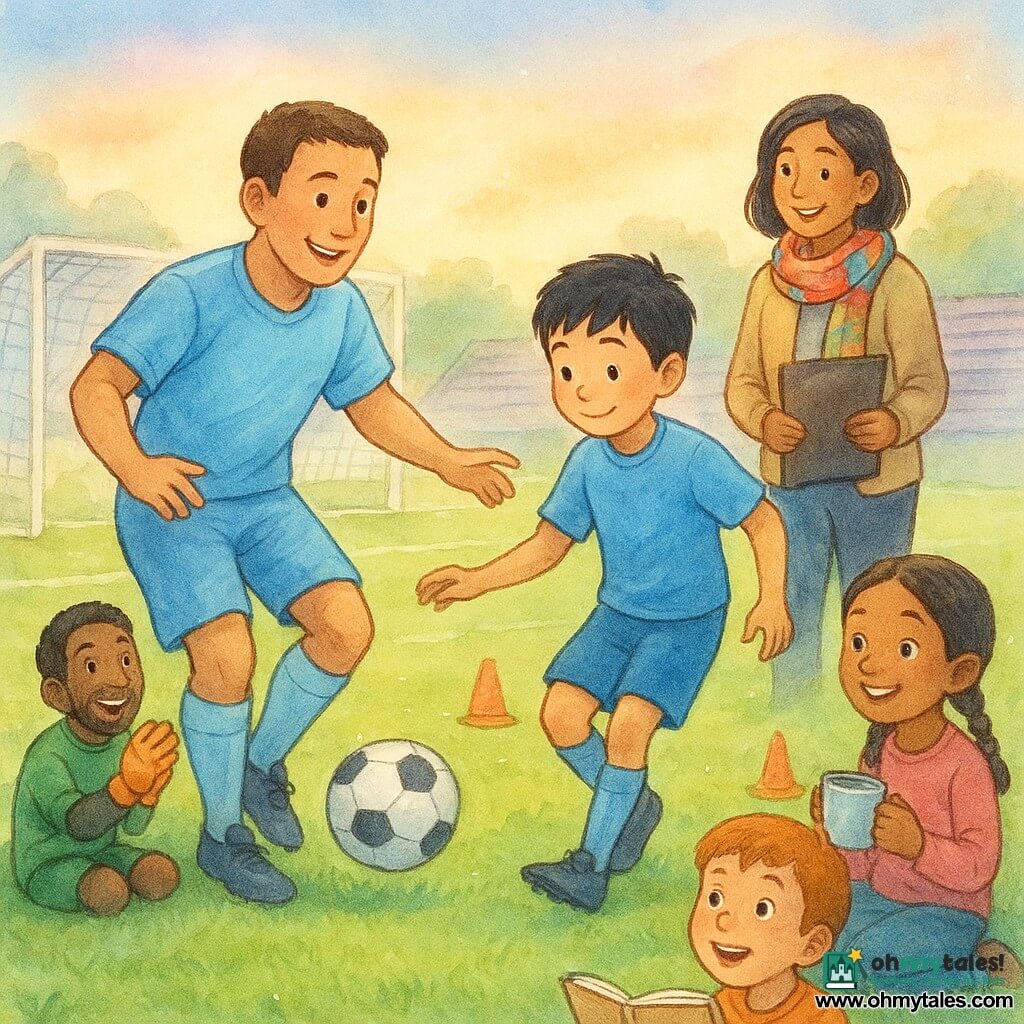
Chapter 1: Morning Passes and a Friendly Plan
The stadium was still sleepy when Leo arrived. The seats were empty, the grass looked brushed and shiny, and the air smelled like rain that had decided to be kind.
Leo was a professional soccer player. That meant soccer was his job, like a baker bakes bread or a teacher teaches math. Leo trained most days, traveled for games, and worked with many people to help the team do its best.
But Leo had his own special skill. He was known for precise passes.
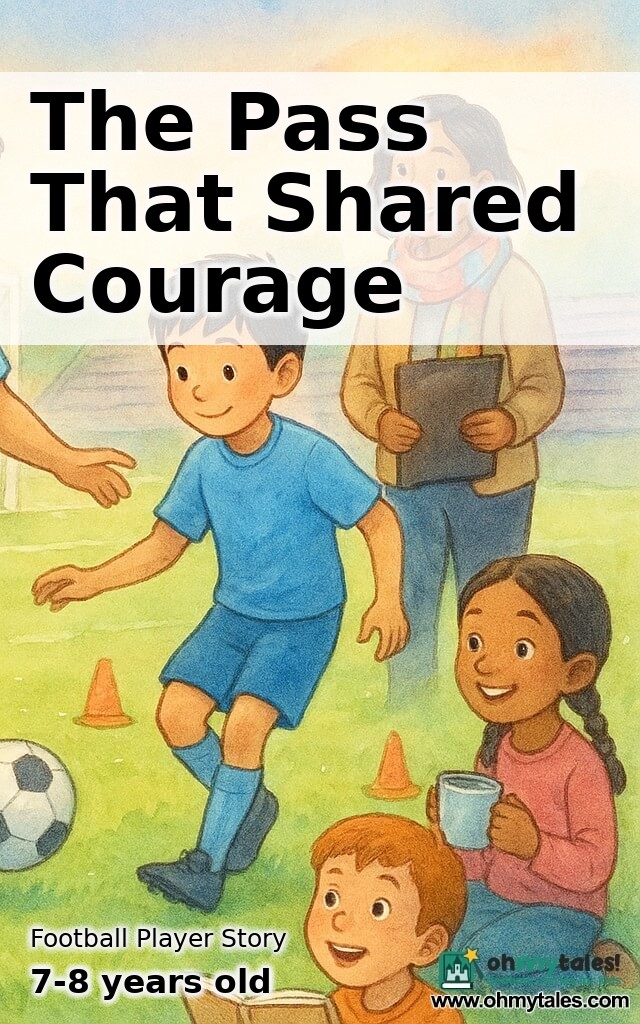
Coach Mina stood near the touchline with a clipboard and a warm scarf. She waved. “Good morning, Pass-Master.”
Leo laughed. “Morning, Coach. I'm ready. My feet had breakfast.”
Coach Mina raised an eyebrow. “What did they eat?”
“Tiny pancakes,” Leo said, wiggling his toes inside his boots. “With extra accuracy.”
A ball rolled toward him, gentle as a greeting. Leo tapped it back, soft and neat.
Coach Mina pointed to the field. Cones were lined up like little orange party hats. A few players were already jogging. A goalkeeper bounced on his toes, catching imaginary shots.
“Before practice,” Coach Mina said, “we have visitors today.”
“Fans?” Leo asked.
“Kids,” she said. “A school group. They'll watch training and ask questions. They want to learn what a professional soccer player really does.”
Leo's smile grew. “That's great. I can show them how passing is like sending a friendly message.”
Coach Mina nodded. “Exactly. Also, we'll do a fair-play challenge. A small one.”
Leo leaned closer. “What kind of challenge?”
Coach Mina's eyes sparkled. “At the end of training, we'll play a short game with a rule: every goal must come after three passes, and everyone must touch the ball at least once.”
Leo clapped his hands. “Teamwork goals. I like it.”
“Good,” Coach Mina said. “Remember, the kids will be watching. Show them how pros act—how we encourage each other, how we listen, how we care.”
Leo looked across the quiet field. He pictured the kids arriving, wide-eyed, gripping water bottles, maybe whispering, “That's a real player!” He hoped they would leave feeling brave and welcome.
Leo placed a ball at his feet and took a breath. The day felt bright, even without sunshine.
“All right,” he said softly to the ball, “let's be kind and clever today.”
Chapter 2: The Cone That Wanted a Dance
Practice began with warm-ups. Leo jogged with his teammates, knees lifting, arms swinging. They did stretches. They did little hops. They laughed when Tom, the tall defender, tried to touch his toes and made a dramatic groaning sound.
“My toes are hiding,” Tom said. “They are shy.”
“They're right there,” Leo teased.
“They're pretending to be someone else,” Tom replied, and everyone chuckled.
Then came passing drills. Coach Mina set up squares with cones at the corners. The players stood at the cones and passed the ball around.
“Eyes up,” Coach Mina called. “Soft touch. Clear message.”
Leo loved passing. A good pass was not a smash. It was a gift, sent at the right time, to the right place, with the right speed. It said, “I see you. I trust you.”
As he passed, Leo talked, too. “Here you go, Santi.” Tap. “Nice turn, Maya.” Tap. “Good job, Tom—your toes are still with us.” Tap.
Soon, the kids arrived in a small group, guided by a teacher. They sat in a safe area near the sideline. Some waved. One boy held a notebook bigger than his head.
Coach Mina blew the whistle and walked over. “Welcome! You'll see how we train, and later you can ask questions. Remember, players need to focus, so save your big questions for the end.”
The kids nodded seriously, like tiny coaches.
Back on the grass, Coach Mina set up a dribbling lane. Cones stood in a line, spaced apart. “Dribble through,” she said, “and keep the ball close. Then pass to the next player.”
Leo took his turn. He approached the first cone, tapped the ball with the inside of his foot, then the outside, like he was guiding a friendly puppy on a leash.
As he neared one cone, a silly thought popped into his head. The cone looked lonely, just standing there. Leo grinned.
“Excuse me,” he whispered to the cone, as if it could hear. “Would you like a dance?”
He dribbled right around it, quick and smooth, circling the cone in a tiny loop. It was still part of the drill—just a little extra flourish.
From the sideline, a few kids giggled.
Leo heard one child whisper, “He danced with the cone!”
Leo finished the lane and passed the ball cleanly to Maya. “Your turn,” he said.
Maya leaned in. “Did you just dribble a cone like it was your partner?”
Leo shrugged, trying to look serious, but his eyes laughed. “It asked nicely.”
Maya snorted. “Cones are very polite.”
Coach Mina called out, “Leo, beautiful control. And thank you for keeping it fun.”
Leo raised a hand. “Fun helps me focus, Coach!”
Next came a shooting drill. Players passed, ran, and took turns shooting. The goalkeeper, Bruno, made a few big saves and pretended to bow like an actor.
“Thank you, thank you,” Bruno said, catching an easy shot. “I'll be here all week.”
Then Coach Mina gathered everyone. “Water break,” she said. “And then the fair-play challenge game.”
Leo drank, listening to the field sounds: sloshing bottles, light chatter, the soft thump of a ball being juggled. He glanced at the kids. They watched every move, as if each pass was a secret spell.
One girl pointed at Leo and told her friend, “He looks happy when he passes.”
Leo liked that. He was happy. Passing meant helping.
Coach Mina stepped onto the field again. “All right!” she called. “Two teams. Remember the rule: three passes before a goal, and everyone touches the ball.”
Leo's team huddled. Santi bounced on his heels. Maya tied her hair. Tom tried to look fierce and failed because he kept smiling.
Leo spoke softly. “Let's make sure everyone gets a chance. And if someone makes a mistake, we help. Deal?”
“Deal,” they said.
The whistle blew, and the small game began.
Chapter 3: The Soft Tension of the Fair-Play Game
The ball zipped across the grass. Leo's team tried to keep it moving: pass, pass, pass. The other team pressed gently, trying to win it back.
It wasn't a real match with roaring crowds, but it still had that exciting feeling—the kind that makes your heart beat quicker, like a drum tapping, “Go, go, go.”
Leo received a pass from Maya. He turned, head up. He saw Santi near the edge, Tom in the middle, and a young teammate named Jiro on the other side.
Jiro had joined the club recently. He was fast and smart, but sometimes he looked unsure, like he was afraid to mess up.
Leo noticed that. A professional player didn't just think about the ball. He thought about people.
Leo took two touches, then passed to Jiro. A crisp, kind pass, right to his foot.
Jiro's eyes widened. He trapped the ball, then hesitated.
“Time,” Leo called gently. “You've got time.”
The other team came closer. Jiro tried a pass, but it was a bit weak. The ball rolled toward the middle, where an opponent almost grabbed it.
Tom stepped in and won it back cleanly. No push. No angry face. Just good timing.
“Nice try, Jiro,” Tom said. “Keep showing for it!”
Jiro exhaled. “Thanks.”
The kids on the sideline leaned forward. They weren't just watching goals. They were watching how players treated each other.
Leo's team built another attack. They made two passes. They needed one more before shooting, because of the rule.
Maya got the ball and looked ready to blast it. She stopped, remembering. She laughed at herself, then passed sideways to Leo.
“Three!” she called.
Leo could shoot now. The goal was open enough. But he saw Jiro running into space, free and hopeful.
Leo's foot hovered over the ball. The easy choice was to shoot and score. The better choice was to share the moment.
Leo passed to Jiro.
The pass slid across the grass like a note being delivered: “This is for you.”
Jiro met it. He took one touch, then shot.
The ball rolled into the net—softly, neatly, as if it wanted to be polite.
Goal.
Jiro froze for half a second, then smiled so wide it looked like his face had turned into sunshine.
Leo jogged over and tapped Jiro's shoulder. “That was perfect.”
Jiro's voice came out small but bright. “You trusted me.”
“Of course,” Leo said. “I saw you. That's what a good pass is.”
The other team clapped too, because Coach Mina had told them: fair play includes cheering good effort, even from the other side.
The game continued. There were a few mistakes, like a pass that went behind someone, and a shot that bounced off the post with a silly ping.
Bruno the goalkeeper called, “The post is my helper! We have a contract!”
Everyone laughed, even the kids.
At one moment, an opponent named Kira tripped—not hard, just a quick tumble after her foot caught the grass. She sat up right away, surprised more than hurt.
Leo stopped and offered a hand. “You okay?”
Kira took his hand and stood. “Yeah. Thanks.”
Coach Mina nodded, pleased. The whistle blew for a short pause. “That,” she said, loud enough for the kids to hear, “is empathy. You notice someone. You help. Soccer is competitive, but it should also be caring.”
The kids murmured to each other, and the boy with the big notebook scribbled fast.
The game ended with smiles, not sulking. Both teams gathered at the center circle. Coach Mina clapped. “Great work. Now—question time.”
The players walked toward the sideline where the kids waited, buzzing like friendly bees.
Chapter 4: Questions, Answers, and Sweetness Everywhere
The kids sat in a semicircle. Coach Mina stood with the players behind her, like a team of tall big siblings.
“Who has a question?” the teacher asked.
Hands shot up.
A boy with freckles asked, “Do you play soccer all day?”
Leo shook his head. “Not all day. Training is a big part, but we also do recovery—resting our muscles, stretching, eating healthy food, and sleeping enough. Sleep is like a secret coach.”
A girl with braids asked, “Do you ever feel nervous?”
Maya answered, “Yes. Everyone does. Even pros. But we breathe, we focus on the next small thing—one pass, one step—and we remember we're not alone.”
The big-notebook boy stood up and read carefully. “What is your job, exactly, if you are… the pass person?”
Leo stepped forward. “Great question. My job is to help the team play together. I look for space. I listen with my eyes. I try to send the ball where it helps my teammate. A good pass can start an attack, calm the game, or help someone feel confident.”
A small child near the back asked, “Did the cone really ask you to dance?”
The group giggled.
Leo put a hand on his chest in a serious pose. “The cone was very shy, so it asked quietly. I couldn't ignore it.”
Even Coach Mina laughed. “Cones deserve respect,” she said.
Another kid asked, “What happens if someone makes a mistake?”
Tom answered, “Mistakes happen every day. We don't yell. We talk. We try again. We learn. Being a pro is not being perfect. It's working hard and being kind while you get better.”
The teacher nodded. “That's a good lesson.”
Coach Mina looked at her watch. “All right, team. One more thing before the kids go.”
She waved to a staff member, who rolled out a cart. On it were trays covered with cloths. The cloths lifted, and the air filled with a sweet smell—like warm sugar and happy kitchens.
The kids gasped.
“After practice,” Coach Mina said, “we always refuel. Today, we're sharing. Because effort matters, and so does community.”
On the trays were small treats: soft cookies shaped like soccer balls, little fruit cups, and tiny rolls with honey. There were also cups of warm cocoa for anyone who wanted it.
Leo's eyebrows rose. “Coach… sweetness everywhere?”
Coach Mina grinned. “Everywhere.”
The kids lined up politely. The players helped hand out treats. Leo gave Jiro a cookie first.
Jiro looked at it like it was a medal. “Thanks.”
Leo lowered his voice. “And thanks for trusting the pass.”
Jiro nodded. “I'll keep showing for it.”
Leo handed cookies to the big-notebook boy and his friend. The boy said, mouth full but careful, “So passing is like… sharing.”
Leo's eyes softened. “Yes. Sharing the ball, sharing chances, sharing the work. And when someone feels left out, a pass can say, ‘Come with us.'”
The kids sat on the grass to eat. The players sat too, boots stretched out, shoulders relaxed. The stadium didn't feel empty anymore. It felt full of quiet joy.
A kid offered Leo a piece of their fruit. “Do you want some?”
Leo smiled. “Thank you. That's very kind.”
He took it, and it tasted fresh and bright.
Coach Mina spoke gently to the whole group. “Remember what you saw today: practice, teamwork, fair play. Soccer is a game, but it's also a way to learn how to be with others.”
Leo looked around. The sun had finally come out, painting the field in gold. He saw kids laughing, players chatting, and the cones standing in their line, proud to have been part of the day.
Leo stood and called out, “Before you go—one last message.”
The kids looked up.
Leo tapped his chest, then pointed to them. “In soccer and in life: notice people. Make space. Share the ball. If someone trips, help them up. If someone feels nervous, pass them courage.”
The boy with freckles raised his cocoa cup. “To passes!”
Maya raised hers. “To teamwork!”
Tom raised his. “To toes that are not shy!”
Everyone laughed.
Leo raised his cookie. “And to sweetness everywhere.”
The group echoed it, and for a moment the stadium felt like the coziest place in the world—warm, sporty, and safe, ready for bedtime stories and tomorrow's kind, clever passes.