Chapter 1: Warm Lights in the Early Morning
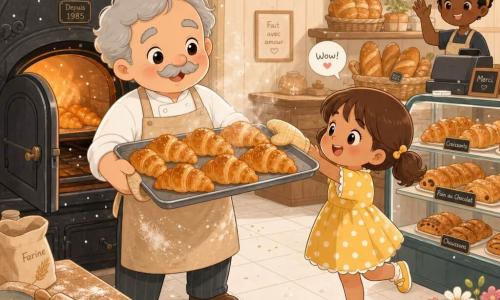
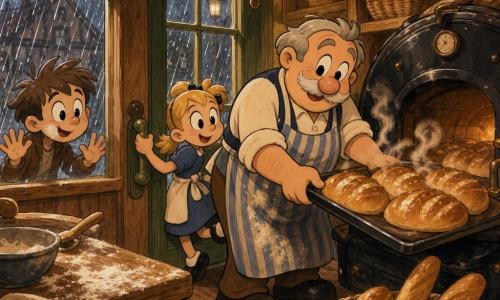
In the town of Maple Lane, the streets were still quiet when Leo unlocked the bakery door.
Click. Creak.
A soft, yeasty smell greeted him like a friendly hug. The bakery was called Sunbeam Bread, and the windows always looked warm, even before sunrise.
Leo was a young man, and he was a baker with patient hands. He didn't rush the dough. He didn't rush the ovens. He didn't rush people, either.
He hung up his coat, tied on his apron, and washed his hands until they were squeaky clean.
“Good morning, bowls,” he said in a silly serious voice.
The bowls, of course, did not answer.
Leo chuckled anyway. “All right. Let's work together.”
He opened the flour bin. A little cloud puffed up and tickled his nose.
“Achoo,” he said politely to the flour.
Then he measured, leveled, and poured. Flour fell like pale snow. Salt sprinkled like tiny crystals. Yeast looked like sandy freckles.
In the quiet, Leo could hear small sounds: the tap of a spoon, the soft scrape of a scoop, the whisper of flour sliding.
He poured warm water into a big bowl. The water made the yeast wake up. Soon, little bubbles appeared.
“Hello, sleepy yeast,” Leo said. “Time to stretch.”
He mixed everything together. At first it was sticky and messy, like a muddy puzzle. Then he began to knead.
Push. Fold. Turn.
Push. Fold. Turn.
His hands pressed the dough. The dough pressed back, like it wanted to play.
Leo breathed in. The dough smelled like clean wheat and something bright, like morning.
He loved this part. The steady rhythm. The calm.
Push. Fold. Turn.
While he worked, he thought about the people who would come in later: Mr. Finch, who always bought two rolls and pretended one was “for a friend.” Mrs. Rami, who asked for the crustiest loaf. And little Nia, who came with her dad after school, eyes wide as saucers at the pastry case.
Leo didn't just bake for money. He baked to help. To share comfort. To make people smile.
He patted the dough into a round ball and tucked it under a cloth.
“Rest,” he whispered. “Good work.”
The bakery clock ticked. The ovens warmed up. The lights glowed like buttery lanterns.
Soon, the town would wake up.
Chapter 2: A Special Bag of Old-Time Flour
Later that morning, the front bell jingled.
Ding-a-ling!
A delivery person rolled in a small cart. On it sat a paper bag with a label that looked fancy and old.
The delivery person smiled. “New ingredient for you, Leo. From a local mill.”
Leo wiped his hands and read the label. “Ancient grain flour.”
Ancient sounded like castles, dragons, and dusty books. But this was flour—soft, pale, and very real.
He opened the bag carefully. A warm, nutty smell rose up. It was deeper than regular flour, like toasted crackers and sunshine on hay.
Leo leaned closer. “Oh,” he said softly. “That smells… wise.”
He pinched a tiny bit between his fingers. It felt slightly different—silk mixed with sand, but in a nice way.
He remembered what his baking teacher once told him: “A good baker learns with every sense. Look, smell, touch, and taste.”
Leo hesitated. Tasting flour was not a snack. But a tiny pinch, just to learn, was part of his job.
He dipped a fingertip into the flour, then touched it to his tongue.
The taste was gentle. Earthy. A little sweet, like warm oats. It didn't shout. It hummed.
Leo nodded slowly. “Hello, ancient flour,” he said. “I think you'll make a kind loaf.”
Just then, the bell jingled again.
Ding-a-ling!
Nia stepped into the bakery with her dad. Nia was seven, almost eight, with a backpack that seemed as big as she was.
She sniffed the air. “It smells like bread hugs.”
Leo grinned. “That is the best kind of smell.”
Nia leaned over the counter. “What are you making today?”
“A lot of things,” Leo said. “And I have something special. Want to learn a baker secret?”
Nia's eyes sparkled. “Yes!”
Leo lifted the bag a little so she could see the label. “This is ancient grain flour. It comes from a grain people grew a very, very long time ago.”
Nia tilted her head. “Like… dinosaur time?”
Leo laughed softly. “Not quite. But it is old enough that your great-great-great-great-grandparents would say, ‘Oh! I know that!'”
Nia's dad smiled. “So what does it do?”
“It changes the bread,” Leo explained. “It can taste nuttier. It can smell warmer. And it can make the crumb”—he paused and used a simpler word—“the inside of the bread, a little different. Soft, but with character.”
Nia tried the word. “Char-ac-ter.”
“Exactly,” Leo said. “Bread has a personality.”
Nia giggled. “Does this bread have a name?”
Leo looked at the bag, then at the warm ovens. “Maybe… ‘Old-Time Sunny Loaf.'”
Nia clapped once. “That sounds delicious.”
Leo leaned forward, voice gentle. “Baking is like taking care of something. We measure so it's fair. We wait so it's ready. We share so it matters.”
Nia nodded, serious now. “Like helping.”
“Yes,” Leo said. “Service. We make food so people can feel good.”
Nia's dad checked his watch. “We should go. But we'll be back later.”
“Come back near closing,” Leo said. “If you like, you can help me make one small loaf.”
Nia gasped happily. “Really?”
“Really,” Leo said. “A baker keeps promises.”
As they left, Nia called, “Bye, Leo! Bye, bread hugs!”
Leo waved. “See you soon.”
Then he turned back to the flour. “All right,” he murmured. “Let's bake something kind.”
Chapter 3: The Dough That Needed Patience
In the afternoon, Leo set out two bowls. One for regular flour. One for ancient grain flour.
He spoke softly as he worked, like the bakery was a sleepy friend. “Measure. Level. Breathe.”
He mixed the ancient flour with the regular flour, because ancient flour could be strong in flavor, and he wanted it just right for everyone.
He added water and watched it change.
At first, it looked shaggy and rough. The dough seemed unsure. Ancient flour, Leo realized, needed extra patience.
“That's okay,” he told it. “I have time.”
He let the dough rest for a few minutes. Resting was important. It helped the flour drink the water. It helped the dough become smoother without being forced.
Leo cleaned the counter. He wiped his tools. A baker's space mattered. Clean tools meant safe food, and safe food meant people could trust you.
“Trust is part of service,” Leo said to the empty room.
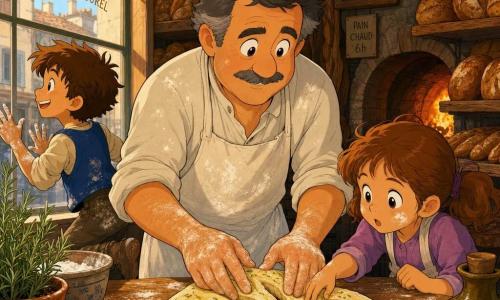
When the dough was ready, he kneaded it slowly.
Push. Fold. Turn.
Push. Fold. Turn.
The dough became springy. It warmed under his palms. It smelled even better now—like toasted grain and gentle sweetness.
Leo placed it in a bowl and covered it.
“Now we wait,” he whispered. “Waiting is not doing nothing. Waiting is letting good things happen.”
While the dough rose, a few customers came in. Leo greeted each one with calm kindness.
“Good afternoon, Mr. Finch,” he said.
Mr. Finch winked. “Two rolls. One for me, one for… a friend.”
“A very lucky friend,” Leo said, handing them over.
Then Mrs. Rami arrived. “Leo, I need a loaf with a brave crust.”
“A brave crust?” Leo repeated.
She nodded firmly. “The kind that goes crunch.”
Leo saluted with a bread peel like it was a flag. “One brave crust coming right up.”
Mrs. Rami laughed, and the sound filled the bakery like warm tea.
Between customers, Leo checked the dough. It had risen into a soft dome. When he pressed it gently, it sprang back, like it was saying, “Ready!”
Ding-a-ling!
Nia returned, holding her dad's hand and a small cloth bag.
“Are we making the loaf?” she asked, bouncing on her toes.
Leo washed his hands again. “We sure are. Come around to the side counter.”
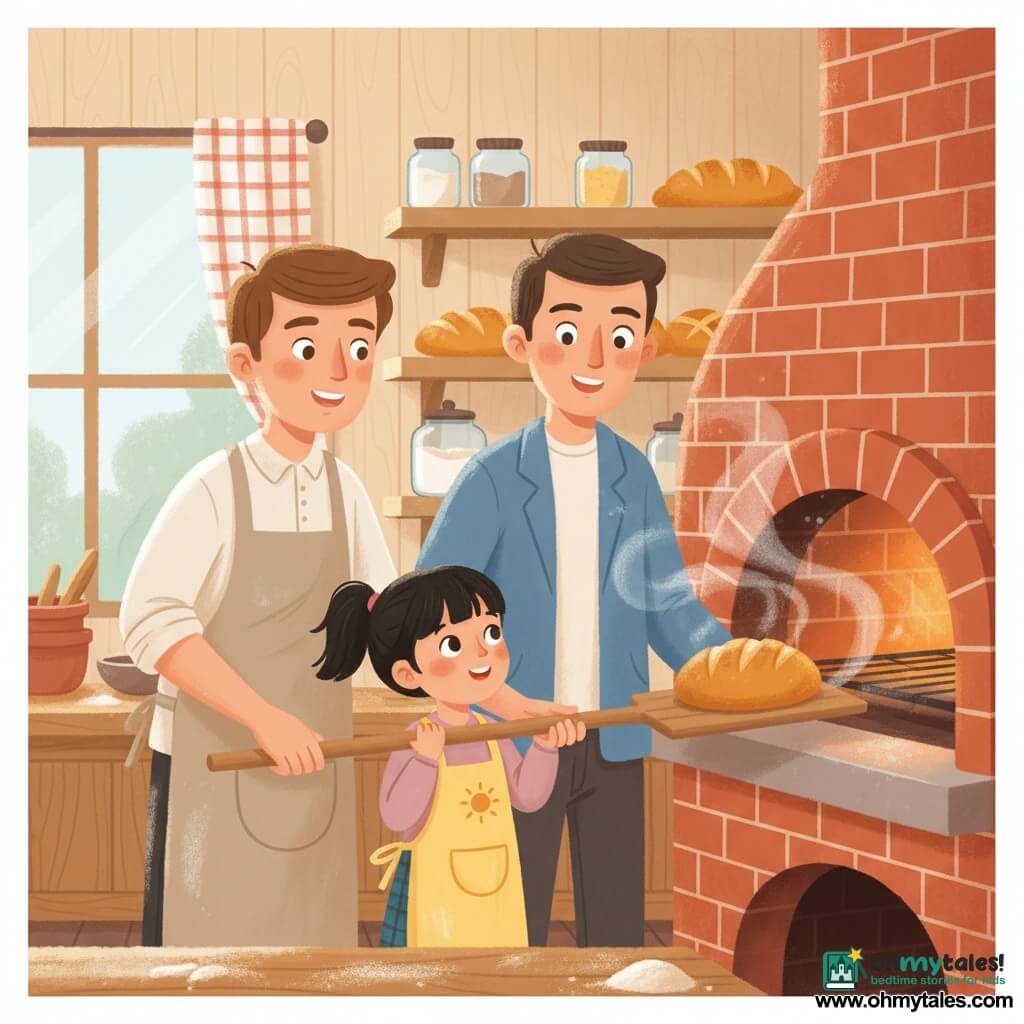
Nia slipped on a tiny apron Leo kept for young helpers. It was yellow, with a stitched sun on the front.
Leo showed her the dough. “First, we sprinkle a little flour so it doesn't stick. Bakers use flour like a helper dust.”
Nia sprinkled. A bit too much.
Leo coughed gently. “Ahem. The flour is very excited.”
Nia giggled. “Sorry! It jumped!”
“It happens,” Leo said kindly. “In baking, we don't worry. We adjust.”
He helped her brush off the extra flour. Then he showed her how to fold the dough.
“Like a blanket,” Nia said.
“Yes,” Leo replied. “Fold it like you're tucking it in.”
Nia folded carefully. Her fingers were small, but her focus was big.
Leo guided her hands. “Now we shape it. We want the top smooth, like a round little hill.”
Nia smoothed the dough. “It feels like a squishy pillow.”
“That's a perfect description,” Leo said. “Now we set it in this basket to rise again.”
Nia peered in. “Why does it rise twice?”
“Good question,” Leo said. “The first rise wakes the dough up. The second rise helps it get ready to bake into a nice shape. Bread is like a story. It needs time for the middle part.”
Nia nodded as if she had been waiting for that answer her whole life.
They covered the dough. The bakery felt peaceful again. Outside, the sky turned soft and pink.
Leo said quietly, “Baking teaches us: be gentle, be careful, and think about others.”
Nia whispered back, “And be patient.”
“Yes,” Leo said, pleased. “And be patient.”
Chapter 4: The Old-Time Sunny Loaf and a Sleepy Ending
When the dough was ready, Leo heated the oven extra hot. The oven whooshed like a friendly dragon that only breathed warmth.
Nia's eyes widened. “It's loud.”
Leo crouched beside her. “It's just the oven getting ready to do its job. It's safe because we keep our hands back and use tools.”
He showed her the long wooden peel. “This is like a bread paddle. It helps us slide the loaf in without getting close.”
Nia held the handle with him. Together, they guided the loaf onto a hot baking stone.
Leo scored a small line on top with a special tool. “This lets steam escape and helps the bread open up nicely.”
Nia watched, very serious. “Like giving it a little smile.”
Leo smiled back. “Exactly. A bread smile.”
They closed the oven. The timer ticked. The bakery filled with a smell that was almost a lullaby: warm grain, crisp crust, and something sweet and old-fashioned.
While they waited, Leo packed a few leftover rolls into a paper bag.
Nia pointed. “Who are those for?”
Leo tied the bag. “For Ms. Dal, who lives near the park. She's been feeling tired. Fresh bread can be a small kindness.”
Nia thought about that. “So baking is helping.”
“It is,” Leo said. “We serve people. We listen. We make what they need. Even when it's just bread, it can make a day softer.”
The timer chimed.
Leo pulled the loaf out. It was golden-brown, with a crust that looked like it had been painted with sunshine. The scored line had opened like a happy grin.
Nia breathed in. “It smells like… warm adventures.”
Leo tapped the bottom. It sounded hollow—thump-thump—like a tiny drum.
“That means it's baked through,” he explained.
He placed it on a rack. The loaf crackled softly as it cooled.
Nia leaned close to listen.
“It's singing,” she whispered.
“It's the crust cooling,” Leo said. “Bread sings when it's proud.”
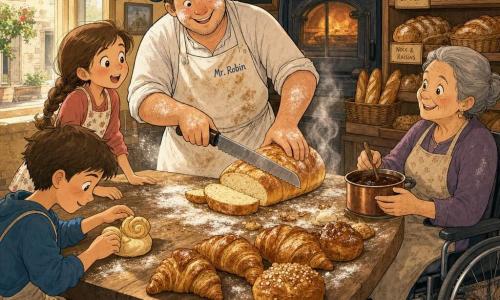
After a little while, Leo sliced the loaf. The inside was creamy and soft, dotted with tiny holes.
Nia watched the knife carefully. Leo's movements were slow and safe.
He handed her a small piece. “Here. Taste our Old-Time Sunny Loaf.”
Nia took a bite. Her cheeks puffed as she chewed.
“It tastes… cozy,” she said at last. “Like toast and oats and… like you kept a secret from the sun.”
Leo laughed quietly. “That's the ancient grain. It has a gentle flavor.”
Nia's dad bought the loaf, and Leo wrapped it carefully.
“Thank you,” Nia's dad said. “You always make this place feel welcoming.”
Leo nodded. “That's what a bakery should do.”
Nia held her small piece of bread in her cloth bag. “Can I have a tiny bit for later? For bedtime?”
“Of course,” Leo said. “Bedtime is a good time for warm stories and small snacks.”
Outside, the sky turned dark blue, and the first stars blinked awake.
That night, at home, Nia brushed her teeth and put on her pajamas. She climbed into bed with her favorite blanket. The room smelled like clean soap and sleepy quiet.
Her dad sat beside her and opened the cloth bag.
Inside was a small piece of the Old-Time Sunny Loaf.
Nia sniffed it. The smell was still there—warm and nutty, like a gentle kitchen.
She took one tiny bite.
“It tastes like the bakery lights,” she murmured.
Her dad kissed her forehead. “Leo is a good baker.”
Nia's eyes drooped. “He's patient. And he helps people.”
“Yes,” her dad whispered. “That's service. That's care.”
Nia hugged her blanket. In her mind, she saw Leo's hands: pushing, folding, turning. She heard the quiet crackle of the crust. She felt the soft dough like a pillow.
Push. Fold. Turn.
Warm. Safe. Kind.
Nia yawned. “Goodnight,” she whispered, and the last crumb melted on her tongue like a tiny, cozy promise.
Her breathing slowed. The room stayed calm. The stars kept watch.
And Nia fell asleep.