Chapter 1: The Little Tune
Sammy woke up humming before the sun had even stretched its light over the rooftops. He was seven, with an honest smile and socks that never seemed to match. Today was the last day of the year, and the house smelled like orange peels and cinnamon. Sammy had been thinking of one thing all week: making a song to welcome the new year.
He sat at the kitchen table with his pencil and a sheet of music paper his grandmother had given him. The paper had tiny stars in the corner, which he liked. He tapped the pencil on the table, and a little rhythm clicked into his head.
“I want a song that makes everyone feel kind,” he said aloud. His mother stirred batter for pancakes and smiled. “Kind is a lovely tone,” she said. “What kind of instruments will you use?”
Sammy drew a triangle first because it sounded bright. Then he added a tambourine for jingle and a tall drum for heartbeats. He wanted something that sounded like frost on the window and warm soup in a bowl. He hummed a melody that went up like a kite and came down like a comfy blanket.
When the song was half written, Sammy hopped on his chair and chanted the lines.
“May the new year bring a morning soft and kind,
May your shoes find steady paths and your friends be gentle and kind.
We'll clap our hands for courage, tap the drum for cheer,
We'll sing a tiny wish so the whole world hears.”
He laughed when he sang the last line because it sounded a bit big for someone who still had a gap where his front tooth used to be.
“That's perfect,” his dad said, peeking in with a stack of folded laundry. “But you can't play everything by yourself, little conductor.”
Sammy knew that. He put away his pencil carefully, like a treasure, and decided to find friends and neighbors who might help. He imagined midnight with everyone singing together, and his chest filled with warmth like the sun had tucked itself under his shirt.
Chapter 2: The Hunt for Musicians
Sammy stepped outside with mittens and a scarf that smelled faintly of lemon soap. The street was already dotted with little lights and paper stars hung from porch rails. He walked first to Mrs. Lee's house. Mrs. Lee grew marigolds and played the piano in the afternoons.
“Mrs. Lee!” Sammy called, breathing puffs of cloud into the air.
“Hello, Sammy!” she answered, opening the gate. She wore a shawl the color of late summer. “What brings you out in the frost?”
“I made a New Year's wish-song,” Sammy said, bobbing like a small bird. “Would you play the piano at midnight?”
Mrs. Lee's eyes crinkled. “I'd be honored. But I must finish making fortune biscuits. Will you help me hand them out later?”
“Of course!” Sammy beamed. He stepped into the warm kitchen and tasted a scrap of dough that Mrs. Lee pretended she hadn't noticed.
Next, Sammy visited the community center. Mr. Alvarez kept a small collection of odd instruments and stories. He was tuning a golden saxophone when Sammy arrived.
“I need a sax, maybe a bell, and someone to clap,” Sammy said, explaining his song with big gestures.
Mr. Alvarez laughed, “A bell I have. But a sax is too loud for midnight wishes. I'll bring a flute instead, soft as a whisper. Clapping is easy—bring the neighborhood.”
Sammy's list grew. He knocked on doors, traded antler-shaped cookies for promises to play tambourines and tap small drums, and made a new friend, Maya, who loved the violin and said her cat, Whisk, liked to nap near the strings.
At every house, Sammy listened as people added their own little ideas. Mr. Thompson wanted a drumbeat like walking in snow. Fatima offered to teach everyone a simple chorus. Sammy wrote down everything with careful letters. People smiled at his seriousness. “You're making this into a little orchestra,” his neighbor said. Sammy felt proud and helpful.
By the afternoon, Sammy had a patchwork band: piano, flute, violin, a bell, two tambourines, a drum, and a chorus that included children and grown-ups. He ran home to practice the chorus words. His song needed words everyone could sing.
“Let's make it about kindness,” he told his mother. “And respect—because we have to listen to each other's parts.”
His mother squeezed his shoulders. “That's the best idea. Respect can make a song sound like a hug.”
Chapter 3: Rehearsal and Small Surprises
The rehearsals were gentle and silly. The community center smelled of glue and hot cocoa. People arranged chairs in a crooked circle. Sammy stood in front like a tiny conductor with a scarf flag.
“On the count of three,” he said, and everyone laughed because he raised an invisible baton with seriousness. The piano played the warm stairway of the song, the flute added shivery snowflakes, and the violin drew a ribbon of sound across the middle.
When they practiced the chorus, Sammy reminded everyone to listen.
“Respect includes listening,” he called. “If someone needs a softer sound, we make room.”
Maya, the violinist, nodded. “And if someone is shy, we invite them.”
During a pause, Mr. Alvarez produced a box of tiny paper lanterns. “A little light helps singers see each other's faces,” he said. People held the lanterns up and Sammy saw faces glow like soft moons. An old man named Harold, who hardly spoke two words a day, hummed so quietly that it sounded like a secret bell. Sammy's heart felt full.
A small surprise came when Whisk the cat decided to contribute. He strolled into the circle and twined around a drum stand, purring in time. Everyone giggled. One of the youngest children clapped and the cat paused, then resumed purring like it was a practiced part of the song. “Look,” said Fatima, “even Whisk approves.”
They practiced their midnight greeting too. Fatima suggested each person say a tiny wish after the chorus, so the wishes would float like paper boats into the night. People wrote wishes on small slips of paper—wishes for friends, a new library book, pet health, courage for someone starting school. Sammy wrote “may we all be kind and respectful” and folded it neatly.
By evening, the sound of the song felt like a warm blanket. Sammy could almost see the words stepping into the air, ready to meet midnight.
Chapter 4: Midnight and the Little Coucou
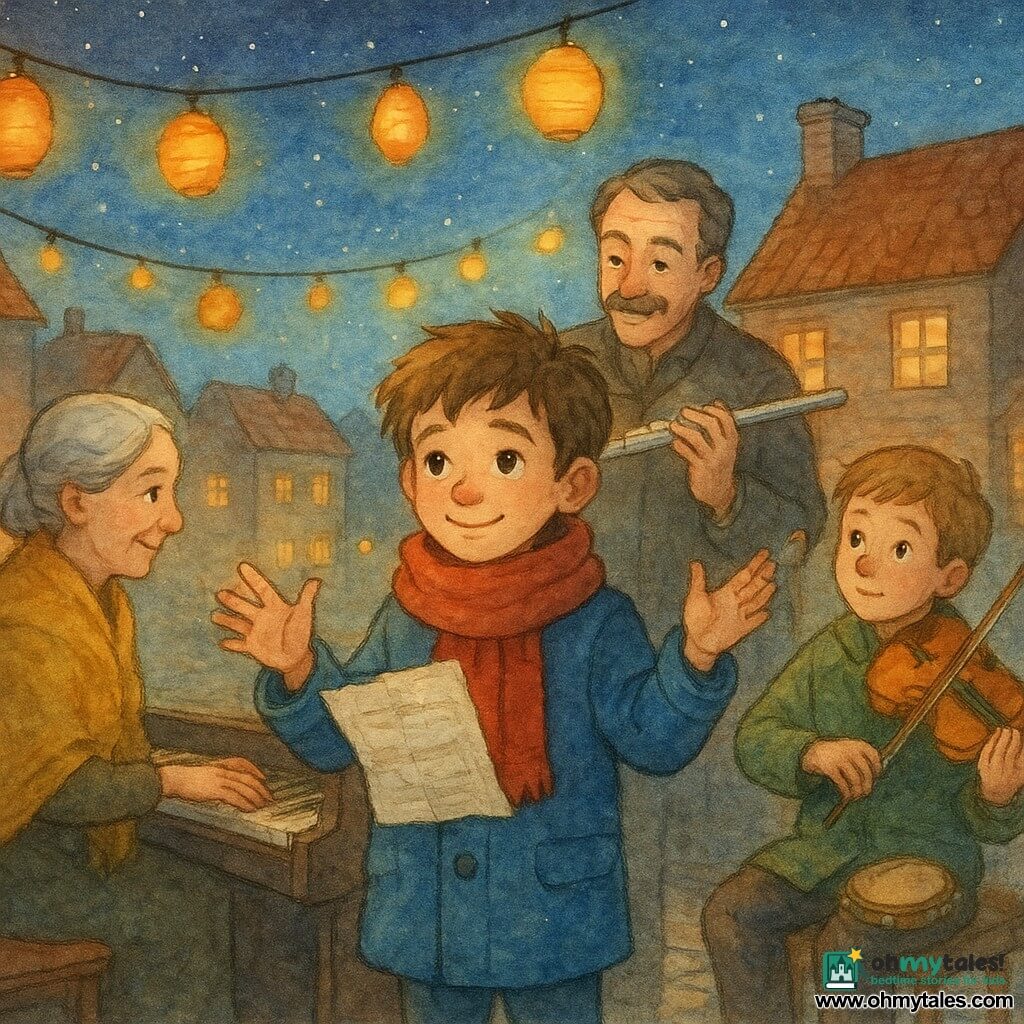
The town square glittered when Sammy and the band arrived. Lanterns swung quietly, and children twirled paper streamers. It was nearly midnight, and everyone had their slips of paper in pockets and hands. The band stood in a semi-circle. Mr. Alvarez winked. Mrs. Lee placed her hands on the keys and smiled at Sammy like he was made of sunshine.
Sammy took a deep breath. “Remember our promise,” he said softly. “Respect and listening first. Then we sing for everyone.”
They began with a hush. The piano dropped down to a single note like the first snowflake, the flute tucked a silver thread, the violin drew out a friendly sigh, and the tambourine gave a small, cheerful jingle. Sammy counted in with a quiet clap.
When the chorus rose, the town listened as if each house had pressed its ear to the same chest. Voices were small but steady at first, then gathered like friendly neighbors meeting at a fence.
“May the new year bring a morning soft and kind,” everyone sang, hands joined where they could. “May your shoes find steady paths and your friends be gentle and kind.”
At the last chorus, tiny lanterns were raised in the dark like little galaxy seeds. People took turns whispering their wishes into the night. One child wished for a new pair of glasses for his dad. An elderly woman wished for more afternoons with her granddaughter. Sammy's wish drifted out: “May we all be kind and respectful.”
When the clock chimed twelve, the town let out a gentle cheer and clapped in perfect, respectful rhythm. The music swelled with joy. It felt like a ribbon had been tied around the whole year.
After the song, people shared hugs and biscuits. Mr. Thompson said, “You did something wonderful, Sammy. You brought us together.”
Sammy blushed. He looked for his parents in the crowd, and they smiled back with eyes bright as lantern glass.
As the celebration quieted, Sammy felt a small tickle of wonder. He had one more plan. He slipped away from the square and walked home under a sky that looked like a dark velvet blanket with scattered glitter.
At his window, he found the spot he liked to sit—sill warmed a little by the house's breath. He opened the glass an inch and looked out over the sleeping street. Across from his house, Mrs. Lee had left her window slightly open too, and a ribbon of music still floated on the air. He felt the night listening.
Sammy leaned forward and made the smallest sound he knew. He pressed his lips together and said, “Coucou,” like a secret hello.
From the other window, a small face peeked out—a neighbor boy named Theo, who had attended the chorus but not spoken much. Theo's eyes widened, and he answered with a shy, “Coucou.”
The two boys waved, their little hands lit by the last surviving lanterns. It was a simple exchange: a tiny greeting that said, We see each other and we are okay. From some windows, other small faces peered out too. The town felt connected by those quiet coucous, like a soft bridge of tiny hellos across sleepy roofs.
Sammy felt proud and calm. The song had done what he hoped: it had made people kind to each other and had taught them to listen. Respect threaded the evening like silver string through beads of light.
He closed his window slowly, tucking the night back like a blanket. As he climbed into bed, his mother tucked him in and kissed his forehead.
“You did a good thing,” she whispered.
Sammy smiled and hummed the last line of his song once more, soft as a pillow.
“May we all be kind and respectful,” he whispered to the dark. Outside, somewhere, a small chorus of coucous answered, and Sammy slept with the feeling that the new year would be gentle and bright.