Chapter One: The Missing Melody
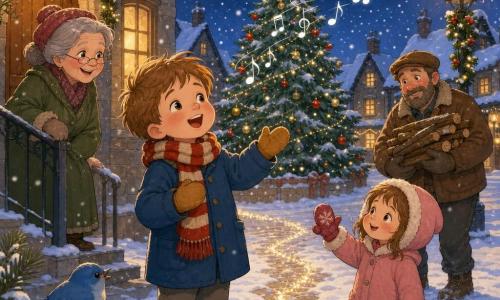
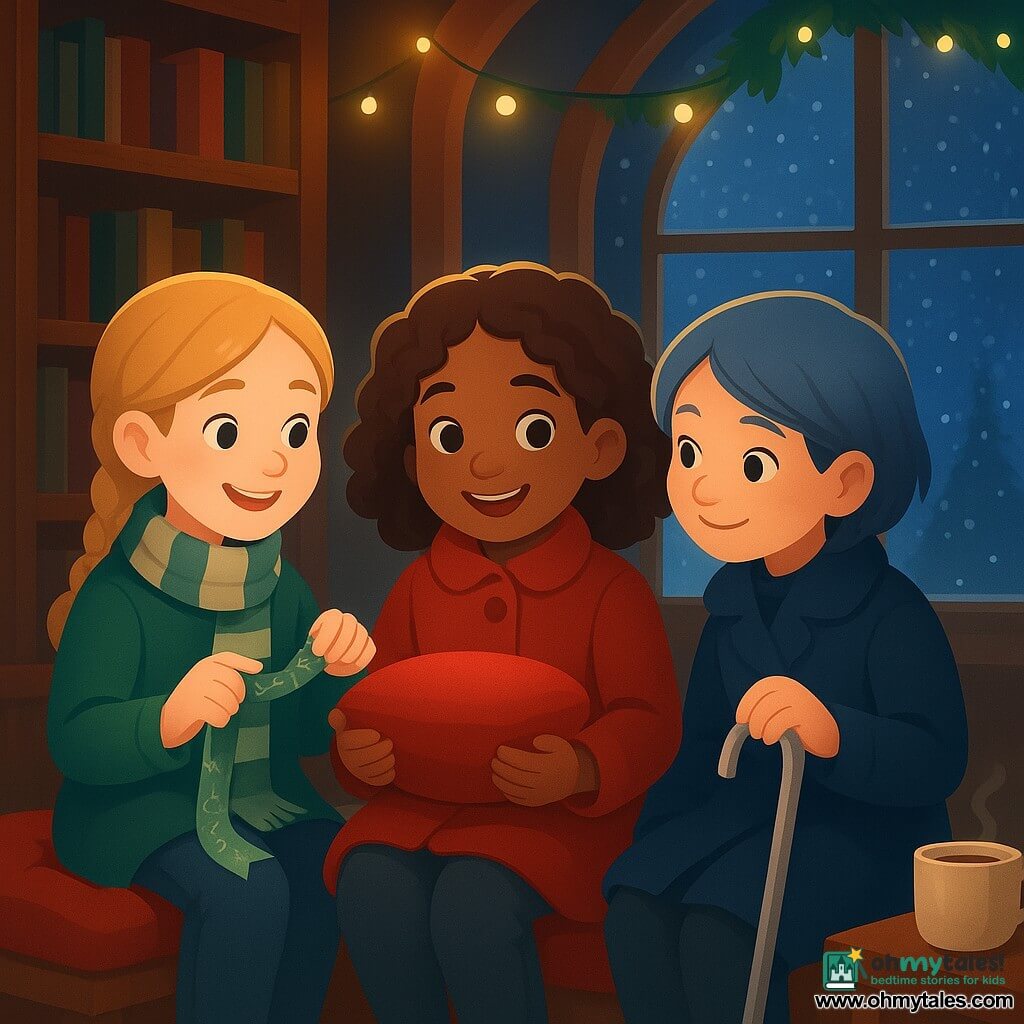
Snowflakes danced like tiny paper stars as the three friends hurried down Pineberry Lane. Their breath puffed in soft clouds. Lamplight made the snow glow warm and gold. Lila, Nora, and Mira laughed and tugged their scarves, their mittens leaving little marks on the snow.
"Do you hear it?" Lila asked, cupping her hands to her ears. Her eyes were bright with excitement.
Nora tilted her head. "Not yet. The carollers sang at the square, but the melody slipped away," she said. Nora loved tunes. She hummed quietly when she walked, and the birds sometimes answered.
Mira, who had a little silver cane with a bell on the handle, smiled. Her cane chimed each step, like a tiny music box. "Maybe it's hiding," she suggested. "Songs sometimes hide when they want a game."
They were on a mission. The town's Christmas hymn—the soft, twinkling tune everyone sang every year—had been forgotten. No one could whistle the exact first line. Old Mr. Bell in the toy shop tapped his chin and frowned. The choir at the church sang kind of close, but the words were fuzzy like snow through a fogged window. The girls decided to find that missing melody and bring it back.
"Come on," Lila said, and the bell on Mira's cane chimed, as if it agreed.
They crossed the frozen pond, where ice made little silver cracks like lace. Their skates hung from Nora's backpack. Around them, houses wore wreaths and sugar-cookie lights. The air smelled faintly of cinnamon and pine. Small surprises seemed to peek from behind doors: a ribbon here, a paper star there.
"It's like a treasure hunt," Nora said, eyes wide. "Only softer."
They followed the sound of movement—the whisper of people setting lights, the rustle of leaves in winter trees. But the song itself felt shy. It fluttered away when they tried to catch it.
"Maybe the song is shy because we're rushing," Mira said. "We should try being gentle, like the snow."
So they walked slowly, listening with their feet and the backs of their necks and the small kindness in their pockets. Lila sang a few notes; Nora hummed; Mira tapped her cane to a rhythm. The echoes mixed with the wind and made little ringing patterns that felt like breadcrumbs.
At the edge of town stood an old garden shed painted robin's egg blue. It was the place where the town kept old decorations: tinsel that had once glittered like a comet, a Santa hat with a thingamajig that jingled, and an enormous cushion that had never quite been the right color for anyone. The girls peered through the frosty window.
Inside, light made everything look cozy. A small figure moved behind a pile of wreaths. A kitten poked its head out, yawned, and then — a sound! The smallest, most delicate note floated through the slats: a single bell-like note that seemed to say, hello.
"Shh," whispered Mira. "We found something."
They opened the door and stepped into a space that smelled of cedar and sugar. The kitten scampered out, wearing a scrap of ribbon. On a shelf, a tiny wooden music box sat half-buried beneath paper snowflakes, but when Nora lifted it, they heard nothing—only a faint memory of music.
"We are getting closer," Lila said, hopeful. "But this isn't the whole song."
Mira set her cane against a stack of garlands and peered inside an old trunk. Her fingers brushed paper. Inside were scraps of a songbook: torn pages with faded notes and half-words. Nora read a line, but the note above it had melted like ice.
"Honesty," Nora read softly. "Keep the song true." The words sat in the air like a promise. The girls looked at each other. If the song had been lost, perhaps someone had changed it and that was why it felt wrong. The girls decided right then they would find the song and bring back the honest melody.
Chapter Two: Little Clues and Friendly Secrets
They left the shed with a plan. First stop: the bakery. The baker, Mrs. Plum, always hummed while kneading dough, and dough held memories like pockets hold treasure.
Mrs. Plum smiled when she saw them. "Looking for the lost hymn?" she asked, flour dusting her hair like new snow.
"Yes!" the girls chorused. Nora took a small piece of dough and pressed it gently. It made a soft, singing-sound under her fingers.
Mrs. Plum poured them warm cocoa each. "Songs are like bread," she said. "They taste best when they're honest. If someone mixes in fibs, the tune won't rise right."
"Has anyone changed the words?" Lila asked, sipping chocolate. The liquid was warm and brown, like a small hug.
Mrs. Plum's eyes twinkled. "Old Mrs. Tibbins used to write verses on ribbons and hang them from the lamppost. If a verse were misplaced, it could tangle a whole song. She's been quite forgetful this season."
"Then we should visit her," said Mira. "She has a garden of lanterns that carries many words."
They walked through a sugar-sparkled lane to Mrs. Tibbins' house. Lanterns of red and gold swung softly, and paper ribbons streamed like small waterfalls. The ribbons had notes written on them, tiny enough that you needed to step close and listen to read them.
Mrs. Tibbins was a sprightly old woman who kept her knitting in a drawer labeled 'important.' She remembered everything, most of the time, except the exact place where she put certain verses. "Verses love to travel," she said. "They gossip with the wind."
"Have you seen any ribbons missing?" Lila asked.
Mrs. Tibbins held out a pair of knitting needles like a conductor's baton. "One ribbon is missing—bright green with silver thread. It had the chorus of our hymn on it. I tied it to my coat to keep it safe and then...well, perhaps it rolled away under a cloud."
"Under a cloud?" Nora asked.
"Sometimes," Mrs. Tibbins replied, "words slip into small, unexpected places. Try the tree-house behind the toy shop. Children like hiding things where they can watch the world."
The tree-house was built in an old fir, with a rope ladder that felt like a hug when you climbed. They climbed together, Nora careful with her feet, Mira steadying herself with the cane's handle against the trunk. At the top, the tree-house smelled of old paper and star-crackles. A nest of scarves lay in a corner, and a little notebook had been left open with a scribble that looked almost like a song.
Lila read aloud, "We need the truth in the chorus, honest as the snow." The writing rambled like a stream. Underneath was a pressed leaf. Tucked beneath it, folded with careful fingers, they found a green ribbon with silver threads shimmering.
"Yes!" Nora whispered with joy. She unfolded the ribbon. The chorus was written plainly: "Ring the bells, say the truth, let kindness fill the night." But the melody lines were missing. Only small dots where notes should be hummed.
"We have part of it," Mira said. "Now we need the tune."
They realized the tune could be hiding in places that make music without words: the clock tower, the wind chimes by the school, the church organ bellows. They decided to visit each place, and each one gave them a hum: a low, steady thrum, a tinkle, a mellow boom. They collected these sounds like shells on a beach and tried to match them to the rhythm of the chorus.
At the clock tower, an old man named Jakob wound the gears. He laughed softly when they asked about the tune. "Tunes are friends of time," he said. "You must listen to the pauses, not just the notes."
They listened. The pause between the bell and the turning gear sounded like a breath. That breath belonged in the place between lines in a song. With these pieces, they tried to hum, and a stitch of the missing melody settled like a snowflake into place.
But when they sang the chorus together, something still felt off. The notes didn't settle warmly; they trembled like a ladder in the wind.
"Maybe someone keeps a different version because they'd like the attention," Nora said quietly. "If so, someone might have taken a line for themselves."
Lila looked at their reflection in a window, and thought of the verse Mrs. Plum mentioned—honesty makes a song rise. "We should ask," she said. "Gently."
They asked around with gentle words, listening to answers like little birds. A boy admitted he'd borrowed a line because his sister's choir needed a new verse. He had not meant to keep it; he thought it matched his sister's high notes. The girls explained about honesty in songs and how a melody belongs to everyone. The boy's eyes grew wide and watery. "I didn't know it mattered so much," he murmured. He returned the line, red-faced but honest.
The chorus felt fuller when the missing pieces were returned honestly. They stitched the verse back to the ribbon with a bit of twine and a careful knot. The tune hummed pleased.
Chapter Three: The Singing Snow and the Soft Ending
The last place left was the old hollow tree at the edge of the evergreen grove. It had a door no bigger than a mitten and inside smelled like warm blankets. The girls knelt by the hollow, and Lila slipped her hand in. Her fingers closed around something soft.
"It's a cushion," she said, pulling out a small, round, surprisingly plump cushion wrapped in red velvet dusted with frost. Its surface shimmered faintly, as if stars had been stitched into the fabric. On the cushion lay a scrap of paper, and on that scrap the music notes danced.
"Oh!" Nora breathed. The melody here was clear; it had been sleeping inside the cushion, snuggled warm. The cushion had somehow collected tiny sounds and kept them safe, like a nest keeps baby birds.
Mira gently smoothed the cushion surface. "It needed a home to remember the tune," she said. "Poor little song."
They took the cushion into the clearing and sat in a small circle. The night sky was a bowl of deep velvet, and snowflakes fell slow as lullabies. The ribbon with the chorus lay folded on Lila's lap. Nora opened her mouth and sang the first line. Lila let the melody flow from her like warm milk. Mira tapped her cane for a soft rhythm.
The tune returned at last—honest, bright, and true. It climbed into the air like steam from a kettle, sweet and simple and strong. Nearby, houses lit their windows to the sound. People stopped and listened. Old Mr. Bell wiped his glasses. Mrs. Plum laughed with a little sob of joy. The kitten from the shed pranced and circled the girls, purring as if the melody tickled its whiskers.
"Sing it again!" someone called from a porch, and their voices joined like ribbons weaving into a wreath. The town gathered, voices small and big blending. Some sang perfectly; others missed a note and smiled anyway. The song didn't judge. It only warmed.
After the final verse, the crowd clapped softly, like hand mittens meeting. The choir director stepped forward, wiping his hands on his coat. "Who found our hymn?" he asked.
The girls stepped from the circle, Lila clutching the cushion. Nora held the green ribbon with the chorus, and Mira steadied herself with her cane bell chiming softly. They told the story plainly: how they had looked, how they had asked, and how they had learned to be honest and share what belonged to everyone.
The director smiled and bowed. "You three have given us a gift," he said. "The song was a little lost, but you found it with kindness and truth."
As the crowd drifted back to their warm homes, a soft hush settled. The girls walked home together, their boots making quiet beats. They carried the cushion between them like a treasure. Mira tucked it gently under her arm. "It likes being soft," she said.
At Lila's house, they sat on the kitchen floor with cocoa cups in their hands. The cushion gleamed in the lamplight. "What shall we do with it?" Nora asked.
"Keep it where everyone can sit," Lila suggested. "A place that remembers songs."
So they carried the cushion to the town library, where stories lived thick on the shelves and children liked to curl up and listen. The librarian, a gentle woman with spectacles that perched like small moons on her nose, accepted it with a smile and put it on the big window seat. "A perfect listening cushion," she declared.
From then on, the cushion sat on the window seat. When children came to the library to hear tales, they sat on the cushion and hummed the hymn before the story began. It puffed softly, as if breathing with memory. People said the tune sounded warmer when someone sat on that cushion because it had listened to the honest voices of the three girls.
Sometimes, the cushion still caught stray notes—those tiny secrets tucked into pockets or sleeves—and it made them gentle again. Mira's cane bell chimed a little every time someone left a piece of the melody on the cushion, like a promise being kept.
One evening, the three friends sat together on the library steps, looking at snowflakes that glittered like sugar. Nora wrapped her scarf around her ears. "I like that we told the truth," she said. "It felt right."
"It did," Lila nodded. "And everything fit back where it belonged."
Mira looked at the cushion in the window, its velvet shining. "Soft things remember," she said. "And honest things last."
They hugged and laughed and decided to sing the hymn one more time, just for themselves. Their voices were small but brave. The song rose into the night, steady as a lamp, warm as a mitten. A star above winked, as if pleased.
That Christmas, people in Pineberry Lane sang with an extra glow. They sang honestly and kindly, and they saved a cushion on the library window seat for anyone who needed to sit and remember the melody. It was fluffy and safe, and sometimes, if you pressed your ear to it gently, you could hear the echo of three small voices laughing and the faint chime of a cane bell, and the honest little notes of a hymn that had been found and given back to everyone.