Chapter 1: The Creak in the Attic
Lily found the map on a rainy Tuesday. The house was full of the soft sound of rain tapping the roof. Inside, the floors sighed and creaked like they had stories to tell. Lily loved those creaks. They were like quiet voices saying, "Come and look."
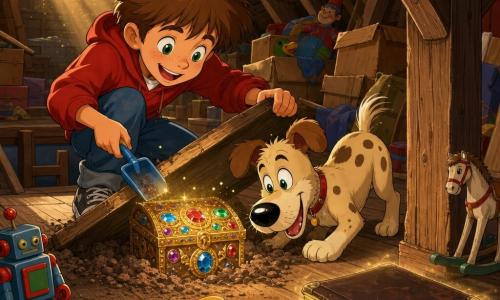
She climbed the ladder to the attic. The ladder wobbed a little and made a polite creak. A box of old quilts sat under the eaves. A wooden rocking horse with one faded eye looked at her. When Lily moved a quilt, something paper-crinkled and slid out. She picked it up. The paper was thin and a little yellow. On it, someone had drawn a map.
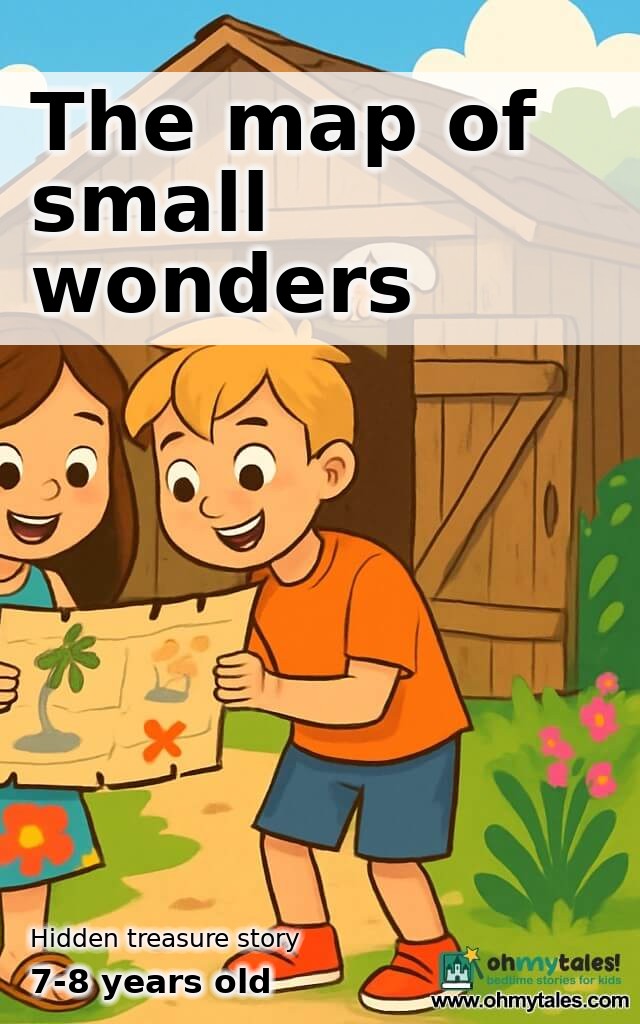
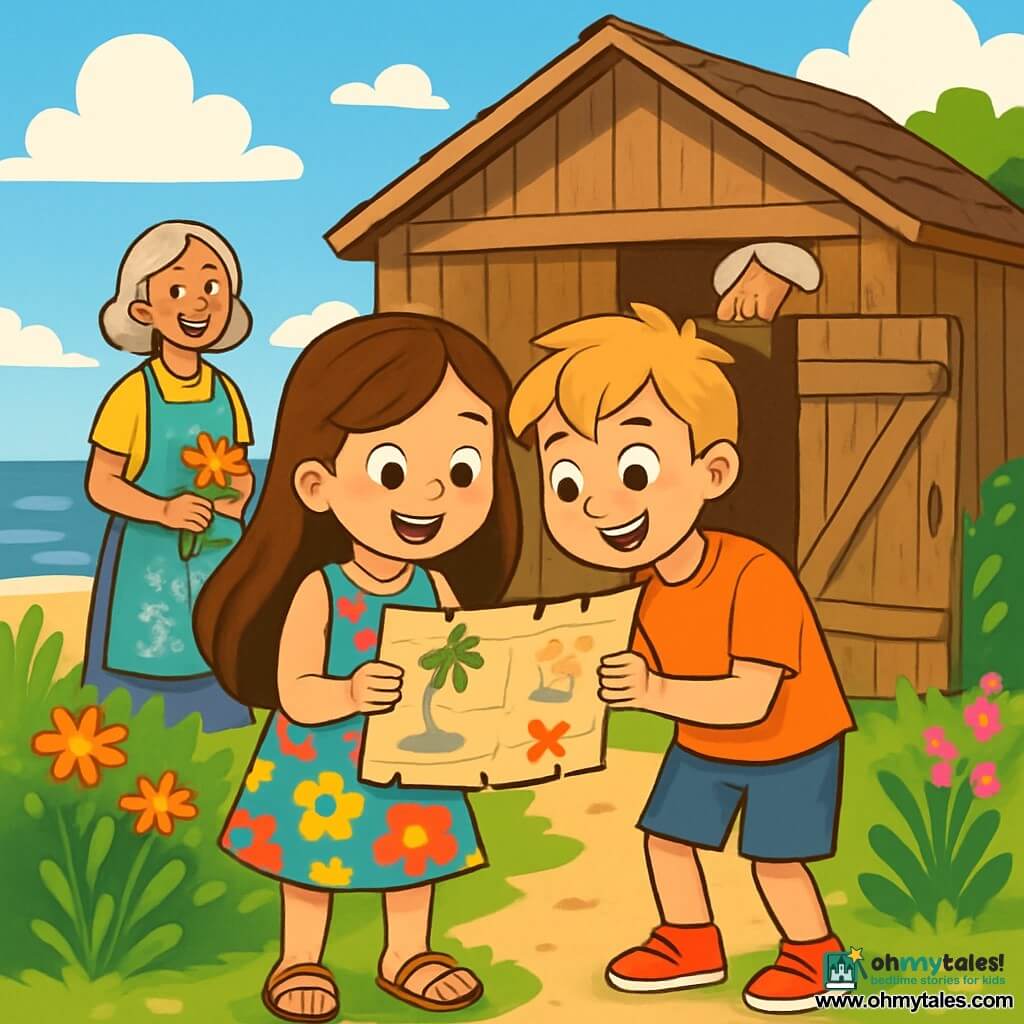
There were squiggly lines for paths, a tiny house, a circle for a willow tree, and an island with a star drawn on it. The top of the map had writing in neat, old letters: "For the brave who ask for help." Lily smiled. The map smelled like dust and lemon soap. Her heart felt both jumpy and calm.
She ran down the creaky stairs. Each step made a musical creak. "Grandma!" she called. Grandma was at the kitchen table, knitting. The radio played a slow song about the sea.
"What's that you've got?" Grandma asked.
"A map!" Lily held it out. "It says treasure, and it says brave. Do you know where this is?"
Grandma peered over her glasses. She smiled the way she always did when she knew a secret but didn't want to give it all away. "Ah. That map has been in this house longer than my knitting needles. It belonged to your great-grandad. He liked hiding small wonders, not things to sell. He liked things that made people brave."
Lily felt her toes tingle. "Can I find it?"
"You will need help," Grandma said softly. "Maps have riddles, tides, and sometimes a stubborn boat. And your great-grandad liked talking to the flowers. If you ask the florist in the lane, she might tell you about the shore. Her name is Rosa. She knows the places around the bay."
Lily hugged the map tight. "I'm ready to ask for help," she said. Her voice was strong. She felt bold just saying it.
Grandma folded the map and handed Lily a small compass. "This was his. Keep it on your neck, like a little brave-guard."
Lily fastened the compass with a string. It sat warm against her chest. She looked at the map again. There was a tiny drawing of a barque tied near a willow and a note: "Free the barque when the moon is kind." Lily's mouth shaped a question. "Moon? Barque?"
"Come on then," Grandma said with a little laugh. "Let's go ask Rosa."
Chapter 2: The Florist with Mud on Her Boots
Rosa's flower shop smelled like peppermints and rain. Bunches of flowers leaned against the windows. There were blue cornflowers like little bright stars, marigolds with proud faces, and rosemary that smelled like a forest. Rosa had mud on her boots and a crown of tiny daisies tangled in her hair.
"Hello, Lily!" Rosa wiped her hands on her apron. She had gentle eyes that looked like warm tea. "I remember your great-grandad. He always bought a bunch of wildflowers in spring."
Lily showed the map. Rosa crouched down to look, her knees making a soft rustle. She traced the squiggly path with her finger. "This is the old willow by Willow Creek," she said. "And that island? That's Little Pebble Isle. You need a boat to get there."
"Barque?" Lily asked.
"Yes," Rosa said. "An old barque. It's moored in the boathouse by the willow. It wasn't used for years. Last time I walked past, the door was stuck. The tide is clever there. Sometimes the sand holds the door closed like it is hugging a secret."
"Can you help me get it open?" Lily asked. Her voice felt bright and a little shaky. She held the map like a small sun.
Rosa nodded. "I will. But a map likes company. It will be happier if you ask others too. There is a boy named Tom who minds the jetty. He can make lines and knots. And your friend Nia knows how to read the tide calendar."
Lily wrote their names on a scrap of paper. The florists' shop felt warm and encouraging. Rosa handed Lily a small sprig of rosemary. "Smell this when you feel unsure," Rosa said. "It helps settle the knees."
Lily smelled the rosemary. It smelled like cliffs and soups. Her knees felt steady again.
They walked down the lane together. Rosa hummed a tune about bright petals. Lily asked things. She asked how to tell the difference between a safe tide and a wiggly tide. She asked what a barque looked like. Rosa laughed and drew a little boat on a napkin. "Not big like ships," she said. "Small and loyal."
When they reached the willow by the creek, the tree hung its leaves like green curtains. The boathouse door was old wood with a rusted latch. It made a low groan when Rosa pushed. Lily heard a sound like the map's paper sighing. Inside the boathouse was a barque. It was wooden and painted blue once, but the paint had sun freckles. A rope coiled at its bow like a sleeping snake.
"Now," Rosa said, "we need Tom and Nia. The tide will turn at midday. That's when the boat can be freed. But first, a riddle." Rosa tapped the map. "Your great-grandad loved rhymes."
Lily listened. She loved rhymes. The map had a little verse: "Between willow whisper and pebble shout, a moon will lift what sand keeps out. Ask three hands to loosen the line, brave and true will find the sign."
Lily turned to Rosa. "I asked for help. I'm brave. What does 'three hands' mean?"
"It means three people make three hands," said Rosa. "So find Tom and Nia. Together you'll do the lifting."
They found Tom by the jetty. He had salt in his hair and a pocket full of pebbles. He liked making knots and telling jokes that made his nose scrunch. He grinned when he saw the map. "A treasure? Count me in," he said.
Nia came with a tide calendar rolled up like a sleeping whale. She wore a scarf with tiny anchors. "Low at midday," she said. "We have two hours until it rises. We can free the barque at twelve. Bring gloves."
Lily nodded and said, "Thank you." It felt good to say thank you. She held the map steady. She had asked for help. She had been brave.
Chapter 3: The Barque and the Little Waves
At noon, the sky was friendly and blue. The willow made slow, swaying waves with its leaves. The sand around the boathouse was soft like cake. Tom, Nia, Rosa, and Lily stood like a small team. Lily's hands trembled a little, but her feet felt planted.
"Ready?" Tom asked.
They each took a hand on the rope. It smelled like wet wood and sun. They pushed together. The latch groaned. The door of the boathouse scraped like a sleepy giant waking up. Sand fell out, little grains chuckled on the floor.
The barque rolled free like a shy animal. Lily's heart thumped. She hopped in. The boat rocked gently. It felt like being in a cradle that belonged to the sea. Nia tightened the oar locks. Tom handed Lily a small wooden key. "Your great-grandad's compass told me to give you this," he said. "Maybe it's another map key."
The map had a picture of a small key under the willow drawing. Lily turned the key over in her palm. It was warm. She put it in her pocket and kissed it like a pet.
They pushed off from the shore. The oars dipped into the water and made tiny circles. The bay hummed with boats and gulls. The island sat like a flat hat with a soft feather of grass. Little Pebble Isle was close, but it looked farther when the water was wide.
As they rowed, Lily asked the map a question out loud, because sometimes maps made better sense when you said things. "Where should I look first?" she asked.
Tom squinted. "I say look for the star. Great-grandad drew a star on the map. Maybe there's a marker."
"Or follow where the flowers would like to be," Rosa said. "He loved flowers."
Lily thought about the rosemary on her neck. Smelling it made the map feel warmer. "We'll look for a place the wind likes," she said.
They landed on the island. The sand felt like sugar. Lily's footprints looked like little commas. Pebbles winked up at them. The island had a few small shrubs, a ring of flat stones, and a pile of sea glass that shimmered in secret colors.
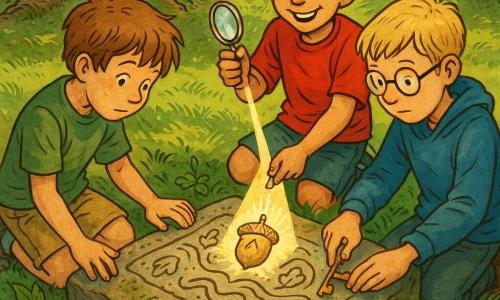
Near the center, a small mound rose like a sleeping turtle. On top was a circle of stones, and in the middle, a tiny hole like a button. Lily recognized it from the map. The map showed the star there. Her hands felt a little shaky as she reached for the hole. She pulled out the wooden key. The key fit into a notch between the stones.
Click.
The mound softly moved. It wasn't heavy. It was more like a door lifted in slow applause. Inside, wrapped in oilcloth, was a box. Not very big, but heavy enough to make Lily stand straighter. Her breath felt bright.
"Open it," Nia said.
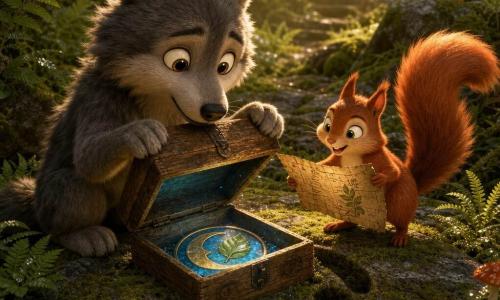
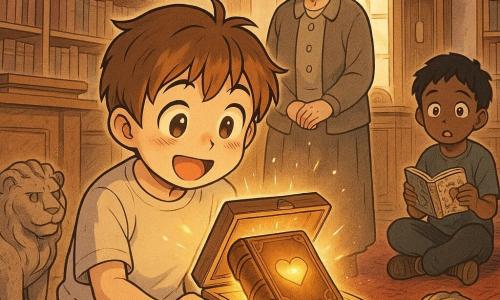
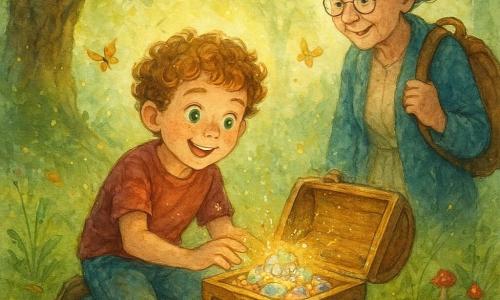
Lily untied the cloth. Inside lay a little chest. When she opened the chest, a soft glow came out—not a strange light, just a warm, warm feeling that smelled like cinnamon, cedar, and lemon drops. Inside the chest were small things: a brass compass, a folded letter, a packet of old seeds, a tiny painted boat no bigger than a thimble, and a badge of enamel painted with a little lighthouse and the word BRAVE.
Lily looked at the badge. It was bright, like a little sun. She felt proud. Her eyes were a little wet. "It's beautiful," she whispered.
Rosa smiled. "The treasure of stories," she said.
Tom opened the letter. It was written in looping, careful letters. "To the child who asks for help," he read, "If you have found this, then you have done what I loved most. You asked. You listened. You were brave enough to knock on doors and to row when the tide pulled a little. The real treasure is what you bring home: courage, friends, and seeds to plant. Use them. Grow wonders."
Lily felt her chest warm. She understood. The badge wasn't only pretty. It was a promise. It said she could be brave again. The seeds looked small but hopeful. They were labeled "Willowflowers" in a shaky old hand.
"What do we do with the seeds?" Lily asked.
"Plant them where they might need a friend," Rosa said. "Plant one near the boathouse. Plant one under the old maple by your house. Plant one by the jetty. Let the flowers remind you of this day."
Lily tucked the envelope and the badge into her pocket. She held the compass in her palm. She thought of all the times the house had creaked and felt like a story. She thought of asking for help and getting it. She thought of the boat and the map and the way the willow had whispered.
On their way back, the wind picked up and teased the boat. A small wave nuzzled the side and jumped onto the wooden slats. Lily felt a moment of worry—what if the oars slipped? But then Tom hummed a silly tune about a dancing crab, and Nia counted strokes like a metronome, and Rosa hummed with him until Lily found herself laughing. The boat rolled steady. They reached the boathouse and tied the barque to the post. The door closed with a polite thump, as if the barque had yawned and gone to sleep.
Chapter 4: Seeds and Stories
Back in the kitchen, Grandma made hot chocolate with too many marshmallows. Lily sat at the table and spread the map out. The creaky house seemed softer now, full of things she had learned. She shoved the badge into her pocket where the compass lay next to it.
"You did well," Grandma said. She put a hand on Lily's hair. The touch was light like a storybook page. "Your great-grandad would be pleased. He liked people who asked for help. He liked that bravery is a team."
Lily took the packet of seeds. She and Grandma walked to the maple tree behind the garden. The earth smelled kind and safe. Lily dug a small hole. Her fingers felt like little tools. She planted the seeds one by one and covered them with soil. She pressed them down and whispered, "Grow brave, tiny ones. Grow bright."
Then she planted another by the boathouse, and one by the jetty. Each time she planted, she thought of Tom's jokes, Nia's steady counting, Rosa's laughter, and Grandma's warm hands. Each seed felt like a promise.
Word of the treasure and the freed barque moved softly through the town. People came by sometimes to see the nook under the willow. Tom tied the barque neatly and put a little bell on the post. It rang a friendly chime when the wind walked by. Rosa made a small sign that read: "For curious hearts. Row with a friend." The boathouse began to look less tired. The willow looked pleased.
Lily wore the badge to bed that night. It clicked against the compass as she turned. In the dark, she thought of the chest and the letter and the way the sea had sounded like a lullaby. She felt proud. Happier than a squirrel with a new acorn.
A week later, little green shoots poked through the soil like shy fingers. Willowflowers bloomed with small faces that opened to the sun. People stopped to smile at the new line of color between the jetty and the boathouse. Children traced the map on their own paper and drew their own stars.
Once, Lily sat at the boathouse steps and watched the water. She asked the map one more question, not with worry, but with wonder. "What other treasures are there?" she whispered.
The map didn't answer in words. It answered in the creak of the floorboards behind her when the house sighed, in the scent of rosemary when Rosa walked by, in the tiny bell on the post that swung in the breeze. It answered in the way her friends came when she asked.
The chest had not been full of gold. It had been full of things that made people brave: a letter that asked them to be brave, a badge that told them they could, seeds that showed them how small care can become a garden, and a little boat to remind them that doors can be opened when hands join.
One evening, Lily found Grandma sitting at the window, looking at the map on the table. Grandma smiled when Lily came in. "You asked for help," she said simply. "You asked because sometimes being brave is saying, 'I can't do it alone. Will you come with me?' And others came. That's the treasure."
Lily put her hand over the map gently. The paper felt warm now, like something that had been hugged. She looked at her badge and the compass at her throat. She felt a little older and much braver.
When the next spring came, more seeds were planted. The boathouse lost some of its dust and gained a small shelf with jars of shells and a tin for spare ropes. The barque was freed more often, taking small crews to Little Pebble Isle to leave messages in bottles and pick up odd stones and to sing silly songs for the gulls.
Sometimes, when the wind was right, the house creaked in a happy rhythm. Lily would sit on the stairs and listen. The noises were no longer strange. They were like friends telling a new part of the story each day. She would trace the squiggly lines on the map and remember the exact moment the boathouse door had scraped open and the chest had clicked.
"Will you go on another adventure?" Rosa asked once, tying a daisy behind Lily's ear.
Lily looked at the map. She looked at the small tools of courage she had gathered. She looked at the little badge and the compass and the sprig of rosemary still tucked in her hair. Her smile was steady. "Yes," she said. "And next time, I will ask myself how to be brave enough to ask, too."
Everyone laughed. They laughed because it was true. Bravery was not only pushing open doors alone. It was also knowing when to knock, to call others, to share laughter and to plant seeds. It was knowing that sometimes treasure looks like a chest of small, wonderful things and sometimes like a row of bright flowers.
And the map? The map stayed on the table in the house with the creaky floors. Sometimes it was folded; sometimes it was flat. Sometimes Lily took it down and drew new paths on it. Sometimes she added small notes: "Ask for help" and "Bring rosemary." Each note was like a tiny star guiding the next brave step.
At night, when the wind made the willow wave, Lily would whisper to it like an old friend. "Thank you," she would say. "For helping us remember to be brave."
And the willow would drop a leaf into the water. The leaf would float like a little boat. It would bob toward the island and then—somehow—come back. It was as if the world nodded and said, "We remember too."
Lily slept with her compass and badge beside her. She dreamed of maps that had corners that giggled and islands that hid only the best kind of treasure: friendships, courage, and seeds that grew into telling flowers. She woke ready for the next question, the next knock, and the next small, brave step.