Chapter 1: The Man with the Pencil
There was a city with lots of tall buildings, jingling buses, and a park where pigeons practiced synchronized walking. In that city lived a man named Arthur. Arthur was not loud or flashy. He wore plain shoes, a sweater that had once been blue, and glasses that slid down his nose when he smiled. Most days Arthur liked quiet things: tea with two spoons of honey, the soft hum of his radiator, and his little notebook full of doodles.
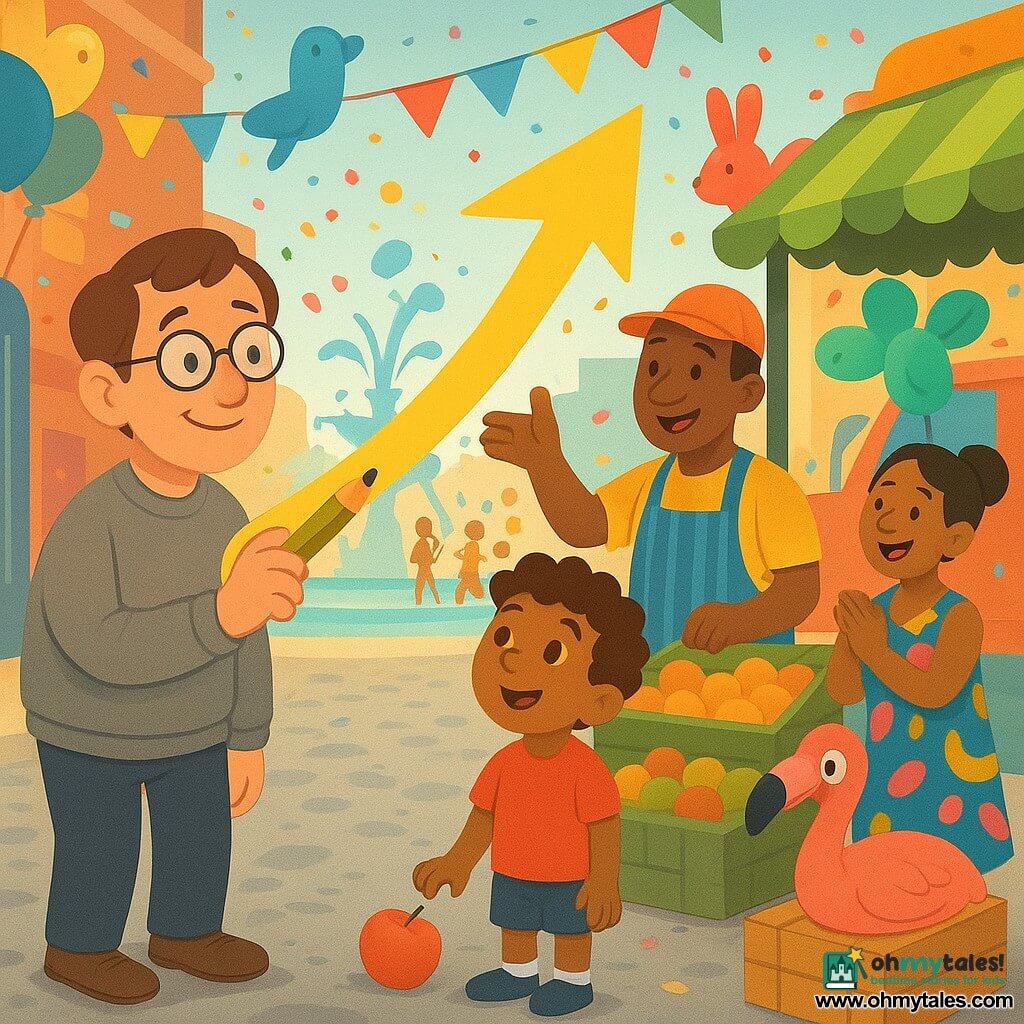
But Arthur had a secret. When he took out his special pencil—short, stubby, and wrapped in a silly sticker of a dancing banana—he could draw arrows that did more than point. His arrows were Rescue Arrows. If someone was stuck, sad, or puzzled, an arrow Arthur drew would pop out of the page, hover, and point to what needed to happen next. If a cat was on a slippery roof, his arrow might point to a ladder. If a bus was late, his arrow would point to a friendly driver with a spare seat. Arthur had discovered this one rainy Tuesday when he'd sketched an arrow toward a lost mitten and found himself holding the mitten in the palm of his hand as if by magic.
Arthur loved helping. But he was shy. He liked shadows and side streets, and he did not like big crowds or microphones. So he used his arrows quietly. He practiced at home on paper cups and on his own shoelaces until his arrows behaved politely. The arrows were always a little silly. They sometimes boogied before settling, or they would point with a tiny cartoon hand making a polite "ahem." That only made Arthur chuckle behind his glasses.
One morning, the city woke up to the sound of a horn that couldn't decide whether it was a trumpet or a foghorn. A parade of moving trucks had accidentally reversed into a street of market stalls, and fruit began to roll like planets escaping their orbits. A little boy chased an apple and went the wrong way, straight toward a very confused elephant balloon. Arthur saw this from his window and took a breath. He tightened his pencil's sticker and drew an arrow on a scrap of newsprint.
The arrow popped out and floated like a mini dirigible, pointing first at the boy and then at the nearest safe path, then at a kindly vendor wearing an orange hat. The vendor saw the arrow, followed it like a treasure map, scooped up the boy, and steered him away from the balloon. The elephant balloon, with a squeaky sigh, drifted back to its spot.
"A rescue arrow?" the vendor asked, holding Arthur's scrap in amazement.
Arthur, who was very shy, could not say much. He only shrugged and offered the vendor a small wave. The vendor waved back as if Arthur had just performed a tiny magic trick. Word of the little hero with the pencil spread like jam on warm toast. People liked jam.
Arthur liked that people were helped, but he also liked being quiet. He kept drawing arrows that pointed to small things—someone who'd lost a shoe, an old lady who needed help across the street, a pigeon stuck on a chandelier. His arrows were polite and practical and sometimes a bit silly. He was careful to stay out of shoes-and-sweater fame.
Chapter 2: The Radio Ruckus
The city had a small radio station called Whistlewave FM. It broadcast cheerful tunes, the weather that liked to gossip, and Matilda's morning show—a program famous for two things: Matilda's loud laugh and the stuffed flamingo she called Señor Beaky who sat on the sound desk and nodded along. One day Matilda announced a special segment called "City Helpers," where listeners could talk about everyday heroes. A caller mentioned a man who drew arrows. Matilda giggled into her microphone.
"An arrow-drawing hero?" Matilda asked, eyes sparkling. "We must meet him!"
A week later, a message arrived at Arthur's door tied to a bright blue balloon. The note read: "Dear Pencil-Man (or Pencil-Gent?), would you please visit Whistlewave FM? We think our listeners would love a rescue story. Also, Señor Beaky has been practicing a tango. Yours, Matilda."
Arthur read the note three times. He turned the balloon around as if it might offer advice. He pictured himself in a small booth under bright lights, his face like a punctuation mark on the air. His heart shuffled like socks in a dryer. He liked the idea of helping many people, but microphones sounded like giant teeth to him. He almost hid the note in a book. Then he remembered the apple-rolling parade, the boy saved from the elephant balloon, the vendor's grateful grin. He felt something warm and brave grow in his chest. It was a small thing, like the beginning of a balloon.
Arthur took his special pencil, cleaned the sticker (because superheroes tidy), and stepped outside with the note folded in his pocket. He walked to Whistlewave FM, which looked like a friendly house with radio waves painted on the walls. Inside the studio, Matilda greeted him like a sunbeam. "Arthur!" she said. "Come meet our listeners!"
Arthur met a microphone that looked back with two shiny eyes. He sat in a chair that hummed slightly. The studio smelled of coffee and crayons. Señor Beaky was indeed practicing a tango, which made Arthur laugh so quietly his nose did a polite wiggle.
Matilda handed Arthur a cup of tea—two spoons of honey, as Arthur liked—and set up a tiny cushion for his pencil. The radio booth glowed. They tested the levels. "We're live in three, two—" Matilda chirped. Arthur gulped tea.
When the voice came through the speaker, it wasn't a storm; it was a warm bread loaf of voices—a woman from a bakery, a boy with questions, an old man who made jokes like confetti. Matilda introduced Arthur. "Our city's helper is here! Tell us about your arrows, Arthur."
Arthur opened his mouth. The first words felt like tiny marbles. But he had promised the apple boy, the vendor, and every little rescue that had no name. He inhaled and said, "I... draw arrows to help."
On the air, the station filled with curious "oohs" and encouraging "aaaahs." Matilda asked if Arthur could show a rescue live. Arthur looked at his pencil on the cushion and nodded. He took out a scrap of paper and drew an arrow. The arrow popped out, did a little twirl, and pointed toward the studio door. Outside, a delivery person was juggling a tower of boxes. The arrow floated through the window, landed on the top box, and tapped it like a stage director. The delivery person followed the arrow's dance, set the boxes down neatly, and tipped his hat to the invisible director.
The listeners loved it. Calls poured in like confetti. "Can you make an arrow for my lost toy?" a little girl asked. "Can you make one to help my dad find his keys?" a man said. Arthur drew arrows, each one popping into the air with a tiny salute and a squeaky promise. They pointed to singing birds, tidy shoes, and even to a cat that had bravely entered a bathtub and decided to stay until the plumber came.
Arthur felt laughter bubbling in his chest like carbonated lemonade. The studio hummed with joy. Matilda clapped so enthusiastically that Señor Beaky nearly toppled. Arthur began to think perhaps a microphone wasn't a giant tooth after all. Maybe it was just a mouth that liked to share good things.
Then—because no good story is ever perfectly calm—came a call with a quiver in the voice. "My bus stop sign is crooked," a lady said. "People keep standing in the wrong place. My plants on the corner are getting squished."
Matilda turned to Arthur. "Could you draw an arrow for that?" she asked, gentle but quick.
Arthur's pencil wiggled. The arrow he drew was a little more determined than usual. It popped out and zipped through the window toward the street. It zoomed like a paper airplane, pointing to the crooked sign, then to a group of teenagers who were munching gum and sharing jokes, and finally to a kindly crossing guard with a strong pair of gloves. The arrow led them like a parade conductor. The teenagers moved the sign, the crossing guard steadied it, and the plants were saved from a doomed squish.
The city callers cheered. Arthur's confidence grew as warm as summer socks. He answered questions, drew arrows for a lost umbrella and for a bakery's oven that had forgotten its manners. Each arrow returned home with a tiny bow, and Arthur felt his shyness loosen. He was still gentle, still soft-spoken, but now his heart hummed with the idea that helping could be loud in a kind way.
Chapter 3: The Silly Superhero Showdown
The fun at Whistlewave FM made Arthur a little famous. Not famous-flying-a-zeppelin famous, but the kind of fame that puts stickers on lunchboxes and sparks in people's eyes. Kids started drawing arrows in their notebooks, though most of their arrows only pointed to snacks. Arthur didn't mind. Initiative was catching like laughter.
One bright afternoon, the station rang with a voice that sounded like someone trying to juggle bananas. "This is Chief Bumbles of the Puppet Parade. We need help! Our marching puppets are tangled in ribbons and the grand marionette—the Great Millie—has a jammed pulley!"
Arthur went to help. He drew an arrow that pointed to the puppet theater's backstage, where a tangle of ribbons looked like a rainbow had sneezed. The arrow floated in like a patient spider, then boldly pointed to a manageable starting knot, which a determined helper could undo. A troupe of volunteers followed the arrow, freed the puppet legs, and cheered as the Great Millie bobbed her wooden eyebrow.
After the puppet rescue, Arthur walked home feeling lighter, like a balloon with one especially polite knot. He took off his shoes and hummed quietly, thinking about the day when his pencil slipped from the table and fell under his chair. When he bent down, he found a note tucked beneath it. The handwriting was messy and very excited.
"Arthur, radio fans want a show! They want to see a Rescue Parade! They want to watch you save the city from ridiculous things! Please, please, please, please?" it read, signed by "Team Tickle-Toes" and a small doodle of a dancing pineapple.
Arthur blinked. A Rescue Parade sounded like a very big thing—more like a rescue festival with trumpets and probably confetti. He imagined marching down the street with a cape and a large hat. He imagined microphones. He imagined Señor Beaky doing the conga. His cheeks warmed like toast.
But Arthur thought of the apple boy, the vendor, the crooked sign, the puppets, and the way Matilda's laugh made everything seem possible. He also thought of the pencil under his chair, which now seemed to think he could do bigger things. It wasn't about fame. It was about starting something. Initiative. He took a deep breath and wrote back on a scrap of paper: "I'll do it."
The city prepared for the Rescue Parade. Ribbon blowers tested their loops. The mayor ordered a dozen exceedingly enthusiastic foam fingers. Kids painted cardboard arrows. Arthur drew his best arrows, which were particularly jaunty that week. He practiced stepping forward, then stepping back, then not tripping on his own shoelaces.
On the day, the streets hummed with joy. Stalls offered lemonade of several very silly flavors. The parade began with a band made of spoons and karaoke. Arthur led a small procession of helpers—people who knew how to make things better no matter how tiny the task. His arrows bobbed and pointed, guiding volunteers to lost hats, to a man whose kite had decided to live in a tree, and to a puddle that needed a bridge of cardboard and kindness.
Midway through, a sudden commotion bubbled up near the fountain. A troupe of newly hired city clowns had accidentally mixed up their juggling balls with the mayor's important music discs. The discs spun dangerously close to the fountain fountain's fish (who were surprisingly opinionated about music). If the discs splashed, the clowns would be sad and the mayor's playlist might become soggy.
Arthur's pencil trembled with purpose. He drew an arrow so long that it needed a napkin. The arrow popped out and zipped to the fountain, pointing first to a sensible safety rope, then to a team of careful jugglers who could swap the discs with soft rubber balls, and finally to a pond-friendly playlist suggestion. The crowd watched as the plan unfolded like a polite umbrella. Rubber balls were swapped, the discs were saved, the fish swam in measured beats, and the clowns performed a hat-toss of gratitude.
The parade finished with confetti that was very proud of itself. Arthur, who had been nervous most of the morning, felt his shyness settle like a comfortable shawl. He had led without shouting. He had pointed without pushing. People thanked him and put stickers on their jackets that read "I Helped Today." Arthur pinned one on his sweater and felt proud.
Chapter 4: A Calm Ending and a New Beginning
After the parade, Arthur returned to Whistlewave FM to say thanks. Matilda was broadcasting a soft hour of music. "So, Arthur," she said, voice cozy as a blanket, "what did you learn?"
Arthur thought for a moment. He could have said, "That confetti is noisy," or "That Señor Beaky's tango is surprisingly sharp," but he chose another answer. "I learned that if you start with a small thing, it can become something bigger. You don't have to shout. You just need to try."
Matilda nodded, and even the microphone seemed to lean in. The listeners hummed their agreement into the city. Arthur spoke about initiative—the tiny pushing of a door, the small step toward helping—and the studio felt like a garden where little acts could grow into trees.
As the sun set, painting the buildings in marmalade, Arthur walked home along a quieter street. Children played hopscotch, and someone left a tiny chalk heart on the pavement. He passed the bakery where the baker waved and held up a fresh croissant in salute. The city felt calm and soft. Arthur looked at his pencil, which was now a little frayed at the tip. He tucked it into his pocket.
That evening, as Arthur made his tea and sat by the window, the phone at Whistlewave FM rang one last time. Matilda had left a message. "Thank you, Arthur. You showed us that even a shy person can make a big difference. Also, Señor Beaky sends a postcard."
Arthur smiled, and his glasses slid. He set the phone down and opened his notebook. He drew one final arrow for the day—small, neat, and pointing to the moon as if to remind it to watch over the city. The arrow popped out, made a tiny salute, then floated to the sill and winked at Arthur before sailing out the window into the night sky.
Arthur felt something light as a feather but firm like a promise. He had found his voice not by shouting into microphones but by choosing to act when something needed help. He learned that initiative could be the gentlest superpower: a pencil, a step forward, a small arrow of courage.
The city went to sleep with its windows like blinking eyes. Arthur turned off his lamp and folded his sweater over his chair. He placed his pencil carefully nearby, in case someone needed a small pointing tomorrow. He was still the shy man in plain shoes and a slightly faded sweater, but he had a new habit: when he felt unsure, he drew a tiny arrow on paper first and then took one brave step.
Outside, somewhere between the lampposts and the pigeons, an arrow floated past the moon, doing a little twirl, then settled on a rooftop where a cat was deciding whether to snore. The arrow pointed the cat toward a comfier cushion. The city slept, safe and smiling.
And Arthur, who had once kept his magic in the quiet corners of his room, now kept it in the city, one helpful arrow at a time—gentle, funny, and always ready to point the way.