Chapter 1: The Lunchbox Surprise
Leo was twelve and already good at a lot of things: remembering bus times, fixing loose backpack straps, and making his little sister laugh with terrible impressions of their math teacher.
Today, though, he was not good at opening his lunchbox.
He flipped the lid in the cafeteria and a smell jumped out like a rude puppet.
Leo froze. His stomach tightened, then rolled, like it was trying to move away from the smell all by itself. His tongue felt too big. His nose suddenly seemed extra talented at noticing everything.
Across the table, his friend Nia took one look and leaned back. “Whoa. What did your lunch do to deserve being in there?”
Leo snapped the lid shut. “I don't know. Mom packed leftovers.”
Nia sniffed the air carefully, like a detective. “Leftovers from… the dawn of time?”
Leo's cheeks warmed. He wasn't sure if he wanted to laugh or disappear. He heard a couple kids nearby whisper and then giggle. It wasn't mean exactly, but it still stung.
He shoved the lunchbox under the table with his foot. “It's fine.”
Nia's eyebrows lifted. “Is it, though?”
Leo wanted to say, Yes, everything is normal, I am a calm and confident pre-teen. But his face was doing that tight thing, and his throat felt like someone had tied a tiny knot in it.
At the end of lunch, he carried the lunchbox to the trash. He didn't even open it again. He just held his breath the whole way.
“Leo?” Nia asked gently, walking beside him. “You look like you just met a garbage monster.”
He tried to grin. “Maybe I did.”
But the truth was, he didn't like how big the feeling had gotten. It wasn't just “Ew.” It felt like a whole-body alarm.
And he didn't know what to do with it.
Chapter 2: The Green Wall Rest Zone
After lunch came the part of the day when the hallway sounded like a flock of shoes. Leo escaped to the library, where the air always smelled like paper and quiet thinking.
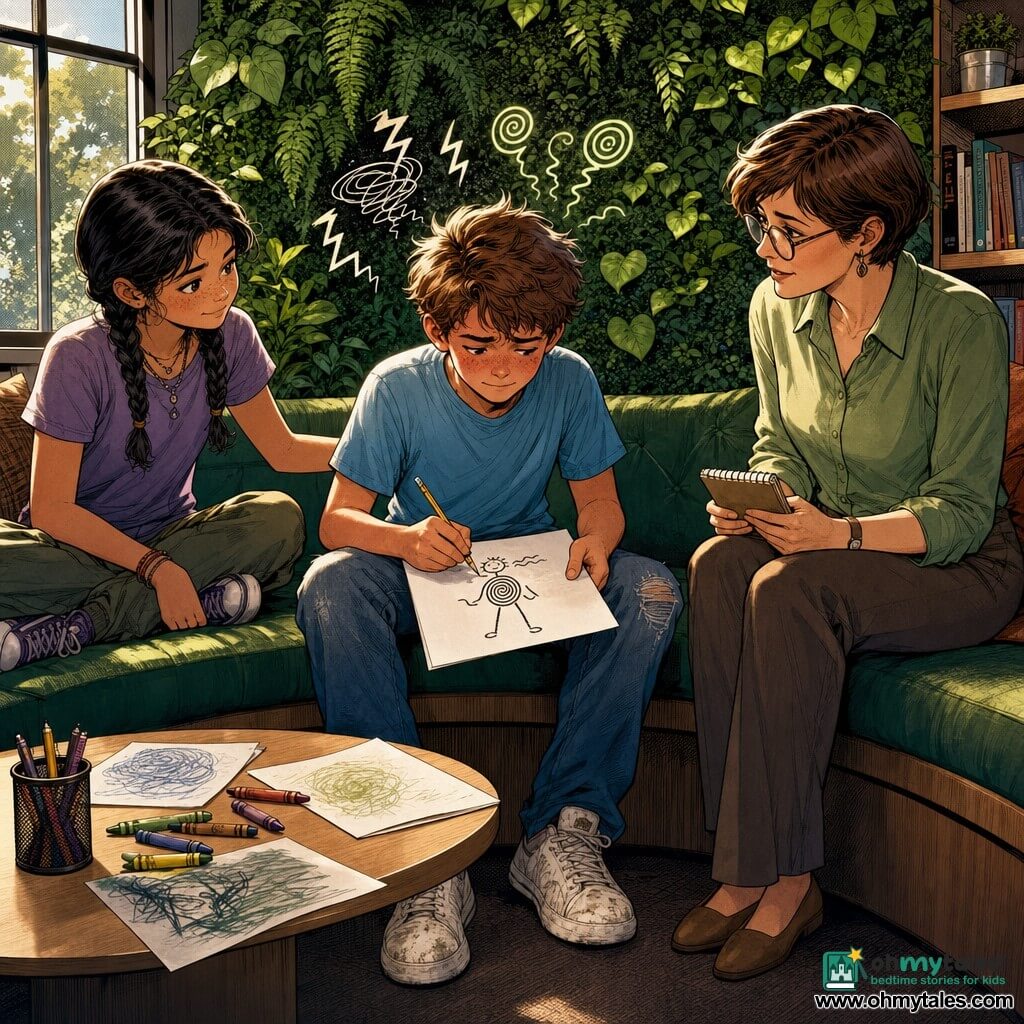
Behind the library, there was a rest zone the school had built for “brain breaks.” It had soft benches, a low table with pencils and scrap paper, and—best part—a tall living green wall covered in plants.
The wall looked like a vertical garden. Ferns drooped like gentle eyebrows. Tiny leaves shivered when someone walked past, as if they were whispering to each other. A few vines dangled down like green shoelaces.
Leo sat on a bench facing the wall and breathed in. The air was cooler here, a little damp in a good way. It smelled like rain without the wet socks.
Nia plopped down beside him, careful not to bounce the bench too much. “This place is basically a hug,” she said.
Leo watched a leaf tremble. “I think my lunch hated me.”
Nia snorted. “Maybe it was trying to be memorable.”
He managed a real laugh, then stopped. The laugh faded fast, like a light switching off. “I don't get it,” he admitted. “It was just food. But my whole body freaked out.”
Nia tapped the pencil cup on the table. “Our bodies are dramatic. Mine panics if I think about speaking in front of class.”
Leo nodded. “But this one felt… sharp. Like I wanted to push the world away.”
He glanced at the scrap paper. It was blank, waiting.
On the opposite bench, Ms. Kline, the school counselor, was arranging brochures in a neat stack. She always moved like she had time, even when everyone else didn't.
She noticed Leo's face and didn't rush. She just asked, softly, “Is this a good moment for a check-in?”
Nia lifted her hands. “I can disappear if you want.”
“No,” Leo said quickly. “Stay. It's easier.”
Ms. Kline sat at the end of the bench, not too close. “Tell me what happened.”
Leo explained the lunchbox, the smell, the way his stomach turned into a washing machine.
Ms. Kline listened like his words mattered. When he finished, she nodded. “That sounds like disgust.”
The word made Leo's shoulders loosen a tiny bit. A name made the feeling less blurry, less like a monster.
“Disgust,” he repeated. “It feels… rude.”
“It can be,” Ms. Kline said. “But it's also protective. It's your brain saying, ‘That might not be safe.' The trouble is, sometimes it gets loud and embarrassing.”
Nia whispered, “Like an alarm that screams when you burn toast.”
Ms. Kline smiled. “Exactly.”
Leo stared at the green wall. A fern frond curved like a question mark. “So what do I do with it when it shows up like that?”
Ms. Kline nodded toward the paper. “Want to try something simple? A small drawing can be a way to express the feeling without letting it control you.”
Leo blinked. “A drawing?”
“Just a little one,” she said. “Not for a grade. Not for anyone else unless you choose. Just to get the feeling out of your body and onto the page.”
Leo didn't feel like an artist. But he did feel like he needed somewhere to put that sharp, pushing-away feeling.
He picked up a pencil.
Chapter 3: Pencil, Paper, and the ‘Ew' Shape
Leo held the pencil like it might bite him. “I don't even know what to draw.”
Ms. Kline leaned back. “Start with what you noticed. Where did you feel it?”
Leo touched his stomach. “Here. And my throat. And my face got hot.”
Nia pointed at his nose. “Also your nose did a full performance.”
Leo huffed a laugh. “Yeah.”
“Okay,” Ms. Kline said. “Draw a simple body outline. Stick figure is fine. Then add shapes where the feeling showed up.”
Leo drew a stick figure with a big head and skinny arms. It looked like it could fall over in a breeze.
Then he shaded the stomach area with a tight spiral, like a coiled spring. He added a jagged little lightning bolt in the throat. Around the nose, he drew squiggly lines that wiggled away, as if they were trying to escape.
Nia leaned in. “That's… actually perfect.”
“It looks silly,” Leo muttered, but he didn't erase it.
Ms. Kline said, “Now, what did the feeling want you to do?”
Leo remembered the instant urge: slam the lid, shove the lunch away, get out. “It wanted me to run.”
He drew tiny feet on the stick figure pointing backward like they were ready to sprint.
“Good,” Ms. Kline said. “And what did you do instead?”
Leo thought. He had shut the lunchbox. He had made it through lunch. He had come here. “I… didn't throw up. I didn't yell at anyone. I left.”
He drew a small door next to the stick figure, open. A way out that wasn't a disaster.
Nia added, “And you talked about it.”
Leo hesitated, then drew a speech bubble with one word inside: “Ew.”
Ms. Kline's eyes warmed. “That's a clear message. Disgust is a messenger emotion. It says, ‘I don't like this,' or ‘This might be unsafe,' or sometimes, ‘I need space.'”
Leo stared at his drawing. It was small, messy, and somehow… honest.
“But what if people laugh?” he asked quietly. “It felt like everyone knew.”
Ms. Kline nodded. “That makes sense. When an emotion shows up strongly, we can feel exposed. One thing that helps is adding a second message. Not just what you feel, but what you need.”
Leo's pencil hovered. “What I need is… for my lunch not to smell like a compost bin.”
Nia covered her mouth. “Compost bin!”
Leo's grin surprised him. It was still there when he looked back down.
He drew another speech bubble: “I need a different food.”
Then, because the green wall was right there, he drew a tiny leaf next to the stick figure's head, like a little flag.
“What's the leaf for?” Nia asked.
Leo shrugged. “To remind me to come here. This place makes my brain less… loud.”
Ms. Kline said, “That's a good plan. A calm place can help your body settle so you can make choices.”
Leo stared at the leaf. It looked like a soft exhale.
Chapter 4: The Mystery of the Container
The last bell finally rang, and Leo rode the bus home with the lunchbox on his lap like it was a suspicious package.
At home, his mom was at the kitchen counter, chopping carrots. The house smelled normal—soap, warm air, and a hint of dinner.
Leo set the lunchbox down carefully. “Mom?”
She glanced over. “Hey, buddy. How was school?”
He swallowed. The knot in his throat tried to return, but he remembered the drawing. Spiral stomach. Lightning throat. Squiggle nose. He could see it like a map.
“It was… mostly fine,” he said. “But my lunch smelled really bad. Like, really bad.”
His mom's eyes widened with concern. “Oh no. What was it?”
“Leftovers. The pasta.”
She frowned. “That pasta was from yesterday. It should have been fine.” Then her face changed. “Wait. Did I put it in the new container?”
Leo blinked. “New container?”
His mom opened a cabinet and pulled out a plastic container with a bright blue lid. “This one. I washed it, but maybe it kept a smell from the store. Or maybe it didn't dry properly.”
Leo leaned in cautiously. Even empty, the container had a faint weird scent, like old sponge and melted rubber.
His stomach did a small warning flip.
“Yep,” Leo said, stepping back. “That's it. That's the villain.”
His mom sniffed and made a face. “Oh wow. That is… not good. I'm sorry, Leo.”
He stared at her. Adults said sorry, but sometimes they said it like they were rushing past it. His mom sounded like she meant it.
“It was embarrassing,” he admitted, voice quiet. “People noticed.”
His mom set the container down like it had offended her personally. “I get that. I would hate that too.”
Leo's shoulders eased. “I learned something, though,” he said, surprising himself.
“Oh?” She paused the carrots.
Leo ran to his backpack and pulled out the folded paper. He smoothed it on the table. The stick figure looked even sillier under kitchen lights, but also braver.
His mom leaned in. “You drew this?”
“Yeah. Ms. Kline helped.” He pointed. “This is my stomach. This is my throat. And this is my nose freaking out. It's… what it felt like.”
His mom nodded slowly. “That makes a lot of sense.”
Leo looked up. “It's called disgust.”
His mom smiled a little. “That's a useful emotion. Not a fun one, but useful.”
Nia's voice popped into his head—alarm that screams when you burn toast—and he almost laughed again.
His mom tapped the tiny leaf Leo had drawn. “And what's this?”
“The rest zone near the green wall,” Leo said. “It helps me calm down.”
His mom's face softened. “I'm glad you found a place like that.”
Leo felt something warm in his chest—not hot like embarrassment, but steady, like being wrapped in a clean towel.
His mom picked up the blue-lidded container. “This is going straight into recycling. And tomorrow I'll pack something simpler. Maybe a sandwich?”
Leo exhaled. “Thank you.”
Then he added, because Ms. Kline had said to name what you need, “Also… if something smells weird again, can I tell you right away? Like, without you thinking I'm being dramatic?”
His mom set down the container and looked him in the eyes. “Yes. Always. Your body's signals matter. We can figure them out together.”
The word together landed like a promise.
Chapter 5: A Quiet Practice
That evening, Leo lay on his bed while the house settled into nighttime sounds: a distant TV, water pipes clicking, his sister humming as she brushed her teeth.
He thought about the cafeteria, the whispers, the sharp wave of “Nope” that had rushed through him. It still wasn't his favorite memory.
But now it felt… organized. Like books placed back on a shelf.
He took out another piece of paper and a pencil. Not because anyone told him to, but because it helped.
He drew a smaller stick figure this time. He added a spiral in the stomach—lighter, like it wasn't squeezing so hard. He drew a tiny lightning bolt in the throat, but he gave it a little cap, like it was wearing a hat and trying to behave.
Then he drew a speech bubble: “I feel grossed out.”
Under it, another: “I need space and fresh air.”
Finally, he drew the green wall: a rectangle filled with leaves. He shaded it softly, as if it were made of quiet.
Leo paused, listening to his own breathing. In through the nose. Out through the mouth.
He realized something important: disgust didn't mean he was mean. It didn't mean he was weak. It was just information, like a sign on the road.
He could read it without crashing.
A knock came at his door. His mom peeked in. “Can I come in?”
“Yeah.”
She sat on the edge of the bed. “I talked to Ms. Kline at pickup,” she said. “She said you did a brave thing today.”
Leo's face warmed again, but this time it wasn't the bad kind. “I just drew a weird stick figure.”
“That's not ‘just,'” his mom said. “You noticed what was happening inside you, and you found a way to say it.”
Leo looked at his new drawing. “It helped. The feeling got smaller.”
His mom nodded. “Emotions can be like weather. If you name the storm, you can prepare. You can find shelter. Or you can wait it out.”
Leo yawned, suddenly heavy with sleep. “Tomorrow I'm bringing a sandwich,” he mumbled.
His mom laughed quietly. “A heroic sandwich.”
He smiled into his pillow. “And if it smells weird, I'll… do the leaf thing. Go breathe near plants.”
“Perfect,” she said. “And you can tell me, and we'll fix it.”
As she stood to leave, Leo said, “Mom?”
She paused.
“I thought people were laughing at me,” he confessed. “But mostly I think I was just… scared they would.”
His mom's voice was gentle. “That's normal. And for what it's worth, anyone who has ever opened a questionable container has been there.”
Leo chuckled. “So the whole world?”
“Pretty much,” she said.
The room felt safe. His thoughts slowed, like a bike rolling to a stop.
He wasn't alone with the feeling anymore.
He was understood.