Chapter 1: The Little Snail Who Wanted to Know
In a damp, glittering corner of the green wood lived a little snail named Nib. His shell was a warm spiral, painted in soft stripes like the rings of a tiny tree. Nib moved slowly, and his thoughts moved slowly too — but they were bright and curious like pebbles polished by a stream. Each morning he would wake to the hush of dew and ask himself the same sweet question: "Who are you, little world?"
Nib liked names and stories. He liked the way a robin's song sounded like a ribbon in the wind and how the fox's laugh curled like smoke. But what Nib liked most was understanding why every creature did what it did. "If I can know why," he told his shell, "I can be kinder."
So one foggy dawn, with his tiny eyes set like beads at the tip of a slow face, Nib packed his shell with nothing but a crumb of bread and a brave thought. He slid from his mossy bed and set off across the leaf-carpeted floor. The forest watched him go with soft eyes. Leaves whispered, "Go on." A sparrow tipped his hat and sang, "Mind the stones." Even a hedgehog, who kept to his hedges, peeped, "Come back when you have learned."
Nib met many folk on his way. A beetle with a bronze back spoke in short clicks about hard work. "I carry my home like you," said Nib. A squirrel chattered about leaping and saving nuts. "I rush to the next thing," he said. Nib would listen and ask, "Why?" The beetle and the squirrel answered, and Nib tucked each answer into his shell like a bright bead.
Sometimes he heard secrets that tasted of sadness. An old elm sighed how it had lost a limb to a storm. A mouse whispered she moved her young at night because the owls watched with hungry eyes. Nib's heart, small and wet like a newborn leaf, felt heavy with these songs. He wanted to understand them better — not to fix everything, but to know how to be near and kind.
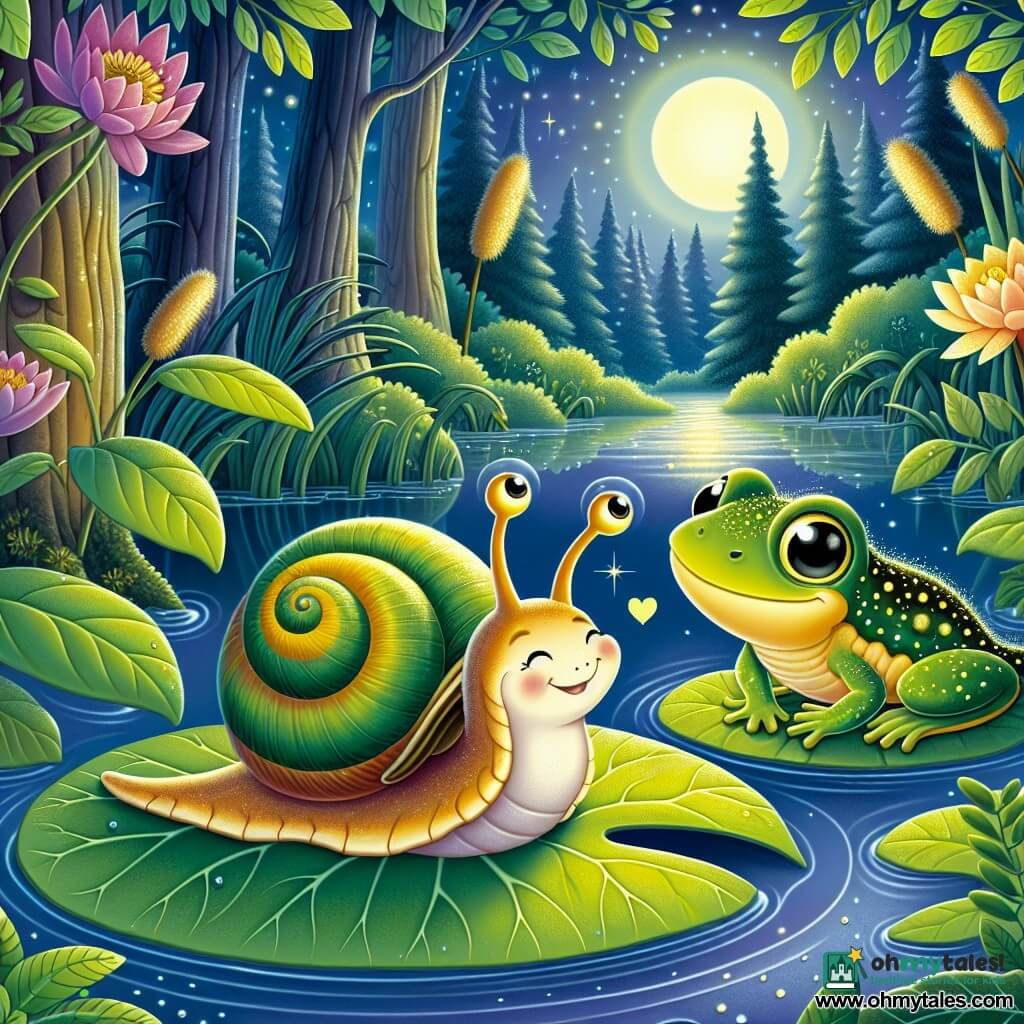
At the edge of the wood, where reeds began to murmur and the land grew soft with mud, Nib found a pond that shone like a mirror. Moonlight lay upon it as if a silver cloth had been spread there. The pond was famous for the way it kept secrets and gave them back in ripples. Nib peered into that glass water and saw his own slow face looking back, round and patient.
He had not yet met the triton who would change everything. He did not know that tonight, beneath the pond's pale skin, a small, strange visitor swam with a hurt heart.
Chapter 2: The Triton Under the Moon
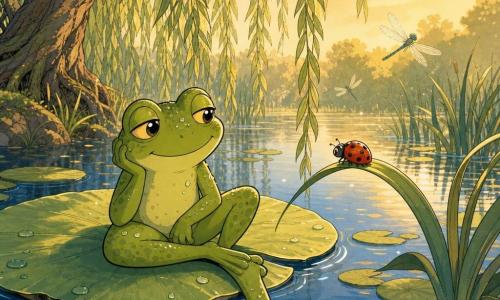
The triton was a shy creature, born of pond and poem. He had a head like a coin and hands that looked like tiny fans. He wore a coat of moss and a crown of reed. Some called him a newt; others whispered triton like a secret name only the water knew. He lived in the pond and kept the rain's music in a blue locket.
One night, when the moon put a paper-thin bridge across the water, the triton came to the surface. He hummed softly, and the song was like bubbles and bells. But tonight his tune cracked like thin ice. He had lost his voice, or perhaps his voice had wandered away like a shy fish. The triton could not sing to call the other pond folk or to soothe the lilies. He felt small as a pebble in a stream.
Nib had rolled to the very edge of the pond to look. He watched the triton with eyes wide as coins. The triton saw Nib too and blinked his small, pond-green eyes. He was surprised that such a tiny traveler sat so still and listened. "Why are you here, little shell?" asked the triton, his voice a whisper that smelled of mud and moonlight.
"I am here to learn," Nib said. "I want to understand."
The triton fished a pebble from the pond and, with a timid smile, set it on a lily. "Then listen," he said. "Once, I sang for the frogs, and the frogs taught me to laugh with my throat. I sang for the dragonflies, and they taught me to skip my tune like pebbles across the pond. But the moon came and took a piece of my song, and now the notes hide in the dark corners."
Nib thought. He could have offered advice as some animals did — "Just do this" or "Try that" — but Nib had come because he wanted to understand, not to fix. So he asked, "What does it feel like, when your song is lost?"
The triton's eyes grew round, like rings in a tree. "It feels like a coat with a loose button. It feels like walking on a path and finding no footprints of your own. It feels... lonely, because my voice kept the pond's nights warm."
Nib listened and listened. The reeds seemed to lean closer. He told the triton, "I do not know how to swim the way you do, or how to hush the moon, but I can wait. I can sit with you while the pond remembers."
So they sat. The triton balanced on his lily, and Nib rested on a pebble at the water's lip. Crickets kept time, beating tiny tambourines. A water beetle drifted by and hummed a rhythm. At first it was silence that hummed; then, slowly, a small note wriggled free from the triton's throat. It was wobbly and purple, but it was a start. Each night they returned, and each night the note grew braver. Nib's listening was like sunlight — patient, steady, and kind — and it warmed the triton's heart.
One night a wind came that tasted of far stones and far leaves. It carried a whisper: "The voice is not lost. It is afraid. Voices are shy when the heart has knots."
"Knots?" asked Nib.
"Yes. Knots like worries that tie the song in place," said the triton. "I am afraid I've hurt someone without meaning to. I remember scaring a mother frog when I leaped too loud. I remember telling a dragonfly a joke that fell like a stone. Now I fear I cannot be the gentle sort of friend, so I hold my song back."
Nib folded this like a letter in his shell. He knew, from the beetle and the squirrel and the elm, that fear could be a heavy stone. He wished to understand how to loosen such knots.
Chapter 3: The Listening Circle
Nib had learned that to understand was often to ask small, brave questions and to hold answers like fragile gifts. He decided they would make a circle — a listening circle — where everyone could speak and be heard. "We must not try to fix the knots," he told the triton. "We must only hear them and show them they are seen."
So Nib crawled into the wood and invited friends: the frog with a belly like a green gourd, the dragonfly who wore sunlight as a suit, the hedgehog who kept time with prickles, and a kindly old heron who watched the pond with slow, careful eyes. They gathered in a ring around the water like small moons.
"Tell us about your knots," Nib said gently.
One by one, the creatures spoke. The frog croaked that he feared the nights when he could not sing back because his throat was thin with cold. The dragonfly admitted he was ashamed when his wings tumbled from the wind. The heron said he worried about long paths and short feathers. Each voice was small, like pebbles, but together they made a soft drum of truth.
When it was the triton's turn, he told of the jokes that fell like stones, of the times he leaped too loud and scared a friend. He did not use big words. He used the simple, true ones that make a night bright: sorry, afraid, and wanting to be better. The pond held his words and returned them in gentle ripples.
"You see," Nib said afterward, "when we speak, the knots show where they are. When a knot is seen, it is not so frightening."
The hedgehog nodded, and even the heron smiled. The dragonfly buzzed a small laugh. The triton felt a warmth like bread rising. He tried his song again, this time not to fill the whole sky but to tiptoe out, a soft bell note. A frog answered with a croak that sounded like a hug. The dragonfly clicked in time, and the heron hummed a long, slow note that looked like a cloud.
Nib watched and felt something like a bright thread tie his own shell to the pond. Understanding, he discovered, was a kind of light. It did not always mend everything at once, but it made the dark less thick. Compassion, he saw, was not solving — it was walking into the room where someone sat alone and simply staying.
That night, the pond glittered like a bowl of stars, and the triton found that he could say, "I am sorry," and "Thank you," and mean both. The other creatures forgave with gentle paws and wings. They taught him how to ask if his laughter startled them and how to wait for a laugh to land before joining it. The triton, small and brave, learned how to listen back.
"Sometimes," he said to Nib, "I thought my song had left forever. But it only hid. When I listened, it came back to say hello."
"You helped me hear it," Nib said. "You helped me, too."
Chapter 4: The Long Walk Home
When spring breathed a sigh and painted the wood in green again, Nib felt the tiny compass in his shell point homeward. He had learned many things: that asking "Why?" could be a bridge, that listening could fix a map as well as any repair, and that kindness was a small, steady drumbeat that kept friends close.
The triton walked to the pond's edge to say goodbye. He had no gift to give but his green eyes and a promise. "We will sing together when the nights are cold," he said. "And if ever your shell feels heavy, come and sit by the pond."
Nib smiled and tucked the memory of the triton's song into a soft place in his shell. He knew the sound would keep him warm on long nights.
On the long slide home, Nib met those he had passed before. The beetle clicked a new song of work and welcome. The squirrel tossed him a nut, saying, "Now you know why I hurry." The old elm bent a branch in a tired bow. Nib told each one of the triton's listening circle and how they had learned to ask and to say sorry and to listen until answers came like rain.
"Does understanding mean you have to change everything?" the elm asked in a voice like wind through dry leaves.
"No," Nib replied softly. "Sometimes it means you only have to be near. To hold a tiny light for someone who cannot yet find their own."
When Nib reached his moss bed at the heart of the wood, the moon was a thin coin over his home. The hedgehog had placed a small leaf blanket over his bed. The snail's shell felt a pinch fuller, snug with new beads of stories. He tucked his head in and thought of the pond and the triton and the ring of friends who had learned to listen and speak.
Outside his window, the world hummed in a thousand tiny voices. He smiled into his shell and whispered, "I wanted to understand others, and I have. I will keep learning."
And so the little snail slept, the spiral of his shell a swan-song of comfort. The pond kept its triton and his shy, mending voice. The forest folded around them like a book closed with care. The moon washed the world with a small, silver hand.
It is easy, in stories, to think of heroes as the ones who move mountains. But Nib had taught that courage might be slow and small. Courage is patient like moss, kind like the circle of friends at a pond, and brave like a snail setting off to learn. Understanding others, he learned, is a gift to be given like bread — shared beside a fire so no one must eat alone.