Chapter 1: The Quiet Rustle
Moss the hedgehog liked mornings best when the forest was still half-asleep. He could hear tiny things other animals missed: a leaf turning over, a pinecone tapping the ground, a squirrel's soft footsteps on bark.
Autumn had arrived without shouting about it. It showed up in small ways—cooler air that made Moss's nose feel awake, a new spicy smell of wet soil, and light that looked like it had been poured through honey.
Moss was gentle and a little shy. He didn't mind being alone, but sometimes he wondered what it would feel like to share a discovery with someone else. Then he would shake his spines once, as if to shake off the thought, and go back to collecting good things.
Good things today were fallen leaves.
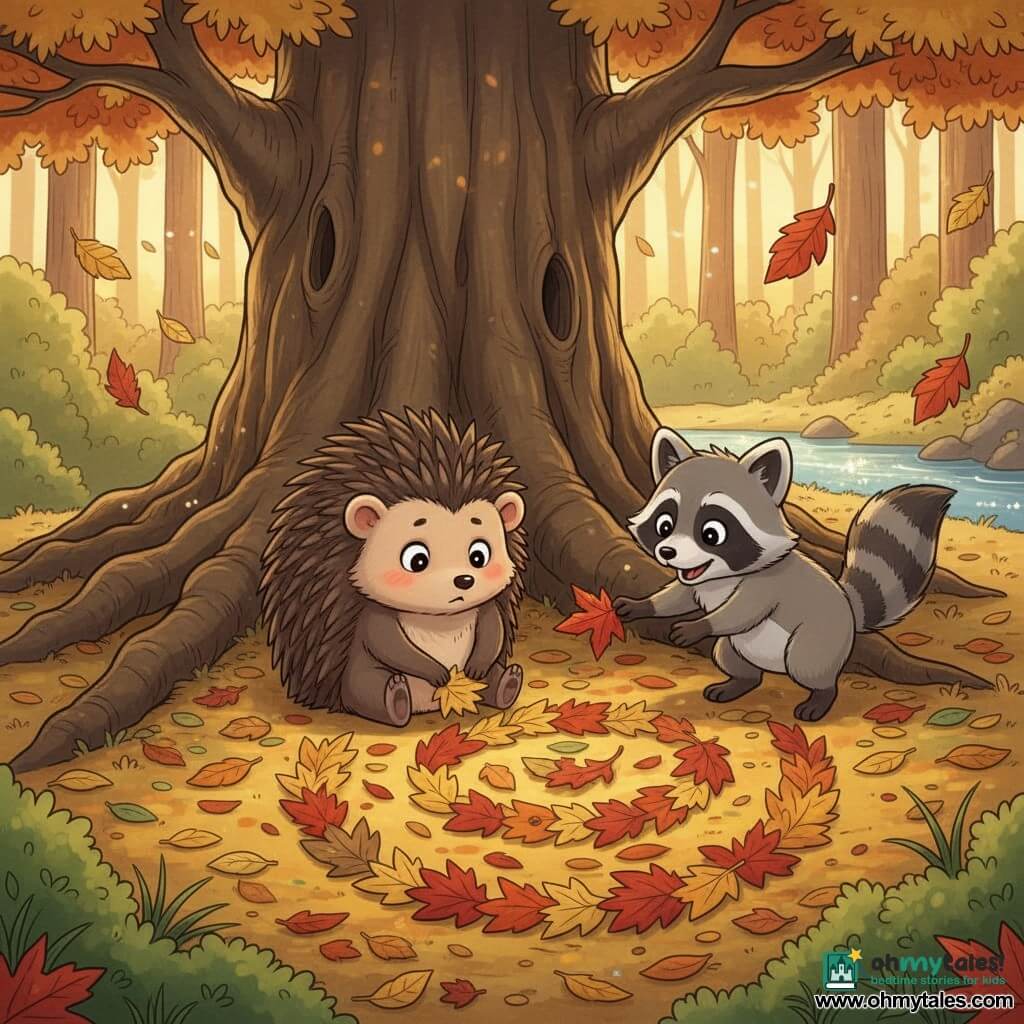
He padded along the path, choosing the best ones: a bright maple leaf like a tiny flame, a round oak leaf with deep ribs, a yellow birch leaf that looked like a small boat. He liked to line them up by color under the big old oak tree near the stream. The oak's roots rose out of the ground like knuckles, making a sheltered corner beneath the branches. It was Moss's favorite place in the whole forest—quiet, safe, and smelling faintly of acorns.
He reached the tree and began arranging his leaves carefully, nose close, enjoying the soft scratchy sound they made.
A breeze passed through the oak's crown. A shower of leaves twirled down like slow, spinning coins.
Moss watched them and whispered, “Perfect.”
Then he heard something else: a small, clumsy scuffle, as if someone had tried to tiptoe and failed.
Moss froze. He wasn't used to visitors.
Chapter 2: A Stranger Under the Oak
From behind one of the oak's thick roots, a young raccoon peeked out. His mask-like face made him look serious, but his eyes were wide and curious.
He held a leaf between his paws—a red one shaped like a star. He stared at Moss's neat line of leaves and then at his own leaf, as if checking whether his belonged.
Moss's heart gave a small hop. He wanted to run. But the raccoon didn't look scary. He looked… hopeful. A little lost, too.
The raccoon cleared his throat in a tiny, polite way. “Um. Hi.”
Moss swallowed. Talking was not his strongest skill, but being kind was. “Hello,” he said softly.
The raccoon stepped out fully, careful not to crunch Moss's leaf collection. “I'm Rill. I was following the smell of acorns, and then I saw the leaves falling like… like dancing.”
Moss glanced up at the oak branches. “They do that a lot in autumn.”
Rill's ears perked. “So it's because of autumn?”
“Yes.” Moss felt braver when he talked about things he had noticed. “The days get cooler, and the tree stops making as much food for its leaves. The green fades, and other colors show up. Then the tree lets the leaves go.”
Rill looked up, mouth slightly open. “So the colors were hiding?”
Moss nodded. “Kind of. Like secrets.”
Rill crouched near the line of leaves, his tail flicking with excitement. “This is amazing. I thought leaves just… fell when they felt like it.”
Moss let out a small chuckle, surprised by it. “Sometimes it looks like that.”
Rill held up his red leaf. “Can I put mine with yours? It might make the line brighter.”
Moss hesitated. His leaf line was usually only his. But Rill's leaf really was bright, and Rill's question had been polite. Moss shifted a little to make room.
“Okay,” Moss said. “If you want.”
Rill placed his leaf carefully, like it was a treasure. “Thank you. I won't mess it up.”
Moss felt something warm under his ribs, like a tiny lantern had been lit.
Chapter 3: The Wind's Little Test
The two of them worked quietly for a while. Moss found more leaves and slid them into place. Rill hunted in a messy zigzag, returning with leaves that were bigger, crinklier, or full of holes—leaves with stories written in chew marks and raindrop stains.
Moss started to like Rill's choices. They weren't neat, but they were interesting.
“Look!” Rill said, holding up a leaf with a round hole in the middle. “It's a leaf donut.”
Moss tried not to laugh, but he did. “That's not a real donut.”
“Still,” Rill said, “it looks tasty.”
They were both bent over the leaf line when the wind changed. It stopped being a gentle whisper and became a pushy gust that rushed under the oak like it was late for something.
The leaf line lifted and scattered.
Moss watched in shock as his careful colors spun away. Some leaves slid into the stream. Others flipped and skittered over the roots.
“Oh no,” Moss breathed. His belly tightened. All that quiet work—gone in a second.
Rill jumped up. “We can get them! Fast!”
Moss darted after a yellow leaf, but it slipped past him. He chased a brown oak leaf, only to have it hop away like it had tiny legs. The wind made everything feel silly and out of control.
One leaf—the bright red star—tumbled toward the stream. Rill sprinted, paws thumping, and grabbed it just before it splashed in.
“I saved the star!” Rill said, panting.
Moss wanted to feel glad, but he mostly felt the old familiar sting: the feeling that he should not have tried something new. If he'd been alone, he wouldn't have had to share. If he hadn't shared, it wouldn't have hurt so much.
Rill noticed Moss's face and lowered his voice. “I'm sorry. I didn't mean—”
“It's not your fault,” Moss said quickly. His kindness came out automatically, even while his thoughts tangled.
The wind faded, leaving the forest quiet again, as if nothing had happened.
But Moss could still see leaves floating away on the stream, small boats heading somewhere he couldn't follow.
Chapter 4: Curious Questions in the Root Corner
They returned to the sheltered corner under the oak's roots. A few leaves still lay there, rumpled but safe.
Rill sat down slowly, as if he was afraid his movement might make Moss's feelings spill. “Do you want to stop?” he asked.
Moss looked at the ground. The root corner smelled of damp wood and acorns. Above them, the oak's branches held on to their last clusters of leaves, rattling softly like paper.
“I don't know,” Moss admitted. Saying it out loud made his throat feel tight. “I liked it when it was neat. I liked knowing where everything would be.”
Rill turned the red star leaf in his paws. “I like that too,” he said. “But I also like finding out what happens when things change. Even if it's messy.”
Moss stared at him. “Why?”
Rill shrugged. “Because the forest is always doing something new. If I don't pay attention, I miss it. Like how the air smells different today. Like apples and mud. And how the light makes the spider webs look silver.”
Moss glanced around. He noticed a web between two roots, shining with tiny beads of mist. He had walked past it earlier without seeing it.
Rill continued, softer now. “Maybe your leaf line wasn't ruined. Maybe it just… became a different kind of leaf line.”
Moss imagined the leaves traveling: some in the stream, some under ferns, some resting on stones. He pictured them as little messages for other animals to find.
That thought didn't fix everything, but it loosened the tight knot in his belly.
Moss took a breath. The air was cool and clean, and when he breathed out, he saw the faintest puff, like a secret cloud.
He looked at Rill. “Would you like to help me make something new?”
Rill's face brightened. “Yes!”
Moss pointed at the ground. “Not a straight line. Maybe… a spiral. Like the way leaves spin down.”
Rill nodded hard. “A leaf storm spiral!”
Moss smiled, a small one, but real.
Chapter 5: A Spiral of Autumn
They collected again, but this time they didn't hurry. They moved with the calm of the oak itself.
Moss chose leaves by feel—smooth, crisp, curled—rubbing them gently between his paws and noticing the different sounds. Rill chose leaves by story, announcing each one like a tiny report.
“This one is freckled,” he said, holding up a yellow leaf dotted with brown. “It looks like it's been thinking.”
Moss placed it near the center of the spiral.
“This one is half green,” Rill said. “It couldn't decide.”
Moss set it beside a fully red leaf. “That's okay,” he murmured. “Autumn doesn't happen all at once.”
As the spiral grew, it began to look like a little galaxy on the forest floor—gold, red, and brown circling around the middle. The messy leaves made it better. The holes and rips made it real.
When they finished, they sat back under the oak, side by side in the root corner. The forest around them seemed to settle, as if it approved.
A small breeze slipped through the branches again. The spiral shivered, but it held.
Moss felt proud—not because it was perfect, but because it was theirs, and because he had tried.
Rill leaned closer, voice gentle. “You know,” he said, “you're good at noticing things. The secret colors. The way leaves sound. I never thought about any of that.”
Moss's spines warmed under his fur. “You're good at asking questions,” he said. “And at catching star leaves.”
Rill grinned. “I am pretty great at that.”
They sat quietly for a moment, listening to the stream murmur and watching one leaf drift past like a slow fish.
Moss thought about how he had almost run away at the start. He thought about how the wind had scared him, and how he had wanted to shrink back into his usual quiet.
He looked at the spiral, then at the oak above them. Leaves were letting go, one by one, without fear. They didn't cling to where they had been. They simply traveled.
Moss closed his eyes for a second and let the calm of the afternoon sink in. He didn't have to be loud to be brave. He didn't have to be alone to feel safe. He could be himself—reserved, gentle, and curious—at the same time.
When he opened his eyes, the forest looked full of small wonders again.
“Same time tomorrow?” Rill asked.
Moss nodded. “Yes,” he said. “Let's see what autumn teaches us next.”