Chapter One — The Quiet Keeper
In a village of red clay and bright lanterns, near rivers that curved like the backs of sleeping dragons, lived a quiet man named Suren. He wore a thin linen robe and walked with soft sandals that hardly made a sound. People called him the Keeper because he loved old things: cracked bowls, faded banners, and scrolls that smelled of earth and rain.
Suren kept the small temple at the hill's edge. Children would run up the steps to see the carved stone dragons, and fishermen would stop to tie their boats to the temple post. Each night, Suren lit a single oil lamp so the temple would not be lonely.
He had a secret. Under the floorboards, hidden beneath a mat of woven reeds, lay a tattered map and a note written in a careful hand. The note said, "Remember the river that spoke. Tell the truth when the moon asks." Suren touched the paper every evening and whispered, "One day."
"Why do you keep that old thing?" asked Mei, a girl who liked to climb the mango tree by the temple.
Suren smiled and showed her the map. "Because stories must travel, little one," he said. "They carry the past to the future."
"But the elders say the legend is only a tale," Mei said. "They say the river never spoke."
Suren's eyes softened. "Legends grow quiet because people forget to listen," he answered. "Maybe it is time someone listened again."
At night, Suren dreamed of a great city of stone and gold, where music made the air tremble and old kings left secrets beneath carvings of lotus and lion. In his dream, a voice as clear as falling rain asked him to find the truth and tell it to the world. He woke with the taste of river water on his lips and the quiet strength of someone who knows what should be done.
Chapter Two — The River's Memory
One morning, the river ran higher than the roofs. Boats bobbed like toys and the village hummed with worry. Suren climbed the hill and watched the water sweep past, carrying leaves and a bright blue scarf.
An old woman named Lila came beside him. She had once been a storyteller in the palace, and her house smelled of jasmine. "The river remembers," she said simply.
Suren turned. "What does it remember?"
"It remembers the day the two kings met," Lila said. "They sat upon the riverbank and spoke of the land's name and of how to keep the rains kind. They carved words into the stone, words that would hold truth like a seed holds life. But time and storms buried the stone. Only the river remembers, if one asks it kindly."
Suren knelt and pressed his palms to the earth. "Will it tell me?"
Lila laughed softly. "You are gentle, Keeper. The river hears gentleness. You must go to the old stones in the ruined city and ask the river there. But bring care and courage. Stories find danger when they are near forgetting."
Suren prepared the few things he had. He wrapped the map and note, tied his sandals, and gave Mei his lantern. "For your reading at night," he said. "So the stars will not fall into the dark."
Mei hugged him. "Bring back the truth," she whispered.
The path to the ruined city was a place of thick green and tall palms. Monks had once walked there, and their chants lingered like echoes. Suren felt small beneath arching banyan roots, but he held his secret with steady hands. As he walked, he sang a soft song the elders had taught him, a song about seeds and stories. The song gave him courage like a coat.
He reached the city as the sun leaned toward the west. Towers rose like broken teeth, and stone carvings of lotus and lion smiled down with mossy mouths. In the center, half-buried, rested a great stone. Water pooled around it, cool and shining.
Suren knelt at the edge. He unrolled the map and traced the faded lines with a careful finger. "Old river," he said then, and his voice was like a small bell. "I have come to hear what you remember."
The water made a small ripple. For a moment, there was only the soft sound of frogs and a heron calling. Then a voice, smooth as river glass, replied. "Who tells the tale?"
Suren bowed his head. "I am Suren, Keeper of the little temple. I wish to bring back the truth of the two kings and the carved words. The elders say it is gone. I believe the river keeps it."
"Truth is heavy," said the river. "It will sit in a heart and sometimes sink. Why do you want it?"
Suren thought of Mei and the children, of the lamp he tended and the nights when the moon asked nothing. "Because stories live when told," he said. "Because when truth sleeps, the heart of a people gets colder. I wish to wake it."
The river hummed like a lute. "Very well. But first, you must listen to the stone."
From the pool rose a small fish with scales that flashed silver. It held a leaf shaped like a coin and pushed it toward Suren.
"Take the leaf," said the river. "Carry this memory to the stone and ask it to open. The stone will ask for an answer. Tell it what you would give so the truth can travel."
Suren took the leaf. It felt warm and smelled faintly of lilies. He set it on his palm and walked to the stone where the old carving slept. In the dusk, the carved lions looked almost alive.
"Stone," he whispered, laying his hand on the cool face. "I bring the river's leaf."
The stone shivered like a sleeping thing waking. A faint light traced the carved letters, and the stone asked, "What will you give for the truth?"
Suren closed his eyes. He thought of the lamp he lit every night, the scrolls he kept, and the quiet hours he spent polishing a bowl until it gleamed. He thought of speaking the truth that would make people smile again. He answered, "I will give my silence to bear the weight until it can be shared. I will give my listening so the truth will not be lost. I will give the story a home in my hands."
The stone hummed and opened a thin crack. A whisper like old wind slipped through. "Then take this," it said, and a small pebble rolled into Suren's hand. The pebble glowed with a soft blue light. On its face, tiny carved words showed: the kings' names and the vow they made long ago to keep the land kind.
Suren felt a joy like a bird in his chest. "Thank you," he breathed.
The river sang a low note of approval. "Now you must carry this pebble to the temple of songs," it said. "There, the elders will listen and the children will learn. Do not hurry past the trees of forgetting."
Suren rose. He held the pebble like a promise. The path home seemed brighter under the moon that night, and even the frogs croaked in a kindly rhythm.
Chapter Three — The Trees of Forgetting
On the road back, a grove stood in the valley. People called it the Trees of Forgetting because travelers sometimes felt sleepy and lost their wishes among the roots. The trees had leaves that shimmered like coins, and their trunks were wrapped in ribbon-like vines.
Suren sat beneath a tree to rest. The pebble in his pocket warmed his thigh like a small sun. For a moment, the air smelled of cloves and old books. A voice, soft as moss, said, "Where do you carry the story?"
Suren answered honestly. "To the temple of songs, so the elders can read the carved words and the children can know."
A shadow stirred. It was not mean or sharp; it was the shape of a memory that had wandered away. It touched his hand and asked, "Why should I not take your wish? I could make you forget, and then you would sleep without the burden."
Suren stroked the pebble through his robe. "Because truth is not a burden; it is a seed," he said. "Even seeds sleep, but they wake when they find a warm hand. I will carry it."
The shadow seemed to sigh like a small wind. "Many pass and leave pieces of themselves here," it whispered. "But you sound steady."
"Steady enough," Suren replied. "And I have a lamp for the night and friends who wait."
At that, the shadow melted back into the roots. Leaves shook, and an acorn rolled to Suren's foot like a tiny drumbeat. He tucked the pebble into his palm and continued, humming the seed-song with the simple rhythm of his feet.
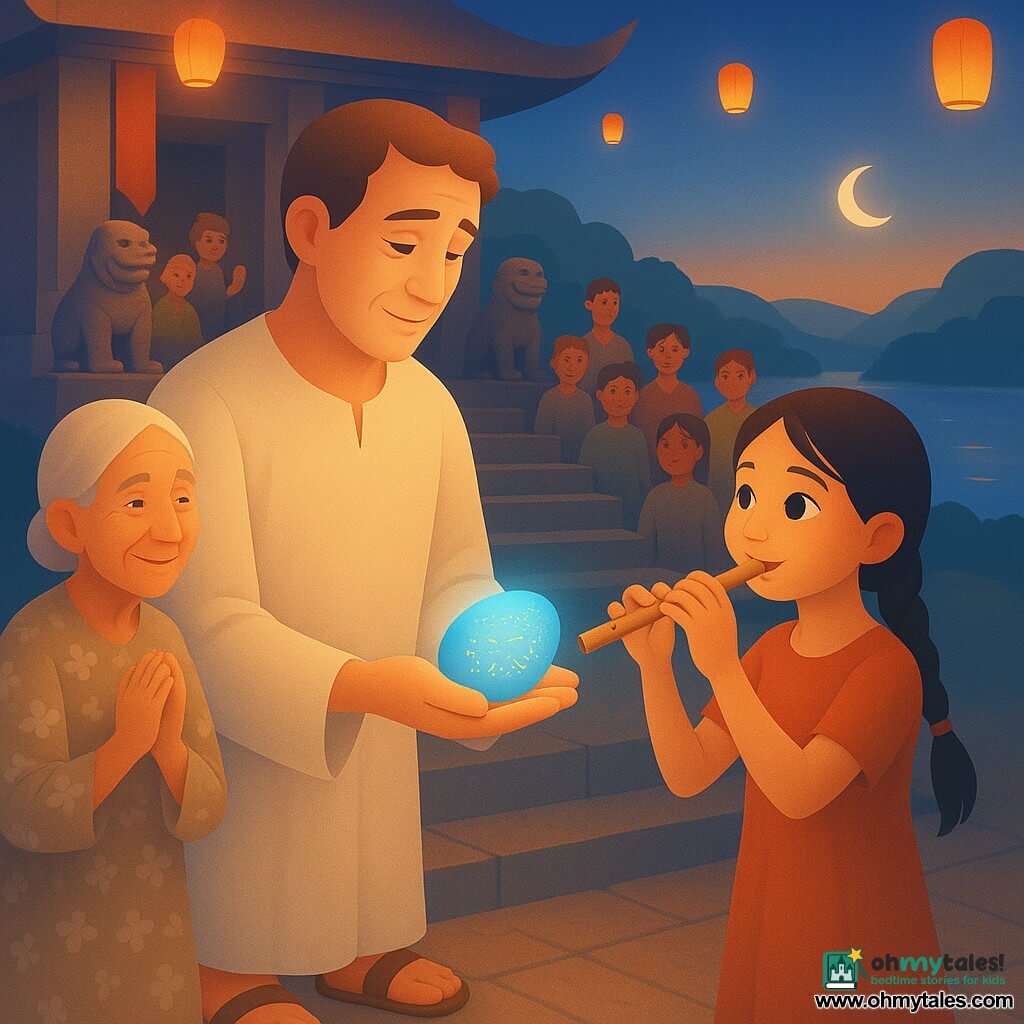
By the time he reached the temple, dawn was pushing pink into the sky. Mei ran down the lane waving a reed flute. "You found it!" she cried. "You look like sunrise."
Suren laughed and handed her the pebble. Mei's eyes widened. "It glows like a tear of the moon," she said.
They climbed the temple steps together. The elders sat in a circle near the silk banners, their hands folded like closed flowers. Lila was there, and the head elder, who had hair like the inside of shells.
Suren bowed and placed the pebble on a cloth. The old men and women leaned close. The carved letters shone faintly, and when the head elder read them, his voice was slow and careful.
"In the time of the two kings," he said, "they promised to share water, grain, and story, so the land would flourish. They bound truth with a vow, so that truth could be passed like a lamp from hand to hand."
A child in the back whispered, "So the river keeps the promise?"
"Yes," said Lila, smiling. "And someone must remember."
Suren spoke then, his voice steady. "I found the stone. I listened to the river. I kept the pebble."
The elders looked at each other. One elder asked, "Why did you keep it alone?"
Suren thought of his quiet nights and the secret map. "Because I thought if I held it, I could keep it safe until the moment was right. But it belongs to everyone. It must be told."
An elder nodded. "Very true. Truth grows when it is shared."
Mei raised the reed flute. "We should tell it with song," she said. "So children will sing it at play."
"Yes," said the head elder, smiling like sunlight. "And we should carve the words again, where all may see."
So they decided to travel to the market and the schools and the riverside. The elders would read the carved words aloud, and children would clap and learn the vow of the two kings. Lila taught a short rhyme, and the children learned it quickly.
Suren watched as faces brightened. The pebble glowed, not like a secret kept, but like a lantern shared. He felt his heart light as a leaf.
Chapter Four — The Smile of the World
Weeks passed. The story spread like rice seedlings in a wet field. Fishermen sang it while mending nets. Potters hummed it as they turned clay on the wheel. Mothers told the rhyme to babies who drifted to sleep with tiny smiles.
Suren walked the lanes and listened. People spoke the names of the two kings and the vow they had made. Children drew little stones on mud walls, and elders carved tiny marks on doorposts so their grandchildren would remember.
One evening, while the sun fell into the river like a coin, Mei ran up the temple steps. "Suren! Come quick! The river sent a bird!"
They went to the bank. A kingfisher with feathers like glass skidded to a reed and dropped a strip of red cloth. On it were threads of gold sewn in a pattern that matched the pebble's letters.
"It is a message," said Lila, catching her breath. "From the river, thanking us."
Suren held the cloth and felt a warmth like a friend's hand. He thought of the long nights when he had stood alone with his lamp, and he realized his secret wish had been to set the legend free. Now, the legend walked along the paths, nestling into kitchens, into bamboo huts, into classrooms where children learned to listen.
That night, the villagers lit lanterns and gathered on the hill. The elders told the story under the old stars, and children acted it out with simple masks. Lila beat a drum softly while Mei played the reed flute. Suren sat in the back, his hands in his lap, and he listened to the laughter that rose like steam.
"You kept your promise," the head elder said, leaning over to him. "You did not carry it alone forever."
Suren smiled and replied, "I learned that a story needs hands to pass along. It is like planting a tree: one hand plants, another waters, another sits in its shade."
The people began to sing the rhyme together. The tune was small and bright. It told of two kings, of a carved vow, and of a river that promised to remember. It spoke of seeds, lamps, and hands that pass the light.
As they sang, the river, which had flowed so long and quietly, seemed to laugh in bubbles. Fish leaped like silver coins, and lanterns reflected a thousand small smiles. Even the stone lions at the ruined city looked as if they might grin.
Suren closed his eyes. He thought of his old map, his oil lamp, Mei's laughter, and Lila's steady voice. He felt a peace deep as the riverbed. When the song finished, a warm breeze moved through the crowd. It was like the world taking a breath.
"Will the story stay?" asked a child, tugging at his sleeve.
"It will," said Lila. "Because now many remember."
Suren stood and walked to the edge of the gathering. He took the pebble from his robe and showed it to the people. "This is not mine," he said. "It belongs to all who wish to keep truth shining. Take it. Tell it. Pass it on."
A small boy stepped forward, wide-eyed. He cradled the pebble in both hands, then handed it to the older girl next to him. She passed it down a long line, from young to old, from hands that trembled to hands that were steady, and back again. Each person felt the pebble's glow and promised to tell the rhyme, to teach the names, to carve a small mark.
When the pebble returned to Suren, he felt something change. The town no longer seemed like four walls and a bright lamp, but like an open bowl of light that could share soup and song. He understood that keeping truth did not mean hiding it under floorboards. It meant planting it, tending it, and handing it forward.
The moon rose, full and round, and seemed to smile over the river. The lanterns looked like a galaxy of small moons. Lila leaned over and touched Suren's arm. "You brought the past to us," she said. "You made a promise come alive."
Suren felt shy and happy. "It was not only my doing," he said. "Many hands made it grown."
They stood together as the song drifted into the night. Children slept on their mothers' laps, dreaming of two friendly kings and a river that kept its word. The elders hummed the tune as they packed up their cloths. On the hill, the stone lions watched the sky.
Before the lanterns were put out, Suren walked to the riverbank. He slipped the pebble into the water for a heartbeat and then placed it on a small stone where many could see. The water licked the pebble as if to say thank you, and the pebble gave a last soft glow.
A gentle wind came, and Suren felt it like a hand on his cheek. He looked up and, in that quiet moment, the world seemed to curve and smile. Not a grin that bared teeth, but a soft, knowing smile—the kind that comes when a seed becomes a tree and when a secret becomes shared. It was the smile of the world.
Suren walked back to the temple with his lamp and his map, which he now folded and set in a place where children could read. He had kept his silence long enough to learn how to pass the light. Around him, the village breathed warm and full of songs that would travel on the wind.
And from then on, whenever the river sang or the moon leaned close, children would ask their elders to tell the rhyme of the two kings. They would learn to listen, to hold, and to hand on the stories that keep a people kind. Suren tended his lamp each night, but his secret wish had changed. He no longer wished to hold truth alone. He wished for the next hand to be ready.
Under the same moon, the pebble slept on its stone, and the world kept its soft, wide smile.