Chapter 1: The Humming House
Moss lived in a small house tucked between three birch trees and a sleepy creek. The roof was made of dark slate that warmed quickly in the sun, and the windows were round like friendly eyes. At night, the house made gentle sounds—soft clicks, tiny sighs, a steady hum like a bee dozing.
Moss liked the hum. It meant warmth, light, and tea-kettle comfort. Still, lately the hum seemed louder.
One evening, Moss padded across the wooden floor and pressed an ear to the wall near the pantry.
“Hmmm,” the wall hummed back.
Moss narrowed their bright eyes. “Are you… working harder than usual?”
The house did not answer with words, but the air felt warm in places it shouldn't. The hallway was cozy even though no one was sitting there, and the lanterns over the reading nook glowed with a stubborn brightness.
Moss marched to the kitchen, where the old fridge-stone—an enchanted block that kept berries cold—was frosting over like a winter window.
“That can't be right,” Moss muttered. “It's not even chilly outside.”
Moss was not the kind of creature who gave up just because something was confusing. When a jar lid stuck, Moss tried a cloth, then a tap, then a deeper breath, then another twist. When a puzzle piece hid under the rug, Moss lifted the whole rug.
So Moss asked questions.
“Why are the lanterns so bright?” Moss asked the ceiling.
The ceiling only creaked politely.
Moss pulled out a notebook—smudged with jam and penciled sketches—and wrote:
- Lanterns: too bright
- Hallway: too warm
- Fridge-stone: too cold?
- House hum: louder
Moss sat on the stool by the window. Outside, the creek ran low for this time of year. The birch leaves fluttered, dusty at the edges.
Moss had heard elders talk about the seasons shifting like chairs being moved in a quiet room. Not crashing, not shouting—just… different.
Moss tapped the notebook. “If the world is warming, then wasting energy is like leaving the kettle boiling when no one wants tea.”
The thought made Moss's stomach feel tight, the way it did before a spelling test.
A small breeze slipped through the cracked window. It smelled like dry grass.
Moss made a decision. “I'm going to find out where the energy goes in this house,” they said aloud. “Even if it takes all week.”
The house hummed, steady as a heartbeat, as if listening.
Chapter 2: The Energy Hunt
The next morning, Moss began an energy hunt.
First, Moss checked every lantern. Some were needed: the kitchen, the reading nook, the stair corner where toes liked to bump. Others were glowing in places no one used—like the closet with old scarves and the hallway that led to the broom cupboard.
Moss clicked those off.
The house's hum softened, just a little.
Moss felt a spark of pride. “See? We can do things.”
Then Moss looked at the windows. Each one had a thin gap where the frame met the wall, like a tiny mouth left open. In winter, Moss had liked that because it made the house smell like pine. But now it seemed like the house was leaking comfort, the way a sponge leaks water.
Moss held a feather near the gap. It trembled.
“Drafts,” Moss said, tasting the word. “Little thieves.”
Moss found a roll of old cloth tape in a drawer and carefully sealed the worst gaps. It wasn't perfect, but it helped. Then Moss laid a thick rug in front of the door, because the bottom crack there looked wide enough to slide a postcard through.
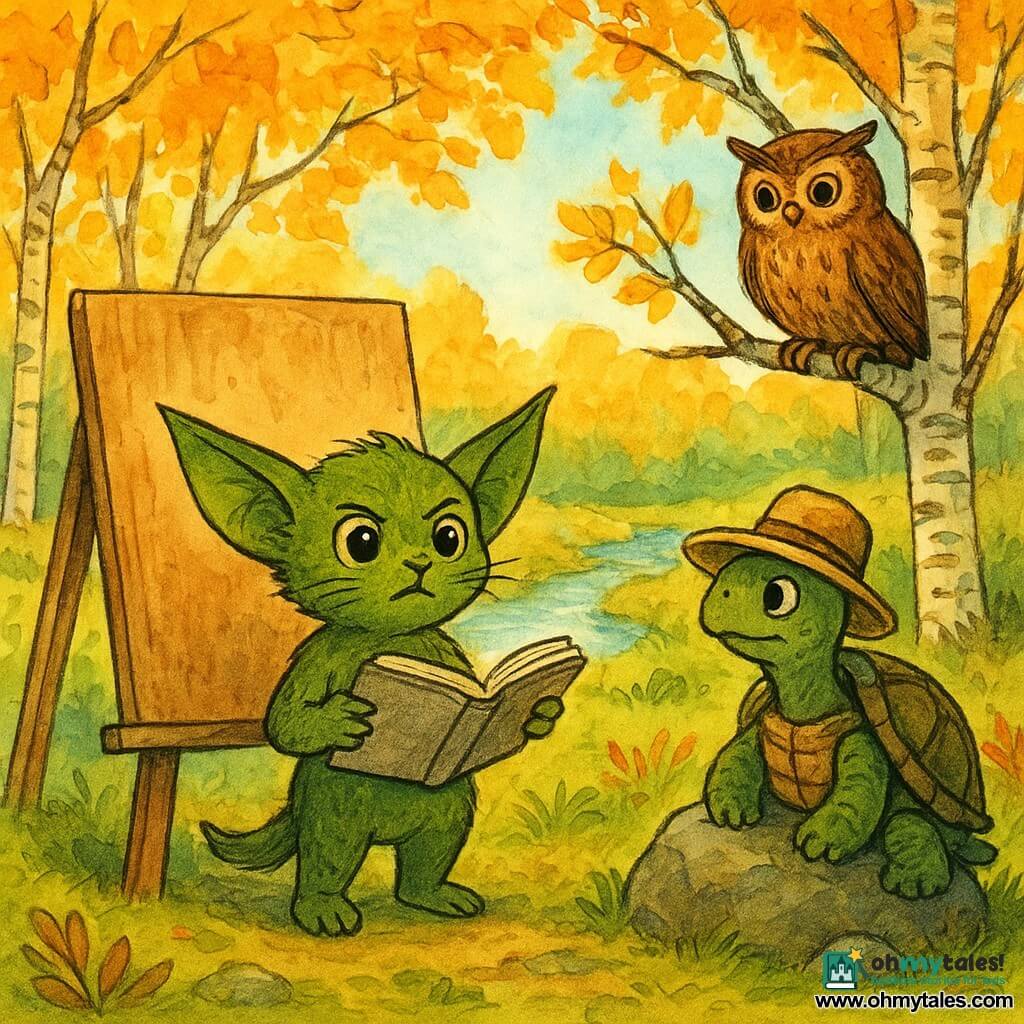
While Moss worked, the neighbor from across the creek—an owl who always looked as if she had read every book twice—landed on the railing.
“You're up early,” the owl said.
“I'm chasing invisible thieves,” Moss replied, tugging the rug straight.
The owl blinked. “Invisible thieves?”
“Energy,” Moss said, and pointed at the door crack. “It slips out. Then the house hums harder to keep things cozy.”
The owl's head turned, smooth and thoughtful. “A careful question leads to careful choices. That's a strong habit.”
Moss wiped their paws on the rug. “I'm trying. But I still don't understand the fridge-stone. It's making ice in summer.”
The owl hopped closer. “What's beside it?”
Moss glanced. “The oven-cave.”
The owl gave a soft hoot that sounded suspiciously like laughter. “So your cold stone sits next to your hot cave. They are arguing.”
Moss stared. “Oh.”
“Move one,” the owl advised. “And check the back. Dust can make devices work harder, too.”
Moss pulled the fridge-stone away from the wall. A thick blanket of dust clung to the vents like gray moss.
Moss sneezed so hard their ears flapped. “Bless my whiskers.”
After cleaning, Moss shifted the fridge-stone a bit farther from the oven-cave and made sure air could flow behind it.
By noon, the kitchen felt calmer. The hum from the walls became a gentle purr.
Moss wrote in the notebook:
- Turn off extra lanterns
- Seal drafts
- Clean vents
- Don't put cold next to hot
It felt good. Like straightening a messy shelf and suddenly being able to find things again.
Still, Moss knew this was only one house. Outside, the creek was still low.
Moss leaned on the windowsill and watched a cloud drift slowly, thin as wool pulled too far.
“I want to understand more,” Moss said. “Not just my own walls. The whole picture.”
As if the world had been waiting for those words, a bright envelope slid under the door—carried by a clever gust.
Moss picked it up. The wax seal showed an emblem of two shaking paws.
An exchange program invitation.
Moss's heart thumped with excitement and nerves. “A school exchange,” they whispered. “In another region.”
Chapter 3: A Different Kind of Weather
The exchange trip began two days later.
Moss packed lightly: notebook, a pencil, a warm scarf, a small jar of honeyed nuts, and a tiny screwdriver set for “just in case.” Moss didn't know what “just in case” meant yet, but it felt wise.
A riverboat ferried Moss downstream. No oars splashed; it glided using a quiet wind-sail and a small spinning wheel that turned with the current. The ferrypilot—a beaver with a tidy tail—winked.
“Less smoke,” the beaver said, patting the sail rope. “More sense.”
Moss liked that.
As the boat traveled, the land changed. The birch trees gave way to a stretch of fields where the soil looked pale and cracked. Some ponds were half-shrunk, like puddles deciding to quit.
Moss hugged the scarf. “Is it always like this here?”
A swallow darted above the water. “Not always,” it chirped. “It used to be wetter. Now the rains forget their appointments.”
Moss scribbled that sentence in the notebook because it sounded both funny and sad.
At the exchange home, Moss was welcomed by a family of clever, burrowing folk who lived in a hillside house. The doorway was round and low, and the inside smelled like warm bread and dried herbs. Everything felt snug, as if the hill itself was holding the rooms close.
One of the hosts—quick-eyed and calm—showed Moss the sleeping nook.
“We keep it cool at night,” the host said, pointing to a thick curtain over the doorway. “Curtains are like gentle doors.”
Moss touched the fabric. “To keep warmth in?”
“And out,” the host replied. “In heatwaves, we keep the sun from strolling inside.”
Heatwaves. Moss knew the word, but it sounded more serious here, like a story that happened to real roofs.
Later, Moss joined the exchange group for a walk to the community garden. No humans were there—only other creatures from different burrows, nests, and dens. They carried watering cans and seed packets, moving in a friendly line like a parade that had decided to be useful.
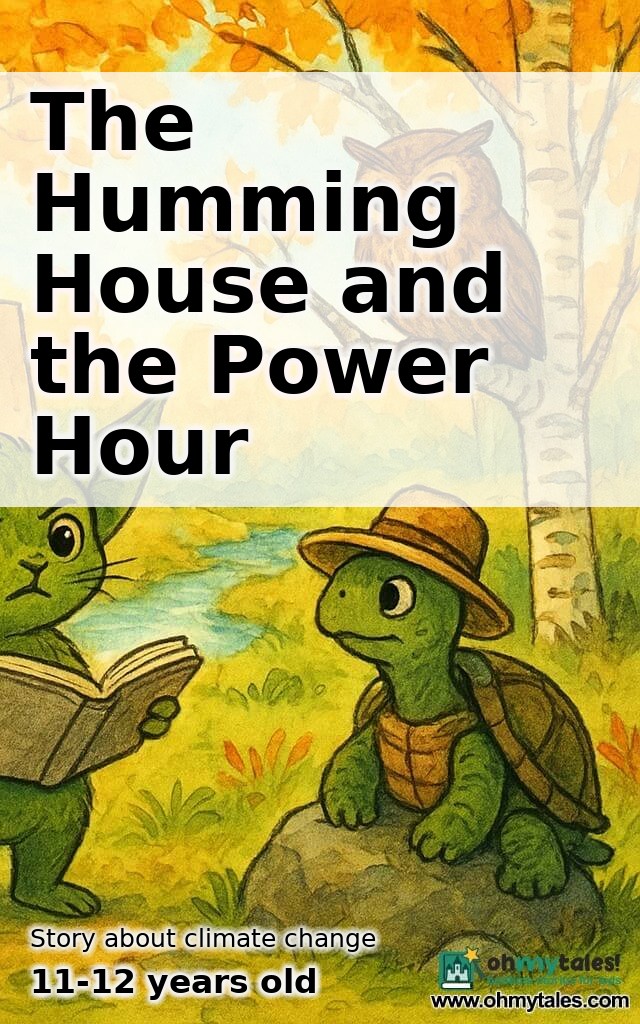
The garden leader, a tortoise with a straw hat, tapped a chart pinned to a post.
“Rainfall is changing,” the tortoise said. “We can't order clouds. But we can plan.”
Moss listened closely. “How?”
“Mulch,” said a rabbit, holding up dry leaves. “It keeps moisture in the soil.”
“Shade cloth,” said a magpie, flicking a wing toward a frame covered with light fabric.
“Drip watering,” said the tortoise, pointing to a hose with tiny holes. “Slow and steady. Like good studying.”
Moss raised a paw. “Does this help with climate change?”
The tortoise's eyes were kind and steady. “It helps us adapt, and it saves water and energy. For climate change, we also need to reduce what warms the air. That means using less fuel, wasting less electricity, and choosing clean ways when we can.”
Moss felt the same tight feeling as before, but softer now because it came with a plan.
That evening, the hillside house stayed cool even though the outside air was heavy and warm. Moss noticed the thick walls, the curtain-doors, the small windows positioned for cross-breezes.
In bed, Moss whispered into the notebook, “Homes can be smart. Not just comfortable—responsible.”
Chapter 4: The Night of the Power Dip
On the third night of the exchange, the lights flickered during dinner. The room dimmed, brightened, then dimmed again as if someone was blinking slowly.
Everyone paused with spoons midair.
“Power dip,” the host said calmly. “It happens when demand is high.”
Moss's ears perked. “Demand?”
“When many homes cool themselves at the same time,” the host explained. “The grid strains. It's like too many creatures trying to drink from one narrow stream.”
Moss looked at the lanterns overhead. “So if we use less at the busiest time, it helps everyone?”
“Exactly,” said the host. “We call it shifting. We do chores earlier, cool the house with shade and air first, and use the fan only when we truly need it.”
Moss thought of their own house humming, humming, humming.
A young skunk at the table grinned. “We play a game. Power Hour!”
“What's that?” Moss asked.
The skunk wagged its tail. “For one hour, we see how low we can go. No extra lights. No unnecessary gadgets. We tell stories, eat cold snacks, and open the windows if it's safe.”
“Aha,” Moss said, smiling. “Saving energy with snacks and stories. That sounds like my kind of science.”
The lights steadied again. Dinner continued, but Moss stayed thoughtful.
After dishes, the exchange group gathered outside. The sky was a deep navy with a scattering of stars. The air was still warm, yet a small breeze moved along the hill like a careful hand smoothing a blanket.
The tortoise joined them, carrying a small device with a spinning needle.
“This measures how much electricity we use right now,” the tortoise said. “It's not magic. It's numbers. Numbers help us tell the truth.”
Moss stepped closer. “At my house, I didn't have numbers. Only humming.”
The tortoise nodded. “Humming is a clue. But numbers can show patterns. When do you use the most? Which device is the loudest eater?”
“Loudest eater,” Moss repeated, delighted. “Like a cousin who crunches too much at movie night.”
Everyone chuckled quietly so as not to wake the birds.
Moss's mind buzzed with ideas. What if Moss made a chart at home? What if Moss timed lantern use? What if Moss learned which things could be unplugged?
Then Moss remembered something: the invitation letter had mentioned a “shared project.” Each exchange guest had to bring home one practical idea and teach it to their community.
Moss swallowed, suddenly nervous. Teaching meant speaking. Speaking meant possibly getting it wrong.
But Moss was persistent. Fear was just another stuck jar lid.
Moss looked up at the warm, starry sky and thought of the creek running low back home.
“I'm going to do my project about home energy,” Moss said, mostly to themselves.
The tortoise's voice was gentle. “That's a strong choice. Home is where habits live.”
Moss nodded. “And habits can change.”
Chapter 5: The Return and the Drafty Mystery
When Moss returned home, the creek greeted them with a thin, tired ribbon of water. The birch leaves looked a little more curled than before, like paper left near a candle.
Moss placed the bag down and listened.
The house hummed.
Not as loudly as before—but still, there was a steady, eager buzz.
“I'm back,” Moss told the house. “And I learned things.”
Moss began with the easiest changes. They chose a “Power Hour” each evening. During that hour, Moss turned on only one lantern and used it like a campfire, reading by its glow and telling the house about the trip.
“Today I learned about shade cloth,” Moss said, as if the house were a friend on the stool. “And mulch. And grids that get tired.”
The house creaked softly, which Moss decided meant interest.
Next, Moss made a simple chart in the notebook:
Morning: kettle, lanterns, fridge-stone
Afternoon: almost nothing
Evening: cooking, reading, washing
Then Moss tried something new: Moss touched each wall and window, searching for warm spots and cold spots. Drafts were still sneaking in. The tape helped, but something else was wrong.
Moss noticed the back door didn't quite meet the frame. The latch clicked, but the bottom corner stayed shy, leaving a sliver of space.
Moss sighed. “Of course. It's always the corner.”
Moss tried tightening the hinge with the screwdriver. It helped a little, but the sliver remained.
This was the moment when many creatures would shrug and say, “Good enough.”
Moss did not.
Moss fetched a thin strip of rubber seal from the toolbox and pressed it along the door edge. Then Moss adjusted the latch plate until the door pulled in snugly.
When Moss closed it, the sound was different: a clean, satisfying thunk. The air in the hallway stopped drifting.
Moss held up the feather again. It barely moved.
“Yes!” Moss whispered, not wanting to scare away the victory.
That night, the house's hum softened to a peaceful murmur. The hallway felt normal—cooler, steadier. The fridge-stone stopped frosting.
Moss sat by the window with the notebook open and wrote:
- Fix door seal
- Choose one lantern at night
- Plan energy use (no guessing)
Outside, the sky was hazy with heat, but the room felt balanced. Moss didn't feel like they had solved climate change—because they hadn't. The world was still warming, and the creek was still low.
But Moss felt something else: agency. The quiet knowledge that small choices were real choices.
A tapping came at the window. The owl neighbor perched on the sill, looking impressed.
“You've been busy,” the owl said.
Moss held up the notebook. “I'm trying to make the house waste less.”
The owl nodded slowly. “Responsibility is not a single heroic act. It's many regular ones.”
Moss smiled. “Regular is doable.”
Chapter 6: A Community Plan, Warm and Bright
For the exchange project, Moss invited neighbors to the clearing by the creek. Word traveled the usual way—chirps, hoofbeats, and polite knocking.
Creatures arrived with stools, blankets, and snacks. The beaver ferrypilot came, smelling faintly of river reeds. The tortoise from the exchange region had sent a rolled-up poster by mailbird, and it arrived tied with twine.
Moss stood by a simple board propped against a stump. Their stomach fluttered, but Moss planted their feet firmly.
“Thanks for coming,” Moss began. “I'm not here to scare anyone. I'm here to share what I learned—because our creek is getting lower, and our summers are getting hotter.”
A few heads nodded. No one argued. The truth was visible right there in the waterline.
Moss took a breath. “At my house, I asked: where does the energy go? I found out it slips away through drafts, it gets wasted by lights we forget, and it gets gobbled by machines that are dusty or placed badly.”
The rabbit in the front raised a paw. “So… what do we do?”
Moss pointed to the poster. “We start small. Here are five things most homes can do.”
Moss read them clearly:
“Turn off extra lights. Seal drafts. Clean vents. Keep cold things away from hot things. And try a Power Hour—one hour a day when you use less.”
The skunk from the exchange—visiting with another group—popped up from behind a bush and called, “Power Hour is the best hour!”
Laughter rippled through the clearing like wind through grass.
Moss continued, voice steadier now. “Also, shade helps. If you can hang a light cloth outside a sunny window, your home stays cooler without extra energy. And planting a small tree or tall shrub in the right place can shade a wall over time.”
The beaver raised a question. “What about travel? Boats, carts, all that?”
Moss nodded. “If we can share rides, take the riverboat with the sail, or walk when it's safe, that reduces fuel use. It's not about being perfect. It's about being thoughtful.”
The owl leaned forward. “And measuring?”
Moss held up the notebook. “Even without fancy tools, you can keep track. Write down when you use the most. Notice what makes your home hum.”
After the talk, neighbors wandered in small groups, comparing door gaps and window frames like detectives. Someone joked about a lantern that had been glowing in a pantry for “three whole moons.” Someone else promised to dust their fan instead of blaming it for being “lazy.”
As the sun lowered, the clearing turned golden. Moss sat near the creek, watching the water move, slow but steady.
The tortoise's words returned to Moss: numbers tell the truth. Habits can change.
Moss dipped a paw into the creek. The water was cool, and for a moment, it felt like the world was taking a calm breath.
The owl sat beside Moss. “You did well,” she said.
Moss shrugged, modest but glowing inside. “I still feel small.”
The owl's eyes softened. “Small creatures keep forests alive. They carry seeds. They dig channels for water. They notice things.”
Moss looked at the neighbors packing up, chatting about draft seals and shade cloth, about swapping extra lantern oil for berries, about checking on elders during hot days.
Moss's chest warmed—not the uncomfortable heat of wasted energy, but the gentle warmth of community.
“I guess responsibility is contagious,” Moss said.
“Like laughter,” the owl replied.
That night, back in the humming house, Moss turned on one lantern and wrote a final note in the notebook:
We can't fix everything alone.
But we can notice, ask, learn, and share.
That's how change starts—quietly, kindly, and for real.
The house hummed softly, like it agreed, and the creek outside whispered on in the dark.