Chapter 1: The Listening Log
Milo the otter liked quiet things: smooth stones, slow rivers, and stories told at the right speed.
On the afternoon before Easter, he sat on a sun-warmed log outside the Willowbank Library, paws folded neatly, whiskers barely twitching. Inside, the room smelled of old paper and lemon tea. A few animals whispered and shuffled, but Milo stayed still, the way he did when he wanted to catch every word.
At the front, Aunt Junie—an older beaver with a bright scarf and an even brighter smile—opened a big picture book. Its cover showed a meadow sprinkled with eggs like candies dropped from the sky.
“All right, riverfolk and forestfolk,” she said, tapping the page with her flat tail. “Tonight's tale is about Easter: about color, and tradition, and the most surprising basket in all of Thimblewood.”
Milo leaned forward. His calmness wasn't sleepy; it was focused, like a lantern behind glass.
A rabbit kid behind him whispered, “I bet the basket explodes with chocolate.”
A squirrel snorted softly. “Baskets don't explode.”
“Not with that attitude,” the rabbit muttered.
Aunt Junie began.
“In Thimblewood,” she read, “every spring, when the first daffodils nod and the mud stops being rude, the animals wake up hungry for two things: sunshine and secrets.”
Milo smiled. He loved secrets that turned out to be kind.
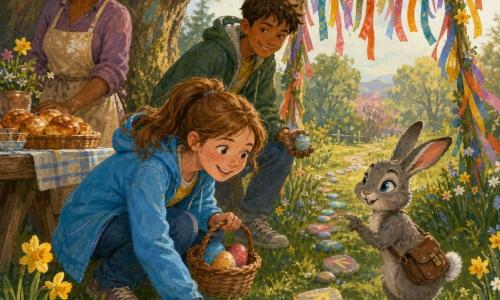
“And on Easter morning,” Aunt Junie continued, “a trail of painted eggs appears—hidden high, low, and sideways—waiting for sharp eyes and gentle paws.”
Milo's tail swished once, slow and pleased. Painted eggs were not just treats. They were tiny artworks, tiny promises.
Aunt Junie turned the page, and the illustrations flashed with blues like river-glass and pinks like apple blossoms. Milo felt the room brighten, even though it was still only afternoon.
“But this year,” Aunt Junie read, lowering her voice, “the eggs were… different.”
Milo held his breath with the others.
“They hummed.”
Chapter 2: A Hum Under the Grass
When the story ended, the library animals spilled outside like marbles rolling into sunlight. Everyone talked at once, imagining humming eggs and magical baskets.
Milo walked home along the stream path, where reeds made shushing sounds and waterbugs skated like they had secret appointments. He lived in a burrow-house tucked into the riverbank, cozy and tidy, with a small round door that always stuck a little in rainy weather.
He tried to shake off the story's hum, but it followed him anyway—soft as a bee, steady as a song remembered.
At the edge of his yard, he stopped.
There, half-hidden under new grass, was an egg.
Not a plain one. This egg was painted in spirals of teal and gold, and it gave off the faintest vibration, like it was purring.
Milo crouched carefully. “Hello?”
The egg did not answer, because eggs are famously quiet. But the humming grew warmer, as if it recognized his voice.
Milo glanced around. No one else was on the path. No one watching—unless you counted the alder tree, which watched everybody and never blinked.
He touched the egg with one claw.
The humming zipped up his paw, not unpleasant, just surprising, like stepping into a sunbeam. And then—pop—something flickered above the egg: a tiny ribbon of light that curved into the air and pointed down the path.
Milo blinked. “That's… new.”
The ribbon wiggled, as if it had been waiting all day to finally be useful.
Milo picked up the egg gently and tucked it into the pouch of his satchel. The ribbon of light didn't disappear. It floated ahead, patient and bossy.
“Are you saying I should follow you?” Milo asked.
The ribbon bobbed twice, which felt like a yes.
Milo's calm heart did a small, excited hop. Not a wild hop—more like a polite hop with good manners.
“All right,” he said. “But we're doing this sensibly.”
Chapter 3: The Egg Trail Club
The ribbon led Milo toward the Meadow of Lanterns, where spring flowers grew in bright patches and the air smelled like green apples and damp earth.
Halfway there, he nearly bumped into Tessa the fox, who was juggling three painted eggs with the confidence of someone who had never dropped anything important in her life.
She caught them neatly and grinned. “Milo! You look like you're being followed by a very fancy worm.”
Milo glanced at the ribbon. “It's more like… a magical direction suggestion.”
Tessa's ears perked. “Magic? On a Tuesday? I love it. What's the mission?”
Before Milo could answer, a hedgehog rolled up—literally rolled—then uncurled into Pip, who wore a tiny belt with pockets full of string, chalk, and what looked suspiciously like a spoon.
“I heard the word mission,” Pip said, breathing fast. “Missions require equipment. I have equipment. I also have snacks, but I'm not sharing those unless the mission is dangerous.”
“It might be mysterious,” Milo said.
“That counts,” Pip decided, and offered Milo a stick of peppermint bark. “For courage.”
Tessa leaned close to Milo's satchel. “Do you have a humming egg in there?”
Milo hesitated. He liked being careful. He also liked being honest. He opened the flap a little.
The teal-and-gold egg gave a soft, pleased hum, like it was happy to have an audience.
Pip squeaked. “It's singing! It's singing in egg language!”
“It's humming,” Milo corrected, though he wasn't sure what the difference was anymore.
The ribbon of light darted ahead, impatient.
Tessa cracked her knuckles. “All right, Egg Trail Club,” she said grandly. “We follow the shiny worm.”
Milo sighed, but he was smiling. “Fine. But we share what we find. No hoarding.”
Tessa put a paw over her chest. “I vow not to hoard. Unless it's embarrassing poems.”
Pip saluted with the spoon. “I vow to share… except snacks. But I'll share information. Information is lighter than snacks.”
They followed the ribbon into the meadow.
It led them to a patch of daisies, then to a crooked stone, then to a stump that had a door painted on it—just paint, no real door. Each time, the ribbon paused until Milo—or one of the others—noticed another egg.
Soon, they had six eggs in Milo's satchel and Pip's pockets and Tessa's scarf.
And every egg hummed.
Not the same note. Not the same mood. One hummed like laughter. One hummed like a lullaby. One hummed like it was trying to remember something.
Pip tilted his head. “These eggs are… making a chord.”
Milo listened. The humming threads wove together into something almost like a map. Not a picture-map. A feeling-map, tugging them toward the old oak at the far end of the meadow.
Tessa's tail flicked. “If this ends with a surprise basket, I want credit for predicting it.”
“You didn't predict it,” Pip said. “The beaver librarian did.”
“I predicted I would want credit,” Tessa replied smoothly.
Milo laughed, quietly. The day felt bright enough to lift even the shyest thoughts.
They reached the oak.
At its roots, hidden between two thick ridges of bark, was a hollow.
Inside sat a seventh egg—bigger than the rest, painted midnight blue with silver stars. It hummed so clearly Milo could feel it in his teeth.
Milo reached for it.
The egg's humming suddenly grew louder, and the ribbon of light spun into a small circle above the hollow, like a glowing hoop.
Pip backed up. “That looks like a portal.”
Tessa squinted. “Or a very dramatic bracelet.”
Milo swallowed. Calm didn't mean fearless. Calm meant choosing the next step carefully.
He looked at his friends. “If we do this, we do it together. And if we find anything good, we share.”
Pip nodded. Tessa nodded, too—more casually, but still real.
Milo lifted the starry egg.
The light hoop widened, and the oak's hollow filled with the scent of vanilla and rain.
Then the world went softly sideways.
Chapter 4: The Basket Workshop
They didn't fall. They slid, like smooth stones down a streambed, and landed on springy moss.
Milo sat up.
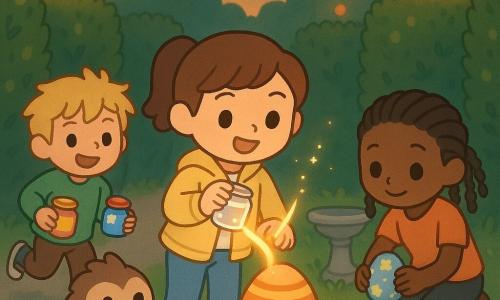
They were in a hidden glade that didn't exist on any path he knew. The trees here were slimmer, their leaves shimmering like they had been polished. Tiny lanterns—firefly lanterns, bobbing in jars—hung from branches, making a gentle golden ceiling.
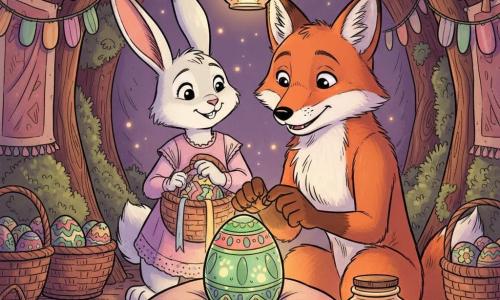
In the center of the glade stood a long table covered in paint pots, ribbons, brushes, and… baskets. Dozens of baskets. Small ones and big ones, woven from reeds and grasses, some plain and some decorated with little bells.
And behind the table, wearing a crown of dandelions, stood a rabbit with silver-tipped ears and a grin full of mischief and warmth.
“Welcome!” the rabbit said. “I'm Lumen. Keeper of the Easter Spark.”
Tessa immediately whispered, “Called it. Surprise basket situation.”
Pip stared at the baskets like they were sacred. “So many. So organized. It's beautiful.”
Milo held the starry egg in both paws. “We found humming eggs. They led us here.”
Lumen clapped once, and the firefly lanterns brightened politely. “Excellent! That means the eggs chose you.”
“Chose us for what?” Milo asked.
Lumen's grin softened. “For making sure Easter stays shared.”
He gestured to the table. “These baskets are meant for every burrow, nest, den, and hollow in Thimblewood. But this year, the Easter Spark got tangled.”
“Tangled how?” Pip asked, already taking out his chalk like he planned to draw a diagram.
Lumen picked up a ribbon. Instead of fluttering, it drooped sadly like wilted grass. “Some animals have been collecting eggs and keeping them to themselves. Hiding them where no one can find them. Not for fun—out of fear there won't be enough.”
Milo thought of the way spring sometimes arrived late, making everyone nervous. He understood the fear. He just didn't like what it did to paws and hearts.
Tessa's ears tipped back. “So the eggs started humming… to fight back?”
Lumen nodded. “The eggs hum to call helpers. They want to be found by animals who know that Easter only works when it belongs to everyone.”
Pip puffed out his chest. “That's us. Except for my snacks.”
Lumen laughed. “Snacks can be private. Kindness can't.”
Milo set the starry egg on the table. “How do we untangle the Spark?”
Lumen pointed to a large empty basket at the end of the table. It was woven with pale reeds and lined with soft moss, ready but unfinished. “This is the Doorstep Basket. It's the last one. The most important one. It's meant to appear near a certain door at the end of Easter night.”
Milo's whiskers twitched. “A door?”
“A very normal door,” Lumen said. “But the basket's magic needs a final ingredient: a chord made from the humming eggs, offered willingly.”
Tessa crossed her arms. “Meaning… we have to give up the eggs we found.”
“Not give up,” Lumen corrected. “Give forward.”
Milo looked at the eggs they had gathered. They were so pretty. It would be easy to imagine keeping one on a shelf, just to admire.
He took a slow breath. “We can do it.”
Pip hesitated, then carefully placed his eggs on the table. “I can share eggs. Eggs are not snacks.”
Tessa rolled her eyes, but she set her eggs down too, gently. “Fine. But if the universe gives me a dramatic role, I'm accepting it.”
Lumen bowed as if Tessa had just delivered a heroic speech. “Dramatic roles are available.”
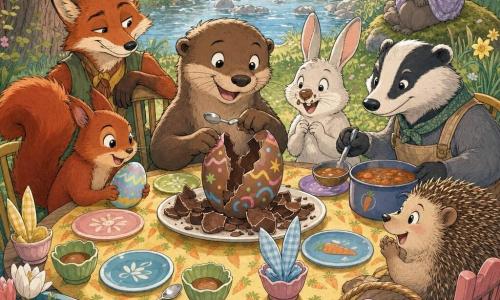
Milo added his eggs. Seven in total, humming in different voices, now gathered in a circle.
The humming changed.
It tightened into a clear, bright harmony that made the firefly lanterns sway like they were listening.
Lumen lifted his paws over the eggs. “Now we need to deliver the Spark where it's stuck.”
“Where is it stuck?” Milo asked.
Lumen's eyes twinkled. “In the hoard.”
Chapter 5: The Hoard in Bramble Hill
The ribbon of light reappeared, but now it looked sturdier, like it had eaten a good breakfast. It led them out of the glade and back through the oak's hollow—this time without the sideways feeling—and straight toward Bramble Hill.
Bramble Hill was a tangled place where berry bushes grew in knots and the paths tried to trick you. Milo didn't like it much. It was too scratchy for calm thoughts.
They climbed carefully. Pip poked the ground with his spoon to test for hidden holes. Tessa walked ahead, tail high, acting like thorns were simply rude decorations.
At the top, nestled under a roof of brambles, they found a hollowed-out space packed with eggs.
So many eggs.
Painted eggs in every color: sunset orange, pond green, cloud white, storm gray. Some had stripes. Some had dots. Some had tiny pictures: boats, moons, mushrooms, dancing frogs. The sight was dazzling and also a little sad, like a party where no one was allowed to laugh.
A small badger sat among them, paws wrapped around his knees.
He looked up sharply. His name was Bram—Milo recognized him from the market. Bram usually spoke in short, brisk sentences, like he was afraid of wasting air.
Now his voice shook. “Don't take them.”
Milo stepped forward slowly, keeping his paws visible. “We're not here to steal.”
Tessa muttered, “Speak for yourself. I'm here to judge your interior decorating.”
Pip elbowed her.
Milo said, “Why did you gather them all?”
Bram's eyes darted to the brambles, then back to the eggs. “Because last year I found none. Everyone else had baskets. Everyone else had color. I went home with empty paws.”
His ears flattened. “This year I decided… that wouldn't happen again.”
Milo's chest tightened. He could picture it: walking home while laughter floated from other doors, pretending it didn't sting.
Pip's voice turned gentler than usual. “That sounds awful.”
Tessa's joke-face slipped off, and for once she didn't replace it with another. “Yeah,” she admitted. “Empty Easter is the worst Easter.”
Milo sat on the ground, not too close. “Bram, the eggs are humming because Easter's magic is tangled. If they're all here, no one else can find them. That means other animals might have the same empty feeling you had.”
Bram's jaw clenched. “Then at least I won't be the only one.”
The words hung there, heavy as wet moss.
Milo didn't argue fast. He listened, like he listened to stories. He let Bram's fear finish speaking.
Then Milo opened his satchel and pulled out a peppermint bark stick—another one Pip had stuffed in earlier without being asked.
He held it out. “This is small, but you can have it. Not because you took eggs. Because you're here, and you're part of Thimblewood.”
Bram stared at the peppermint like it was a rare animal.
Tessa, surprising herself, took off the bright ribbon tied around her wrist. “And you can borrow this. It's ridiculous, but it makes you look like you're in charge of something.”
Pip dug into his belt pockets and produced a tiny spool of gold string. “For… tying baskets. Or tying feelings together. I'm not sure. But it's useful.”
Bram's eyes flickered. Confused. Then tired. Then—slowly—less hard.
“You'd share with me,” he said, voice small, “even though I was selfish?”
Milo nodded. “That's the point.”
Bram's shoulders sagged. “I just wanted to be sure.”
Milo pointed to the eggs around him. “Let's be sure together.”
The humming rose, as if the eggs were holding their breath for Bram's answer.
Bram reached out and touched one egg—a bright yellow one with blue dots. It hummed like a giggle.
He swallowed. “Okay.”
He stood up, a little wobbly, and began passing eggs out.
Milo, Tessa, and Pip worked with him, forming a line. Eggs moved from the hoard into shared piles: one pile for the meadow hunt, one for the library, one for the nestlings near the creek, one for the elderly who couldn't hop or climb much anymore.
As they worked, the brambles seemed less sharp. Or maybe the air simply felt softer when nobody was guarding anything.
When the last egg was lifted from the hollow, a small sparkle—like a shard of sunrise—floated up from the ground.
Lumen appeared at the edge of the hill as if he'd stepped out of the sparkle itself. “There it is,” he whispered. “The Easter Spark.”
The sparkle drifted toward the pile of humming eggs Milo had brought. When it touched them, the harmony turned bright and complete, like a song reaching its chorus.
Lumen lifted the big, unfinished basket—the Doorstep Basket—and held it near the humming eggs.
“Now,” Lumen said, “the final chord.”
Milo looked at Bram. “Will you help?”
Bram nodded, cheeks a little pink beneath his fur. “I should.”
They stood in a circle and placed their paws lightly on the eggs. No squeezing, no grabbing. Just contact—like saying, We're here. We're together.
The eggs hummed.
The sound rose and braided into a single clear note that seemed to ring through the air without being loud. The Easter Spark shivered with delight, then poured itself into the Doorstep Basket like golden water.
The basket changed.
Its reeds brightened. Its moss lining turned velvety and spring-soft. A ribbon appeared on its handle—teal and gold, matching Milo's first egg. Tiny painted patterns bloomed along the rim: daisies, river ripples, fox footprints, hedgehog curls, and one brave badger paw.
Lumen exhaled. “Done.”
Tessa wiped her brow dramatically. “We saved Easter. Again.”
Pip whispered, awed, “We made a basket with teamwork.”
Milo felt his calm settle into something deeper: a warmth that didn't rush, but stayed.
Lumen pointed down the hill toward the riverbank homes. “Now it must be placed where it belongs. Near a door. Before the night ends.”
Milo lifted the basket carefully. It wasn't heavy, but it felt important, like carrying a promise.
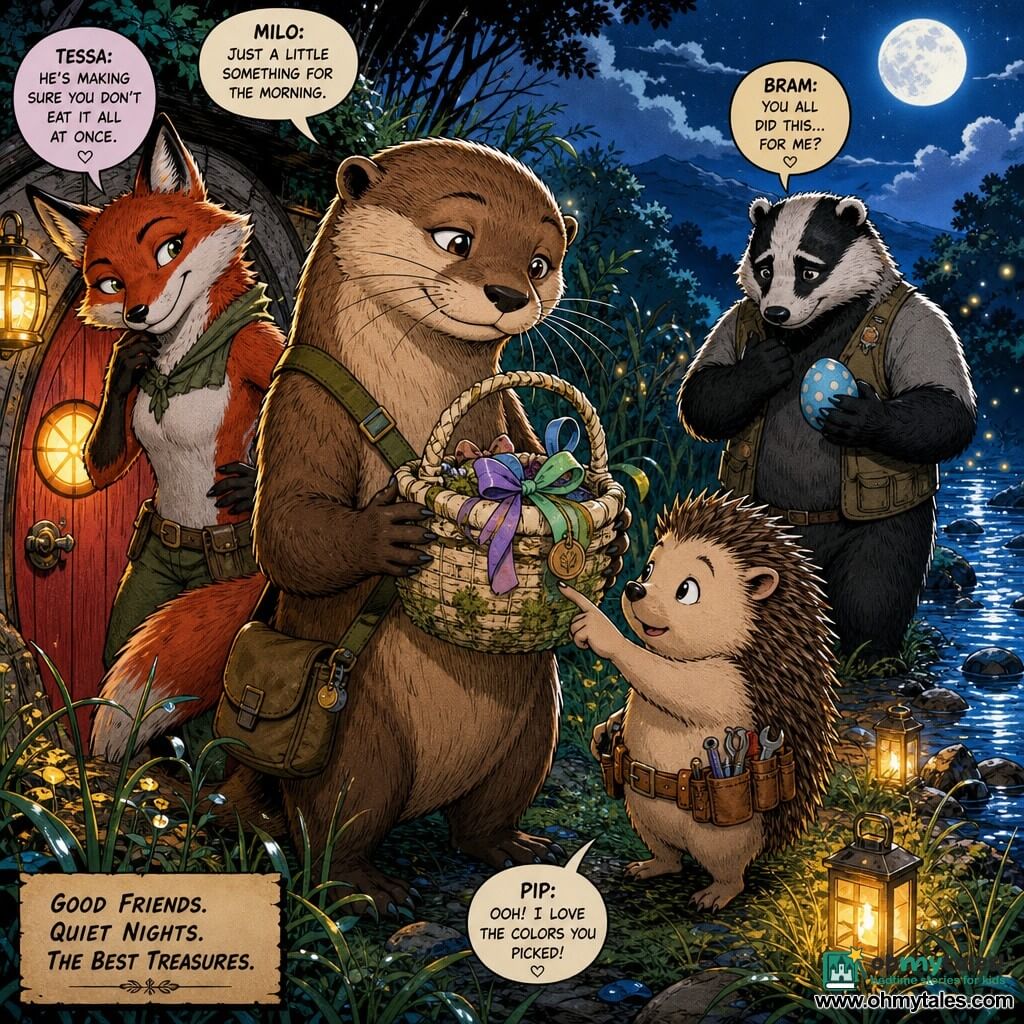
“I know a door,” Milo said softly.
Chapter 6: The Bright Quiet End
The moon rose, pale and curious, as they walked back toward Milo's burrow-house by the stream. Night insects sang. The water reflected the lantern-light from distant homes, turning the river into a ribbon of moving stars.
They didn't talk much. Not because they were unhappy—because the quiet felt full.
At Milo's yard, Bram paused. “Milo… thank you.”
Milo nodded. “Tomorrow, come to the meadow hunt.”
Bram gave a shy smile. “I will. And I'll hide some eggs for others. In places that are fun, not cruel.”
Tessa stretched. “Make them medium hard,” she advised. “So I can show off without suffering.”
Pip perked up. “I can design a difficulty chart. Level One: Under Leaf. Level Five: Inside Hollow Log. Level Ten: Balanced on an Acorn You Didn't Know Was There.”
“Level Ten is a crime,” Tessa said.
Milo chuckled. “We'll keep it kind.”
They reached his round door, the one that stuck when it rained. It was closed now, dark behind it, peaceful.
Lumen had vanished, but the basket in Milo's paws still glowed faintly, as if it remembered the glade.
Milo set it down gently near the door.
For a moment, nothing happened. Just the soft night, the river's hush, the scent of wet earth and budding leaves.
Then the basket's ribbon fluttered—no wind, just joy—and a faint hum rose from inside, like laughter wrapped in song.
Milo stepped back and looked at it with a quiet, satisfied smile.
“Happy Easter,” Pip whispered.
Tessa nodded toward the basket. “Best doorstep decoration ever.”
Bram's eyes shone. “And it's for everyone.”
Milo felt the words settle into him, steady as the stream: not mine, not yours—ours.
They left the basket there, near the door, glowing softly in the spring night, waiting to be found in the bright rush of Easter morning.