Part 1: The City That Breathes
In the year 2148, the city of Lumen Marsh rose like a bright boat above a wide, gentle wetland. It was a big city, but it didn't shout. It listened.
Tall towers wore gardens on their sides. The roofs were soft with moss and tiny flowers. Bridges curved like ribbons between buildings, and under the bridges ran clear water that glittered in the light.
All around the city were the filtering marshes—long, green lanes of reeds and lily pads. The marshes were not messy or smelly. They were neat and busy, like a team of helpers. The plants drank dirty water and gave back clean water. The soil stayed healthy and dark, the way good soil should be.
Aria, Bina, and Cleo were three girls who were almost six. They were small, quick, and curious. They lived on Level Seven in a building made of pale glass and warm wood, with a balcony that looked out over the marsh paths.
This morning, rain tapped the window like a thousand tiny fingers.
Tap-tap-tap.
Aria stood on her toes to watch it. “The city looks like it's wearing a shiny coat,” she said.
Bina pressed her nose close to the glass. She loved how the drops slid down in racing lines. “The marsh is drinking the rain,” she whispered, as if the marsh could hear.
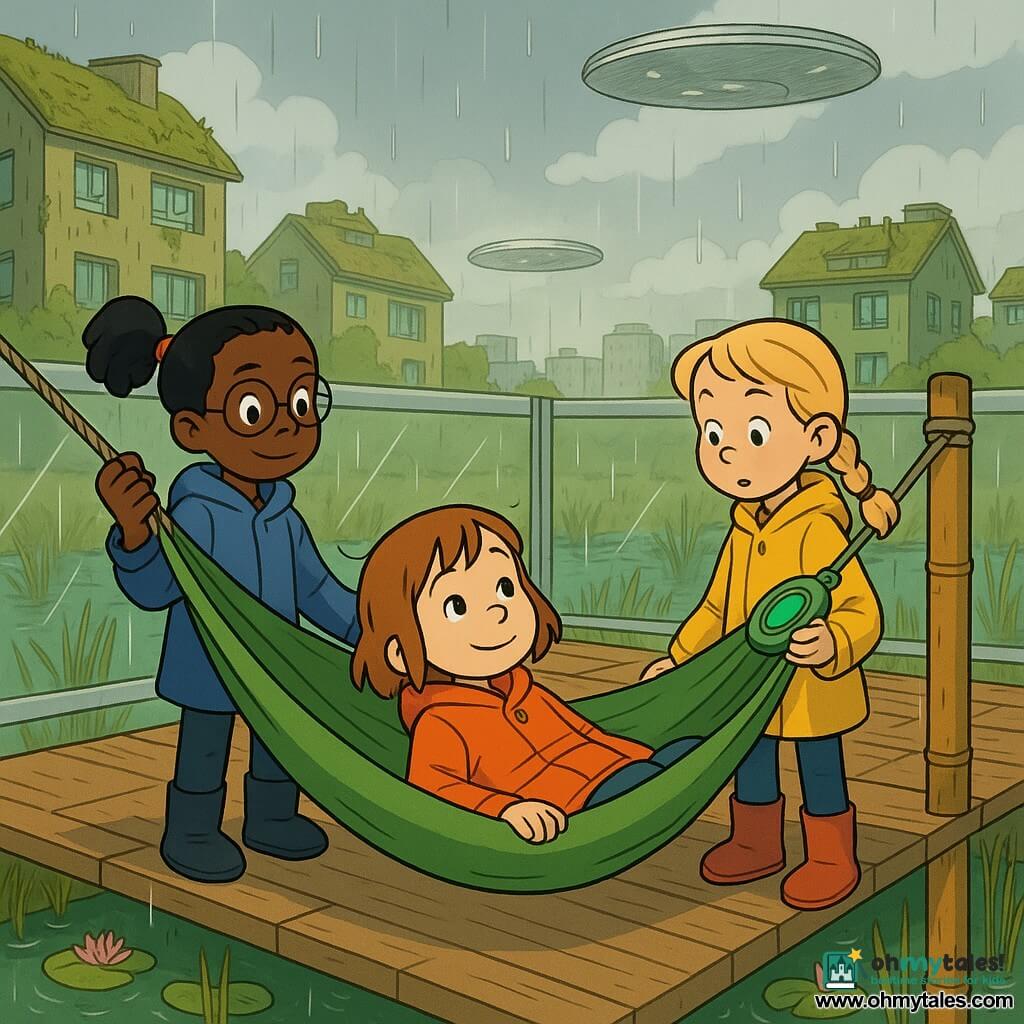
Cleo held a little pocket scanner in her hand. It was a smooth oval with a green light. It could tell the air quality, the water level, and even if the plants were happy. The green light blinked twice. Good.
“We can still go out,” Cleo said. “We have our rain capes.”
They put on their bright capes—orange, blue, and yellow—and stepped into the hallway. The building's hallway smelled like clean wood and mint. A soft drone, like a hummingbird, floated past carrying a tray of seed packets for the rooftop garden.
Down in the shared plaza, the ground was not hard stone. It was a springy path made from recycled plant fibers. The rain fell onto it and slid toward small channels. Those channels led straight into the marsh lanes.
The girls walked beside the water. The reeds swayed and nodded, even in the rain, as if they were saying hello.
Aria's eyes were always hunting for something new. “Look,” she said, pointing up.
High above, the Sky Mirrors hung like quiet kites. They were big silver panels that floated on air-cushion drones. On sunny days, they bounced warm light into dark corners so plants could grow everywhere. On rainy days, they moved slowly, watching and measuring, helping the city understand the weather.
Bina loved rules and signs, especially the ones that made people safe. She stopped at a bright post with a screen. “This is the Rest Spot Map,” she said, reading the big pictures. “It shows where you can sit, where you can play, and where you can hang a hammock. See? Authorized.”
Cleo's green scanner blinked again. She grinned. “We should hang one. An urban hammock. Right here in the marsh city.”
Aria's face lit up like a small sunrise. “A floating nap in the rain!”
“A safe nap,” Bina added quickly, because she liked safe.
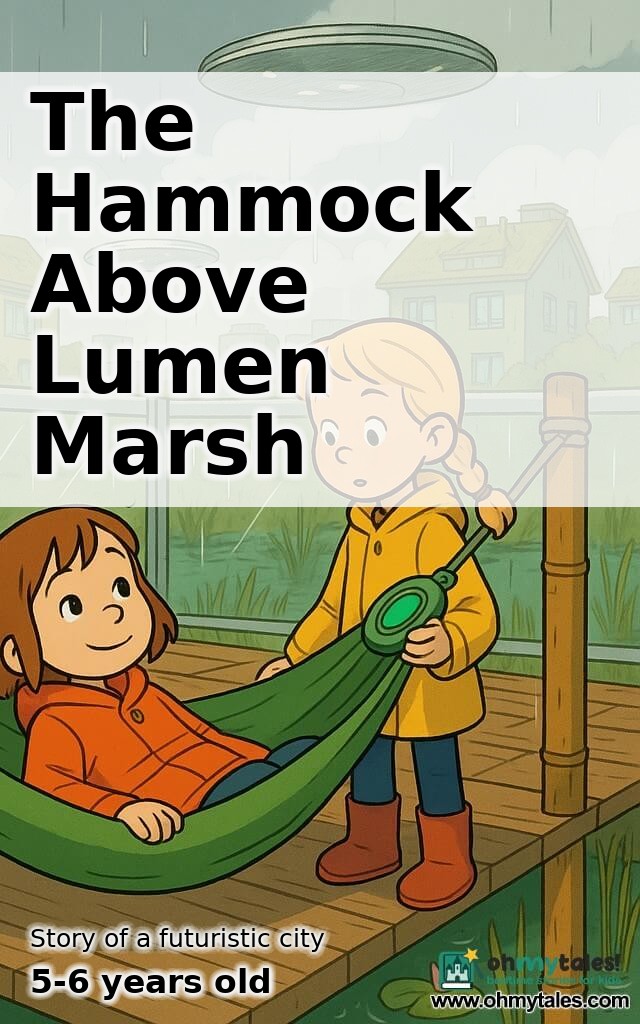
They hurried along the path to the place marked with a hammock symbol: two strong posts made from bamboo-composite, set on a platform above the marsh water. The platform had railings and a little sign with a smiling leaf that meant: Approved by the City Gardeners.
But when the girls reached it, their smiles slipped.
The two posts were there, yes. The platform was there, yes. The sign was there, yes.
But the hammock hooks were empty.
“No hammock,” Aria said, her voice small.
Bina checked the sign as if the sign might explain itself. “It says hammocks are allowed,” she murmured. “So where is it?”
Cleo crouched and ran her fingers along the edge of the platform. “Maybe it got taken away for cleaning,” she guessed. Then her scanner made a tiny sad beep.
“What does that mean?” Aria asked.
Cleo lifted the oval. The green light had turned yellow. “It means… the water level is rising faster than usual.”
Bina looked down. The marsh water, usually calm, was bubbling in tiny bursts. Not scary, just strange. The rain still tapped and tapped, and the sky looked like soft gray cotton.
Aria swallowed. “What if the marsh is too full?”
Bina's eyes widened. “The city takes care of the marsh,” she said, but her voice wobbled. “The marsh takes care of the city.”
Cleo stood up. “Then we help, too,” she said. “We can be part of the team.”
The girls looked at the empty hooks again. A hammock would be cozy, but right now the marsh needed something else.
Still, Aria touched one hook gently. “We will hang our hammock,” she promised. “But first, we find out why the water is acting funny.”
Part 2: The Quiet Alarm
They followed the marsh path toward the Water Garden Hub. It was a low building shaped like a smooth pebble, with windows like raindrops. Inside, the city's marsh helpers worked: gardeners, water scientists, and tiny cleaning robots that rolled on soft wheels.
The door slid open with a whisper. Warm air wrapped around the girls, smelling like wet leaves and tea.
A screen on the wall showed a simple picture map of the marsh lanes. Blue lines for water. Green blocks for plants. Little dots for sensors. Most dots were calm and green.
But one corner flashed yellow.
Cleo pointed. “That's near our hammock platform.”
A gardener in a green coat noticed them. Her hair was braided with a thin strip of silver thread that held a sensor. She smiled, kind and tired. “Hello, explorers,” she said. “Out in this rain?”
“We're checking the marsh,” Bina said carefully, because she wanted to sound helpful and polite. “Our scanner says the water is rising.”
The gardener nodded. “Good eyes. The marsh is fine, but one filter gate is stuck halfway closed. It's making the water swirl instead of flow. It's not dangerous, but it can make the plants work too hard.”
Aria leaned forward. “Can you fix it?”
“We're trying,” the gardener said. “But the rain makes the gate's hinge slippery, and the little robots keep sliding.”
Cleo hugged her scanner. “We can walk there. We have boots.”
The gardener's eyebrows lifted. “You are very small.”
Bina puffed up. “We are careful small.”
Aria added, “And curious small.”
The gardener laughed softly. “All right. But you must stay on the path. No stepping into the reeds.”
She tapped a button on the wall, and a small helper drone floated down. It was the size of a lunchbox, with a glowing line that looked like a smile. A gentle voice came from it. “I am PIP. I can light your way.”
PIP hovered beside them as they left the hub. Outside, the rain had turned thicker. Drops bounced off the rails. The marsh plants bowed under the water and then sprang back up.
As they walked, the city around them felt alive. Pipes under the paths carried water like veins. Tiny vents breathed warm air to keep roots from freezing. The Sky Mirrors drifted above, shifting slowly, gathering weather data and sending it down like secret messages.
Soon they reached the corner of the marsh map that had flashed yellow.
There, under a curved bridge, was the filter gate. It was a wide panel made of strong mesh. It let water pass through plants and stones before the water moved on to the clear canal.
But the gate was stuck at an angle, like a door that wouldn't close.
Water pushed against it and swirled. Little leaves spun in circles.
PIP's smile-line glowed brighter. “Gate hinge is resistant,” it said.
Bina peered at the hinge. “It's jammed with… something.” She pointed to a clump of brownish plant fibers and a shiny wrapper stuck in the corner.
Aria frowned. “Trash?”
Cleo's face tightened. “Someone dropped it,” she said quietly.
Bina's voice went firm, the way it did when she saw a problem that had a rule. “Trash doesn't belong in the marsh.”
Aria looked around, eyes wide. “But we can't reach the hinge. It's down there.”
The gate was just below the path, not far, but the water was too deep for their short legs. The reeds stood like a green fence.
Cleo stared at the swirling water. Then she turned to the bridge above them. “We can't go down,” she said, “so we go up.”
They hurried onto the bridge. The bridge was made of recycled metal that didn't rust, and it had a clear side panel so you could see the marsh below. Water droplets clung to it like tiny beads.
From the bridge, they could look straight down at the stuck hinge.
Aria's eyes flicked to a safety box attached to the railing. It had a picture of a hammock on it, plus a rope symbol. “Emergency lines,” she read, sounding proud.
Bina nodded. “For rescue or for work,” she said. “Authorized.”
Cleo opened the box. Inside were two coiled ropes and a small tool with a hook at the end. The tool was light but strong, made for grabbing things without climbing down.
PIP floated closer. “Tool use approved with adult permission,” it said.
Cleo pointed her scanner at PIP, as if the scanner could make choices for them. “PIP, can you ask the hub gardener?”
PIP blinked. “Requesting permission.” It paused, as if listening to faraway air. Then its smile-line brightened. “Permission granted. Stay behind railing.”
The girls leaned over the clear panel, careful not to tip. Bina held Cleo's cape at the back, like an anchor. Aria held the rope, feeding it slowly.
Cleo lowered the hook tool. It swung a little in the wind.
“Too wiggly,” Bina whispered.
Aria took a deep breath. “We can make it steady.”
She looked at the rope and then at the empty hooks far away in her mind. Hammocks didn't just appear. You had to tie them right. You had to make the ropes calm and strong.
Aria wrapped the rope once around the railing post, the way she had seen grown-ups do. “Like this,” she said. “Now it won't swing so much.”
The hook steadied.
Cleo guided it down. The hook touched the clump of fibers and the shiny wrapper. She nudged, trying to catch.
It slipped.
She tried again. The hook snagged the wrapper first. The wrapper lifted, dripping. Cleo raised it slowly, carefully, until it came up over the water. Aria grabbed it and stuffed it into her pocket, face serious.
“One piece,” Bina said. “More to go.”
Below, the plant fibers were still jammed.
Cleo lowered the hook again. This time she aimed for the thickest part, like fishing for a stubborn knot. The hook caught. She pulled gently.
The fibers held tight.
Aria whispered, “We need more pull.”
Bina glanced at the rope. “We can use two ropes,” she said, thinking fast. “One for the tool, one to help lift the gate a little.”
They worked as a team. Aria tied the second rope to a handle on the top of the gate—there was a loop made for that exact job. Cleo kept the hook tool steady. Bina counted softly, because counting made her brave.
“One… two… three…”
They pulled together.
The gate creaked, just a little. Water shifted. The swirl loosened.
Cleo tugged the hooked fibers again. This time they slid free like a soggy wig.
The hinge snapped back into place with a soft clunk.
For one moment, everything paused.
Then the water stopped spinning and began to flow straight through the stones and roots. The reeds lifted their heads. The tiny bubbles calmed.
Cleo's scanner beeped happily. The light turned green.
Bina let out a breath she had been holding. “We did it,” she said, voice shaking with relief.
Aria looked down at the marsh. “The city is breathing again,” she whispered.
PIP's smile-line shone. “Good work, team.”
Part 3: The Hammock Above the Reeds
When they returned to the hammock platform, the rain was still falling, but it felt softer, less heavy. The marsh water looked smoother now, like a glassy ribbon.
At the platform, the same gardener from the hub waited under a wide leaf-shaped umbrella. She held a rolled bundle of fabric in her arms.
“I heard you helped the gate,” she said. “Thank you. That was smart and careful.”
Aria's cheeks warmed. “We just… pulled ropes.”
“Pulling the right ropes matters,” the gardener said.
She lifted the bundle. “This is an urban hammock. It was in the cleaning station. We were going to install it later, but after your help, I thought you might like to do it.”
Bina's eyes went huge. “Us? Install it?”
“Authorized,” the gardener said, tapping the smiling-leaf sign. “And I will watch.”
The hammock fabric was deep green with tiny bright dots like stars. The ropes were thick and soft, made from plant fiber that didn't mind water.
Cleo ran her hand over it. “It feels like a leaf blanket.”
The gardener showed them the steps with calm hands. Loop the rope. Check the knot. Pull tight. Check again.
Bina repeated each step in a quiet voice, like a chant. “Loop. Check. Tight. Check.”
Aria tested the knots with careful tugs. “Strong,” she announced.
Cleo scanned the posts. Green light. “Safe,” she said.
Together, they lifted the hammock and hooked it to the posts. The fabric dipped in a friendly curve, ready to hold a small body like a gentle smile.
The gardener stepped back. “All yours. One at a time, and feet inside.”
Aria climbed in first. She lay on her back, cape spread under her like a bright petal. Above her, the city's towers rose into the rainy sky, their garden walls dripping with clean water that ran into channels. The Sky Mirrors floated slowly, silver and calm.
“It's like… being a cloud,” Aria murmured.
Bina took her turn next. She sat stiffly at first, then relaxed when nothing bad happened. The hammock rocked a tiny bit. She let out a giggle she didn't expect. “It's like a safe swing,” she said.
Cleo climbed in last. She held her scanner on her belly and watched the green light blink. “We helped,” she said softly. “And the marsh helped us.”
The gardener nodded. “That's how Lumen Marsh works. We take care of the water, the soil, and the sky. And they take care of us.”
A small hush fell over the platform. The rain's tapping changed from loud patter to quiet sprinkle.
Aria sat up. “Listen,” she said.
They all listened.
The rain was slowing, like someone turning down a gentle drum.
The clouds above the towers began to thin. Pale light leaked through, making the wet leaves shine. The marsh water caught the light and turned silver-green.
PIP floated in, carrying a tiny sign. It showed a smiling leaf and three small stars. “Citizen Helpers,” it said in a simple, friendly font.
Bina read it out loud, proud. “That's us.”
Cleo's eyes followed a drop of water sliding off the edge of a lily pad. It fell into the canal with a soft plip. “I wonder,” she said, “where the water goes next.”
Aria's face brightened. “Maybe it goes under the city,” she said, “and then to the river, and then to the ocean, and then to the sky again.”
Bina added, “And then it comes back as rain… but not forever.”
As if the city heard her, the rain stopped completely.
Not all at once, but with a gentle ending. A few last drops fell, and then the air went still.
The world smelled clean and new. The towers dripped quietly. The marsh plants stood tall, relieved and proud. Somewhere, a rooftop wind-spinner began to turn, shining like a tiny sun.
The gardener pointed to the sky. “Look.”
The Sky Mirrors shifted position, catching the new sunlight and tossing it down in soft beams. One beam landed right on the hammock platform, warming the girls' wet capes.
Aria stretched her arms. “We should come here again,” she said.
“We should keep it clean,” Bina said, thinking of the wrapper in Aria's pocket.
Cleo nodded. “And we should keep asking questions,” she said. “That's how we notice things.”
The gardener smiled at the three of them—three small girls in a giant future city, sitting above the marsh that filtered and protected and shone.
“You are curious,” she said. “And curiosity is a kind of care.”
Aria climbed out and tucked the wrapper into a recycling slot on the platform. The slot glowed green and made a soft, happy chime.
Bina straightened the hammock so it hung neatly, just right.
Cleo checked her scanner one more time. Green for air. Green for water. Green for plant health.
All green.
They stood together at the railing and watched the marsh lanes stretch away, bright and alive, leading into the city and beyond.
The rain was gone. The sky was open.
And in the fresh, quiet light, the city of Lumen Marsh seemed to whisper to them, as if it had a voice made of wind and water:
Thank you. Keep looking. Keep learning.