Chapter 1: The Dreaming Knight
Sir Zen of Little Hollow was a knight with a polished helm and a head full of clouds. While other squires practised sword drills and shouted commands, Zen sat beneath the orchard's apple trees and watched the sky. He loved the idea of great deeds: rescuing lost kings, guiding frightened villages, and riding into storms. He also loved quiet things—a soft tune hummed on a lute, the smell of rain, the way fireflies made the night glitter like a lanterned road.
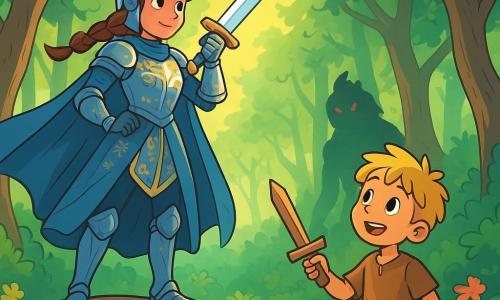
People teased him for being dreamy. "A knight needs steel, not sighs," some would say. But Zen carried a small, steady bravery inside him, like a hidden lamp. He wanted, above all, to speak plain words to those he met — not fancy speeches full of long words, but a short, true sentence that would make people feel braver. He had practised that sentence in the mirror and under the apple trees: "You are not alone."
The call for a quest came on a wind that smelled of pine and old maps. The King sent riders with a sealed scroll. The village of Greyfen, up past the broken bridge and the weeping cliffs, had fallen under a strange shadow. Lights faded at dusk, and the stream ran quieter than it should. The King asked for knights who would travel with courage and heart. Zen's heart tapped hard. He gathered a small pack, tucked his speech inside his helmet, and mounted his nag, Pebble.
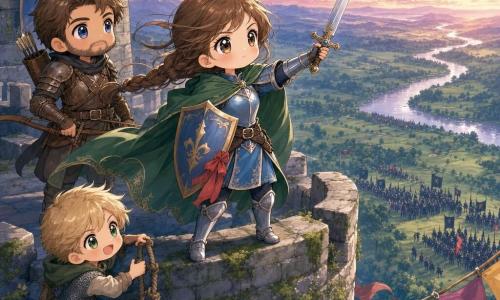
Before he could leave, three friends came to stand at the gate: Mira the archer, quick as an arrow and fierce as a storm; Bram the tinkerer, who could fix a broken wheel or a broken promise; and Old Rowan the minstrel-knight, who had a beard like a map and a laugh like thunder. They would ride with him. "Because," said Mira, tapping Zen's shoulder, "adventure needs your dream, and we need your courage."
Chapter 2: The Fog of Doubts
The path to Greyfen wound through the Hollow Vale, where mist curled like white serpents and made the trees whisper secrets. On the second night, while they camped under a crescent moon, a fog-sprite slipped through the camp and touched Pebble's hoof. The sprite's eyes were like coal sparks. It hissed doubts into their ears—small, nagging doubts that felt like cold pebbles in the boots.
Bram woke first, and his hands found his toolbox. He makeshifted a bell out of a copper cup and hung it from Pebble's bridle. "When we hear fear ring," he said, "we will know it's only a voice." Mira strung her bow and stood watch, singing a high, steady tune to steady their hearts. Zen wrapped his small speech in cloth and tucked it in his tunic, feeling each word warm against his chest like an ember.
The fog thickened, and shadows flitted near the fire. The sprite curled close and whispered that they were foolish to go on. Zen's mind filled with questions: What if the shadow was stronger than their swords? What if his simple words meant nothing? His courage felt thin like bread crumbs. For a moment, he wanted to fold his hands and turn back.
Old Rowan cleared his throat and began to play a low, brave melody. The tune spoke of ancient oaks who stood firm when storms struck, and of blades that kept their shine by being used. The music reminded Zen of something he had almost forgotten: courage is not the absence of fear, but the choice to walk forward anyway. He stood, and before anyone could cheer or say a word, he delivered his simple speech aloud beside the fire: "You are not alone."
Mira's eyes softened. Bram's shoulders eased. The bell on Pebble chimed as if to say, "Good sound." The fog-sprite, hearing that honest small sentence, recoiled as if stung. The mist thinned. They pressed on with softer steps, their friendship a bright thread between them.
Chapter 3: The Bridge of Broken Promises
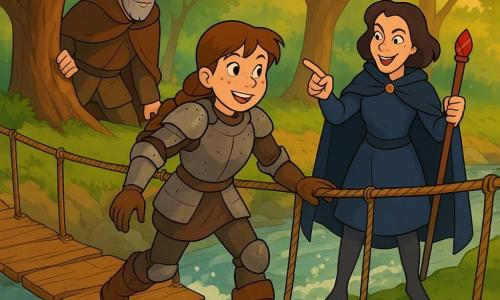
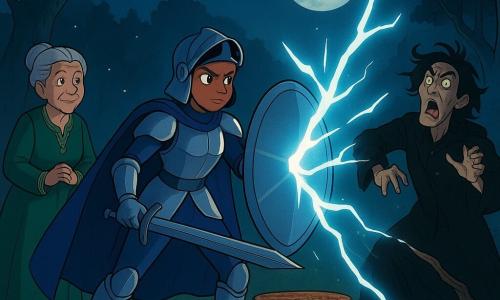
The path narrowed to a single stone bridge strung across a gorge that swallowed echoes. The bridge was half-collapsed, ropes frayed like old scarves. At its center stood a figure in rusted armour—the Warden of Broken Promises, a knight cursed long ago to test whose hearts were true. He challenged them with riddles and tempting lies: promises of gold for one who turned away, memories for those who let go of loyalty.
Mira stepped forward, arrow nocked. Bram tightened his jaw and measured the ropes with his tools. Zen felt the old fear prickle, but he saw how his friends looked to him for a steady light. The Warden's voice boomed, "Prove to me you can keep a vow, and you may cross."
Bram offered to go first, promising with a grin to fix the bridge on the other side. He crawled along the broken planks, wrench in hand, his heart hammering. Halfway across, a plank snapped. Without thinking, Mira shot an arrow that pinned it to the beam below, holding Bram in place. Bram laughed, "Never bet against a tinkerer and an archer."
Zen knew his test was not strength but truth. The Warden demanded a vow. Zen stepped forward, visor raised, and spoke plainly, "We promise to help Greyfen and one another, come what may." His words were not loud or grand; they were honest and steady. The Warden's armour rattled; it sighed like old chainmail. A single piece of rust fell, and a light like morning seeped through his visor. He knelt and allowed them passage, for simple truth can topple old curses.
They crossed together, hand in hand, plank by plank. When at last they stood on the far bank, they found that the ropes the Warden had cursed now braided themselves into new ropes for the bridge, mending because vows kept will stitch the world as well.
Chapter 4: The Heart of Greyfen
Greyfen lay beneath a hanging dusk. Houses leaned like tired soldiers, and windows glinted like sleepy eyes. At the village square, a tall tower twisted into the sky, wrapped in a shadow that hummed like a trapped wind. Villagers peered from doorways, their faces lined with worry. The stream that ran through the town trickled in a thin, unhappy thread.
Old Rowan asked the villagers to sing old songs to bring light back, but the songs came out like fragments. The shadow grew thicker near the tower's base, where an ancient stone—The Heartstone—had cracked. The Heartstone was the village's soul; it kept the moonlit path clean and the stream singing. The crack leaked a chill into the air. Pieces of the stone lay scattered, dim and dull.
The elders said only a piece of true courage could mend the Heartstone. They spoke of knights who thundered and mages who muttered long spells. Zen knelt beside the broken stone and breathed in the cool dust. He felt uncertain. His hands were not calloused like many knights', and his armour knew fewer battles. Still, he had a small lamp inside him that glowed when he spoke true words.
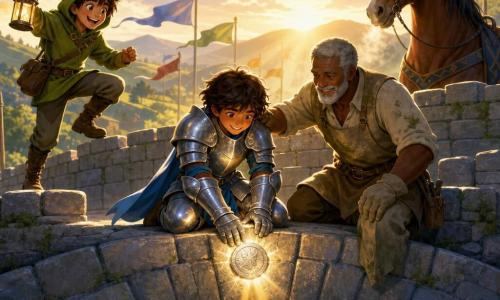
He took out the stitched cloth from his tunic and wrapped his palm around a fallen shard. He closed his eyes and thought of the orchard, of Pebble, of Mira's steady aim and Bram's tinkering hands. He thought of Old Rowan's music. He thought of the short sentence he'd practised for so long. He spoke, not for the crowd, but as one friend to another, "You are not alone."
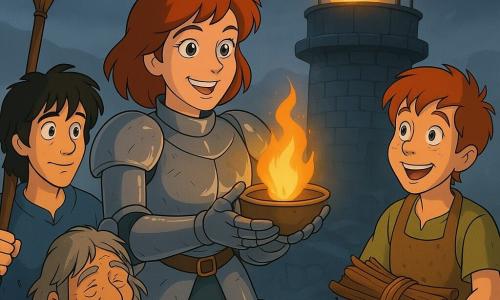
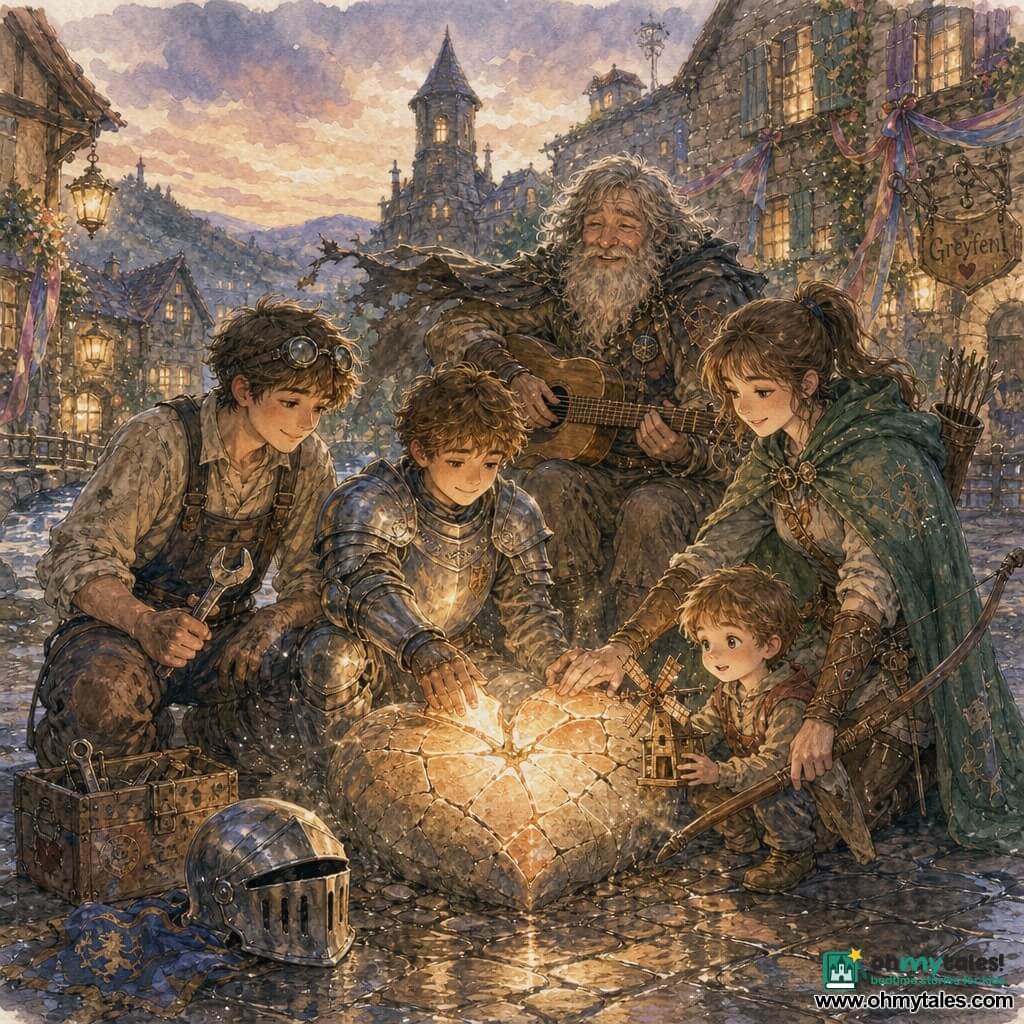
The shard warmed. Light pooled from the broken seam like a spring finding its bed. The villagers gasped. The stream brightened and hummed a clearer tune. Zen placed the shard in the Heartstone. One by one, the friends laid their hands upon other pieces. Friendship is a kind of glue, thought Zen, binding pieces back to the whole. The Heartstone mended, not whole and perfect, but stronger where it had been fixed with honest hands.
The shadow shrank and winked like a child whose game had been found out. Light spilled from the tower and washed over Greyfen, making colors pop like fresh paint. The villagers cheered, and lanterns sparked to life. Zen's voice, soft and steady, became the melody that led them out of gloom.
Chapter 5: The Night Sky's Promise
With Greyfen bright again, the King rewarded the knights with a simple feast. The villagers hung ribbons and sang, and the fire beside the square popped and spat golden sparks. Zen felt a quiet pride, not the loud kind that beats drums, but a calm glow that warmed his chest. He had said his small speech when it mattered, and it had done something true.
As the night grew deep, Old Rowan led them outside the square to a hill that rose like a watchful hand. They lay on their backs on cool grass and watched for stars. Bram mended a toy windmill for a little girl who hugged it like treasure. Mira pointed out constellations, tracing their stories with a gloved finger. Zen hummed a soft tune beneath his breath and felt the world open like a book.
He had promised himself that he would deliver a simple speech to those who needed it most. The moment came quietly. A little boy, eyes wide and raw from days of fear, sat beside him. Zen thought of all the tests they had passed: fog, lies, a broken bridge, a wounded heartstone. He lifted his head and looked at the boy. The words came like a steady star: "You are not alone."
The boy smiled, and it was like the first petal of spring opening. Around them, villagers looked up as if expecting something grand. Zen turned to his friends, and each met his gaze with soft, true smiles. In that hush, something bright arced across the sky—a single, silver line that burned like a message.
They all watched as the star burned and fell, tracing a silver thread through the night. It winked once, as if agreeing, and then it was gone. Zen felt the small lamp inside him blaze into something brighter. He thought of pledges kept, of songs mended, of hands that had fit into fissures like skilled woodworkers. He thought of the simple power of a true sentence.
"Look," breathed Mira.
"A wish," said Bram.
Old Rowan lifted his voice in a soft, joyful hymn. The villagers whispered their thanks and made silent wishes. For Zen, the falling star was a kind of promise from the world: that brave, plain words can change things, and that friendship makes the road lighter.
They rose and walked back to the square together, their shadows long and gentle in the lantern light. That night, as fireflies danced and the Heartstone hummed, Zen placed his hand on his helm and felt its cold metal warm beneath his palm. The speech he had wanted to give had done its work. He had learned that being a knight was as much about listening as it was about leading, and that small, honest words could shine as brightly as any sword.
And far above them, the sky kept its secret—stars wheeling like guardians—while, for a moment, one of them had fallen to remind them all that even the smallest voice can make the night a little less lonely.