Chapter 1
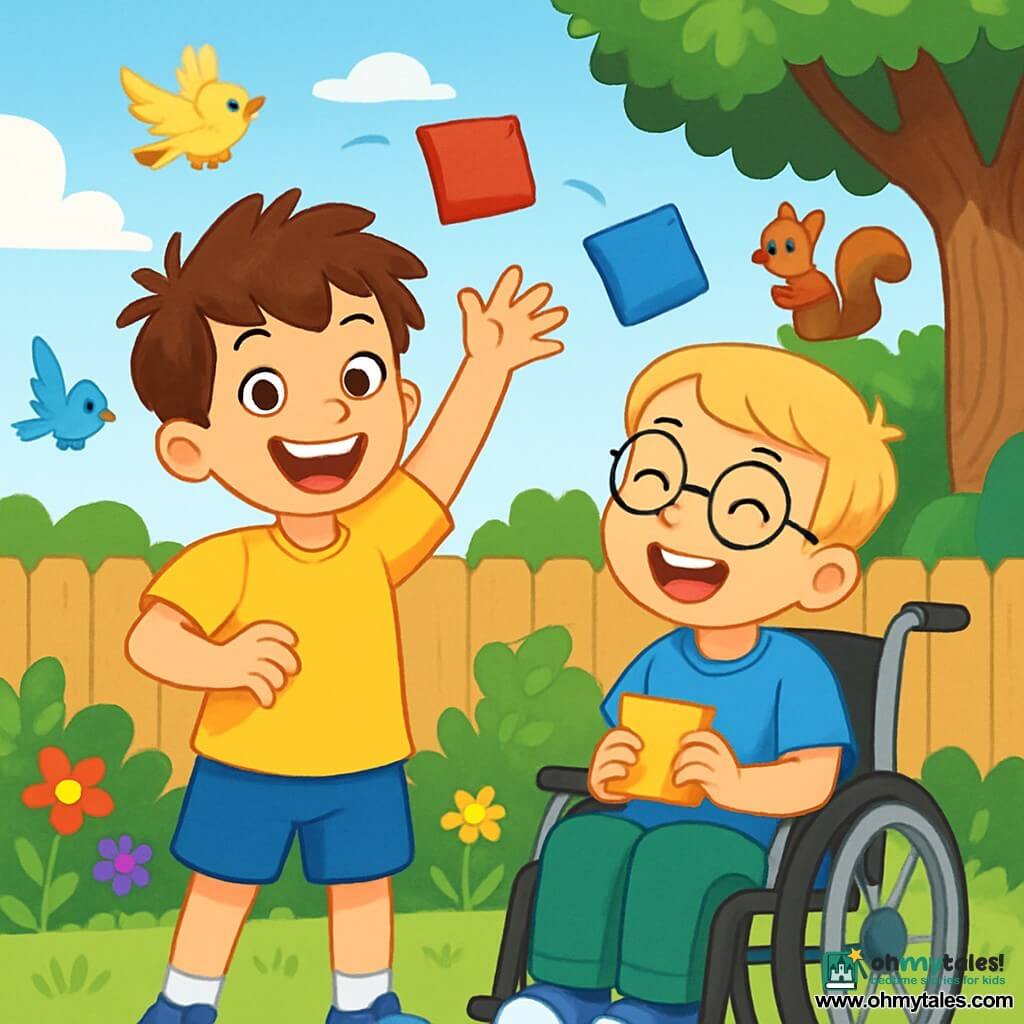
On a bright, bouncy morning, Ben and Milo made a plan. The sun looked like a big coin in the sky. The grass in the garden glittered with tiny drops of light. Ben had sticky hair from sleep. Milo rolled out of the house in his bright blue wheelchair, wheels that liked to sing on the path. They were both almost six. They were both very brave.
They drew a big list. At the top, in bold crayon, they wrote: LEARN SOMETHING IMPOSSIBLE TODAY. The letters nearly fell off the page because they were so excited. Around the edges, they drew stars, a laughing sun, and a little dog with a hat. They made the list long and silly. There was "walk on banana peels" (for pretend), "talk to the clouds" (for fun), and "build a castle that sits on the grass and does not fall." But the real challenge was in the middle, circled with a red marker. Three happy, bouncy circles. JUGGLE THREE BALLS BY SUNSET.
To Ben, juggling sounded like a magic trick. To Milo, juggling sounded like a stack of tiny dances in the palm of the hand. They had seen a juggler once at a fair. The juggler had a red nose and a hat with feathers. He made little balls fly and catch. It looked impossible and delicious. Ben and Milo wanted to make something impossible become a silly new game.
They promised each other they would not cheat. No secret tricks. No glue. No friend hiding with magnets. They would learn with their own hands and their own giggles. They would give themselves the right to mess up. The right to fall on their bottoms. The right to laugh and try again.
Ben found three small beanbags. Each was a different color: sky-blue, lemon-yellow, and tomato-red. They felt warm and soft. Milo brought his little notebook, the one with funny drawings and scribbles. He called it the Idea Book. It had pictures of rockets, of shoes that flap, and a banana that could be a boat.
They started at the garden gate. The first lesson was to make tossing into a game. Ben tossed one beanbag up. It made a soft whoosh and landed in the grass. A bumblebee hopped on the beanbag, thinking it was a flower. Ben and Milo laughed. The beanbag bounced like a sleepy frog.
Ben tried two beanbags at once. One flew high and spun. The other plopped to the ground and rolled towards Mrs. Perez's petunias. Milo rolled quickly and rescued the bag. He pushed his wheelchair over the grass with a happy kick. His wheels made small tracks, like little rivers. Ben tripped on his own shoelace. He tumbled onto the grass and made a funny cow-noise. They both laughed so much that the sun must have smiled bigger.
The first day felt like a parade of silly mistakes. The bird kept stealing a beanbag for its nest. A neighbor's cat jumped on the sky-blue bag and pretended to be a pirate. Each mistake was a new joke. Each mistake was a bright, useful clue. They drew a star in the Idea Book next to the page that said, "Mistakes are clue-sticks."
As the day wore on, the boys made small rules. Rule one: toss low. Rule two: toss in a soft curve. Rule three: count "one-two-three" like a dance. They tried counting but sometimes they counted "elephant, train, jelly" and then both fell into giggles until their bellies hurt.
By noon, juggling was still mostly wobble and tumble. But their hands were learning to play. Their eyes learned when to look. Their arms learned to be patient. They took turns, like sharing ice cream. When one was tired, the other made funny faces while tossing, which made all the bags fly in strange directions. The bags responded by being terribly silly.
Chapter 2
In the afternoon, they built an obstacle course. It was not a boring course. It was a course with purpose. They called it the Impossible Path. There were pillows to hop, a twig bridge to tiptoe over, a cardboard tunnel that smelled like a cave, and a puddle painted with blue cloth that would be the River of Giggles. The course was for practicing balance, and for learning how to keep eyes calm while hands were busy.
They tried to juggle while rolling on a scooter. That lasted for exactly one second before the scooter went "wang" on a pebble and the beanbags all took flight like startled butterflies. They tried to juggle while balancing on a cushion. That lasted two seconds before a brave ladybug decided to land on Ben's nose. Milo tried to juggle while humming. He hummed a tune that made the beanbags sway to the rhythm of a sleepy samba. The samba was not a success, but it was very musical.
Each attempt taught something. They learned that the toss must be gentle. They learned that looking slightly above the hands helped. They learned that a soft laugh makes hands relax. They learned to clap when they did one little thing right. They learned that mistakes could be turned into silly dances.
A small twist happened when they met Mr. Finch, the neighbor with the big hat. Mr. Finch saw them and asked if they were trying to juggle. He showed them a trick. He held one beanbag and tossed it high, then waved a banana peel in the air, juggling the peel and the beanbag in a silly pretend way. The banana peel was not real juggling, but it made the boys giggle and try again. Mr. Finch dropped a hat on his head and left a tiny applause.
The clouds moved like cotton boats across the sky. The boys moved like tiny ships learning new sails. The garden filled with small cheers from birds and a single very interested squirrel that watched from the fence. They started to get three catches in a row. Three! They would shout, then fall down laughing because the next toss went to the backyard and woke up a dozing homework sheet. They learned to pick up the beanbags calmly. They learned to say "try again" like a magic spell.
Milo's Idea Book was always open. He drew arrows and scribbly charts. He drew a picture of a hand and labeled it "soft paw." He drew a face and wrote "look up like a kite." He drew three beanbags with little smiling faces and wrote, "they like slow dances." The book was not a cheat. It was a map made of silly colors. The book had a page of mistakes with a big heart around it. The heart said, "Keep trying. Keep laughing."
Evening slid in like syrup. The shadows grew long. The boys had not given up. They had not yet mastered the full juggling song. But their hands moved in friendly circles. Their eyes sang the rhythm. Their bodies remembered the dance. They still dropped the beanbags, but the drops became soft and funny. Every fall was a new part of the story.
Just when the sun felt like a sleepy tomato, a new challenge appeared. A gust of wind arrived, like a mischievous helper. The wind turned the beanbags into small flying boats. One blue beanbag flew up, up, and landed on the roof. The boys looked up with big mouths. A tiny cheer bubbled and then a tiny worry. How to get the blue bag down?
They tried to climb a ladder, but ladders are for grown-ups in stories, so they did not. They tried a fishing stick with string and a hook made from a paperclip. It caught the beanbag for half a second and then the bag floated back like a cloud with stage fright. The bag seemed to like the roof. The boys sat on the garden bench and thought. They were allowed to think slow. Thinking felt good.
Milo opened his Idea Book. He traced the roof with little dots. He drew a picture of the bag on the roof and a picture of a long stick with a friendly net. Then he tapped his head and grinned. He had a plan.
They dragged out the old kite. The kite had a tail of ribbons and long memories. Ben held the kite string. Milo gave instructions. The kite flew and flew. When the kite was above the roof, they tied the ribbon gently to the roof's edge and snagged the bag free like a tiny rescue. The bag twirled down and landed in Milo's lap. The kite did a bow and came home. The boys cheered like two clapping clams. The sun did a little wink.
That rescue was not part of learning to juggle, but it mattered. It was a test of problem-solving, of making the impossible cozy again. The boys high-fived, but the high-five was only a practice one. The giant high five would come at the end.
Chapter 3
At the edge of sunset, the boys set up one last attempt. They drew a circle with chalk. They stood in it like little planets. The sky was a bowl of orange jam. Ben cradled a red beanbag. Milo held the yellow and blue. They breathed in like blowing bubbles, then breathed out like wind chimes.
They remembered all the small rules. Toss low, toss gentle. Look up like a kite. Count with silly words if you must. Clap when something good happened. When the bags fell, they would turn the fall into a bow. They would turn each mistake into a jig. They would be kind to their hands. They would be kind to each other.
Ben tossed the red bag. It flew in a calm arc. Milo tossed the yellow. Ben caught the red and tossed it again. The yellow looped and landed in his other hand. They almost had three. Their hearts beat like little drums. The last toss wobbled, and the blue bag slipped. It slipped and bounced and landed on Milo's knee. Milo laughed and let it sit. "Try again," he said softly. They both grinned.
They tried again. This time the red went up, the yellow followed, and the blue flew in a lazy loop. Ben's hands moved like soft paddles. Milo's hands moved like happy birds. One, two, three—three catches in a row. The beanbags made a small choir of plops in their palms. The boys froze for half a second, like statues that had learned to dance. Then they whooped and jumped and whooped again. They had done it—real juggling. It was not perfect. A beanbag slid off a fingertip and landed in the mud. They laughed and picked it up and cleaned it with a leaf. The leaf tickled the bag.
Milo opened his Idea Book and drew a big gold star. He wrote, "WE TRIED." Ben drew three little people holding hands. They put the book on the bench for safe keeping. The sunset spread its jam color across their drawings.
They did not finish there. They tried juggling in new ways. They hummed and tossed. They tried with a hat on. The hat was not a good idea—one beanbag thought the hat was a nest and dove right in. But they learned more. They learned that practice could be short and bright, like a tiny comet. They learned that small steps matter. They learned that mistakes are part of the pattern, like a funny note in a song.
When the first star appeared, they went to the fence to watch. The sky turned deep and calm. They both felt something warm like toast inside them. Milo said, "Giant high five?" It was the first real line all day, and it fit like a lid on a pot. Ben smiled and held out his hand. Milo rolled forward and raised his arm. They slapped their palms together so hard the clap sounded like a tiny drum roll. The high five was not small. It was huge in their hearts. It felt like fireworks inside a jar.
They hugged the victory quietly. They felt proud, not just because they could juggle three beanbags, but because they had the right to mess up, the right to try silly things, and the right to make mistakes and still keep going. The garden echoed with their laughter and the soft, proud buzzing of a bee. The Idea Book now had a new page. In big letters they wrote: MISTAKES ARE MAPS. Then they drew a little map with footsteps and funny arrows and three small hearts.
They counted their tries. They counted their giggles. They counted their falls and their saves. They had learned a new thing in one bright, busy day. They had learned that impossible can be peeled like an orange and then eaten, one slice at a time. They had learned to help each other. They had learned to invent plans when winds borrowed a beanbag for a while. They had learned to trust their hands.
When the moon rose, soft and round, Ben and Milo put the beanbags in a bowl and set the Idea Book on top. They closed the book like a treasure chest. They promised to wake the next day and make another impossible thing true. They promised to tell the story to the squirrel if it ever came down from the fence.
As they walked—Ben on two wobbly legs, Milo rolling with steady wheels—they high-fived again, gently this time. Their palms tingled. The world felt like a place with many doors and many silly keys. They were small, but they had big, brave hearts.
The night held the garden close. A crickets' chorus sang them a lullaby. The boys smiled and thought of three little beanbags dancing in their hands. They slept like soft clouds, full of plans, full of the right to make mistakes, full of the next bright day.