The Promise of the Clock
In a castle of pale stone and kind shadows, where a drawbridge sighed over a silver moat and courtyards were stitched with soft, cobbled patterns, there lived a prince named Emory. His hair was the color of toasted wheat, and his eyes were bright as morning water. He walked every day under painted arches and along long galleries where friendly footsteps echoed like polite greetings. The castle seemed to speak in soft sounds—whispers of straw brooms, the murmur of pages, and the patient heartbeat of clocks.
Prince Emory knew many things. He knew how to bow without bending his pride. He knew how to listen to a gardener's stories as if each was a seed. He knew how to tie a ribbon so that it would not crush a single petal. But there was one lesson that slipped through his fingers like fish: the hour.
“‘What time is it, Your Highness?'” the baker would call from the pantry arch, smiling under a dust of flour.
Emory would look up at the tall clock in the hall. Its face was a gleaming moon with black markings, and two hands pointed like polite swords. He would guess, and sometimes he was close. Other times, he was very, very not.
“Um,” he would say, “it's… early past a little.”
“You mean quarter past nine,” the baker would laugh gently. “No matter. There's time to learn.”
There was always a kind voice to help, but Emory felt a tug inside, like a kite wanting the sky. He wanted to tell the time himself. Not only for himself, but for the kingdom. Each autumn, on the day of the Harvest Festival, the prince stood on the highest balcony and called for the First Bell to be rung. The bell was heavy and yawned like a sleepy lion. The whole kingdom waited for that sound to shimmer across the fields. This year, the Queen had laid a hand on Emory's shoulder and said, “I believe you are ready to name the hour.”
It was true. He had grown in quiet ways. Still, the clock face was a puzzle—twelve numbers like little mountains, and two hands that chased each other without ever catching.
That evening, when doves were pinning up the last threads of daylight and the drawbridge chain hummed a bedtime song, Emory stood in the grand clock room and made a promise. The room smelled of polished wood and faint oil, and tall clocks stood like tall uncles, each with a steady voice: tick, tock, tick, tock.
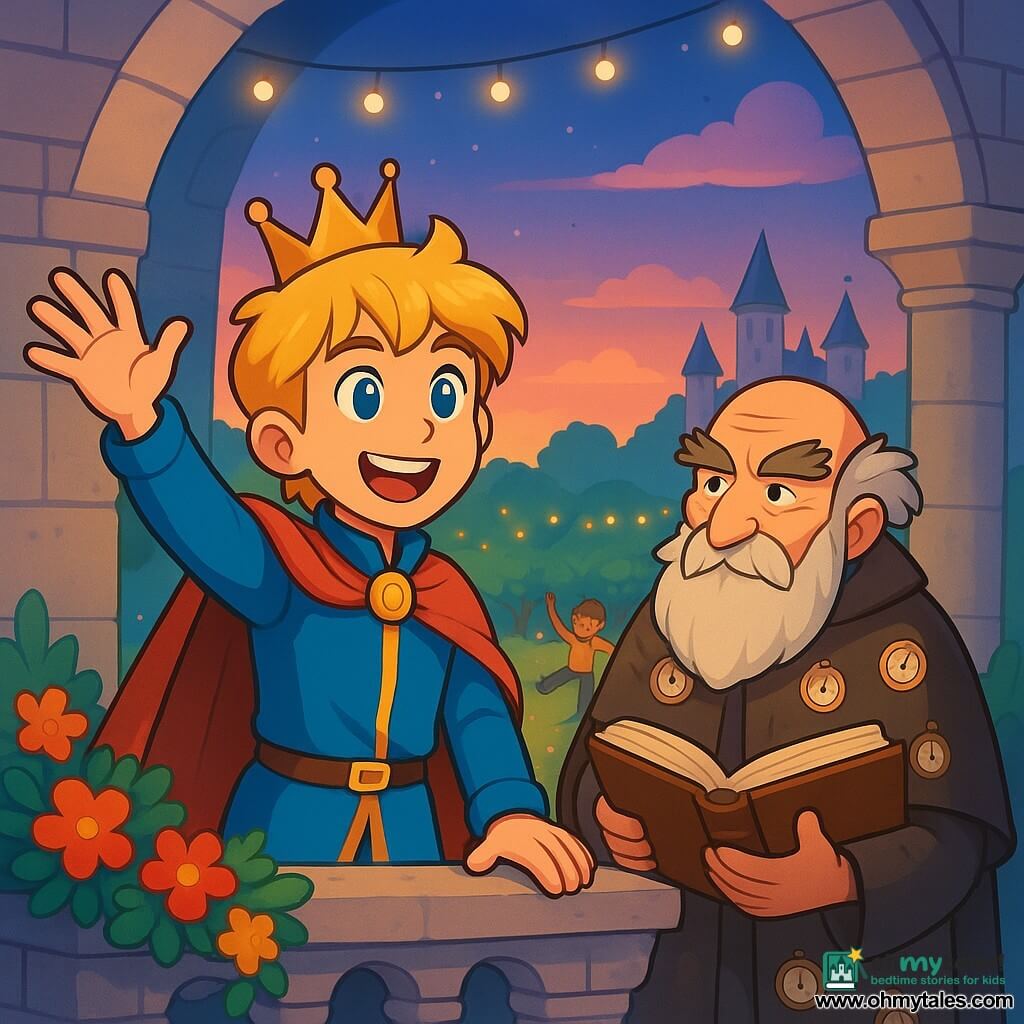
“Master Tock,” Emory said to the Royal Timekeeper, a gentleman with eyebrows like pinecones and a coat stitched with tiny hourglasses, “I wish to learn to tell the time before the Harvest Festival, and I wish to learn it well. Teach me with patience, and I will practice with patience too.”
Master Tock's pinecone eyebrows lifted in pleasure. “Your wish is wise, Your Highness,” he said softly. “Time is a friend who likes to be known slowly.”
“How do I begin?” Emory asked.
“Begin by listening,” Master Tock replied, placing a pocket watch in the prince's palm. The watch was warm, like a small sleeping bird. “Listen to the steps of time, and watch how light makes shadows walk. Tomorrow, at the hour after dawn, meet me in the Sundial Garden.”
The prince looked at the watch and heard its tiny heart. He closed his hand around it and nodded. He could almost feel the kingdom breathing with him: the soft rush of water beneath the drawbridge, the soft shuffle of brooms on the cobbles, and the soft echo of friendly steps in the galleries. He felt a seed of courage underneath his ribs.
“I will be there,” he promised.
Hands of Light and Hands of Brass
Under the lacework of the morning sky, Emory crossed the cobbled courtyards to the Sundial Garden. The garden was a round room of hedges with a stone table in the center. The sundial was a circle of numbers with a bronze pointer that cast a thin, truthful shadow. Bees greeted him like tiny librarians—shh, shh, shh—and a robin hopped near his boot as if to read the hour as well.
Master Tock stood beside the sundial, hands folded like book covers. “Good morning, my prince. Today, the sun will teach you the hour.”
Emory nodded. “So this is a clock that swallows light?”
“Not swallows,” said Master Tock. “Shares. The sundial shares the dance of the sun. Watch the shadow. It moves as slowly as good bread rising. That slow movement is like the hour hand.”
He led Emory to the great clock set into the wall nearby, where two hands lay across the numbers like the arms of a drowsy giant. “On this clock, the short hand tells the hour. It moves like an ox in a field—strong and steady, but never in a hurry.”
Emory looked from the sundial to the clock. “So the short hand is the ox, and the long hand is…?”
“The long hand is a swift fish,” Master Tock said, smiling. “It swims from number to number, counting the minutes. Sixty little fish together make one big ox step.”
Emory laughed. “I think I can remember that.”
They practiced with the sundial and then with a chalked clock on a slate. Emory drew a circle and numbers as carefully as if he was setting fine plates: 12 at the top, 6 at the bottom, 3 on the right, 9 on the left. He placed the short hand between numbers to show half past, and just before a number to show “almost.”
“I see,” he said, feeling the edges of understanding. “When the minute hand reaches the twelve, it tells the exact hour the short hand points to. When it reaches the six, it means half past.”
“Well remembered,” said the Timekeeper. “Remember the quarters too: the three is quarter past; the nine is quarter to. The clock is a pie we share with patience.”
They walked back through the galleries to the training yard. Friendly footsteps echoed—a page whistling, a gardener humming, the soft trot of the stable cat. Emory kept peeking at the pocket watch, whispering to himself. “Quarter past, half past…”
But after lunch, he forgot to check. He saw the minute hand pointing at the three and thought it meant half past. He hurried to meet the Queen for a music lesson and arrived very early. She was alone in the music room, softly tuning her harp.
“Oh, my dove,” she said with a small laugh. “You have come at quarter past the hour. We begin at half past.”
Emory blushed. “I mixed up the three and the six.”
“Many do,” said the Queen. “It is the mistake of swift fish. Sit with me until the right time comes. Listen to the harp count sleepily.”
He sat in a chair of carved leaves, and the harp murmur filled the room like warm tea. He wanted to fidget. He wanted to fix the clock with a quick twist. But he remembered the ox and the bread rising. He took a patient breath.
When the minute hand kissed the six like a polite bow, Emory stood. “Now it is time,” he said, more sure than before.
After the lesson, Master Tock found him in the corridor. “Mistake and correct,” said the old man with a smile. “That is how the watch learns to sing.”
Emory grinned. He felt something steady grow inside him, a little room with a chair where patience could sit.
The Echoes and the Hourglass
The next day, Master Tock led Emory into the long galleries of the castle. Sunlight poured through clouded windows, laying silver stripes on the floor. Their steps echoed softly, as if the walls were repeating kind words. Portraits of past kings watched from their frames with painted patience, and here and there, small clocks rested on tables like shy friends.
“Today we listen,” said Master Tock.
“Tick,” the first clock said.
“Tock,” said the second.
“Tick, tock,” came the third, in a voice like a dozing cat.
Emory tilted his head. “They do not talk at the same time.”
“They do, but not in unison. Still, all together they keep the castle's heart in balance.” Master Tock tapped his pocket watch. “Listen to how each tick is a step. Thirty steps gets you halfway round; sixty, all the way. That is a minute.”
A flicker of black and silver swooped in through the window and landed on a chair. A magpie cocked its head at them, one eye bright as a button. In its beak, it carried a tiny chain.
“Good morning, Lady Miri,” Master Tock said. “She belongs to the tower and thinks everything shiny belongs to her.”
“Does time belong to her too?” Emory asked.
Miri ruffled her feathers and dropped the chain. “Shiny. Shiny minutes,” she chirped, and then snapped up a loose screw and flew off down the gallery with a saucy flap.
Emory laughed, then clapped a hand over his mouth. “What if she steals the minute hand?”
Master Tock chuckled. “Then we must be faster than a magpie.”
They reached the clockmaker's room, a little forest of cogs, springs, and glass domes. On a pedestal sat a tall hourglass with a double belly. Sand glowed in its top half like poured honey. A near window stood open to the courtyard, and the wind came in like a playful uncle—warm and cheeky. The wind heaved a sigh, and the hourglass trembled.
“Careful,” Emory said, stepping forward.
A bigger sigh, and the hourglass swayed like a ballerina.
“Careful!” Emory cried again.
The hourglass teetered to the edge, wobbling between safety and crash. Emory reached out, then stopped. If he lunged, he might bump the pedestal. If he hesitated too long—
He lowered his voice. “Think,” he told himself. “Be the ox, not the fish.” He counted soft steps with the watch. “One, two, three…” He watched the sway and saw its pattern, slow and even. When the hourglass leaned toward him, he slipped his hand around its waist and eased it back, as gentle as setting a baby bird into a nest.
The wind bustled and puffed, disappointed to lose its game. Miri peeked back in through the window and squawked as if to say, “Clever!”
Master Tock clapped quietly. “Well done. Patience saves more than glass. It saves moments.”
Emory set the hourglass down and watched the sand fall. “How long is the sand?”
“This glass is a minute,” said the Timekeeper. “Flip it each time you count to sixty. Feel the tether between your voice and the fall.”
They practiced. Emory counted heartbeats with the watch pressed to his wrist, then matched them to the sand. He counted to fifteen and said, “A quarter.” Counted to thirty and said, proudly, “Half.”
When they left, the galleries gave them back their steps. Emory imagined that if he could see time, it would be a stream of tiny silver seeds pouring from a hand. It would not be scared. It would not rush. It would trust the fall.
On the way back, they passed the drawbridge. The chain purred like a sleeping cat as guards wound it up and let it down. Villagers waved to the prince from wagons of apples and pears. Emory waved back. “Tomorrow?” he called to Master Tock.
“Tomorrow,” said the old man. “We will climb the tower and listen to the moon's clock.”
Emory lifted his face to the sky. Clouds were gathering like gentle geese, and the day was already ready to teach night how to shine. He could not yet say the exact time without thinking hard. But he knew he was closer than yesterday. He felt pride, warm as a lantern.
The Moon's Quarters and the Bell
Night fell like a velvet cloak embroidered with pins of light. Emory climbed the tower stairs with Master Tock. Each step spoke a little poem: stone, stone, stone, stone. The walls were cool, and the torches burned like patient stars that had come down to help.
At the top, the night opened around them. The castle spread below, its courtyards cupped in shadow and starlight. The drawbridge slept in its span across the black ribbon of water. Far fields glimmered, and the wind had turned calm, as if it had done enough mischief for the day.
The tower clock was a giant face, serious and steady. Its hands were long wands, and its chimes hung in a nest of dark metal. A guard stood by the bell with a lantern. “Evening, Your Highness,” he said, his voice as round as the moon.
“Good evening,” Emory replied, feeling his heart move with the clock—tick, tock, tick, tock.
Master Tock pointed up. “See the moon tonight? Do you see its slice?”
Emory looked. The moon was not full; it was a neat half, a silver smile. “It looks like half a pie.”
“It is. We learn about quarters in the sky as well as on the clock. The moon will teach you patience. It never hurries to become full. It grows and then rests and then grows again.”
Emory smiled at that. “Like bread,” he said, remembering yesterday. “Like bread rising.”
Master Tock nodded. “We are bread, all of us. Tonight you must ring the bell at exactly half past nine, to guide a late traveler across the drawbridge. We do not wish him to wait in the dark.”
The guard lifted his lantern. “He'll be near the far oak by then, watching for the ring.”
Emory peered at the tower clock. The minute hand approached the nine. “Quarter to,” he said, steady and sure. He could almost hear the numbers clicking softly into place.
They stood together. The night held its breath with them. Miri the magpie perched on the bell frame, as silent as a jewel thief. Somewhere below, friendly footsteps crossed a gallery. The castle was a kind beast waiting for its own heartbeat.
The long hand drifted toward the twelve. Emory raised the rope and then froze. “Exact,” he whispered to himself. “Not too soon. The fish must touch the top.”
Master Tock's voice was light. “Trust what you know.”
Emory counted. “Fifty-seven, fifty-eight, fifty-nine…” The long hand kissed the twelve. The short hand pointed neatly between nine and ten, right under the star of half past. Emory pulled.
The bell's voice rushed out like a deep, warm river. It crossed the courtyard walls and slid along the stones. It rippled over the drawbridge, down the road, and into the fields. The sound folded around the sleeping cattle and stepped into the hedges. The late traveler heard and lifted his head. Emory could not see him, but he could feel it: the comfort of being called on time.
“Well done,” said the guard.
Miri fluttered and let go of a shiny button she had been hiding in her beak, as if making an offering to the bell.
Master Tock squeezed Emory's shoulder. “You have learned not just to tell the time, but to be its friend.” His eyes were soft and proud.
They stood a little longer in the cool, polite night. Emory did not speak. He breathed with the clock, letting the seconds step by like a company of small, sure dancers. He thought of the Harvest Festival, and a calm joy spread inside him like a calm sea.
The Festival and the Gentle Test
Festival day flowed toward the castle like a parade of bright threads. The sky wore a blue cloak, and the air smelled like apples and clean hay. Children raced across the cobbled courtyards, their shoes tapping like cheerful drums. Stalls bloomed with pies and ribbons. The drawbridge bowed and rose, bowed and rose, carrying a stream of visitors as smooth as cream.
Emory dressed carefully. He chose a jacket the green of leaves and a sash the gold of noon. In the mirror, he felt the same seed of courage under his ribs that he had felt on the first day. He tucked the pocket watch into his vest and hurried out, the galleries offering their friendly echoes like blessings.
On the highest balcony, the Queen and King took their places. Musicians tuned their fiddles. Master Tock stood at the prince's side like a steady shadow. “Today, you will name the hour for the First Bell,” he said softly.
“I will,” Emory answered. He looked to the tower clock, ready to follow its brave hands.
The music began. Dancers spun like petals undone by a happy wind. Emory opened his pocket watch and watched the minute hand cleanly lift and move. But when he looked up to check the tower clock, he frowned.
The tower clock was not moving.
The long hand was stuck just before the twelve, and the short hand was leaning toward three like a tired traveler leaning on a tree. No tick. No tock. The castle's great heartbeat had gone quiet.
Emory's stomach dropped, but his face did not show it. Not yet. He took a slow breath and looked at Master Tock.
The Timekeeper spread his hands. “The bell waits for the hour,” he said. “Sometimes, the clock sleeps.”
Emory looked over the courtyard. He saw the drawbridge lowered and waiting. He saw villagers glancing up with eager, shining eyes. He felt the castle listening without a sound.
“I must name the hour anyway,” he said.
“How will you know it?” Master Tock asked, though his eyes were kind and carried a secret sparkle.
Emory touched the pocket watch, but stopped again. In the press of the festival, the watch's tick was hard to hear. He placed it against his wrist and felt another pulse beneath it, stubborn and brave—his own fierce drum. He looked at the sun and the angle of its light across the Sundial Garden hedges. A sharp triangle of shade sliced across the stones, not too long, not too short.
He watched a ladle of shadow slide along the cobbles and touch the toe of a marble lion. He counted the time it took for the lion's foot to gather the light back as if it were a lost coin. He heard the whisper of the drawbridge chain and the rhythm of feet in the galleries below. He made a basket of all these signs in his mind and held them tenderly.
“Your Highness?” asked the Queen, very softly.
Emory's heart did not race. He told it, “Walk like the ox.”
He closed his eyes for a moment and counted with his breath, pairing it to all the clocks he had listened to—the sun's, the sand's, the moon's. He opened his eyes and smiled. Then he stepped forward to the edge of the balcony and lifted his voice. It came out clear and warm, a rope of sound strong enough to carry across a field.
“It is the hour!” he called. “Let the First Bell ring.”
Master Tock's eyes glimmered. He nodded to the bell guard. The bell swung and spoke, rolling its deep voice across the kingdom. A wave of happiness rose and flowed over the courtyards and through the archways. The valley answered with a cheer. Emory saw the drawbridge bow and rise, the musicians lift their bows, and the bakers smile with relief.
He looked again at the tower clock. As the bell rested, the hands stirred, and the tick returned as politely as a cat who had forgiven itself for a nap. The clock had returned to its duty without a fuss.
Emory glanced at Master Tock, who was watching him as if he were a story that had told itself well.
“Was the clock truly sleeping?” Emory asked.
Master Tock's pinecone eyebrows lifted. “It was tested by a small spell,” he admitted. “A spell I use very rarely, my prince. I wished to see if you could find the hour when numbers refused to speak.”
Emory smiled, not offended. He felt no sting. He felt instead a slow, bright pride glowing like embers. “Then thank you,” he said. “I have learned that time lives in many houses.”
“In shadows and in bells and in the careful beat of your brave heart,” said the Timekeeper.
The day danced on like a ribbon unrolling from a golden spool. Emory played games with the children and taught them what he had learned. He drew clocks on slate and showed how the short hand was the ox and the long hand, the fish. He stood by the sundial and explained how to read the shadow. He told them about quarters using slices of pie and the shape of the moon. He let them hold the pocket watch and feel its tiny animal pulse.
“Time is a friend,” he told a small girl who had lost a button and felt as if she had lost a kingdom. “It will give you another minute to search. And if you search with patience, you find more than you thought.”
She found her button under a bench and giggled as if it were a treasure. Emory smiled, feeling the same small joy inside him.
At dusk, after the last song was played and the last pie crumb forgiven, Emory walked through the galleries. The friendly footsteps were slower now, like sheep returning to their field. The drawbridge sighed into its overnight rest. The cobbles held the day's warmth and gave it back in little flickers.
Master Tock joined him and handed him the pocket watch. “This belongs to you now,” he said.
“Truly?” Emory whispered.
“Truly,” said the old man. “You gave time your patience. Time returns the favor.”
Emory opened the watch and listened to its beating heart. It no longer sounded like a stranger. It sounded like a friend whose hand fit his.
They reached a balcony below the stars. The moon had grown a little since last night, just a breath, just a promise. Emory leaned on the stone and looked out at the sleeping fields. He thought of the sundial and the hourglass and the bell. He thought of the magpie and her pockets of shiny minutes, of the wind's teasing, of the clock's nap, and the kingdom's patient breath. He thought of the Harvest Bell rolling over the rooftops, calling the country to smile.
Master Tock laughed softly beside him, and Emory found that the laughter rose in him too, not loud, not wide—just a small, warm bubble of joy that slipped into the evening without troubling it. He let it go, a simple sound that belonged to that hour and no other—a discreet laugh, bright and kind, that made the stars seem to nod.