Chapter 1: The Clock That Ticked Backward
On a sunny Saturday, three friends met under the old elm tree behind Maplewood Library. Lina, Mia, and Zoe were eight and curious about everything. Lina loved building tiny machines. Mia loved drawing maps. Zoe loved asking questions that made everyone think.
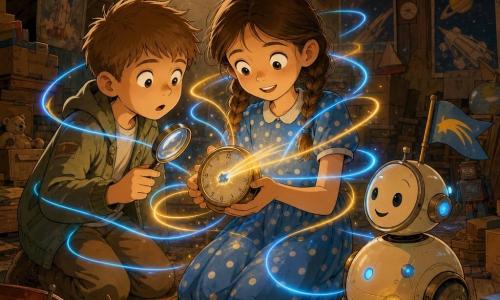
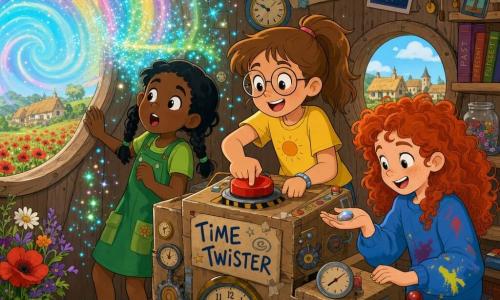
"Look what I found in my attic!" Lina said, breathless. She held a small round clock with bright green hands and a button that looked like a star. The clock did not tick like other clocks. It made a gentle whoosh, as if it were breathing.
Mia leaned close. "It looks like it wants to go on an adventure."
Zoe tapped the star. The green hands spun backward for a moment, then stopped exactly at noon. A soft bell chimed once. The air smelled faintly of lemon and rain.
"Maybe it's a pirate clock," Mia joked. "It steals time!"
"No, I think it returns memories," Lina said, eyes wide. "My grandma said old things can hold stories. This one is... curious."
They decided to test it. Lina pressed the star fully. The clock hummed. The wind under the elm tree hushed. The world around them blurred like watercolor left out in the rain. The children held hands.
When the whoosh ended, Maplewood Library looked different. The elm tree cast a smaller shadow. A dusty banner hung across the library entrance: "Grand Opening: Maplewood Museum." Cars were old-fashioned and quiet. Nobody wore big backpacks. The friends looked at one another and laughed.
"We did it!" Zoe said. "We went back in time."
"Back one week? One year?" Mia asked.
Lina smiled. "Let's find out."
They walked to the museum entrance. Inside, displays showed toys, tools, and photographs from years ago. A man with kind eyes and a name tag that read Mr. Alvarez greeted them.
"Welcome, explorers," he said. "Are you here for the Treasure of Memory exhibit?"
"Treasure of Memory?" Mia whispered.
Mr. Alvarez nodded. "We collect things people want to remember. We stitch memories like quilts." He winked. "Sometimes little mysteries come through the door."
Zoe found a small glass case with a faded photograph of three girls sitting beneath an elm tree. The girls looked very much like Lina, Mia, and Zoe. Their smiles were the same.
"Look," Zoe said softly. "It's us."
Lina's fingers trembled. "But how can that be?" she asked.
Mr. Alvarez smiled again. "Memories are sticky. They like company."
A hush of wonder wrapped around them. They did not yet know they had stepped into a loop of time where memories collected like seashells on a shore.
Chapter 2: The Little Danger
They stepped out, planning to press the star again to go back. A boy dashed past them, white-gloved and panicked.
"Help!" he cried. "The clock in the museum stopped! The bell won't ring for the mayor's speech. The ceremony can't start without it!"
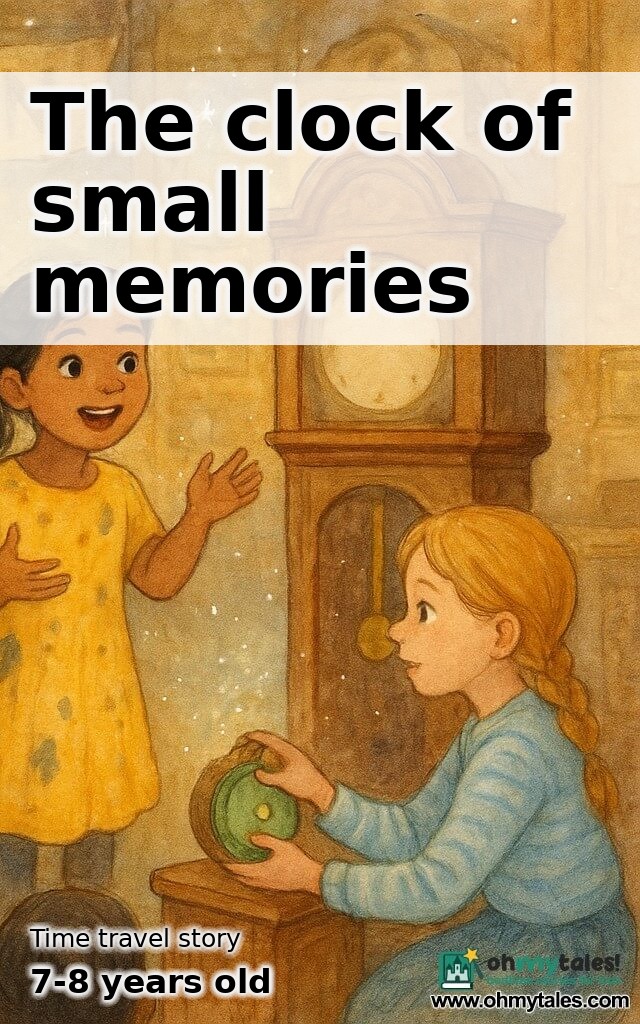
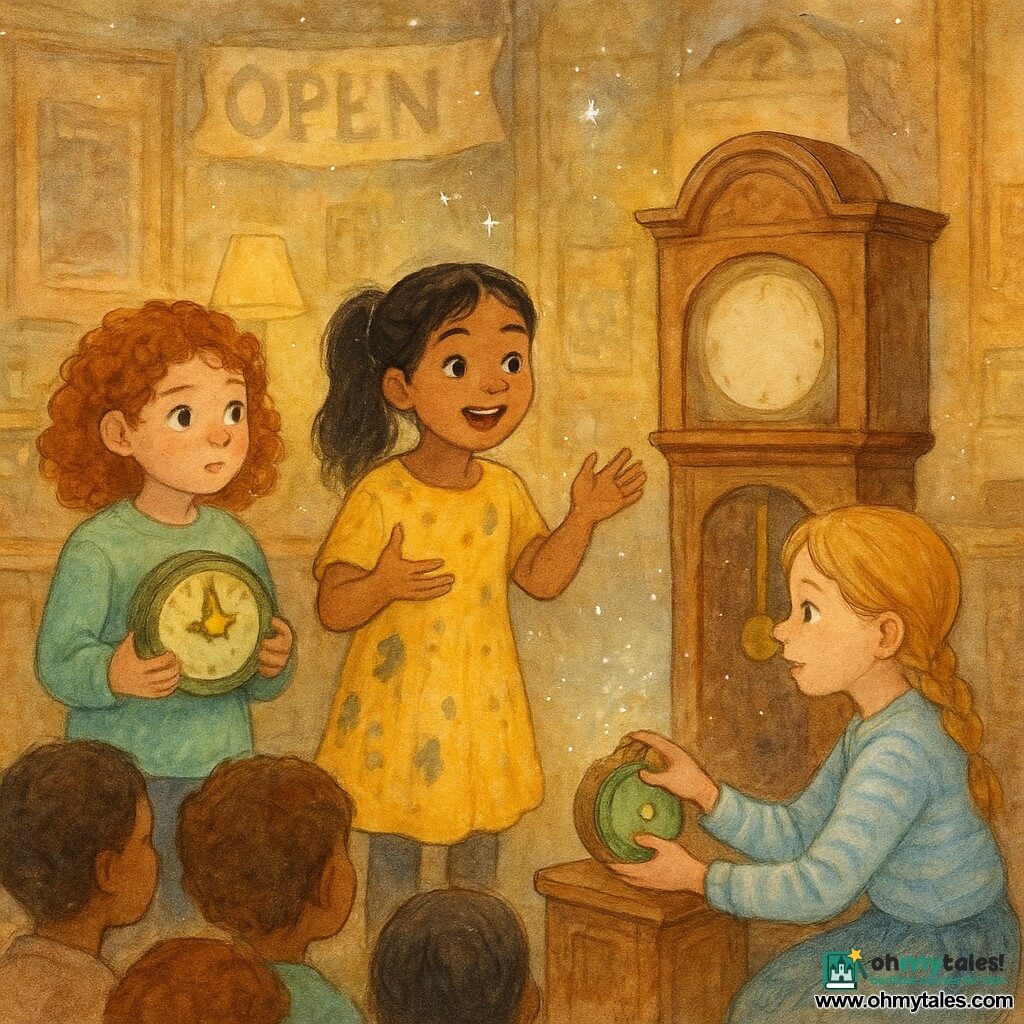
The friends hurried back inside. The main room had a tall grandfather clock on a pedestal. Its face was blank, as if the numbers were erased.
"That clock keeps the ceremony going," Mr. Alvarez explained. "If it does not ring, people will think the opening is cursed. They might close the museum. We can't let that happen."
Lina knelt by the pedestal and examined the clock. Its gears were small, delicate, and caked in a glittery dust that looked like tiny stars. The dust smelled like the same lemon and rain.
"It looks like someone wished time away," Lina said. "A wish might have stuck to the gears."
Mia took out her sketchpad. She drew the gears quickly. "We can clean them," she said cheerfully.
Zoe's hands trembled. "But what if cleaning it changes something? We are already in the past. We could make a paradox."
"A paradox?" Lina repeated.
"A paradox is when time gets tangled," Zoe explained. "Like tying shoelaces together by mistake. But if we are careful, we can untie it."
Mr. Alvarez nodded. "My grandmother used to tell me to fix the thing that is wrong without touching what made it wrong. Follow the memory trail."
They found a small note tucked beneath the pedestal. It read: For the bell to ring, someone must remember why we love small things. The handwriting was curled like waves.
"Remember why we love small things," Mia read. "Maybe we need to tell the museum a memory."
They thought. The bell had stopped because people had forgotten an old kindness. Remembering would need their voices. But the ceremony would start in a few minutes. They had to act fast.
Lina took the green clock from her pocket. "Maybe this clock helps memories," she said. "We could use it to gently return what was forgotten. But we must be careful."
"How?" Zoe asked.
"By giving a memory back, not taking anything else," Lina said. "We will tell the story, listen to others, and place our memory like a sticker on the museum's memory board."
Mr. Alvarez pointed to a wooden board near the entrance. It had empty squares waiting to be filled.
"Put your memory where it belongs," he said. "The board remembers with you."
They formed a plan. Mia would tell a memory, Zoe would listen and hold the clock, and Lina would open the clock only a tiny crack of its star button, so it hummed softly but did not sweep them away.
They stood before the crowd that had gathered. The mayor in a top hat tapped his pocket watch and frowned. The girls took a deep breath.
Mia stepped forward. "I remember," she said, voice high and steady, "a little boy in town who lost his first paper boat. He thought the river took his memory away, but the boat had been caught by a willow root. We found it and put a brave sticker on it. He learned to fold boats with two fingers, not three."
Her words painted the small memory, and the crowd's faces softened. Someone in the front row smiled and shivered with memory. The bell's blank face shimmered.
Zoe held the green clock and whispered, "Do you remember the time you danced in your pajamas when it rained?" She looked at a woman in the crowd who had a drizzle of silver in her hair. The woman closed her eyes, laughed softly, and placed a hand over her heart. The bell's rim gleamed faintly.
Lina opened the star a hair and let the clock breathe. It hummed like a tiny ship. "I remember," Lina said, "my grandma's soup ladle that sounded like a drum and made everyone hungry. We all shared bowls at the table and the ladle kept the beat."
Across the room, an old man remembered a bowlful of warmth and clapped his hands. The blank face of the clock flickered, then the numbers bloomed back in bright paint. With a tiny, brave chime, the grandfather clock rang once—soft, like a bell greeting an old friend.
A relieved cheer spread. People clapped like leaves in the wind. The mayor's worried frown changed into a grin.
"You have reminded us of what we celebrate," Mr. Alvarez said, tears in his eyes. "Thank you."
The girls felt proud and warm. They had helped without taking anything. The clock's dust fell away like clumps of night sky peeling off. Yet, as they left the museum, the green clock vibrated once more. A tiny thought prickled their minds: a photograph in the case had changed. The three girls in the photo were smiling a little more than before.
"Was that dangerous?" Zoe asked, voice small.
"It was a small danger," Lina said. "We almost tied a knot in time, but we didn't pull on the wrong string. We only fed memory back where it belonged."
They patched themselves with laughter and cookies from a smiling volunteer. The ceremony began, and the mayor gave a speech about memory and kindness. The world felt bright and tidy.
Chapter 3: The Mischievous Paradox
After the ceremony, the museum curator led a small tour. She showed an attic trunk filled with labels. On one label a name had been scribbled and erased. The friends peered in. They saw toys that looked like ones from friendly old stories.
On the trunk lid lay a tiny wooden robot with a chipped arm. Its eyes were painted cheerful. Mia picked it up.
"This robot must be part of someone's memory," she said. The robot's painted eyes blinked faintly, like they had been waiting for a hand to hold them.
"Careful," Lina warned. "We mustn't change things too much."
Zoe noticed a cracked sticker near the robot. The sticker had once had a bright blue star but now only had jagged blue edges.
"If stickers are pieces of memory," Zoe suggested, "maybe this robot lost its sticker because someone forgot a promise. Do you think we can help?"
They decided to stick a new star in the empty place, but Lina hesitated. "We can't pretend it's the same sticker. We'll tell the truth," she said. "We will give the robot a new sticker that says: 'Remember to be brave.'"
They agreed and Mia drew a small blue star and wrote "Be Brave" in tiny letters. They pressed it on gently. The robot's eyes glowed a touch brighter. A small sound like a toy whistle came from it as if it was grateful.
But then a playful ripple passed through the room. The photograph by the elm tree changed again. The three girls in the picture now wore small blue stars on their shirts. In the corner of the photo, a little boy who had been shy now waved a hand boldly.
"Oh!" Zoe said. "I think we made something else happen."
They understood that even small kindnesses could move time like ripples in water. The changes were kind, but the girls felt a tingle of responsibility. They had to be careful with the green clock. Lina kept it closed like a sleeping bird.
That night, as the sun started to set, the three friends sat upon the museum steps, watching the world that was both familiar and new. They had helped people remember small things. They had saved the bell from staying silent. They had fixed a tiny sadness for a wooden robot.
"Do you think we've changed the future?" Mia asked.
"Maybe just a little," Lina replied. "But not in the scary way. We added memories, like planting seeds."
Zoe smiled. "Memories don't grow tall all at once. They grow when we water them with stories."
They decided to return to the present before bedtime. Lina pressed the star, gentle as waking a kitten. The clock hummed, and the air blurred again. When they opened their eyes, the elm tree looked as it had that morning. The cars were modern. People walked dogs and wore bright backpacks.
They raced to the library. Everything seemed the same—except for one small difference. On the glass case at the museum, someone had placed a tiny sticker of a blue star. It glinted in the sunlight like a secret wink.
"Look!" Mia pointed. "Our sticker is here. We left a good thing behind."
Zoe held the green clock and felt its purr. "It remembered being polite. It likes being helpful."
Lina looked at the photograph of three girls in the library window. The girls smiled, and they wore tiny blue stars on their shirts. The image matched the memory they had given the robot.
"It fits," Lina said. "We didn't break time. We added something small that makes people remember better."
They giggled and promised to keep the clock safe. But as Zoe tucked the clock into Lina's pocket, a tiny slip of paper fluttered out. It read: For memory is a sticker that stays when you need a little light. The note smelled of lemon and rain.
"Someone left that just for us," Zoe said.
"Or time left a thank-you," Lina said, beaming.
They decided to keep one small thing from the past to remember their adventure. Each girl chose a little item: Mia took a pencil worn smooth by map-making, Zoe took a button shaped like a moon, and Lina took a small scrap of cloth that smelled of soup. They slid the items into their pockets like promises.
Chapter 4: Home and the Sticker
Back in their bedrooms that night, the three friends lay awake and whispered. The world was quiet and safe. The green clock sat on Lina's bedside table, breathing softly.
"We learned something important," Mia said. "Memories are like tiny lights. If you share them, others can see better."
Zoe rolled the moon button between her fingers. "And if you forget, someone might hand you a small sticker to remind you. Memory is gentle."
Lina nodded, eyes heavy. "We must be careful with time. But sometimes time needs a push toward kindness."
They promised to meet under the elm tree again. Before they fell asleep, Lina opened the clock a hair and placed the scrap of soup-smelling cloth inside. The clock hummed and blinked its star once, like a tiny lighthouse.
The next morning, each girl found something stuck to the inside of their jacket pocket: a small round sticker with a blue star and the words "Remember Kindness" in tiny handwriting. The stickers were warm, as if freshly printed from a shop that sells hugs.
They laughed and stuck the stickers onto their notebooks. Every time they opened their books, the star glinted and reminded them of the museum, the bell, the wooden robot, and the old man who clapped at a remembered bowl.
Days passed. The town felt kinder. People lingered to tell stories. The library started a Memory Corner. Children brought small things to the museum that they wanted to remember: a pebble from a seaside trip, a feather from an adventure, a photograph with a dog that always slept by the sofa. Volunteers taped notes beside each item about why it mattered. The museum filled up like a jar with sweet notes.
One afternoon, Lina opened the little clock and found a tiny photograph wrapped in lemon-scented tissue. It showed the three friends under the elm tree, holding hands, smiling. Behind them, just for a blink, the museum's banner read: "Memory Keepers." On the back of the photo someone had written, in neat, slanted letters: For those who remember to share.
Lina brought the photograph to Mia and Zoe. They sat together beneath the elm tree and read the words again. The sun made shadows like soft pencils. A breeze flipped the edge of the green clock's star. The world felt like it had been stitched with golden thread.
"Let's put the photograph on the memory board," Zoe suggested.
"Yes," Mia said. "And let's add our stickers too."
They walked to the library. Mr. Alvarez smiled as they pressed their photograph and three blue star stickers onto the board. A little crowd gathered and read their note. A child clapped, and his clap echoed like a small bell.
"This is how memories travel," Mr. Alvarez said. "When you put them in a safe place, they can be someone else's light."
The girls looked at each other. They had learned something gentle but big: a memory saved is a kindness kept. You can carry memories, but the safest place for them is a shared place where people can see them and remember together.
That evening, Mia, Zoe, and Lina walked home under a sky full of quiet stars. Lina took the green clock from her pocket and held it in her hand. She pressed the star once, just to hear the tiny hum. It purred like a cat and then went silent.
She opened the tiny back door of the clock and placed the small photograph inside, right beside the scrap of soup-scented cloth. Then she closed the door and taped one of their blue star stickers on the outside.
"There," she said. "Now it keeps our memory safe."
Zoe smiled. "And we have stickers too."
Mia stuck her sticker onto her sketchbook. "So we never forget how to help."
They walked home, small lights in their pockets, and the world felt the better for it. Time had bent kindly around them. They had been careful and brave. They had learned to add memories without stealing the past.
That night, Lina placed the green clock back in the attic where she had first found it. She left a small note beside it: Handle with kindness. The clock hummed once, softly, and a tiny blue star sticker attached itself to the note, shimmering in the dark like a secret guardian.
The next morning, the three friends met under the elm tree and compared their pockets. Each girl took out one sticker—the blue star that said "Remember Kindness." They stuck their stickers into a small scrapbooking book they shared. It was their book of adventures and gentle rules: remember to listen, remember to share, and remember that small things can change the world.
Years from then, they would sometimes take the book out and read it, and the blue star would look freshly stuck. It was a small circle of memory that reminded them of one bright Saturday, a humming clock, a bell that rang again, a chipped robot that learned to be brave, and a photograph that carried their faces forever.
For now, at eight years old, they put one final sticker on the last page of their book. Lina pressed it carefully. The sticker made a soft snap sound, like a tiny promise kept. They closed the book, held hands, and the elm tree above them seemed to nod in the sun.
"Remember," Zoe whispered.
"Always," they answered together.