Chapter 1 – The New Seat
At 8:15 on Monday morning, Max pushed open the door of Class 6B, his backpack bumping against his side. The classroom smelled like pencils and whiteboard markers, and the chatter of his classmates bounced off the walls.
“Max, you're late,” Ms Parker said, glancing at the clock but smiling with her eyes. “Find a seat, please.”
“I'm three minutes late,” Max replied. He was always honest. Too honest, his mum said. “The bus got stuck behind a tractor.”
Some kids giggled. Ms Parker raised one eyebrow. “Thank you for the… detailed report. We're changing seats today, so you're just in time.”
A soft groan rolled through the room. Everyone knew what new seats meant: new partners, new neighbours, and sometimes new annoyances.
Ms Parker held up a sheet of paper. “I've thought carefully about this. We're going to sit in pairs that will help everyone learn and feel comfortable. And we have a new classmate, so be welcoming.”
A new classmate? Max straightened, suddenly more awake.
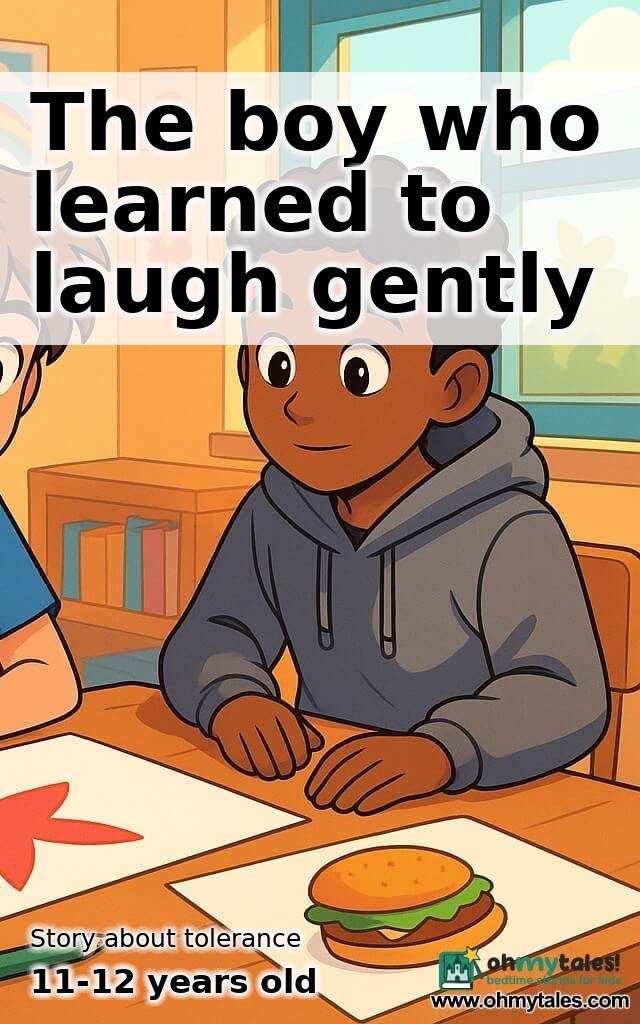
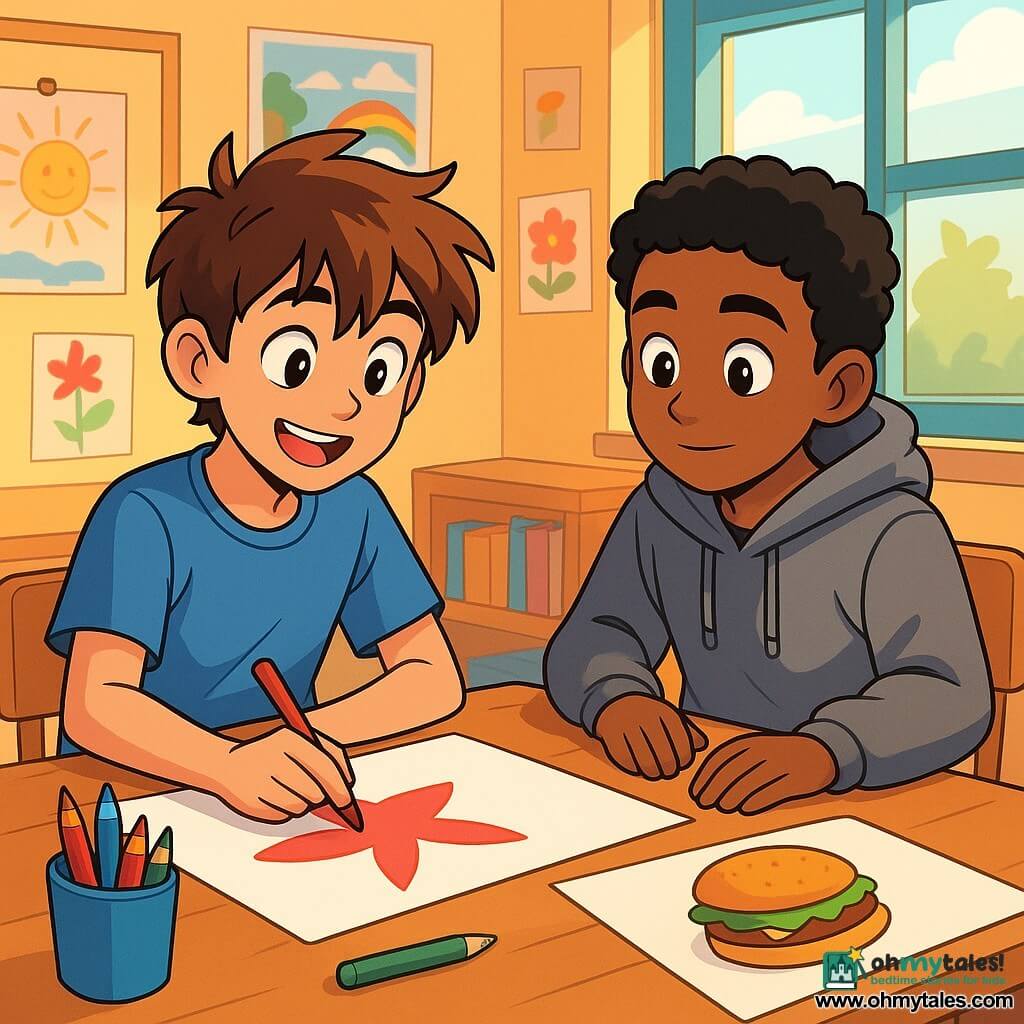
The door opened again, and a boy stepped in. He was thin, with dark curly hair and a navy-blue hoodie that looked a bit too big. His backpack was worn at the edges. He clutched the straps so tightly his knuckles were white.
“This is Samir,” Ms Parker said. “His family has just moved here. He's joining us from another country, so let's help him feel at home.”
“Hi, Samir,” several voices called.
Samir gave a quick, nervous nod. His eyes darted around the room like a bird checking for danger.
“Okay,” Ms Parker went on. “Seats. Front row: Ava with Leo. Behind them: Chloe with Ben. By the window… Max with Samir.”
Max's stomach did a tiny flip. He liked the window, but he wasn't sure about a partner who barely looked at anyone.
He walked over and slid into his usual chair. Samir came quietly to the seat next to him and sat down without a word.
“I'm Max,” Max said, turning so he faced him. “You heard that already, obviously.”
“Yes,” Samir replied in a soft accent. He kept his eyes on his pencil case.
“So… where did you come from?” Max asked.
“From Syra—” Samir started, then corrected himself. “From the city. In the east.”
Max frowned. “Why did you change your answer?”
Samir's fingers froze on his zipper. “It is… complicated,” he murmured.
“I like complicated,” Max said. “You can tell me.”
Before Samir could answer, Ms Parker clapped her hands. “Eyes up here, everyone. We're going to talk about our class agreement for this term.”
Max turned around. The class agreement was a big piece of coloured card stuck to the board, covered in neat sentences such as “We listen to each other” and “We take turns to speak”.
“This term,” Ms Parker said, “I want to add one new rule: No one laughs at mistakes. Not their own, not anyone else's. We can laugh with each other, but not at each other. If we want everyone to feel safe speaking, we need this.”
A couple of people shifted in their seats. Ben whispered, “Even if it's really, really funny?”
“Yes, even then,” Ms Parker said firmly. “You can smile, you can help, but no laughing at anyone. Do you all agree?”
Most hands went up. Max hesitated.
“But if something is funny, and we're not allowed to laugh, won't that feel weird?” he asked. “I'm just being honest.”
“It might feel strange at first,” Ms Parker said. “But this is our rule to help everyone learn, especially when things are new or difficult. Trying matters more than being perfect. Can you accept that, Max?”
He felt several pairs of eyes on him. He didn't like rules that hid the truth. Still, he looked at Samir, who was staring at the desk like it was a shield.
“Okay,” Max said slowly. “I'll try.”
“Thank you,” Ms Parker replied. “Trying is all I ask.”
Chapter 2 – Lost in Translation
By mid-morning, the classroom was warm and buzzing with the sound of pens scratching. The assignment was simple: write three paragraphs about your favourite place and then share with your partner.
Max wrote quickly about the football pitch in the park, where the grass always smelled like rain and mud. He enjoyed describing the way the ball skidded over damp grass and how shouting with his friends made his chest feel big and bright.
When he finished, he leaned over. “Your turn. What's your favourite place?”
Samir looked pale. His paper was still almost blank, just a few crossed-out words.
“I do not know how to say it,” he muttered.
“Say it badly,” Max said. “We're not allowed to laugh, remember?”
Samir glanced at him, suspicious, then took a breath. “In my old city, there is… was… a market. It was loud like… like a hundred birds. And spices.” He frowned, searching for the word. “The smell is like… red and yellow in your nose.”
“That's… actually cool,” Max said. “Write that.”
“I do not know how to spell some words.”
“I'll help,” Max offered. He pushed his own paper aside.
Bit by bit, they built the paragraph together. Sometimes Samir spoke a phrase in his language, then tried to shape it into English. Sometimes he stopped and groaned when the word he wanted just wouldn't come.
“What is the word when you feel… happy and sad at once?” Samir asked.
“Confused?” Max tried.
“No. It is like… you miss it, but thinking about it also makes your chest warm.”
“Oh. Homesick, maybe?”
“Yes. Homesick.” Samir wrote it down, pressing hard.
After a while, Ms Parker called, “All right. Let's share with our partners. Remember our rule about mistakes.”
Max and Samir took turns reading. When Samir said “spices” like “spiss-es”, Max felt a familiar tickle of laughter rise in his throat.
Without thinking, he started, “You said spi—”
He stopped halfway through the word. Across from him, Samir's shoulders had tensed.
Max swallowed the laugh. It felt like trying to hold back a sneeze.
“You said it nearly right,” he corrected himself. “Just a tiny bit different. But I understood. That's the important part.”
Samir peered at him. “You are not laughing at me?”
“I promised,” Max said. “And if I break it, Ms Parker will give me The Look.”
Samir's mouth twitched. “Her eyebrow look?”
“Yes. Exactly that.”
A reluctant grin spread over both their faces.
From the next table, Ben was reading to Chloe. “I like the beach because of the waves and the… and the gulls that are always… dive-bombing,” he said, stumbling on “dive-bombing”.
Max heard a snort. Leo burst out laughing. “Dive-bombing! You sound like a cartoon!”
Ben's ears went pink.
Ms Parker turned sharply. “Leo.”
“I'm sorry, it just sounded—”
“We have a rule,” she reminded him gently. “Ben is brave enough to read his work aloud. That is never funny.”
Leo sighed. “Okay. I'm sorry, Ben.”
The room quieted. Max shifted in his chair, thinking. The rule did feel strange. Keeping a laugh stuffed inside his chest was uncomfortable. But seeing Ben's shoulders slowly relax, he couldn't say the rule was a bad idea.
He glanced sideways at Samir's careful handwriting. Maybe, he thought, some rules weren't about hiding truth. Maybe they were about protecting people so they dared to tell the truth.
Chapter 3 – The Group Project
On Tuesday, colourful paper and glue sticks appeared on every table. That only meant one thing: group projects.
“We're going to create ‘Our Class World Map',” Ms Parker announced. “Each group will design a poster about where your families come from, what you like, what languages you speak, and what you can share with others. This is about our differences and what they bring to our classroom.”
Four hands shot up at “glue sticks”. One belonged to Max. “Will we get to choose our groups?”
“No,” Ms Parker said. “I'm choosing. I want a mix. Cooperation practice.”
Groans again.
“Group A: Ava, Leo, Mia, and Lucas. Group B: Chloe, Ben, Zara, and Eli. Group C…” She looked up. “Max, Samir, and Hannah.”
Hannah came over with an armful of coloured paper. Her hair was in a long, neat braid, and she always had perfect handwriting and perfect answers.
“Hi,” she said, dropping the paper with a soft thud. “I'm really good at drawing flags.”
“I'm good at drawing footballs,” Max said. “And … stick people.”
“I am good at drawing… food,” Samir added quietly. “If you show me picture, I can copy.”
“Nice,” Hannah said. “We'll be the best-looking poster.”
“What if we're not?” Max blurted out. “Someone else might be better. We'll just be okay.”
Hannah blinked. “Well… we'll try our best,” she said, a little stiffly.
“Okay,” Max said, feeling the tension pinch the air. He hadn't meant to sound rude; he'd just said what he thought.
“So,” Hannah continued, “what should we put on our map? Where is your family from?”
“Mine? Here,” Max said. “Mum and Dad grew up in this town. Grandparents too. Really exciting.”
“That's still good,” Hannah replied. “It means you know a lot about the local stuff. Parks, clubs, places people go.”
She looked at Samir. “And you?”
“I was born in Syria,” he said carefully. “But I lived in three other places too. It is… messy for maps.”
“Messy can be interesting,” Hannah answered. “We can use different colours for each place.”
Max watched them. Hannah wasn't scared of the complicated bits; she just sorted them like pieces of a puzzle.
“I can draw our town,” he offered. “The river, the football pitch, the library.”
“And I'll do the flags,” Hannah said. “We'll put them by the places.”
“I can draw the foods from… from my old market,” Samir suggested. “And also from here. Like chips. And… what is that thing with meat in bread?”
“A burger?” Max said.
“Yes. Burger.” A real smile touched Samir's face. “I can draw a burger.”
They worked in quiet bursts. Sometimes they bumped hands reaching for the same glue stick. Sometimes they disagreed about where to put something.
“The river should go here,” Max said, sketching a blue line.
“No,” Hannah objected. “Then there's no room for the library.”
“But the library is by the river,” Max protested. “That's just the truth.”
“Draw it smaller,” Samir suggested gently. “Then both things fit.”
Hannah and Max looked at the space. “That… actually works,” Hannah said.
They tried it. The river curved in a gentle loop, with a tiny brown square tucked near it for the library. Max added minuscule windows.
“That's the children's corner,” he explained. “And that's where I got a book with a footballer who missed a hundred goals before he scored one.”
“That is a lot of mistakes,” Samir said.
“He became really good,” Max replied. “He just kept trying.”
Samir's pencil slowed. “Maybe I will keep trying with… English.”
“Yeah,” Max said. “Please do. Otherwise who will draw all the burgers?”
By the time the bell rang, their poster was splashed with colours: flags, food, river, tiny houses, roads that zigzagged. It looked a little messy but alive.
Ms Parker came over and studied it. “I like the different sizes,” she said. “The big market stall, the small library, the river wrapping around them. It shows how our lives overlap.”
“It's not perfect,” Max said quickly, before anyone else did.
“It doesn't have to be,” Ms Parker replied. “It's honest. And it's ours.”
Chapter 4 – The Honest Comment
On Wednesday afternoon, the class gathered in the hall for music. Mr Baines, the music teacher, clapped his hands for silence.
“Today we're learning a new song for the school celebration,” he said, waving a stack of lyric sheets. “It's about building bridges between people. Very fitting for our world map project.”
He handed out the sheets. The song had a clear, climbing melody. The words talked about speaking kindly, listening, and “sharing the rhythm of our many different hearts”, which made Max snort softly.
“That line is weird,” he whispered.
“It is beautiful,” Hannah whispered back.
Mr Baines heard the tail end. “Something to share, Max?”
“You wrote ‘rhythm of our many different hearts',” Max said. “People don't talk like that.”
A few kids giggled. Mr Baines tilted his head.
“You're right. People don't usually speak like that,” he agreed. “Songs are allowed to be a bit poetic. But thank you for your honesty.”
Max flushed. He wasn't expecting agreement. He'd been ready for a lecture.
The class started singing. Some voices were loud, some shy, some off-key. When they reached the line about “different hearts”, Max mumbled, barely moving his lips.
“Sing, Max,” Mr Baines called. “I need all the honest voices too.”
“I don't like that line,” Max replied.
“Then make it your own,” Mr Baines suggested. “Think what it means to you, not what the words say exactly.”
Max thought about Samir, about the market “like red and yellow in your nose”, about Leo laughing and then apologising, about the rule he was still getting used to. He tried the words again, this time imagining each “different heart” was a different story.
The line didn't feel so strange when he sang it like that.
After music, they walked back to class in pairs. Samir tugged on Max's sleeve.
“You say what you think all the time,” he said quietly. “Does it not make trouble?”
“Sometimes,” Max admitted. “Mum says my mouth runs faster than my brain. Why?”
“In my last school,” Samir said, eyes on the floor, “when I said what I thought, some boys were angry. They said I was wrong to like certain things. Wrong to speak different. I learned to be… quiet.”
“That's not fair,” Max said, too loudly. His voice echoed down the corridor.
A teacher glanced over; Max lowered his tone. “It's not wrong to be different.”
“It feels safer to be quiet,” Samir answered.
Max thought about the no-laughing rule, about trying not to say the first thing that popped into his head when it might hurt someone. Maybe there was another side too—helping people who were quiet to bring out what they really thought.
“If you say something and someone laughs,” Max said, “I'll remind them of the rule.”
“You will?” Samir asked.
“Yeah. I agreed to it, remember? No laughing at mistakes. That includes accent mistakes. Or opinion mistakes.”
Samir smiled a little. “Thank you.”
“And if I say something and it comes out rude, you're allowed to tell me,” Max added. “You can say, ‘Max, your honest mouth is being annoying.'”
Samir laughed properly then, a sound that surprised both of them.
“I will remember that sentence,” he promised.
Chapter 5 – The Lunchtime Problem
On Thursday, the problem started with peas.
The cafeteria buzzed with voices and the clatter of cutlery. Max carried his tray, balancing his plate of pasta, peas, and a small piece of chocolate cake.
He spotted Leo and Ben at their usual table. An empty seat waited beside them. But at the next table, near the window, Samir sat alone, pushing peas around his plate.
Max stood between the two tables, his tray growing heavier.
“Max, over here!” Leo called, waving.
Ben grinned. “We've got cake-trading negotiations to do.”
Max turned to Samir. “Why are you sitting there by yourself?”
“I do not know where to sit yet,” Samir said, eyes lowered. “It is… confusing.”
“You can sit with us,” Max said immediately. “Right, Leo? Ben?”
Leo hesitated. “Yeah… but there are only two spare chairs.”
“We can move one,” Max suggested.
Behind them, the line grew longer. The dinner lady sighed. “Move along, please.”
“Just choose a table,” Leo said. “It's not that complicated.”
Max felt pressure building inside him. He wanted to be honest with his friends. He also wanted to keep his promise to help Samir feel welcome.
He took a deep breath. “I'm going to sit with Samir today,” he decided finally.
Leo blinked. “But we always sit together.”
“Today is different,” Max said. “You can come to this table too.”
Leo looked at the quiet boy by the window and then at the crowded space. “I don't know,” he muttered. “It feels weird.”
“Different isn't bad,” Max replied. “Just different.”
He hated how grown-up he sounded, but it was true.
Ben shrugged. “I'll come,” he said. “I like windows.”
Between them, they dragged over two extra chairs. The table wobbled dangerously, but it held.
They sat down. For a few moments, nobody spoke. The only sounds were forks clicking and peas rolling.
“This is awkward,” Leo whispered to Max.
“You're whispering loudly,” Max pointed out.
Leo snorted. “There's your honest mouth again.”
Samir stared at his food. Max stabbed a pea and tried to think of something that wasn't completely boring.
“Samir draws really good burgers,” he said suddenly.
Ben paused with his fork halfway to his mouth. “Randomest sentence ever. But cool.”
“It is for our project,” Samir explained. “Food from different places.”
“What food do you miss from your old home?” Ben asked.
Samir's eyes brightened just a little. “There is a bread that is flat and big like this.” He made a wide circle with his hands. “We eat it with… everything.”
“Everything?” Leo said. “Even chocolate cake?”
“Maybe not cake,” Samir answered. “But cheese. And beans. And eggs. And… I forget the word.” He frowned. “It is green and you put it on salad.”
“Lettuce?” Ben suggested.
“No. Stronger taste.”
“Spinach?” Leo tried.
“No. It smells a bit like… soap.”
“Coriander?” Max guessed.
“Yes!” Samir suddenly laughed. “That is it. Coriander. How do you know that word?”
“My mum grows it in the garden,” Max said. “It tries to take over everything.”
Leo poked his peas. “So… you miss coriander bread more than you miss us?” he asked, attempting a joke.
Samir hesitated. “I do not know you well enough to miss you,” he answered honestly.
Ben choked on a laugh, then clamped his lips together, remembering the rule.
Max burst out giggling. The sentence was so perfectly honest it surprised him into it.
Samir's eyes widened.
Max caught his breath. “Wait. Sorry. I'm not laughing at you. I swear. That was just… the most honest thing anyone has said this week.”
“It's kind of fair,” Ben added. “You can't miss people you just met.”
Leo sighed. “Yeah. I guess you'll miss us in the future, obviously,” he added, grinning.
“Obviously,” Samir echoed, and the tension scattered like crumbs.
The rest of lunch went easier. They talked about football teams, video games, and how the peas were probably older than they were. Samir didn't know all the words, but he tried. When he mixed up “goalkeeper” and “gatekeeper”, Max felt the laugh bubble up again.
“Goalkeeper,” he corrected gently, slowing the word down. “Gatekeeper is for castles.”
Samir repeated it carefully. Nobody laughed this time. Leo even said, “Honestly, gatekeeper sounds cooler.”
As the bell rang and they carried their trays away, Max realised something. Sitting at a different table had felt weird. But only at the start. After a while, it just felt like… more people to talk to.
Chapter 6 – The Class Agreement
On Friday morning, a big sheet of clean, white card lay on the front table. Coloured pens were lined up in a neat row.
“We're going to redo our class agreement today,” Ms Parker announced. “You've all been practicing our new rule, and I think we can add to it—together.”
Excited whispers filled the room.
“This time,” she continued, “you will help write the sentences. Raise your hand if you have an idea.”
Hands shot up.
“‘We don't laugh at mistakes,'” Hannah suggested. “That one first, please.”
Ms Parker wrote the words in blue. “Any additions?” she asked.
“We also… help with mistakes,” Ben offered. “Like, we try to understand what people mean.”
“Good,” she said, adding: “We help each other when we make mistakes.”
Max stared at the blank space below, his fingers tapping his desk. He wanted to say something, but he also wanted to choose his words carefully this time.
“Yes, Max?” Ms Parker called.
He hadn't realised his hand was up until that moment. “Can we add something about being allowed to say what we think?” he asked. “But… kindly. Not in a way that hurts people.”
“Like honesty with a soft edge,” Chloe said.
“Yes,” Max agreed, surprised she'd understood so well. “Like, ‘We say what we think, but we also think about how it will sound.'”
Ms Parker smiled and wrote, “We share our ideas honestly and kindly.”
Samir raised his hand very slowly, as though it weighed a lot.
“Yes, Samir?” Ms Parker encouraged.
He swallowed. “Maybe… we say… ‘We listen to people who are different and do not say they are wrong just because they are different.'”
The room was very still.
“That's a long one,” Leo muttered, but there was no teasing in his voice.
“It's important,” Hannah said.
Ms Parker wrote carefully: “We listen to people who are different and respect their ideas.”
“Respect,” she said aloud. “A big word. A big idea.”
By the time they finished, the poster read:
We don't laugh at mistakes.
We help each other when we make mistakes.
We share our ideas honestly and kindly.
We listen to people who are different and respect their ideas.
We take turns.
We cooperate to solve problems.
“Do you all agree to this?” Ms Parker asked.
“Yes,” the class replied, some louder than others.
“I want you to sign it,” she said. “Your name means you accept these rules as ours, not just mine.”
One by one, they came up to the table. Ava signed in purple loops, Leo in messy green capitals. When it was his turn, Max chose a blue pen.
He wrote “Max” neat and clear. As he set the pen down, he felt a tiny shift inside him, like a drawer closing with everything in the right place.
On the way back to his desk, he brushed past Samir.
“We really could just say ‘don't be mean',” Max whispered. “But this sounds smarter.”
“It is more… detailed,” Samir said. “I like that it says we can be honest if we are also kind.”
“Yeah,” Max replied. “That's kind of my new favourite rule.”
Chapter 7 – A Gentle Morning
The next morning, sunlight slipped shyly through the curtains of Max's bedroom. Outside, a bird tried out a few notes, like it was warming up for a concert.
Max lay on his side, half awake. The week drifted through his mind in little pieces: the market “like a hundred birds”, the messy map, the lunch table by the window, the new agreement with all their names. He remembered how heavy his laughter had felt when he held it inside, and how much lighter it was when he used it gently.
In his dream, the classroom walls were made of glass. Outside, rivers and markets and football pitches ran together. Voices in different accents joined into one song, not because they were the same but because they tried to listen to each other.
Someone in his dream said, “We can be different and still sit at the same table.”
He wasn't sure if it was Samir's voice or his own.
“Max,” came a quieter, real voice. His mum's. “Time to wake up, love.”
He stirred, blinking as the dream faded. The ceiling came into focus, with the faint shadow of the curtains moving like water.
“Just a minute,” he mumbled.
The door opened a little. His mum peeked in. “You've got football club this morning. Don't you want time for toast?”
“Yeah,” Max said, rolling onto his back. His legs felt heavy with sleep, but his mind felt oddly peaceful.
As he sat up, the agreement words floated back to him: “honestly and kindly”, “we listen”, “we cooperate”. They didn't feel like rules from a poster anymore; they felt like tools he could carry around, like the pencils in his case.
He thought of Samir. Maybe they'd sit together again at lunch. Maybe they'd draw more tiny libraries and enormous plates of food. Maybe he would ask about the flat bread and coriander and see if his mum could find a recipe.
He swung his feet to the floor. The room was cool, but the patch of sunlight by his bed was warm on his toes.
His mum called again, this time with a hint of a smile in her voice. “Max, up. The world won't wait forever, you know.”
“I'm coming,” he answered.
He stood, stretched, and let out a slow breath. The day ahead felt big, the way days always did, full of moments when he might say the wrong thing or laugh at the wrong time, or, maybe, choose better.
He padded to the window and pulled the curtain a little wider. Light spilled into the room like a quiet promise.
Behind that light were his friends, his class, and one new boy who drew burgers and spoke in careful words and laughed like he was still learning how.
Max smiled, suddenly fully awake, and turned toward the door, ready to step into the day.