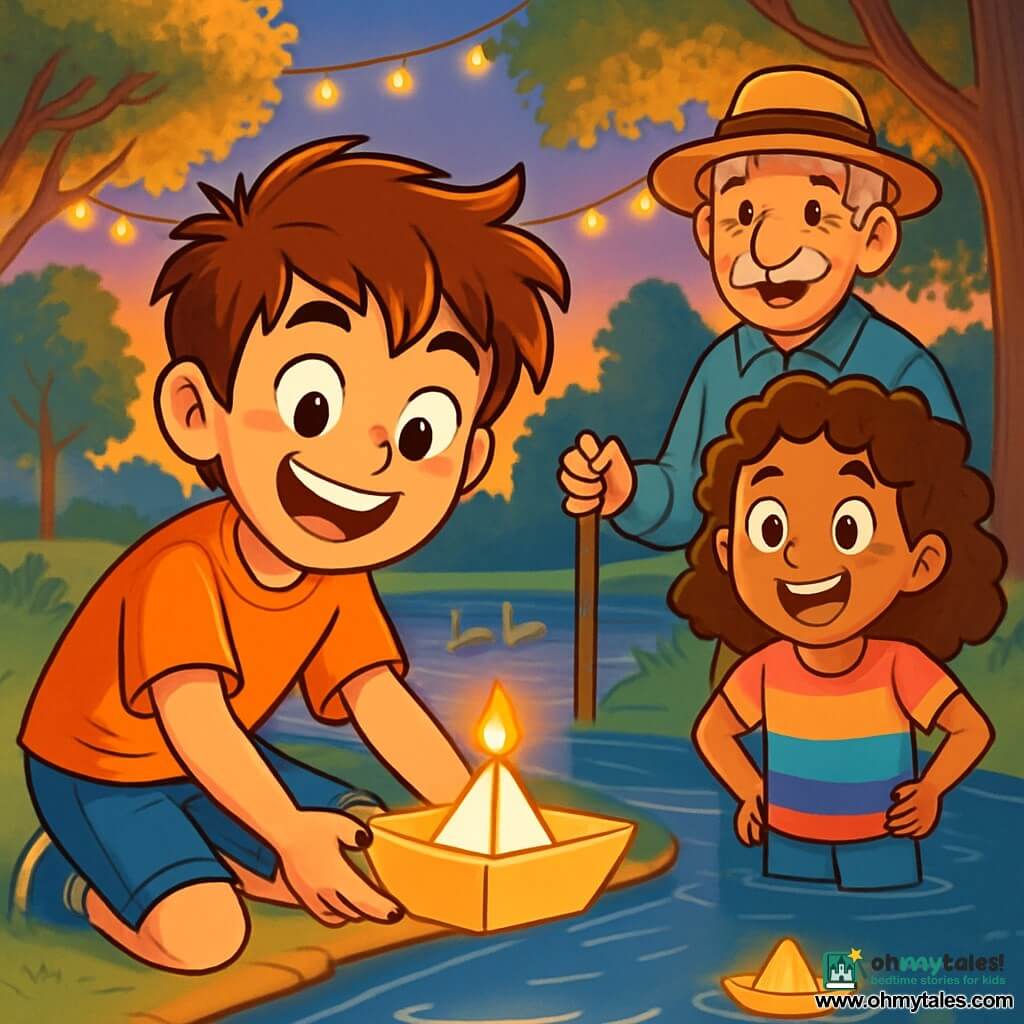
The Memory of Lights
On the morning Theo turned eleven, the sky looked like a frosted cake. Thin clouds smoothed across the blue, and sunlight sprinkled over the kitchen table where a small, lopsided banner read: Hooray for Eleven! His eggs smelled like butter, and the birthday candle stuck in his pancake left a tiny pink wax puddle. Theo's mom sang off-key, which somehow made it better, and his grandma Mimi wore a paper hat with stars that wouldn't stop slipping over one eyebrow.
“Make a wish,” Mom said, sliding a box of matches across the table.
Theo hesitated. Wishes felt slippery. He'd wished for a skateboard last year and spent more time bandaging his knees than riding it. He stared at the candle. The flame trembled like it had its own tiny heartbeat.
Before he could blow, Grandma Mimi lifted her mug of tea. “When I was a girl,” she said, "nobody blew out candles indoors. We floated them.”
Theo blinked. “You floated candles?”
“Oh yes,” Grandma replied, eyes sparkling. “Paper boats with little lights. On birthdays, we'd meet at Maple Pond at dusk. Everyone made a boat, even the grumpy neighbors. We'd whisper our hopes and watch the lights bob, like a pocketful of stars set free.”
Theo imagined it—quiet water, tiny glow after tiny glow, a soft swish of frog sounds. It felt like the inside of a bedtime story, except the world outside his window was full of car horns and scooter wheels and a cat walking along a fence like it knew everything. He blew out the candle in a single puff. The smoke made the kitchen smell like matches and sugar.
“Why did it stop?” he asked.
“Rules, I think,” Grandma said. “And time. Traditions are like kites. If nobody holds the string, they drift off.”
Theo thought about the banner, how the tape kept peeling and how his mom kept pressing it back up. Maybe traditions needed a hand like that. He glanced at his birthday card from last year, still stuck to the fridge with a magnet shaped like a tomato. Some things were worth holding on to.
“I want to bring it back,” he heard himself say. The words surprised him, like when a ball you toss lightly lands farther than you thought it would. “The candle boats. Tonight. For my birthday.” He swallowed. “If that's allowed.”
Mom looked at him with the kind of smile that had a question tucked inside. “It could be. But we'd need to make it safe. Maybe lights that don't burn?”
“We could ask,” Grandma said softly. “The worst that happens is someone says no.”
The idea sparked inside Theo like the candle's tiny flame. He didn't feel like the boy who tripped over his skateboard, or the one who ducked when the teacher asked for volunteers. He felt taller, like his bones were quietly standing up straighter. “I'll go to the park,” he said. “I'll ask the keeper. I'll make a plan.” His voice shook, just a little. He picked up his fork to hide it and accidentally flung a piece of pancake onto the floor. The cat pounced, triumphant.
Grandma laughed. “If you're going to launch a hundred boats, we'd better start with a dozen. And we'll need cardboard. And twigs. And those little battery lights we used at winter festival.”
Theo pictured the pond at dusk. He pictured the neighborhood, the people he knew and the ones he'd only seen in the elevator or walking behind grocery carts. He pictured the lights floating and the soft hush of everyone watching. He pictured being brave enough to make it happen.
“I'll try,” he said. “I'll try today.”
Permission and Puddles
Maple Pond wasn't far. Theo cut across the basketball court and the little triangular park where a statue of a dog pointed forever toward nothing in particular. The pond glinted between willows and a weeping birch, round as an eye. A sign that smelled faintly like rain warned NO FIRES, NO GLASS, NO SWIMMING. Ducks paddled in a patient row like they were late for a meeting and didn't mind.
The park keeper stood by the tool shed, tying up a bag of leaves. She wore a sunhat with a brim so wide it made its own shade. Theo had seen her a hundred times but never up close. He lifted his hand in a wave. It felt heavy, like it weighed as much as a branch.
“Excuse me,” he said. His voice came out small and croaky. He tried again. “Excuse me, Ms. Howe?”
She turned. Her face had the kind of wrinkles that looked like maps. “Yes?”
“It's my birthday,” he blurted. “I'm eleven. There used to be a tradition. My grandma said they floated little lights on the pond. Not real candles. We could use the fake kind. LED.” He said the letters as if they might convince her by themselves. “I wanted to ask if we could do it. Just tonight. With grown-ups.”
Ms. Howe studied him. A breeze tugged at her hat. Somewhere a crow shouted its own name. Theo's palms felt slick. A drip from the fountain tapped on the stones like a clock.
“Floating lights,” she said at last. “People always want to put things in the pond. Roses. Bread. The weirdest was an inflatable dinosaur. It frightened the geese for days.” Her eyes warmed, though, and she looked past Theo toward the shade of the two willow trees. “When I was new here, old Mr. Patel told me about the birthday boats.”
Theo's chest brightened. “So you know!”
“I know it stopped because the candles were hot and the boats were messy and sometimes the ducks got curious.” She tilted her head. “But you said LED.”
“The little tea lights,” he said, holding his hands apart the size of a cookie. “We'd gather them all afterward. We'd maybe even use a net. We'll keep the ducks away with snacks on the other side so they're busy.”
“And grown-ups,” she said.
“Yes. My mom. My grandma. Friends' parents.”
Ms. Howe considered. “All right,” she said. “If you write your plan down and bring it to me before four, and if you promise to leave no trace, and if you bring those lights to show me, I'll let you try it. Eight o'clock, when the sky is soft. Not too dark, not too bright.” She paused. “And I reserve the right to cancel if the wind acts up.”
“Thank you,” Theo said. He hadn't realized he'd been holding his breath until it rushed out of him and made his head float a little. “I'll write it down. I'll be back.”
“Birthday boats,” Ms. Howe said, almost to herself. “I remember the way the water looked, like it was listening.” She lifted a hand. “Happy birthday, kid.”
Theo walked home lighter than air, then heavier, then lighter again as worry and excitement chased each other. A bus splashed through a puddle and glazed his sneakers with dots. He didn't even mind.
At the kitchen table, he drew his plan with colored pencils. A map of the pond. X marks for where people could stand under the willow trees. A box that said light check, and another that said duck distraction. Grandma tracked down the old LED candles in a drawer where batteries, rubber bands, and a one-eyed googly eye had formed a tangled community.
“We'll need invitations,” Mom said, scribbling times and a tiny picture of a boat onto colorful sticky notes. “We'll pass them around after lunch.”
“Do you really think people will come?” Theo asked.
“They won't know unless you ask,” Grandma said. “Courage isn't about never feeling wobbly. It's about walking with your wobble and knocking anyway.”
He pictured himself knocking on Mr. Flint's door. Mr. Flint lived on the third floor and had a mustache shaped like an anchor. He wore socks with sandals and corrected the mail carrier about where to tuck envelopes. Theo's stomach did a small flip. He took a breath and drew an extra neat arrow on his map.
“Okay,” he said. “Let's go knock.”
Boat Builders at the Kitchen Table
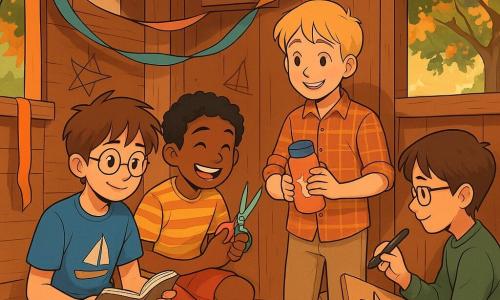
Tables make good shipyards. By two o'clock, Theo's looked like a small storm had blown through. Cereal boxes flattened into cardboard planes. Wooden skewers leaned like masts. String coiled in loops. Glitter had exploded and settled like party snow. Even the cat, whom Grandma called Captain, inspected the scene with a skeptical whisker.
Maya arrived first, carrying a roll of tape bigger than her head. “I brought the good tape,” she announced. “The kind that could hold a piano to the wall.”
“I don't think pianos float,” Theo said, grinning despite the knot in his stomach.
“Neither did dinosaurs,” Maya replied, “and yet.” She glanced meaningfully toward the pond window as if an inflatable t-rex might parade past at any second.
Luis showed up with a box of old chopsticks. “Sails,” he said. “And I brought my dad's hole-punch in case we need to thread strings.”
Juno rolled in on her scooter, helmet sideways. “I designed a hull,” she said, unfolding a piece of paper covered in triangles. “Triangles are strong. Even squares will respect a triangle.”
They made boats. They made mess. They measured and remeasured. Theo had never known cardboard could be so stubborn and so generous at once. Some boats sat on a bed of corks like fat water bugs. Others were sleek and plain. Maya sprinkled a path of glitter down the middle of hers like someone had spilled stardust and didn't bother cleaning it up.
“Names,” Juno said, tapping her pencil. “Important. If a boat doesn't have a name, how will it know who it is?”
Theo's pen hovered. He thought of the tradition he wanted to lift back up. He wrote: Courage.
“My boat is named Snack,” Maya declared. “For obvious reasons.” She attached a banner made from a candy wrapper to the mast.
“Mine is called Steady,” Luis said, aligning tape with methodical precision.
Juno grinned. “And I now christen this triangle-ship: Tri-Umph.”
They tested one boat in the bathtub. The boat sat proud and perfect. The second boat listed to one side and bumped the soap dish. The third boat sank like it had decided it was done with being a boat. Theo tried not to panic as glitter floated in a sad, sparkly cloud.
“It's okay,” Maya said, scooping it out with a colander. “We learn from the sinkers.”
“Should we add more corks?” Luis asked. “Or make a wider base?”
“Triangles,” Juno reminded them. “We need triangles that behave better.”
They adjusted. They thickened the hulls. They taped in ways that would impress the tape factory. They tucked the LED candles into tiny cardboard pockets and tested the switches. Click, click, click—the lights winked awake one by one. Theo's boat, Courage, lit up like something that meant it.
“Plan says we can make twelve,” he said, checking the map and the time. “The rest of the people bring their own.”
“About that,” Maya said, twirling the roll of invitations. “We still have to hand these out. And you have to go convince Mr. Flint, right?”
Theo's mouth went dry. He rested his hand on the table. The glitter on his knuckles caught the light. It felt like a sign, a tiny spark saying yes. “Right.”
“Want backup?” Luis asked.
“Just a little,” Theo said. He pictured the hallway outside Mr. Flint's door. It always smelled faintly of peppermints. Courage doesn't make the wobble vanish, he reminded himself. It lets you walk with it.
He slid one of the LED lights into his pocket, a small star to carry with him, and nodded. “Let's go.”
Knocking and Neighboring
The building's stairwell echoed with a hollow, friendly sound. The kind that made even small steps feel important. Theo led the way, Maya and Luis at his back like a quiet wind. They knocked on Ms. Ravi's door on the first floor first.
She opened it with a dish towel slung over one shoulder and a smear of flour on her cheek. “Children,” she said, smiling at the sight of glitter on their elbows. “What enterprise is this?”
“We're reviving the candle boat tradition,” Theo said. He held up a sticky note invitation like a flag. “But with safe lights. Eight o'clock at Maple Pond.”
Ms. Ravi's eyebrows rose. “Ah! I remember when the water looked like a birthday cake itself. My husband and I floated our wishes when my twins turned five. I'll be there,” she said. “And I'll bring cookies so the ducks don't borrow your boats.” She paused. “Actually, forget that. No feeding ducks,” she corrected herself. “I'll bring people cookies.”
They knocked at the door with the wreath of tiny clothespins. They explained the plan to the teen who always wore headphones, and to the mom with the baby who had a laugh like a bubble. People smiled. People nodded. People said, “I remember,” in soft, surprised voices. The idea, Theo realized, wasn't brand-new. It was like a song many people knew but hadn't heard in a while.
On the third floor, they came to Mr. Flint. Theo could hear the muffled sound of a radio inside—a voice talking about baseball, wrapped in static. He knocked. For a second, nobody came. Then Mr. Flint opened the door, his anchor mustache pointing in two directions at once.
“Yes?” he said.
Theo's tongue tried to tie itself in a bow. He untangled it. “We're bringing back the birthday boats at the pond. Tonight. LED lights. Would you like to come?”
Mr. Flint's eyes flicked to the invitation. He didn't take it yet. Behind him, his apartment smelled like cedar shavings. There were wooden birds on the shelf, smooth and painted in colors that looked like they belonged to autumn.
“Boats,” he said slowly. “I used to build them.” He squinted. “With candles, back before everyone started worrying they'd set the pond on fire.”
“We don't want fire,” Maya said quickly. “We want glow.”
“We're making some in our kitchen,” Theo added. “We could use help, if you wanted.” He felt the wobble step out in front of him and said it anyway. “Only if you wanted.”
Mr. Flint's mustache shifted. It might have been a smile. “I have some thin wood, lighter than cereal boxes. It floats better. I have tiny clamps. And a trick for the hull so the boat doesn't tilt.” He reached for the invitation. “All right. I'll come down. Give me ten minutes. I need to put on shoes that won't embarrass my tools.”
As they headed downstairs, Maya nudged Theo with her elbow. “See? Backup helps.”
Back in the kitchen, Mr. Flint surprised them by laughing when the cat stole a cork and ran under a chair with it. He set up a small boatyard of his own at the end of the table and showed them how to bend thin strips so the edges kissed and made a shape that wanted to stay afloat. His hands were quick and careful. He told them about boats he had built for the solstice and for neighborhood picnics, how sometimes people cried a little when their wishes drifted off, in the good way that feels like a wash.
“People need excuses to gather,” he said. “Tradition is just a good excuse to be together with a purpose.”
Juno stopped by to sand a corner with a bit of nail file and declared Mr. Flint's mustache very nautical. He pretended not to hear and taught her how to tie a clove hitch knot. The room buzzed the way a hive buzzes when all the bees know which flower to visit next.
At three forty-five, Theo stuffed the final boats into a big tote bag lined with towels. He slipped the LED candle from his pocket onto the table and clicked it on and off one last time. The little light blinked steady. He thought about the plan and the pond and all the knocks. He thought about how his whole day was turning into something shaped like hope.
“Let's go show Ms. Howe,” he said.
Dusk at Maple Pond
By eight o'clock, the sky had shivered into that gentle in-between blue—darker than day, lighter than night. The willows leaned toward the water like listeners. People gathered in a loose half circle along the path, faces lifted. Some had brought lawn chairs. A dog in a sweater sat with paws crossed like an old professor. Children wove between legs, their laughter darting like swallows.
Theo counted boats. Twelve from their table, and more carried by others—wobbly wonders wrapped in foil, sleek shapes cut from milk cartons, a few careful wooden ones too perfect to be made in a single afternoon. Ms. Ravi handed around lemon cookies that dusted everyone's fingers in sugar. Mr. Flint stood with a bundle of bamboo sticks under his arm, looking both important and shy. Ms. Howe checked the wind by holding up a blade of grass and watching it lean, then nodded.
“All right,” she said. “Let's keep the branches clear. Lights on only when your boat meets the water. And friends, eyes open—if a duck gets too nosy, clap once, gently.”
Theo swallowed. Everyone's eyes didn't fall on him, exactly, but his birthday spark—the one that had been buzzing inside him—seemed louder. He felt the wobble nudge his ribs. He placed the tote by the bank and looked at his mom. She winked. Grandma rested a warm hand on his shoulder, the way someone presses a note into your palm and doesn't need you to open it to know what it says.
He stepped forward. “Thank you for coming,” he said. His voice carried farther than he expected. Maybe the water helped. “My grandma told me about the birthday boats. We wanted to try it again, with safe lights and a plan. If you want, you can whisper a wish or a hope and set your boat gently on its way. We'll watch. We'll clean up afterward. We'll make the pond proud.”
Someone chuckled softly. Someone else murmured, “Beautiful.” Maya elbowed him from the side, a secret high-five.
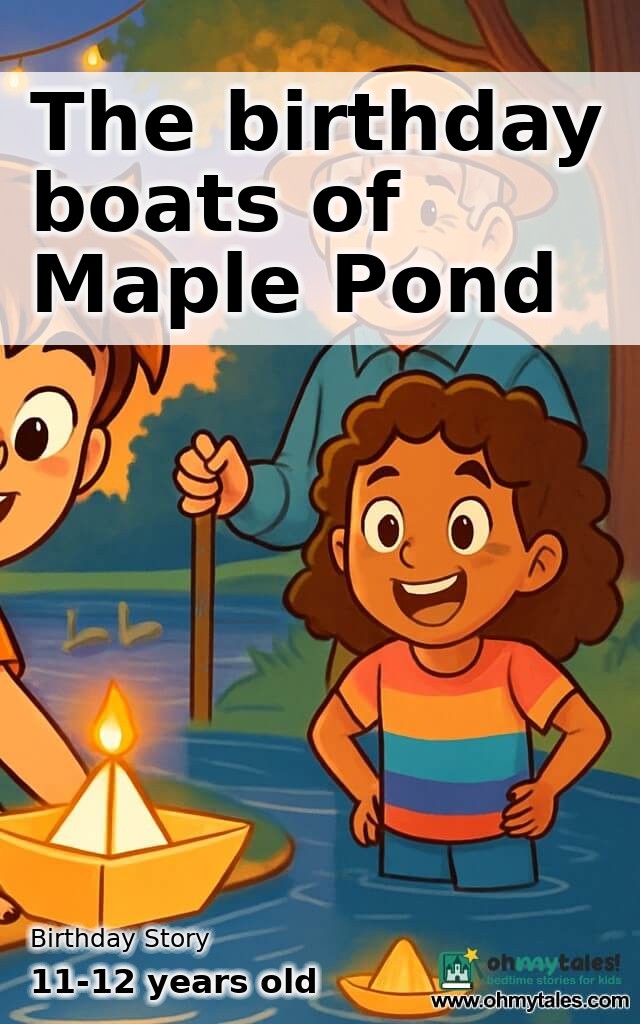
The first boat to touch the water was tiny and round, built from two yogurt lids and twine. Its light winked alive. The boat rocked once, twice, then steadied itself and began to glide. A small sound rose from the crowd, something between a sigh and a cheer. Theo placed his boat, Courage, beside it. When the LED lit, the light made a pathway in the ripples. He whispered, not for anyone else to hear, “Let this bring people together. Let me be brave even when I'm not sure.”
In the hush that followed, more lights bloomed. Boats bumped gently and separated like polite strangers. The pond became a small galaxy. Reflections reached out and curled back, soft as a cat's tail. Ducks floated at the far end, suspicious but not offended, their heads tilting like they applauded in their duck way.
A child squeaked. One boat took on water and slurped downward, the light dimming like a sleepy eyelid. People laughed in the kind way, not the mean kind, and Mr. Flint, quick as a magician, lifted it with a bamboo stick and set it right. “Every sailor tips once,” he said loud enough for the worried child to hear. “That's how you learn what the water is saying.”
A sprinkle of rain showed up, delicate as confetti. Someone opened a striped umbrella that looked like a circus tent. Ms. Howe watched the sky and nodded once, satisfied. “Just a polite drizzle,” she said to no one in particular. “It won't last.”
They sang—without planning to, the way you start to hum when you recognize a tune. It wasn't a traditional birthday song exactly; it stretched itself into something slower, warmer. People added harmonies. It felt like the pond sang back, a watery murmur. Theo grinned, the kind of grin that makes your cheeks ache and you don't care.
Maya held her boat, Snack, up with a flourish, then crouched to release it. The boat floated strong. A duck swam over, curious, then turned away, distracted by the serious matter of a mosquito. Juno's Tri-Umph scissored between two larger boats and sailed like a paper dream. Luis's Steady lived up to its name and refused to wobble at all, as if it had decided wobbling was for other boats.
Theo watched faces. He saw someone wipe their eyes and laugh at themselves for wiping their eyes. He saw a teen who always wore headphones but never smiled much grinning at a boat that resembled a dragonfly. He saw his mom sway a little to the rhythm of nothing, and he saw his grandma look like the happiest version of herself, the one with her paper hat askew and her heart right there at the surface.
“Tradition revived,” Mr. Flint murmured, stepping lightly along the bank with the bamboo stick. “Look at you, kid. Captain Courage.”
Theo felt red rise to his ears and didn't mind. He stood up straighter. The wobble stepped back, not gone, but friendlier now, as if it too had found a place on the shore.
After the Glow
The lights thinned as people gently steered boats toward the bank. Hands reached, careful and sure, fishing out each vessel. LEDs clicked off, one by one, until the pond turned back into itself again—quiet, reflecting a sky with one early star.
They gathered their things. They picked up bits of tape and stray corks. Ms. Howe did a little inventory of the shoreline like a librarian counting books after story time. Everyone found something to carry besides their own belongings. The tradition felt like a soft rope threaded through all their hands at once.
Grandma pressed her palm to Theo's cheek. “You did it,” she whispered. “You gave the string a good tug.”
He swallowed around a lump that felt like it had both edges and feathers. “We did it,” he said. He looked around. “Together.”
Mr. Flint approached, wiping a drip of water from his cuff. He held out a small wooden rectangle. On it, he had burned a simple design—a tiny boat with a light in its belly. Underneath it he had written Boat Night, Theo 11.
“I thought maybe we could make one each year,” Mr. Flint said, almost shy. “A little marker. To remember. We could hang them from the willow, just for the night, and then keep them in a box.”
“That could be a new part of the tradition,” Theo said. “A boat badge.” The idea slid neatly into place. He liked how traditions could bend and grow the way a branch grows around a fence and somehow looks perfect doing it.
People began to drift home, in clusters, like boats themselves. Maya slung her tote over her shoulder. “Best. Birthday,” she said, stretching the words so far they almost squeaked. “Next year we add music with kazoos.”
“Next year we add exactly zero kazoos,” Luis said, deadpan, and they laughed because both possibilities seemed hilarious and horrible in equal measure.
Ms. Ravi pressed a cookie into Theo's hand. “For breakfast tomorrow. Or now,” she said, then slid two more into his pocket as if smuggling kindness.
Theo watched the last few ripples smooth. The air smelled like wet leaves and lemon sugar. He felt filled up in a way gifts never made him feel. It wasn't just attention or cake or even the pretty sight of the lights. It was the way his courage had stretched and found it could hold more than it thought. It was the way his neighbors had shaped a circle out of nothing but willingness.
Grandma took his arm. “One more thing,” she said, leading him to the willow. At eye level, someone had tied a small tin bell. Theo hadn't noticed it earlier. It had a ribbon like the ones on winter presents and a clapper shaped like a tear drop.
“We used to ring the willow after,” Grandma said. “A little chime to say thank you to the pond and to remind us to be good neighbors.” She placed her fingers over his on the ribbon. They tugged together. The bell made a thin, silver sound. The sound seemed to hang over the water for a long, soft breath.
“I like that,” Theo said. “Let's keep it.” Then, because it mattered, he looked for Ms. Howe. “Is that okay?”
“It's lovely,” Ms. Howe said, her voice warm. “I'll make sure it only stays when it should. We'll ring it quietly. Traditions can share.”
On the walk home, Theo carried the wooden boat badge like a treasure. His sneakers squeaked on the damp path. Maya walked backward to keep facing him and nearly tripped into a shrub, which made everyone snort and then pretend not to snort. The dog in the sweater trotted ahead as if leading them to bed.
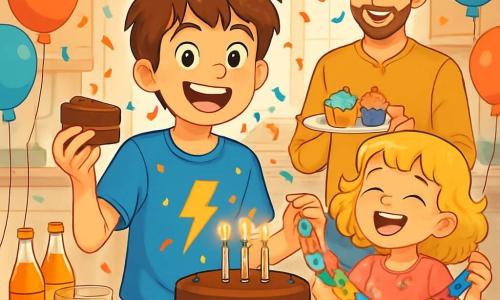
At home, the kitchen smelled faintly of glue and tea and fun. The banner still clung to the wall, a little wrinkled from trying so hard. Mom set out slices of cake. It was simple—layers of vanilla stacked like soft pages, frosting smoothed imperfectly, candles tucked away now that they'd found a new job.
“Speech,” Juno said, plunking into a chair and bumping the table with her knee. “And make it excellent.”
Theo took a bite of cake first, so he wouldn't talk too fast. He looked at their faces—his mom, tired and glowing; Grandma, bright as a fairy light; his friends, carrying a shine that had nothing to do with glitter and everything to do with the pond's quiet magic.
“Thank you for helping me do a thing that scared me a little,” he said. “It's the best present. I think we should keep doing it. Not just for my birthday. For anyone who wants it. We'll make a calendar. It could be a neighborhood thing.”
“Boat Nights,” Maya agreed. “We'll make official signs. With zero kazoos.”
“Maybe just one kazoo,” Luis compromised, failing to hide a grin.
Mom touched Theo's shoulder. “Sometimes one person saying 'Let's' is all a tradition needs.”
Theo felt his heart rest in a good way. He didn't mind that a smudge of glitter would probably live in their carpet until the end of time. He liked the idea of a house that held pieces of nights like this one—stealth sparkles, a wooden badge, the ghost of lemon sugar.
Before bed, he stood at the window and looked toward the dark outline of the trees by the pond. He thought about the first boat tilting, the way everyone had leaned closer together for one small soggy moment, then laughed and fixed it. He thought about how courage didn't mean being the loudest or the boldest. Sometimes it meant saying, “Can we?” to someone with a big hat and listening to their answer with respect. Sometimes it meant knocking on a door with an anchor mustache behind it.
He turned the tiny LED light over in his fingers. Then he clicked it on and set it beside his bed. It made a soft circle on the wall, a reminder that light could float, that wishes could be whispered, that a pond could become a galaxy if enough people believed in small, glowing things.
“Good night, Boat Night,” he said into the quiet, and felt the words settle like a blanket.
In the morning, the bell at the willow would glint. The badge would hang on his doorknob until he found the right place for it. The tradition would stretch like a ribbon into the days to come, not his alone, but something everyone could carry. He felt brave enough, not all at once, but enough to start, which was the kind of brave that most things needed.
He switched off the little light, slid under the covers, and heard the cat leap onto the bed with a thump that said, I was part of this, too. Somewhere outside, a single car rolled by. From the hallway, he heard Grandma humming a tune that sounded like water remembering a boat.
He slept, easy and proud, while the night held the echo of their new old ritual: a choir of quiet lights, a bell promising kindness, a neighborhood that had decided to stand close again, all because an eleven-year-old had decided to knock.