Chapter 1: The Quiet Spark
Noah was eight, and he had a gentle way of walking, like he didn't want to startle the air. He liked shiny things—coins, puddles, and the silver band of the river that curved through his town.
On Saturday morning, he sat on the floor of his room and stared at a sticker sheet. There were rockets, planets, and one silly alien with three eyes and a grin like a banana.
“I'm saving the best one,” Noah told his pillow, which never argued.
His mom leaned in at the door. “River walk today?”
Noah nodded. “Can we bring the binoculars?”
“We can,” she said. “But the ducks might feel famous.”
Noah smiled and tucked the binoculars into his small backpack. He also slipped in his sticker sheet, just in case a day needed a little extra sparkle.
Down by the water, the river path was bright and friendly. Sunlight bounced on the waves like tiny jumping beans. A line of reeds whispered to each other. A kite wobbled above the grass, as if practicing.
Noah walked close to the railing and looked down. The river smelled like wet stones and clean wind.
Then he noticed it.
A flicker of light between two rocks near the edge—too steady to be sunlight, too neat to be a fish.
Noah crouched. “Hello?”
The light blinked back. Once. Twice. Like it was thinking.
He glanced at his mom. She was a few steps away, reading a sign about water birds. Noah's heart did a small drumroll, the kind that meant something new was knocking at the door of the world.
He reached out, not to grab, just to touch the air near the glow.
The glow rose—soft as a bubble—and unfolded into a tiny floating pod the size of a lunchbox. It hummed like a purring cat made of stars.
A small panel slid open.
Two tiny antennae popped up, wiggled, and then stopped, as if embarrassed.
Noah blinked. “Are those… hello antennae?”
The antennae dipped down and up again, like a nod.
Noah's mouth opened, but no words came out. Not because he was scared. Because he was amazed, and amazement can steal your sentences.
The pod made a gentle “bip-bip,” like it was clearing its throat.
Noah tried something brave. He lifted two fingers on each hand above his head, pretending they were antennae.
“Hello,” he said softly. “I'm Noah.”
The pod's antennae perked. The hum brightened, like it liked his idea.
From behind Noah, his mom called, “Found an interesting rock?”
Noah swallowed. He could run to her. He could hide the pod. He could pretend nothing strange was happening.
Instead, he chose courage.
“Mom,” he said, turning. “I found something… friendly.”
Chapter 2: The Antenna Hello
Noah's mom came closer, her face curious but calm. She saw the floating pod and didn't yell. She didn't grab Noah and sprint away. She just knelt beside him, eyes wide like moon slices.
“Well,” she whispered, “that is not a rock.”
The pod hovered politely, as if it had good manners. The antennae made a small wave—up, down, up.
Noah's mom raised her eyebrows. “Is it… greeting us?”
Noah lifted his finger-antennae again. “I think so.”
The pod made a warm chime. A soft beam of light painted a picture in the air, like a tiny movie made of glowing dust.
In the picture, a small alien stood on a smooth, bright deck. It was about the size of a cat, with a round body, long legs, and a face that looked like it was always about to laugh. Two real antennae grew from its head, bending like grass in wind.
The alien tapped its antennae together. Tap-tap.
Then it pointed at its chest. The picture showed a symbol: a swirl with three dots.
Noah tilted his head. “That's your name?”
The pod chimed again.
Noah tried. He tapped his pretend antennae together. “Tap-tap. I'm Noah.”
The pod's antennae wiggled wildly, like it was clapping without hands.
Noah giggled. “It likes it!”
His mom gave a small, careful wave. “Hello, Swirl-Three-Dots. I'm Mom.”
The pod adjusted, and the beam showed another picture: a river, then a starry sky, then a small ship shaped like a pebble. The pebble-ship drifted, and a tiny dot fell—landing right where Noah had found the pod.
Noah leaned closer. “You fell?”
The pod made a sad little “bwoop.”
“Oh,” Noah said quickly, his voice full of comfort. “It's okay. We can help.”
The pod brightened. Another picture appeared: the pebble-ship in the sky above the river path, tucked behind clouds like a shy bird. Under it, a line of glowing arrows pointed to the water.
Noah frowned. “It wants to meet us by the water.”
His mom looked at the calm river, then at Noah. “We can stay right here on the path. Safe and open. If it's friendly, we'll be friendly back.”
Noah's brave feeling grew, not loud, but steady. Like a lamp turning on.
He tapped his finger-antennae again. “We'll come. Tap-tap.”
The pod spun in a happy circle and floated forward, leading them along the riverside promenade. Ducks waddled nearby, totally unaware that first contact was happening beside their feet.
Noah whispered, “Do you think aliens like ducks?”
His mom whispered back, “Everyone likes ducks.”
The pod made a “bip,” as if agreeing.
Chapter 3: A Ship Like a Pebble
They reached a wide spot where the river spread out, smooth and shining. A wooden bench sat facing the water. A few people strolled past, smiling, thinking it was just another bright day.
The pod hovered over the river's edge.
Noah leaned on the railing. “So… what now?”
The air above the water shimmered. It looked like heat, but it felt cool. Then the shimmer folded, like someone closing a secret door.
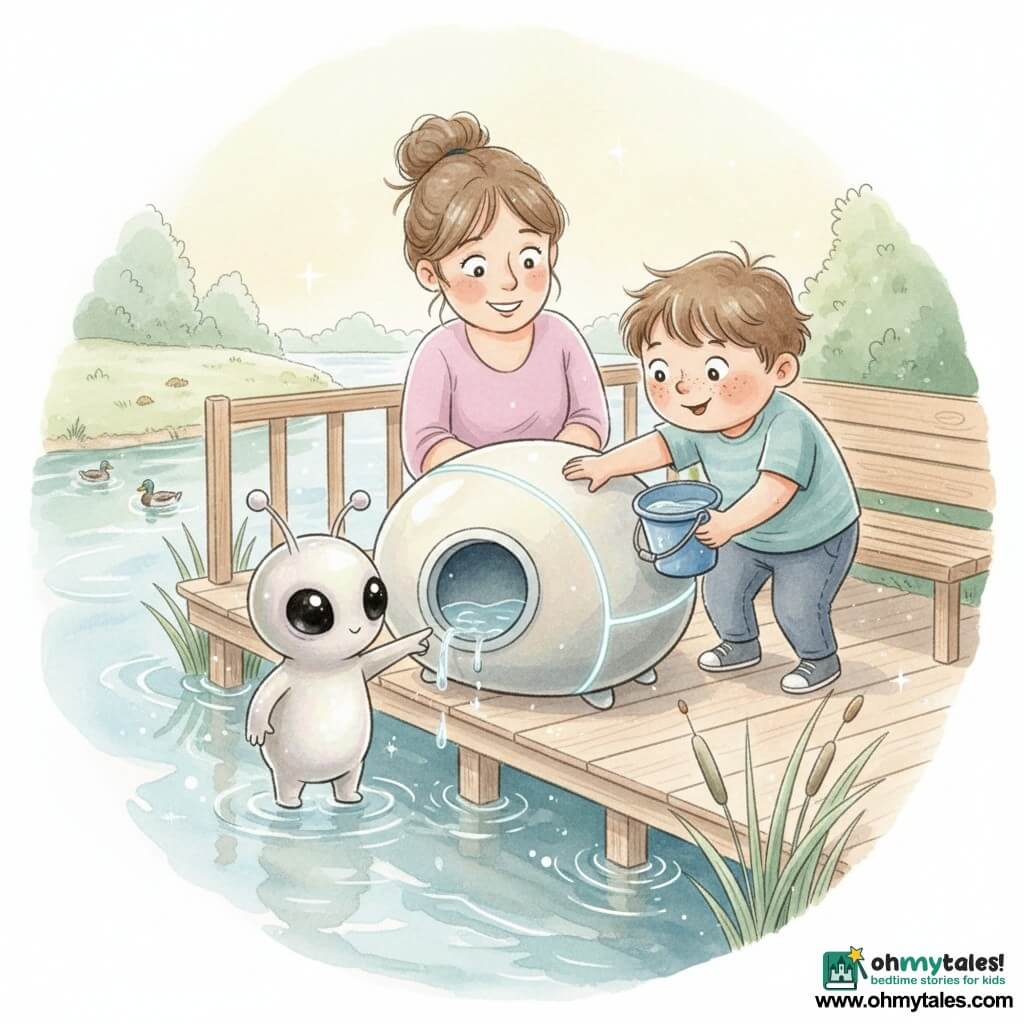
Out of the fold drifted the pebble-ship from the picture. It was the size of a small car, rounded and gray with faint lines that glowed like thin moonlight. It made no scary noise. It simply floated, steady as a leaf on still water.
A hatch opened with a soft sigh.
The alien stepped out.
It really did look like it was about to laugh, but kindly, not meanly. Its eyes were big and dark, like polished stones. Its antennae curved forward, curious.
It saw Noah and froze.
Noah froze too, for exactly one heartbeat.
Then Noah remembered the pod's lesson. Courage didn't always mean being loud. Sometimes it meant being first.
He lifted his hands and made his finger-antennae. “Hello. Tap-tap.”
The alien's face brightened. It tapped its real antennae together: tap-tap. Then it bowed, a little clumsy, as if it was copying something it once saw in a book.
“Loo-rah,” the alien said. The word sounded like a river ripple.
Noah pointed gently. “Loo-rah?”
The alien nodded, antennae bending.
Noah pointed at himself. “Noah.”
“Know-ah,” Loo-rah repeated carefully, proud of the sounds.
Noah laughed, light and happy. “Close enough!”
Loo-rah stepped closer and held out a small device—flat and shiny like a silver cookie. A picture flickered on it: a map of stars, then the river path, then a blinking dot over this exact spot.
Noah's mom spoke softly. “You're lost.”
Loo-rah's antennae drooped.
Noah's chest squeezed. He wanted to fix it right away, like putting a bandage on a scraped knee.
He pointed at the pod. “That helped you find us.”
Loo-rah nodded and made a small, apologetic sound. Then it pointed to the ship and mimed pushing something—like a button—then shook its head. It tried again. Shake. No.
Noah looked at the ship's glowing lines. They pulsed, then dimmed, like a flashlight with tired batteries.
“It needs power,” Noah guessed.
His mom nodded. “Maybe it uses sunlight? Or water?”
Loo-rah perked up at “water.” It pointed at the river and then at a round port on the ship's side. The port looked like a smooth stone circle.
Noah leaned closer. “It drinks water?”
Loo-rah tapped its antennae—tap-tap—then made a tiny slurping motion and giggled.
Noah giggled too. “Okay. That's funny.”
His mom looked around. “We can't bring the whole river to the ship.”
Noah stared at the wooden bench. Under it sat a forgotten plastic bucket from some kid's sandcastle dreams.
Noah picked it up and held it like treasure. “We can bring a little river to the ship.”
Loo-rah clapped its antennae, delighted.
Together, Noah and his mom scooped water carefully—just small bucketfuls, no splashing, no fuss. Noah walked like a tiny astronaut carrying moon juice.
Loo-rah guided them to the port. The water slid in without spilling, as if the ship was politely sipping.
The glowing lines brightened. Once. Twice. Then steady.
The ship hummed in a happy, sleepy way.
Loo-rah's antennae lifted high. It tapped them together—tap-tap—and then pointed at Noah.
Noah understood. “You're saying thank you.”
He tapped his finger-antennae back. “Tap-tap. You're welcome.”
Chapter 4: The Sticker Promise
The pebble-ship rose a little higher over the river, casting a soft shadow that looked like a smooth skipping stone. Loo-rah stepped closer to Noah and held out something small.
It was a sticker.
Not paper—more like a thin, shiny patch that changed colors when it moved. On it was the swirl with three dots, glowing gently, like it remembered starlight.
Noah's eyes went wide. “For me?”
Loo-rah nodded and carefully tapped its antennae to Noah's finger-antennae. Tap-tap—gentle, like a friendly high-five.
Noah felt a warm fizz of joy. “I learned alien hello.”
His mom smiled. “And you used courage.”
Noah looked at the sticker sheet still in his backpack. He pulled it out and peeled the best one—the silly alien with three eyes and the banana grin.
He offered it to Loo-rah. “Trade?”
Loo-rah took it as if it was a royal jewel. It pressed the sticker to its own device, and the sticker stuck perfectly. Loo-rah chuckled, a bubbly sound.
Noah laughed too. “Now you have a human sticker.”
Loo-rah pointed at Noah's wrist, where the color-changing sticker rested on his skin. It patted its own chest, then pointed up at the sky.
Noah understood, even without all the words. “Friends,” he said softly. “Even far away.”
Loo-rah tapped its antennae one more time—tap-tap—then stepped back into the ship. The hatch closed with a soft sigh.
The ship shimmered, folding the air like a gentle blanket. In a blink, it was gone, leaving only sunlight on water and ducks acting like nothing special had happened at all.
Noah stood very still, listening to the river.
His mom squeezed his shoulder. “How do you feel?”
Noah looked at the sticker on his wrist. It caught the light and winked.
“I feel,” Noah said, choosing the best word, “brave.”
They walked home along the promenade, the river beside them like a friendly guide.
Noah kept lifting his hands like antennae, practicing. Not because he expected another ship to appear, but because it made the world feel bigger and kinder.
When they got home, Noah pressed the color-changing sticker onto his notebook, right on the front where he could see it every day.
It stuck with a soft, perfect click.
Noah whispered, “Hello,” and tapped his pretend antennae—tap-tap—ready for the next bright unknown.