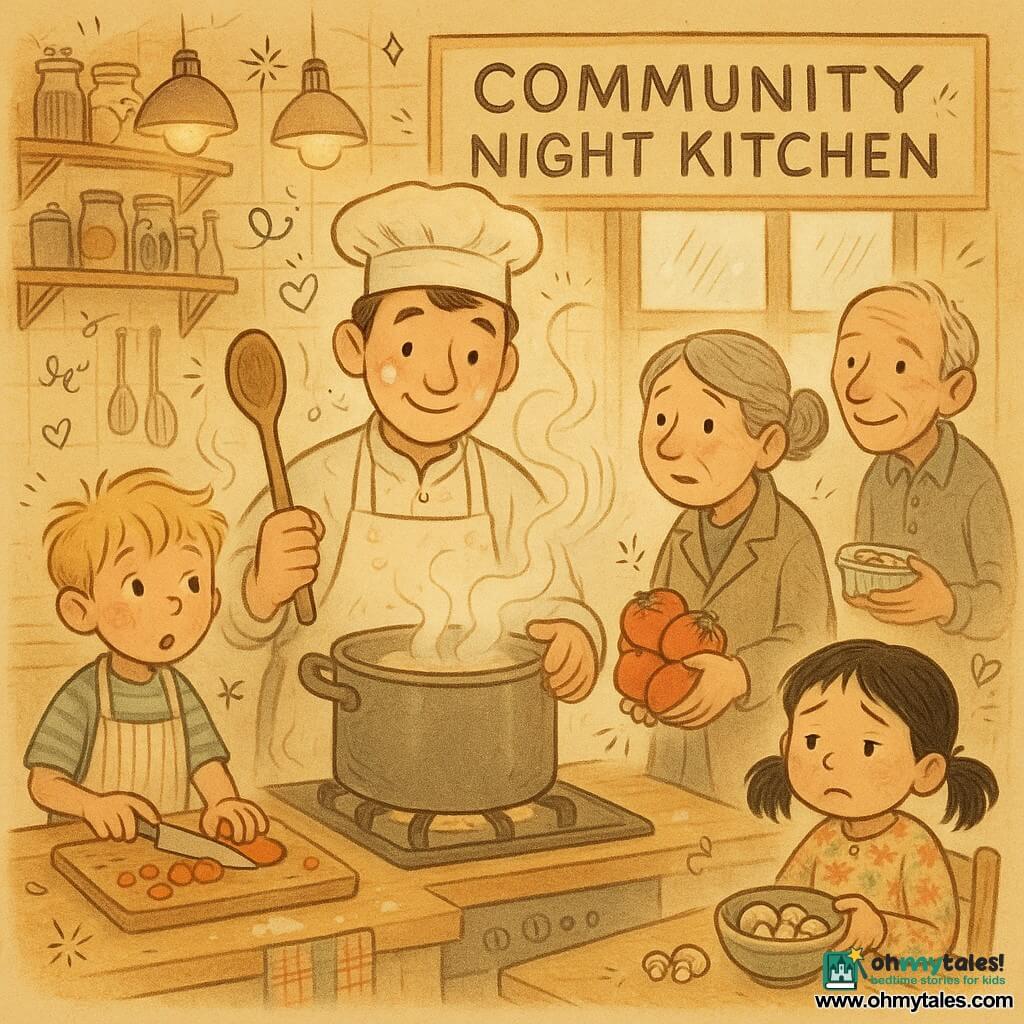
Chapter 1: The Patient Rolling Pin
The evening kitchen smelled like warm bread and sleepy herbs. Soft steam drifted up to the windows and drew foggy swirls like tiny ghosts doing a slow dance.
Leo, a young chef with bright eyes and flour on his nose, held his rolling pin like it was a calm friend. He even had a name for it.
“Easy, Roller,” Leo whispered. “Slow and steady.”
He liked saying that. Slow and steady. Like a gentle refrain.
Tonight, Leo wasn't cooking in a huge, noisy restaurant. He was helping at the Community Night Kitchen, where anyone could come for a bowl of something comforting. People arrived with tired faces. They left with warmer cheeks.
Leo tied his apron tight. Then he did the first job of a real chef, before any chopping or stirring.
He checked hygiene.
He washed his hands with soap until they smelled clean and lemony. He scrubbed between his fingers. He hummed a small tune. He dried with a fresh towel. Then he looked at the counters.
“Clean is kind,” he said softly. “Clean is safe.”
He wiped the table. He checked that the cloth was fresh. He looked at the cutting boards: one for vegetables, one for bread, one for meat. He lined them up like friendly books on a shelf.
A boy named Milo peeked in from the doorway. Milo's hair stuck up as if it had argued with a pillow.
“Are you really a chef?” Milo asked.
Leo smiled. “Yes. And my first recipe is always the same.”
“What is it?”
“Wash, wipe, and watch,” Leo said. “Wash hands. Wipe surfaces. Watch for anything that could make someone sick.”
Milo blinked. “That sounds… not tasty.”
“It's the secret ingredient,” Leo said. “No one can taste it, but everyone needs it.”
Milo stepped closer, sniffing the air. “What are you making?”
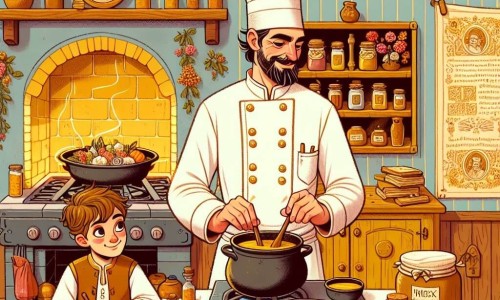
Leo lifted a lid just a little. A deep pot sat on the stove, big as a drum. The marmite breathed out a cozy puff of steam.
“Soup,” Leo said. “A gentle one. For sleepy bellies.”
The pot burbled. Leo listened like it was telling him a story.
Slow and steady, he thought. Slow and steady.
Chapter 2: The Big Pot's Secret
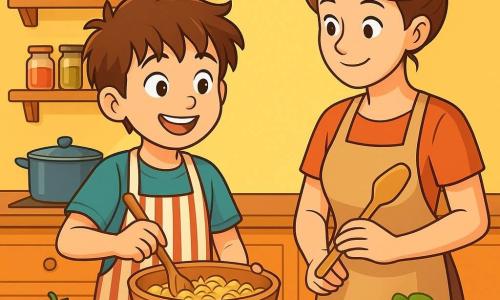
The soup was simmering in the giant pot, and the steam carried the smell of onions turning sweet. Carrots were next—bright and sunny—then celery, which snapped like tiny green sticks.
Leo showed Milo how to hold a knife safely, with fingers tucked like a shy turtle.
“Chef hands,” Leo said. “Curled fingers. Knife away from your body. No rushing.”
Milo tried. His carrot pieces came out wobbly.
“That's okay,” Leo said. “Wobbly carrots still taste brave.”
Milo laughed. “Do chefs always say strange things?”
“Only when the soup is listening,” Leo said, and he tapped the side of the marmite. The pot answered with a plop.
A woman named Mrs. Kwan came in carrying a bag of tomatoes. Her eyes looked worried.
“I'm late,” she said. “My bus—”
“You're here,” Leo said, gentle as a warm towel. “That's what matters.”
He took the bag and checked it. Not for perfection—just for safety. No mold. No strange smells. He rinsed the tomatoes, one by one, under cool water.
Milo whispered, “Why do you check everything?”
Leo lowered his voice, as if sharing a bedtime secret. “Because people trust us with their food. Trust is precious. A chef protects it.”
He dropped the tomatoes into the soup. The pot sighed, pleased.
Then came the herbs—parsley and a little thyme—pinched between Leo's fingers. He rubbed them gently and let Milo smell.
Milo inhaled. “It smells like… green.”
Leo nodded. “Like a garden after rain.”
The soup thickened. Steam wrapped the kitchen in a soft scarf.
Then the important thing happened.
The stove gave a tiny click, and the flame under the marmite grew too strong. The pot started to boil hard, too hard. Bubbles rose fast, as if the soup was suddenly angry.
Milo jumped back. “It's exploding!”
Leo stayed calm. The rolling pin waited on the counter, peaceful as ever.
“Not exploding,” Leo said. “Just shouting.”
He turned the knob down. He slid the pot a little to the side so the heat was kinder. He stirred with a long spoon, slow and steady, slow and steady.
The wild bubbles calmed. The soup returned to a gentle blurp-blurp.
Milo let out a breath. “How did you not panic?”
Leo smiled. “A chef pays attention. A chef listens. Heat is like a mood. You have to treat it with care.”
He tasted with a clean spoon, then used a new one—because tasting is also hygiene.
“A bit more salt,” Leo decided. “And a little more patience.”
The kitchen felt safe again. The pot purred.
Chapter 3: The Hygiene Detective Game
Later, when the soup was resting—because even soup needs a break—Leo turned to Milo with a serious face.
“Now,” Leo said, “we play a game.”
Milo's eyes widened. “A cooking game?”
“A chef game,” Leo said. “The Hygiene Detective Game.”
He pointed to the sink. “Clue one. What do you see?”
Milo ran over. “Soap! A brush! Towels!”
“Good,” Leo said. “And what do you not see?”
Milo frowned, searching. “Dirty dishes?”
Leo nodded. “Because we wash as we go. Less mess means less stress. And less chance for germs to throw a party.”
Milo giggled. “Germs have parties?”
“If you invite them,” Leo said. “We don't.”
They walked around the kitchen. Leo checked the fridge temperature on a little dial. He checked that the raw chicken for tomorrow was sealed and on the lower shelf, far from ready-to-eat food.
“Why lower?” Milo asked.
“So nothing drips,” Leo said. “Gravity is sneaky.”
They found a spoon on the counter.
Milo picked it up. “Clue!”
Leo raised an eyebrow. “Is it clean?”
Milo sniffed it like a detective. “Smells like… soap?”
Leo laughed softly. “We don't sniff our tools. We wash them.”
Milo's cheeks went pink. “Oops.”
“No shame,” Leo said warmly. “Learning is brave.”
He filled a tub with hot water and soap. Milo scrubbed the spoon until it squeaked. Leo showed him how to rinse and dry it properly.
“Clean is kind,” Leo repeated. “Clean is safe.”
The words floated through the kitchen like a lullaby.
Then the door opened, and an elderly man stepped in. His coat was thin. His hands trembled as he held a small plastic container.
“I brought mushrooms,” the man said. “I don't have much, but—”
Leo's face softened. He took the container with both hands, as if it were a gift wrapped in care.
“Thank you,” Leo said. “That's generous.”
The mushrooms were a little bruised, but still good. Leo trimmed the soft spots and kept the best pieces.
Milo watched. “You didn't throw them all away.”
Leo shook his head. “Food is precious. And so are people. We use what we can, safely. We waste as little as possible.”
The man smiled, small and shy.
Leo added the mushrooms to a pan with a tiny bit of oil. They sizzled quietly, like whispering.
“Smell that,” Leo told Milo.
Milo breathed in. “It smells… warm and earthy.”
Leo nodded. “We'll top the soup with these. A little kindness on top.”
Chapter 4: Bowls of Warmth
When the first guests sat down, the room was calmer than before. Chairs scraped gently. Voices were low. The air was full of soup-scent and soft talk.
Leo ladled the soup from the marmite. It poured like golden sunset into each bowl. He wiped the bowl edges with a clean cloth, neat and careful.
“Presentation matters,” he said to Milo. “Not because we want to show off. Because it tells someone: You matter.”
Milo carried napkins to the tables. He tried to walk like a waiter in a fancy place, but his feet made him wobble.
“Slow and steady,” Leo reminded him.
Milo slowed. He steadied. The napkins stayed in his hands.
A little girl at the table looked nervous. Her mother's eyes were tired. The girl stared at the mushrooms.
“I don't like those,” she whispered.
Leo crouched to her level. His voice was gentle, like a blanket.
“That's okay,” he said. “You don't have to. Would you like a bowl without mushrooms?”
The girl nodded, relieved.
Leo made her a bowl just the way she could manage. He didn't roll his eyes. He didn't sigh. He just listened.
Milo watched and whispered, “Is that part of being a chef too?”
“Yes,” Leo said. “A chef feeds bodies, but also feelings. Empathy is a kitchen skill.”
He served the elderly man who brought mushrooms. Leo added an extra spoonful, and the man's shoulders relaxed.
“Thank you,” the man said.
Leo smiled. “Thank you for helping.”
The room grew warmer, not just from the soup. From people sharing space. From soft laughter. From clinking spoons that sounded like tiny bells.
At the end, the marmite was nearly empty. Leo turned off the stove and let the pot cool. He cleaned again—wiping, washing, putting everything away.
Milo yawned so wide it looked like his face might unzip.
Leo chuckled. “Time for you to go home.”
Milo nodded. “I learned that chefs—”
“—wash their hands a million times,” Leo said.
“—listen to soup,” Milo added.
“—and keep people safe,” Leo finished.
Milo's eyes were closing. “And wobbly carrots are brave.”
“They are,” Leo agreed.
Leo hung up his apron. His rolling pin rested on the shelf, patient as a moon.
“Goodnight, Roller,” Leo whispered, and the kitchen lights dimmed.
Chapter 5: The Salad Dream
Leo walked home under streetlights that looked like sleepy stars. His hands smelled faintly of thyme and soap. His shoes felt heavy, but his heart felt light.
In his room, he washed his hands one last time—because the habit had become a comfort. Then he slipped into bed. The sheets were cool at first, then warm.
Slow and steady, he thought. Slow and steady.
Soon, the sounds of the day softened. The kitchen noises faded. The world became quiet.
And then Leo began to dream.
He stood in a garden made of salad.
Lettuce leaves rose like green pillows. Cucumber slices became stepping-stones, cool under his bare feet. Cherry tomatoes rolled by like shiny marbles, giggling when they bumped into one another.
A carrot ribbon waved in the air like a bright orange flag. It smelled sweet and fresh.
Leo laughed in his dream, a silent laugh that made the lettuce wobble.
A gentle breeze carried a whisper: Clean is kind. Clean is safe.
He followed the whisper to a river of dressing that flowed slowly—slow and steady—sparkling like honey and lemon. It didn't splash. It just shone.
On the riverbank sat his rolling pin, wearing a tiny chef hat.
“Even here?” Leo asked.
The rolling pin didn't speak, but Leo understood anyway: patience belongs everywhere.
Then the people from the Community Night Kitchen appeared, smiling. Mrs. Kwan held a bunch of herbs like a bouquet. Milo ran across the cucumber stones without wobbling. The little girl chose a leaf that looked just right for her. The elderly man placed mushrooms gently on a plate, proud and calm.
No one was hungry. No one was afraid. Everyone belonged.
Leo lifted a giant salad bowl that felt light as a cloud. He tossed the leaves with care, as if he were tossing kindness itself.
“Empathy,” he whispered, and the salad shimmered.
The dream smelled crisp and green and bright. It felt cool and soft and safe.
Leo sighed, snug in his bed, and slept on—full of warmth, full of learning, and full of a peaceful salad sky.