Birthday Paper Boats
Sam wakes up to the smell of cinnamon and the sound of rain tapping like tiny drums on the roof. He is nine, calm in a way that surprises his noisy family, and already thinking about paper. For weeks he has been folding paper into boats, birds, and secret envelopes. Today, he has folded invitations for a small birthday picnic in the backyard. The invite asks guests to bring a song, a smile, or a quiet story.
His mother ties his hair back with a gentle chuckle and says, “Keep your imagination ready, little captain.” Sam smiles. He remembers last year when the neighborhood dogs seemed to sing along and a stray balloon sailed into Old Mrs. Duvet's laundry line. This year he wants something different: a celebration where everyone listens as much as they laugh.
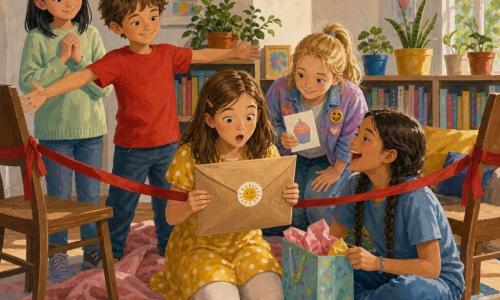
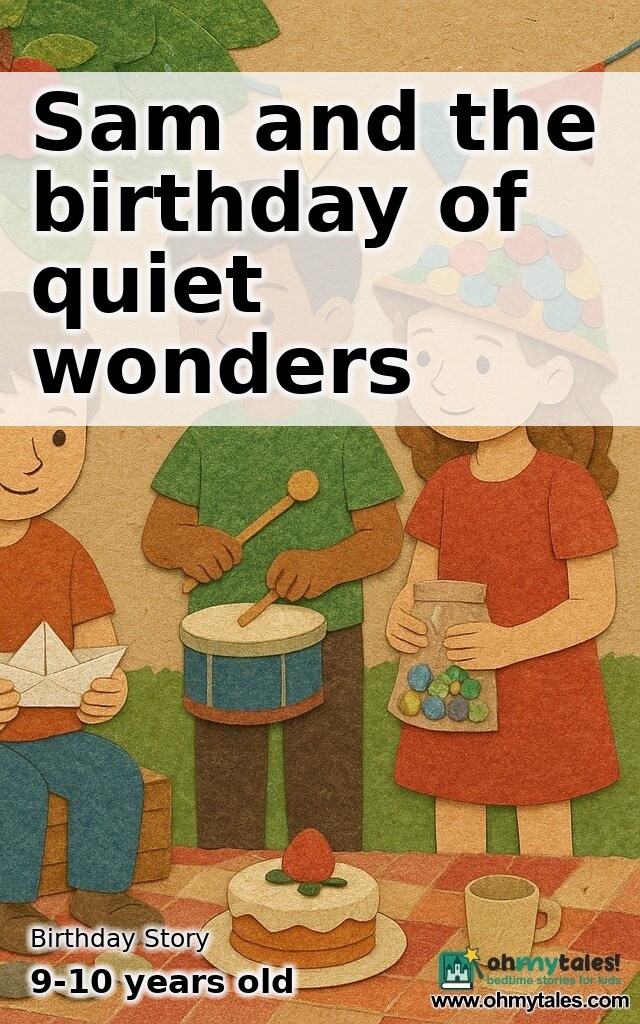
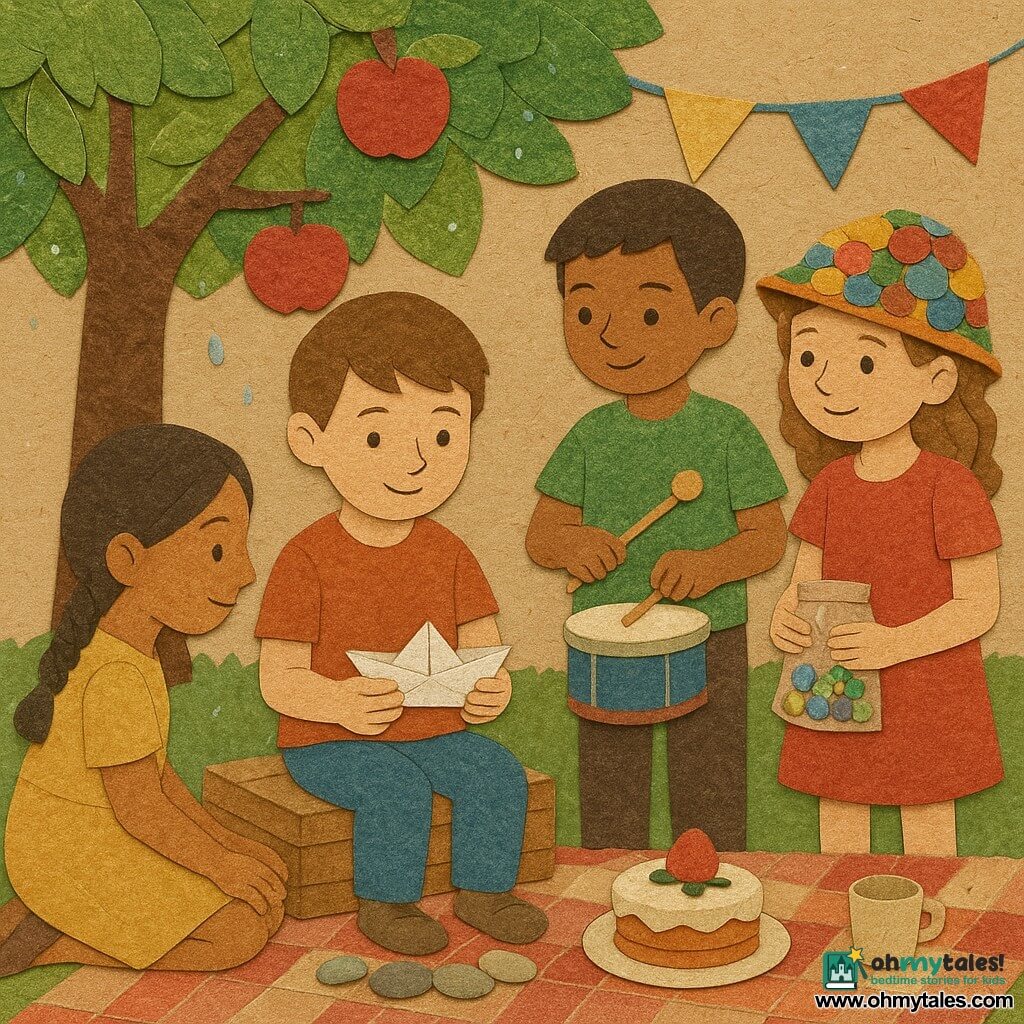
By noon, friends arrive with jars of wildflowers and a mismatched stack of cups. There's Lina with her hat full of marbles, Mateo with a drum made from an old paint tin, and Noor who brings a pocketful of pebbles polished like tiny moons. They spread blankets under the biggest apple tree. Sam hands each guest a folded paper boat—his invitation to be both playful and gentle. On the largest blanket, he sets an empty wooden crown he made from scraps, thinking of how he might fold it at the end.
The Quiet Plan
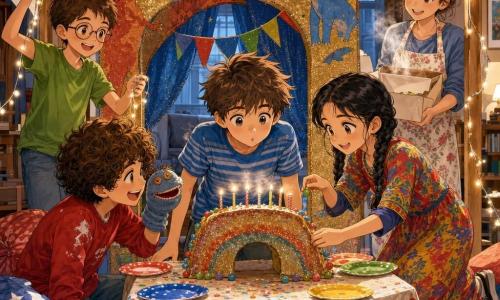
After the first slice of cake—strawberry, slightly lopsided and perfectly sweet—Sam asks for everyone's attention. He stands on a low wooden crate, like a captain on a calm deck. “I have a new birthday wish,” he says, voice steady and soft. He explains something he has practiced: a minute of silence, but not a sad quiet. A quiet that makes room for small sounds to grow—like listening for the wingbeat of a bee or the way the apple tree creaks when it tells stories.
Some children wrinkle their noses. “We came for games!” Mateo says, drumming a speedy rhythm on the tin drum. Lina looks at Sam with wide eyes, curiosity flickering. Noor smiles and smooths a pebble in her palm.
Sam nods. “We can still play. But first, let's try this. If we close our eyes and listen, we might hear a surprise. If someone needs to giggle, it's fine. If someone needs to whisper, that's fine too. The quiet is for everyone.”
They agree, because it sounds like an experiment. The whole backyard seems to hold its breath. The rain has stopped, leaving drops glittering on leaves like tiny lanterns. Sam counts backward from ten with a cheerful steadiness. At one, he taps the crate. They close their eyes.
The first thing they hear is a robin coughing out a long, awkward note, like a throat-clearing singer. Then a distant bicycle bell—ding!—that sounds like a friendly punctuation. Inside the silence, whispers of sound become bright: a neighbor laughing in his garden, the whirr of a wasp, the creak of the apple tree. Someone stifles a giggle, and it sounds like a bird learning to whistle. The minute stretches; it does not press. It grows full of small, surprising music.
When the minute ends, the children do not burst into noise so much as bloom into it—gentle at first, then joyful. Mateo taps a beat on the tin drum coaxing everyone to clap. Lina tosses marbles into a ring and they sing soft, glassy notes. Noor lines up pebbles and tells them secret names. The silence has not taken anything; it has given them new ways to play.
Listening Brings Back Joy
As the afternoon moves, Sam notices something else happening. Down the street, Old Mr. Finch—who usually keeps his curtains tightly closed—opens his window a crack. He smiles and waves, his hand trembling a little. Across the lane, Mrs. Duvet hangs a missing sock on her fence as if returning a favor. The sounds of the neighborhood seem to peel themselves out of their ordinary shells and wander toward Sam's backyard like curious cats.
A little boy who lives two houses over, Tomas, has been sulking all morning because his kite tore. He sits at the edge of the blanket frowning at his shoelace. Sam, calm and imaginative, takes a paper boat and tucks it into Tomas's hands, whispering, “Bring it to the wind later.” Tomas looks at Sam as if the paper has become a promise.
Then a parade begins without anyone meaning to start one. Mateo leads with the tin drum, Lina twirling her hat like a flag, Noor skipping stones that make hop-skip sounds. They march past the apple tree, down the path, and gently wake a sleeping sunflower that stands very tall near the fence. The sunflower tilts like a sleepy giant and nods, scattering a few seeds that look like confetti.
Neighbors come out, not because a horn blew, but because the backyard is humming differently. They bring small things: an old accordion that plays two notes perfectly, a jar of lemonade spiced with mint, a dog with a floppy ear who decides to perform a very dignified bow. Sam's minute of silence has turned into a magnet for unnoticed happiness. People who had been too busy or too sad to celebrate find themselves joining the rhythm.
At one point, Mr. Finch shuffles into the circle carrying a paper crane perched on his cane. He tells a quiet joke about how cranes make better listeners than parrots. Everyone laughs, not because the joke is the loudest thing but because it fits right into the gentle music of the afternoon.
The Folded Crown
As the sun leans low and the shadows stitch long patterns across the blankets, it becomes time to end the party with something small and meaningful. Sam asks everyone to sit in a circle. He places the empty wooden crown in the center and asks each person to fold it in their own way—literally and figuratively.
One by one, hands reach for the crown. Lina creases it into a paper flower crown and pins a tiny marble in the middle. Mateo folds it into a silly hat with a drumstick for a plume. Noor fashions it into a tiny hammock for a pebble. Tomas carefully tucks a kite-shaped notch into the edge, smiling at the memory of his torn kite and at the boat in his pocket.
When it is Sam's turn, he folds the crown slowly, with a deliberate kindness. He shapes it into a small, neat crown that could sit on anyone's head and make them feel like a safe, brave person. No glitter explosions, no fanfare—just a careful fold that speaks of respect.
Sam lifts the folded crown and places it on the wooden crate where he stood earlier. “This crown is for us,” he says. “For listening, for helping, for coming together.” Someone offers it to Mr. Finch, who puts it on with a surprised grin that turns his face soft. The children cheer quietly—not too loud, in case the apple tree is still telling stories.
As the sky turns the color of tired blueberries, the neighbors begin to leave, each carrying a little more light than when they came. The paper boats bob in a shallow puddle, reflecting lanterns like tiny moons. Tomas tucks his boat back into his pocket instead of letting it sail away; he says he might need it tomorrow.
Sam watches them go, heart warm and steady. He had asked for one minute of silence and he had listened—really listened—and the joy had come back like a friend returning from an adventure. He folds the last scrap of the crown and tucks it into his shirt pocket, a small, folded promise.
When Sam finally closes his eyes that night, he dreams of paper boats sailing on a quiet sea, of neighbors who hum as they hang laundry, of a sunflower that claps in slow time. He wakes knowing that respect can be a kind of celebration and that sometimes the best surprise for a birthday is everyone finding a way to listen.
On his bedside table, the folded crown waits like a secret. He smiles and pats it gently. It is small, but it holds a great big thing: the proof that when people listen to each other, they can fold their differences into something beautiful.