Chapter One — The Unraveling at Lantern Night
Rowan Finch had always believed that magic was polite. It knocked once, waited for an answer, and then tidied up after itself. That was partly because Rowan was polite, too, even if his spells sometimes sneezed. He was small for a seventeen-year-old apprentice, with hair the colour of a rooster's comb and eyes that liked to ask questions. Under the strap of his satchel, he carried a spool of thin, silver thread—his first prize from Master Lark's weaving lessons—and he treated it like a luck charm.
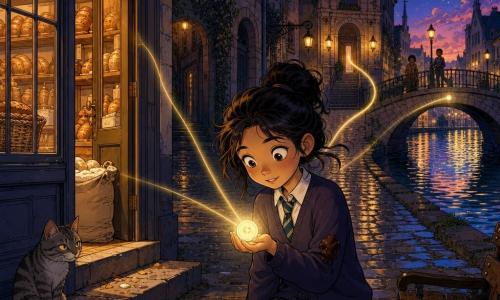
Lantern Night in Brindleford was the town's favourite kind of ordinary-meets-extraordinary: people hung jars of glow-worms from eaves, cats wore little paper hats, and the river smelled of orange peel and willow smoke. But the real magic of Lantern Night happened halfway down the cobbled High Street, where the old clock tower shrugged itself awake and the invisible threads that held the town's small enchantments together pulsed with light.
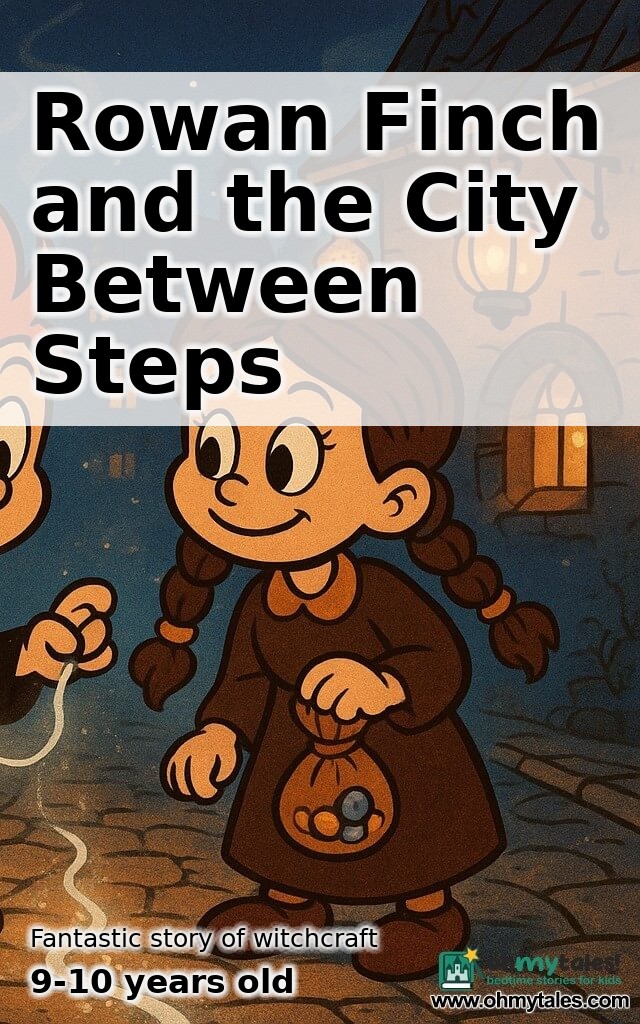
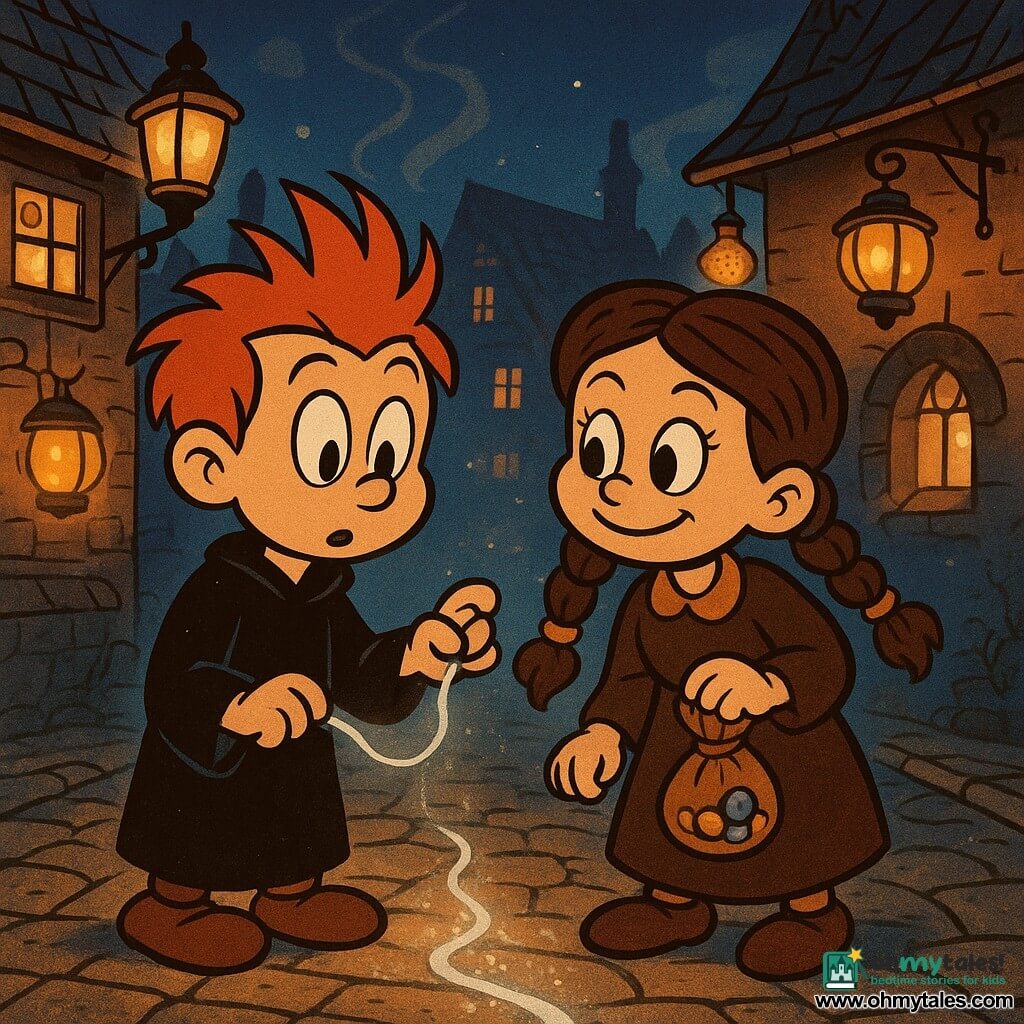
Rowan had been sent to fetch more wax by Master Lark, who rubbed at his beard and muttered about wax being the breath of good lanterns. He bumped into Tilda Marrow on the bridge—Tilda who kept a pocket full of marbles that smelled faintly of peppermint and mischief. Tilda's hair was braided with tiny bells that chimed when she laughed. She had a map of secret places folded in her sleeve.
"Lanterns nearly ready?" she asked, peering at the sky where paper boats glided like lazy clouds.
"Nearly," Rowan said. He meant to be home in ten minutes. He did not mean to touch the thread that uncurled like a silver fish from his satchel and, in a momentary clumsy jolt, let it slip through his fingers.
The thread did not fall. It hung for a heartbeat in mid-air, glowing faintly, then tugged. Rowan's knees went soft as if someone had called them by name. The world grew very quiet. Sounds—laughter, clinking glasses, the river's small gossip—stretched thin and then snapped like a harp string. Lanterns dimmed. A goose honked in an apologetic sort of way.
"Rowan," said Tilda, because saying someone's name is as useful as a rope when things begin to unravel. She reached out, just as the thread slid through Rowan's hand and unspooled into a shimmering pathway that led, impossibly, between cobbles and shadows. The pathway pulsed. A scent rose—old paper, wet leaves, and the slight tang of promises.
"Don't," Master Lark's voice came from nowhere and everywhere. "Knots, boy. Knots hold things together."
Rowan's fingers tingled. He had never been told exactly what the Great Thread was; most apprentices learned by watching the woven lights in the Market—how a child's lost slipper always turned up by the baker's stall, or how rain would change dance steps at the green when the town needed a sunny promise. The Thread was a network of tiny, silver strings that stitched the town's small enchantments into place. To tug one was to tug many.
But the silver path had already unrolled and begun to pull Rowan, like the tide pulling a pebble. Tilda yanked him back. She twisted a braid of her bell-hair into a makeshift knot around his wrist. "Nope," she hissed. "You're not leaving without me."
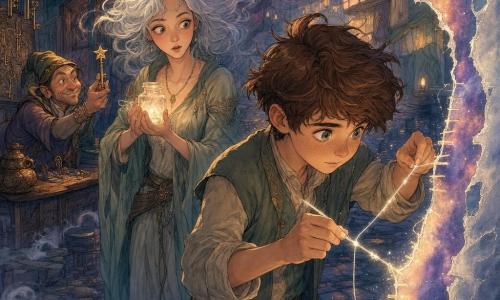
Rowan tried to pull back and instead pulled something with him: the town's breath, the faint hum that sat behind the shutters and the clocks. The world did not fall apart, but a ribbon of colour peeled away from it. For a moment, they saw the town as a tapestry: houses stitched with sunbeam thread, a fountain with stitches of laughter, rooftops edged in the neat chain-stitch that kept rain polite. And then the place where the Thread had loosened showed a ragged gap—a doorway that shouldn't be there, opening between two steps of the same stair.
Tilda looked at the gap and grinned, which is how trouble usually starts. "A city between steps," she said. "We should go in. For research."
Rowan thought of Master Lark's voice and the wax unmade. He thought of promises. He also thought of how his palms still smelled of thread. "We have to fix it," he said. "Not explore."
"Fixing usually involves exploring," Tilda said, which was a very Draughts-and-Excuses kind of logic. She slipped her peppermint marble into her mouth for courage. Rowan tied his remaining silver thread around his finger, like a stitch for bravery, and they stepped through the gap together.
Chapter Two — The City That Could Fit in a Pocket
The city between steps was not large. It was the size of a teacup and the shape of a sigh. Streets were trimmed with moss-braided lampposts. Tiny market stalls sold whispers and feather cookies. A fountain tinkled in a fountain's voice; children there played hopscotch with pebbles that told jokes if you listened closely. The sky above it was a single stitched-on star.
"Look," Tilda breathed, pointing at a window where a hedgehog perused a newspaper. Rowan nearly dropped his head in disbelief. Every little thing had an edge of magic so honest it made his chest ache with wonder.
There was a city council in that pocket-world, run by a tall woman with spectacles that magnified her eyebrows. She introduced herself as Mayor Hemlock, and when she extended a paw to Rowan, it was like shaking hands with a story.
"When a stitch loosens, the small cities between steps feel the tug," she said in a voice like dry leaves. "This town is woven to the human one by tidy knots. Whoever unravels a main thread must mend it, or the promises begin to wander."
Rowan put his hand over his heart. "I didn't mean to—"
"Intention matters but does not unmake fact," Mayor Hemlock said crisply. "You'll need a knot-bag, a spool of patience, and a memory that keeps its promises."
"Can I get one at the market?" Tilda asked, eyes already on a stall selling tiny umbrellas.
Mayor Hemlock smiled a small, secret smile. "Knot-bags are not bought. They are earned. You must learn to listen to threads. They will tell you stories you will have to tie into new knots."
They learned quickly. The threads spoke in a chorus: the baker's laugh that held the shape of a loaf, the lamplighter's hop that kept dusk polite, the clock's drawer of sighs that remembered appointments. Each thread had a tune, and the crucial thread Rowan had let slip hummed like a violin that had lost a bow.
"The City Between Steps thrives on promises," Mayor Hemlock said as they sat on a bench made from an old spoon. "A knot is a promise given. Every knot undone is a promise left hanging."
Rowan remembered his promise to Master Lark about tidy lanterns, and to Tilda about coming back for marshmallows. He felt the weight of a hundred small promises press like rain on a windowpane. He began to understand why Master Lark had said knots mattered. He also felt, oddly, that knots were less about holding things tight and more about remembering why you had bound them in the first place.
Tilda listened to a thread that smelled like peppermint and then laughed. "This one remembers the first time someone left a note under a bench," she said. "It wants to be tied to that memory."
They were given three tasks to mend the main thread: find the knot of courage hidden in the lamplighter's pocket, retrieve the stitch of apology lost in the fountain's song, and gather the tie of promise that had been scattered across three human hands. Each task would restore part of the main thread's music.
"Be careful," Mayor Hemlock warned. "The space between steps is tender. It will show you what it needs, not always what you want."
Rowan and Tilda exchanged one of those looks that say trust me, and then they went to find courage.
Chapter Three — Knots of Courage and Apology
The lamplighter in the pocket-city was a beetle of a fellow who hopped on a bicycle with a lantern tied to the handlebar. He kept his courage in a little brass locket that clinked when he pedalled hard. It had been lost under a heap of yesterday's confetti—someone's mistakes that had been festive at the time.
Rowan and Tilda sifted through confetti, finding memory-crumbs—an apology balloon and a scrap of a lullaby. Tilda pushed a confetti hat onto the lamplighter-beetle's head and made him remember to laugh properly. Rowan reached under a tissue of blue glitter and found the locket, warm as a saved heartbeat.
When the locket closed, a thread of bright orange shot up like a flame and tied itself onto the main silver strand. It hummed, and the city between steps sighed with relief. Courage, they learned, was not always roar and sword; sometimes it was a small click of a brass locket and a beetle remembering to pedal.
The fountain's stitch of apology was trickier. The fountain sang of apologies that had been said and those that had been swallowed. Under its tiny splash lived a fish that collected regrets like pebbles. It handed Rowan a pebble that felt soft as forgiveness.
"Say the apology," Tilda urged. "To the thread. It listens."
Rowan closed his eyes and imagined all the times he'd failed to tidy up a spell or to say sorry to someone he'd upset with a careless word. He spoke an apology into the pebble, not to any one person but to all the small promises he'd frayed. The pebble turned silver, and a stitch slid back into place.
With two pieces mended, the main thread's hum steadied but still faltered. The tie of promise, however, required the most human of tasks: finding the hands that had once tied it and reminding them of what they had vowed.
Chapter Four — The Hands and the Final Knot
Back in Brindleford, the three human hands belonged to an elderly postwoman who always forgot birthdays, a baker who promised fresh bread on Saturdays, and a child who swore to feed a stray cat every morning until it grew into a tabby with a hat.
Finding them involved sneaking through pockets of the ordinary town—listening under park benches and peering into breakfast shops. Rowan felt strange, like a secret or a note passed in class. He and Tilda visited the postwoman first. She had once promised to remember a faraway friend and had tucked the promise under a pile of unsent postcards.
"Promises get lost," the postwoman admitted when Rowan showed her a scrap of the silver thread that had snagged on her coat. She touched it and remembered the friend's laugh. Her hands trembled, and she wove the thread back into her memory. A small knot of brass-and-home sprang into being.
At the baker's, flour dusted the air like winter. The baker made Rowan a roll and then confessed that on certain Saturdays he'd been tempted to sleep in. He tied the thread back to a memory of an old woman who came just for crusts. The tie of promise answered with a warm smell that stitched itself into the main thread.
The child was the hardest to find. He had grown into a teen and moved houses like seasons. But Tilda is good at finding small things; she found him in the market square, repairing a puppet he had once promised to finish. She reminded him of a small tabby he had loved. The teen sighed, returned to the memory, and tied the promise—this time not because someone asked, but because he wanted to.
Back in the pocket-city, the three ties shone like drops of salted caramel on the silver thread. Rowan felt the main strand hum the way a heart hums under a blanket. There was one last thing: a knot Rowan had to make himself. Mayor Hemlock had said already that some knots must be tied by the wrong-doer to feel their truth.
Rowan took his spool of silver thread. He had tied it around his finger earlier, thinking it would help him remember. Now he looped it three times and made a careful, clumsy knot—one that included the locket, the pebble, and the promises. He whispered apologies to the thread, told it the silly things he loved—like the way Tilda's bells chimed when she was thinking hard—and he made a promise out loud: to keep checking the stitches, to mend before punches fell, to remember that tiny things keep towns kind.
When the knot finished, it glowed like a clasped hand. The city between steps released a note so clear it might have been a bell. The main silver thread wound back into its rightful place between cobblestones and clock gears. Lanterns brightened, the goose honked politely, and the town breathed a little easier.
Rowan's knees stopped shaking. Master Lark's voice came again, softer now. "Well tied, apprentice."
Chapter Five — Return and New Knots
They returned to Brindleford not as two children who had poked at a pocket of wonder, but as keepers of a tiny secret. The city between steps folded itself like a map, slipped away between the same two stairs, and left behind the faint smell of peppermint and baking.
"Will it be the same tomorrow?" Tilda asked as they walked home under lanterns that now seemed to wink.
"It will be different," Rowan answered. That, he had learned, was the best of magic. Threads remembered, but people chose how to tie them. The best knots were promises renewed.
Master Lark greeted them with wax on his hands and pride in his eyes. He did not scold them for touching the thread. Instead, he handed Rowan a new spool of silver thread—smaller, but handmade—and wrapped it in a square of cloth the colour of dawn.
"For practice," he said. "You must learn to listen before you bind. And remember: knots are promises, not prisons."
Rowan nodded. He had found courage, given apologies, and nudged forgetfulness into being kinds of promises. He had helped a beetle remember to pedal and a teenager to finish a puppet. He had learned that every knot is a story folded in on itself, and that the right knot can make a town feel safe again.
That night, Lantern Night closed with fireworks that smelled like toasted marshmallows. The town seemed stitched snugly onto its own map, and the city between steps hummed contentedly in its pocket. Rowan and Tilda sat on the bridge, sharing a roll from the baker and listening to the river tell jokes it had learned from the fountain.
Tilda flicked the new spool with a finger. "So," she said, "what will we do with all these knots?"
"Keep them tidy," Rowan said. "And tie new ones."
He wound his fingers around the silver thread and, for the first time since he had been an apprentice, felt the weight of being part of the thing he loved. The world was an enormous fabric with tiny cities tucked in seams, and someone had to care for the threads.
They promised, then and there, with a small, private knot pressed between their palms: to look after the town; to check the space between steps when Lantern Night came; to remember small things. It was a simple knot—neither too tight nor too loose—and in the morning it would have to be retied. But that was the point. A promise kept is a knot reknotted when needed.
And so Rowan Finch, apprentice wizard, learned that magic was not only polite but patient; that knots were not only about holding fast but about keeping faith; and that some tiny cities were safe because two children remembered to be careful with the threads that hum under every step.