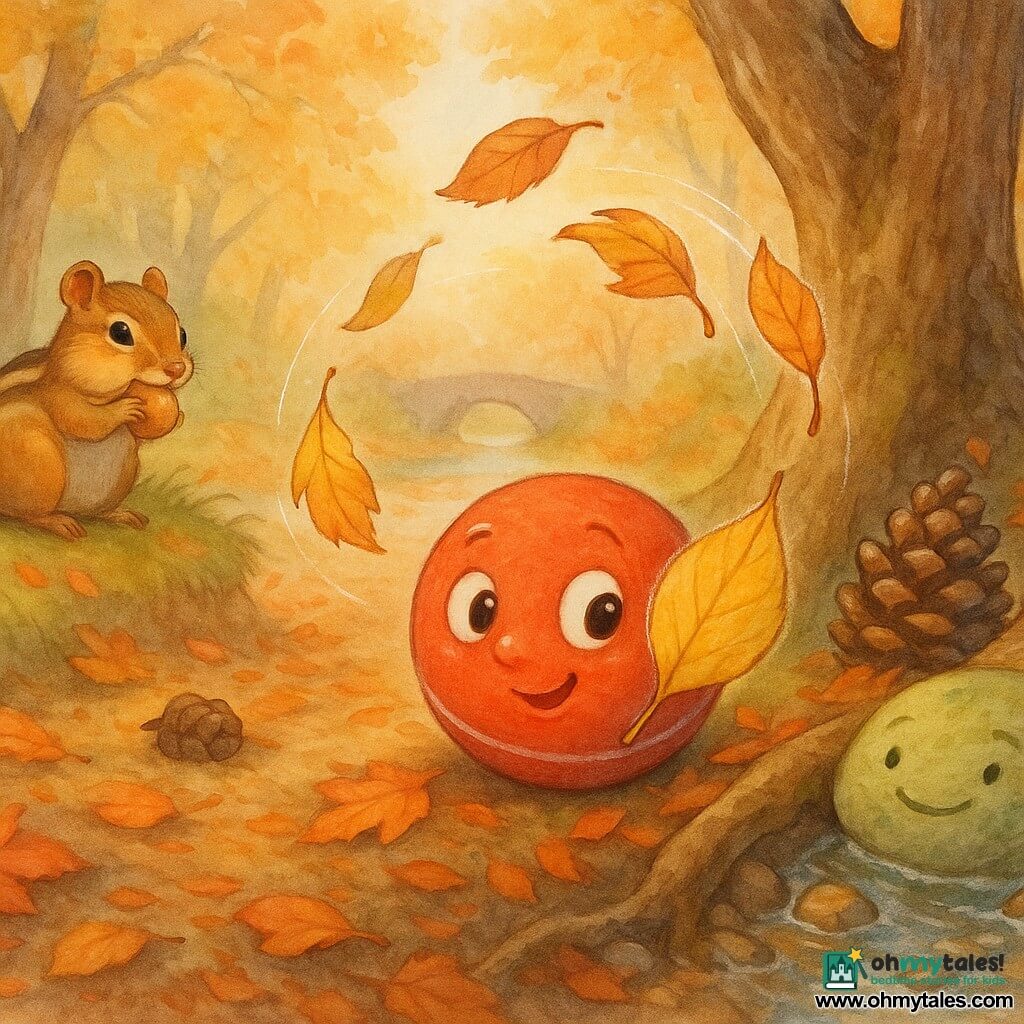
Chapter 1: The Windy Courtyard Challenge
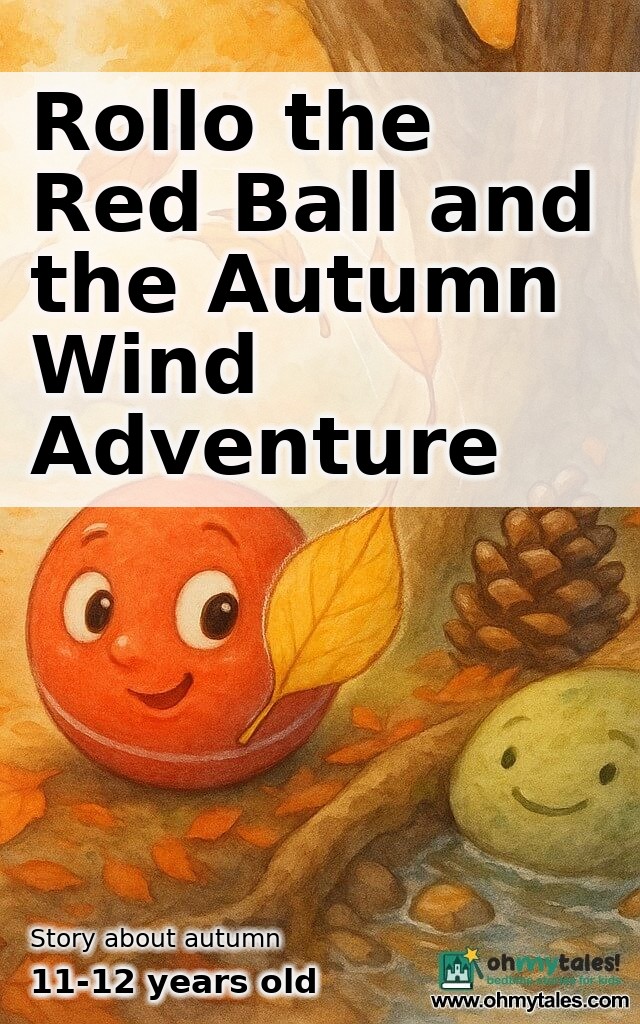
Rollo the red ball lived in a quiet corner of a town courtyard, tucked beside a stone bench and a sleepy flowerpot. He was round, bouncy, and proudly scuffed from many good games. Autumn had arrived without asking permission. It painted the vines in rusty reds and golds, and it sent the wind sprinting between buildings like it had somewhere urgent to be.
Rollo loved games. Not the kind where you just sit and watch—he liked games that made his rubbery skin hum with motion. Today, the courtyard was full of tiny whirlwinds. Leaves skittered across the paving stones, tapping and whispering, as if they were trading secrets.
Rollo wiggled in place. “All right, Wind,” he muttered, “let's see what you've got.”
A gust swooped in and pushed him forward. Rollo rolled, then bounced, then rolled again. He laughed—at least, he made the squeaky, happy sound that meant laughing for a ball.
From a nearby drainpipe, a shiny silver bottle cap called out, “You're going to get blown into the street!”
Rollo stopped with a soft thump against a low curb. “That's why it's a challenge,” he said. “I'm practicing control.”
“Control?” The bottle cap spun in a circle, showing off. “You're a round thing in a wind tunnel.”
Rollo lined himself up between two chalky sidewalk cracks. “Watch. New game: Leaf Dodge. I roll to the fountain, without getting smacked by a leaf.”
A maple leaf, wide as a small hand, swooped down like a slow, dramatic bird. Rollo waited. The leaf sailed past his side with a dry hiss.
Rollo dashed—rolled fast, bounced once—and slipped under the leaf's shadow. The courtyard air smelled like damp stone and distant smoke from somewhere cozy.
“Point for me,” Rollo said, reaching the small fountain basin. The water wasn't running anymore; autumn had made it quiet. A few leaves floated on the surface like little boats.
The bottle cap clinked. “Fine. But the wind is getting stronger.”
Rollo glanced toward the iron gate at the edge of the courtyard. Beyond it, the town thinned out into a path that led to the nearby woods. The trees there were darker and taller, their branches busy trading leaves with the sky.
Rollo's bounce slowed into a thoughtful roll. Curiosity tickled him like static. What did the wind do in the woods? Did it make different sounds? Did the leaves there race in bigger swirls?
He spoke softly, as if he didn't want to scare the idea away. “I wonder what autumn feels like under the trees.”
Another gust nudged him toward the gate, gentle but insistent, like a friend tugging your sleeve.
“Rollo,” warned the bottle cap, “you're thinking that thinking look again.”
Rollo grinned. “I'm going exploring. Just for a bit. I'll be careful.”
He rolled toward the gate, letting the wind push him when it wanted, but steering with tiny bounces and quick stops. The iron bars were cold and smelled faintly of rain. The gate stood ajar, creaking like it was yawning.
Rollo slipped through.
Chapter 2: A Path of Crunchy Clues
The path out of town was made of packed dirt and small stones. Rollo loved the sound his rolling made—soft thuds, tiny clicks, a steady rhythm like a song with no words.
On either side, grass bent low under the wind, and fallen leaves collected in corners like shy crowds. Autumn was busy here. It had stitched orange threads through green bushes, and it had hung a few last berries like bright beads.
Rollo rolled over a pebble and bounced. “Ow—friendly pebble,” he corrected quickly. “You're allowed to exist.”
A stick lay across the path like a narrow bridge. Rollo nudged it. The stick rolled a little, then stopped.
“Excuse me,” said the stick in a dry voice. “Some of us are resting.”
Rollo blinked—if a ball could blink. “Sorry! I didn't mean to bother you.”
The stick gave a tiny wiggle. “It's fine. The wind has been bothering everyone all day. Where are you headed?”
“The woods,” Rollo said. “I want to see what the wind does under the trees.”
“The wind?” The stick sounded amused. “It does everything. It steals hats—well, if there were hats. It rearranges leaves. It makes brave things feel wobbly.”
Rollo puffed himself up, which mostly meant he rolled forward with confidence. “I'm brave.”
“Good,” said the stick. “Then you'll pay attention. The woods are full of clues.”
“Clues to what?”
“To how things work,” the stick replied. “Why leaves fall, how animals store food, where water goes when it rains. Autumn is like a classroom, but you don't have to sit still.”
That made Rollo roll faster. “A moving classroom! Perfect.”
The path dipped down, and the air changed. It became cooler and smelled like wet earth and mushrooms—like the ground had been cooking something quiet all day. Rollo spotted a line of acorns along the edge of the trail, like someone had arranged them carefully.
“Neat!” Rollo said. “Why are they lined up?”
A small, striped chipmunk popped out from behind a root and hugged an acorn. “Because I put them there,” it squeaked, cheeks already full.
Rollo stopped at a polite distance. “Oh! Sorry. I didn't want to interrupt.”
“You're not interrupting,” said the chipmunk, scooting another acorn into place with busy paws. “I'm stocking up. Autumn is the big warning bell. Cold days are coming.”
Rollo watched, fascinated. “Do you always know when autumn starts?”
The chipmunk twitched an ear. “The days get shorter. The air smells different. The trees change their colors. Also, my tummy tells me.”
Rollo bounced once in excitement. “That's amazing. I can tell it's autumn because the wind feels sharper—like it learned a new trick.”
The chipmunk laughed. “That's a good way to say it. If you're going into the woods, stick to the trail. Leaves can hide holes.”
“Thanks!” Rollo said. “Good luck with your acorns.”
“Good luck with your… rolling,” the chipmunk replied, clearly unsure if it was wishing him luck or just describing him.
Rollo rolled on, listening. The wind made a shushing sound through the tall grass, and somewhere above, branches clicked together like wooden fingers tapping.
Ahead, the first trees waited—oaks and maples and birches, their leaves fluttering like flags.
Rollo crossed the line where town ended and woods began, and he felt something new right away: the wind didn't run as straight here. It swirled. It danced. It slipped between trunks and rose up like it was trying to peek at the sky.
Rollo whispered, “Hello, woods.”
The woods answered with a soft rain of leaves.
Chapter 3: The Leaf-Whirl Lesson
Inside the woods, the light changed. It filtered through branches in pieces, making the ground look like it was covered in moving patches of honey and shadow. The air was calmer under the trees, but not still. It hummed with little motions: a leaf spinning down, a pine needle dropping, a squirrel scratching somewhere unseen.
Rollo rolled slowly, because he wanted to notice everything.
A bright yellow leaf landed on his side and stuck there for a moment, tickling his surface.
Rollo tried to shake it off by bouncing lightly. The leaf fluttered down and landed again, right in front of him.
“Do you need help?” Rollo asked the leaf, feeling a little silly.
The leaf wobbled. “I'm fine,” it said, voice papery and thin. “I'm just… traveling.”
“Where to?”
“Down,” said the leaf, as if this was the most obvious destination in the world. “Trees let go of us when the days get shorter. Less sunlight means less food for the tree. So the tree saves energy for winter.”
Rollo leaned closer. “So you aren't falling because you're in trouble?”
“Not trouble,” the leaf replied. “It's a plan. I did my job all summer. I helped make food from sunlight. Now I get to rest.”
Rollo felt his curiosity stretch bigger, like he could bounce higher if he understood more. “What happens when you reach the ground?”
“I become part of the forest,” the leaf said proudly. “I break down slowly. Worms and tiny helpers turn me into soil. Then the soil feeds the tree again.”
Rollo looked around at the forest floor. There were layers of old leaves, darker and softer, like crinkled blankets. He could smell them—rich and earthy.
“So autumn is like… recycling,” Rollo said.
The leaf fluttered in agreement. “Exactly. Nothing is wasted for long.”
A stronger gust entered the woods, and it didn't charge in like it did in town. It moved in circles, scooping leaves into a whirl.
Rollo watched, mesmerized. Leaves lifted and spun like dancers in a rehearsal. Some were red as fire, some brown as toast, some still stubbornly green.
Rollo rolled closer, careful not to get dragged in too fast. “Whoa. That's Leaf Tornado Practice.”
The wind pulled at him. Rollo tried to resist, digging his roundness against a root. He couldn't dig, really, but he could press and stop and wedge himself.
A pinecone sat nearby, sturdy and spiky, like it wore armor.
“Need an anchor?” the pinecone asked in a deep, patient voice.
“Yes,” Rollo admitted. “The wind is stronger than I expected.”
The pinecone shifted slightly. “Roll behind me. I'm not going anywhere. I'm built for falling and staying.”
Rollo rolled behind the pinecone, and the wind's tug softened. Leaves continued their swirl, but Rollo felt safer.
“Thanks,” Rollo said. “How do you stay so calm?”
The pinecone rumbled. “I've been on branches during storms. The secret is noticing what the wind is doing, not just what it's doing to you. Watch: it's slower near the ground because of all these obstacles. Roots, trunks, bushes—they break it up.”
Rollo watched more carefully. It was true. The leaves rose higher where the path opened, then dropped where shrubs blocked the air. Wind was like water, flowing around things.
“That's amazing,” Rollo said. “So if I want to roll safely, I should choose where the wind is gentle.”
The pinecone nodded. “Curiosity makes you smarter. Smart makes you safer.”
Rollo let the leaf whirl pass, then rolled forward again, testing the air. He practiced stopping behind roots, then darting forward when the wind eased.
It felt like a new kind of game. Not just speed—strategy.
“Autumn has levels,” Rollo murmured, pleased. “And I'm learning them.”
Chapter 4: The Stream That Talked Back
The trail curved deeper into the woods and dipped toward a small stream. Rollo heard it before he saw it: a gurgling, slipping sound, like someone whispering while pouring a drink.
When the trees opened slightly, the stream appeared, narrow and quick, moving over smooth stones. Fallen leaves floated along, spinning in tiny eddies before being pulled onward.
Rollo rolled to the edge and stopped. Water always made him cautious. He didn't mind getting splashed, but getting carried away? That sounded like a game with no finish line.
A flat stone near the bank lifted its head a little. “Hello, bouncer,” it said.
“Hi!” Rollo replied. “I'm Rollo. I was exploring autumn.”
The stone's voice was calm and slow, as if it had plenty of time. “You're standing at a good place to learn something. The stream is busy this season.”
Rollo watched the water. “Why is it busier in autumn?”
A reed on the bank swayed and answered in a thin, reedy tone, “More rain sometimes. And the ground drinks less when it gets cold. Water runs off into streams.”
The stream itself seemed to sparkle as if it wanted attention. “And because I carry fallen leaves!” it burbled. “They ride on me like boats.”
Rollo leaned closer. “Where do you go?”
“Downhill,” the stream said proudly. “To bigger streams, then rivers. Eventually, to the sea—if no one stops me.”
Rollo imagined it: a leaf he'd met traveling far beyond this patch of woods, all the way to an enormous ocean. The idea made him feel small in a good way, like looking up at a tall tree.
He noticed something else: leaves gathered behind a half-submerged branch, forming a small pile.
“Is that… a blockage?” Rollo asked.
The flat stone chuckled. “A tiny one. The water slows, drops what it can't carry, then finds another path. Nature is always adjusting.”
Rollo tested a small pebble with a gentle nudge. It rolled into the water, splashed, and disappeared under the surface.
Rollo gulped, even though he didn't have a throat. “Okay, definitely not rolling in there.”
A laugh came from the reed. “Wise choice, round traveler.”
Rollo looked along the bank and spotted stepping stones that crossed the stream, like a careful path designed by someone who loved balance. He rolled onto the first one and paused. The stone was cool and slightly slippery with moss.
“Easy,” Rollo told himself. “Slow beats soggy.”
One stone at a time, he crossed. The wind reached him again, but here it was gentler, as if the trees were holding it back.
On the far side, the ground rose toward a small hill. Through the branches, Rollo could see a slice of sky turning pale, the kind of color that meant late afternoon was stretching toward evening.
He felt a tug—not from wind this time, but from a new thought. If the sky was changing already, he should plan his way back. Curiosity was wonderful, but it didn't have to ignore time.
Rollo turned in a slow circle, taking in the woods: the layered leaves, the dark trunks, the stream's whisper.
“I learned a lot,” he said softly, feeling proud and peaceful. “And I can learn more tomorrow.”
Chapter 5: Rolling Home with New Eyes
On the way back, the path felt different, even though it was the same dirt and stones. Rollo noticed details he hadn't seen before: the way some leaves curled like tiny boats, the way acorns had caps like little helmets, the way the wind carried smells—damp bark, cold air, a hint of smoke from somewhere far away.
He met the striped chipmunk again, still busy.
“You're back,” the chipmunk squeaked, dropping an acorn into a hidden pocket among roots.
“I am,” Rollo said. “You were right about sticking to the trail. Leaves really can hide holes.”
The chipmunk nodded, looking pleased. “And did you find what you were looking for?”
Rollo considered. “I found more than I expected. Leaves fall on purpose. The wind changes in the woods. Streams carry stories downhill.”
The chipmunk blinked. “That's… poetic for a ball.”
Rollo laughed. “Autumn makes me thinky.”
The wind picked up again as he neared town, rushing through the open spaces between buildings. It tried to shove him sideways, but now Rollo knew how to read it. He rolled close to walls when gusts came, paused behind a low step, then darted forward when the air softened.
At the courtyard gate, the bottle cap was waiting, shining faintly in the dimmer light.
“You're alive,” the bottle cap said, sounding both relieved and annoyed about being relieved.
“Of course,” Rollo replied. “I'm also smarter.”
The bottle cap clinked. “Did you fight a wolf?”
“There are no wolves here,” Rollo said reasonably.
“Did you battle a storm?”
“Not exactly,” Rollo admitted. “I watched one. I learned how wind moves around obstacles.”
The bottle cap made a sound like a tiny sigh. “That's so… educational.”
“It was fun,” Rollo said. “Fun and educational can share the same snack.”
The bottle cap paused. “Did you at least do something exciting?”
Rollo rolled in a quick loop and bounced. “I crossed a stream without falling in.”
The bottle cap spun. “Okay, that's actually impressive.”
The courtyard looked cozy now. Shadows gathered in corners, and the stone bench seemed to settle into a quieter mood. A few leaves tapped against the fountain basin, making soft, dry clicks.
Rollo felt pleasantly tired, like his bounces had been used well.
He glanced up. The sky above the rooftops was turning deeper blue, as if someone had dipped a brush into ink and gently spread it.
“I want to see the first star,” Rollo said.
The bottle cap tilted upward. “Stars? Already?”
“Early stars,” Rollo replied. “Autumn nights come sooner.”
They rolled together to the open part of the courtyard where the view of the sky was widest. The wind still moved, but it had calmed, as if it, too, was settling down for the evening.
Rollo waited, perfectly still for once.
Chapter 6: The Early Star Promise
The sky darkened gradually, not all at once. It was like a slow blanket being pulled over the town—soft, patient, and cool. The first star appeared near the edge of a cloud, a small bright dot that looked brave against the growing night.
“There!” Rollo whispered, as if loud voices might scare it away.
The bottle cap stared upward. “It's tiny.”
“It's far,” Rollo said. “But it still reaches us.”
A breeze slid through the courtyard and brushed a few leaves along the ground. They made a gentle scraping sound, like someone tidying up after a long day.
Rollo thought about the leaf he had met, proud to fall and become soil. He thought about the stream, carrying stories downhill. He thought about the chipmunk, preparing carefully for winter. Autumn wasn't loud magic. It was practical wonder—busy, clever, and kind in its own way.
The bottle cap spoke more quietly now. “So… what's the point of looking at a star?”
Rollo took his time answering. “It reminds me that there's always more to learn. The woods are close, but the sky is even bigger. And I don't have to understand everything tonight.”
The bottle cap made a soft clink, almost thoughtful. “That's… not a bad point.”
Rollo felt the coolness of the stone beneath him and the gentle pull of sleepiness, like a warm weight settling over his bounciness. He liked knowing the woods were there, waiting, full of clues for tomorrow. He liked knowing he could be curious and careful at the same time.
Above them, the early star kept shining—steady, quiet, and patient.
Rollo whispered, “Good night, autumn. Thanks for the lessons.”
The wind answered with a soft sigh, and the courtyard rested under the calm, starry watch.