Chapter 1: Pebbles in the City
Once upon a time, under the restless hum of neon lights and the whispering wind of speeding cars, there lived a clever boy whom everyone called Little Thumb. He was as nimble as a sparrow and as vigilant as a fox. His family, gentle and humble, dwelled in a tiny, creaking apartment at the very top of an old city tower, where the clouds would sometimes knock on their window and the city's heartbeat echoed like distant drums beneath their feet.
Little Thumb was the youngest of seven brothers, though he was so slight and quiet that people often forgot he was there at all. Yet inside, his heart burned with ideas as bright and busy as a city skyline at midnight.
The city was a jungle of glass and stone, its trees replaced by tall, gray buildings, and its streams by noisy, blinking streets. Every day, Little Thumb and his brothers would slip through the crowds, dodging between grown-ups with faces buried in glowing screens, searching for odd jobs to help their family. Sometimes, their pockets jingled with coins, but often, their hands returned home empty.
One evening, as the orange streetlights flickered on like fireflies, Little Thumb listened to his parents whispering in the kitchen. Their words fluttered in the shadows: bills, rent, jobs lost to machines and bigger stores, money running thin, hope running out. He understood, as children sometimes do, that things were not as they ought to be.
So Little Thumb, small but sharp, decided to do something. He gathered his brothers and spoke in a voice both soft and sure. “We are not lost,” he said, “only wandering. If we work together and keep our eyes open, we will find a way through this city's maze.”
His brothers, tired and worried, nodded. They trusted the brother who always noticed the hidden path, the overlooked coin, the robin's nest above the streetlamp.
That night, while the city slept under a blanket of smudged stars, Little Thumb crept out with a handful of smooth, white pebbles—each one a promise to find a way home, no matter how far they wandered.
Chapter 2: The Dark Woods of Concrete
The next morning, the seven brothers set out with heavy hearts and empty lunchboxes. Their mother hugged them tightly at the metal door, her eyes shining like windows after rain. “Be careful,” she whispered. “The city can swallow you whole.”
They walked together, their shadows long and thin on the cracked sidewalks. Little Thumb, at the tail of the line, dropped a pebble every few paces, leaving a glimmering trail behind them—a breadcrumb path of hope in a world that seemed to forget small boys like them.
As the day wore on, the city grew stranger. Giant billboards flashed promises of happiness for those who could pay. Shop windows sparkled with treasures, but behind the glass, everything seemed out of reach. The brothers' stomachs rumbled, and the crowds pressed past, too busy to see seven hungry faces.
When night fell, they found themselves in a part of the city they didn't know, where the streetlights buzzed and the alleyways twisted like tangled roots. Here, the shadows were longer, and the “KEEP OUT” signs grew thick as weeds.
The brothers huddled together under a broken awning, shivering. “Will we ever get home?” whispered the youngest.
Little Thumb's eyes, bright as lanterns, scanned the dark. He remembered the pebbles, shining in the gloom like tiny moons. “Yes,” he said softly. “We will.”
But as the city towered above them—cold, indifferent, and unseeing—Little Thumb wondered why a city with so much light should have so many children lost in darkness.
Chapter 3: The Ogre of Greed
In that very city, hidden in a glass castle atop the tallest skyscraper, lived the Ogre of Greed—a man so wealthy that his shoes cost more than a family's rent for a year, and whose meals came from places little boys had never heard of.
The Ogre was not a monster in appearance; he wore fine suits and spoke in smooth words on television, promising jobs and happiness. But his heart, hard as diamond, beat only for gold. He bought up houses and closed factories, always hungry for more.
One morning, the brothers stumbled upon a grand feast outside the Ogre's tower—trays of food, baskets of toys, and piles of shiny gifts. A sign read: “Community Day! Free Food for All—sponsored by the Ogre Corporation.”
The brothers, bellies empty, rushed forward. But guards in dark suits stopped them at the gate, checking badges and names on a golden list. The boys' names were not there, so away they were turned, the feast vanishing before their eyes like a mirage.
Little Thumb, watching from the shadows, saw how many others were turned away—families, old folks, children. He felt anger bubble inside him, hot and sharp. “This is not kindness,” he said, “but a show.”
The city, like a treasure chest, was locked to those who needed it most, while those with golden keys took whatever they pleased.
Chapter 4: Pebbles Become Voices
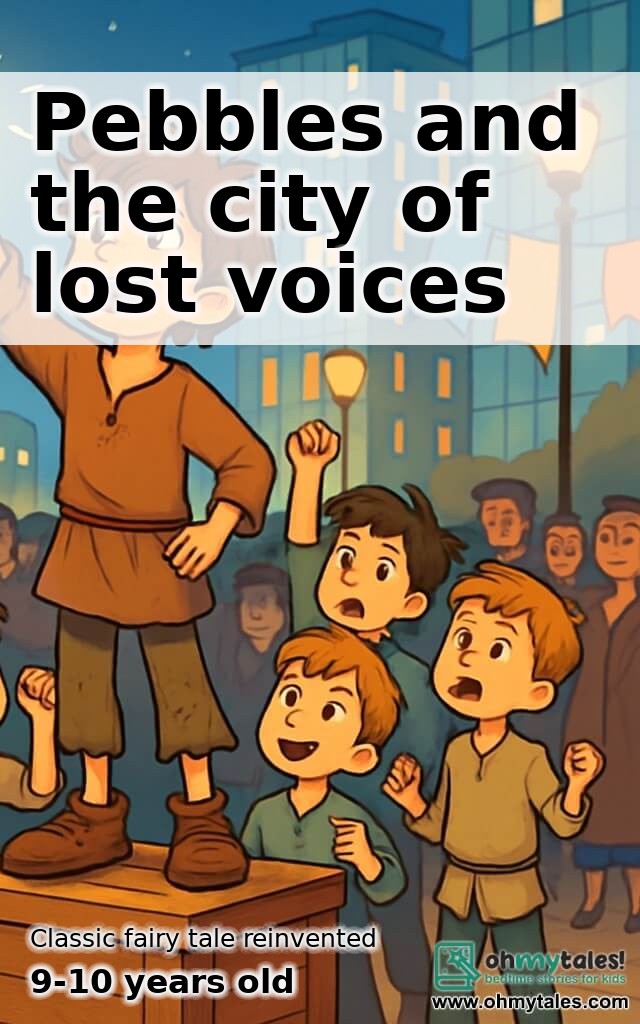
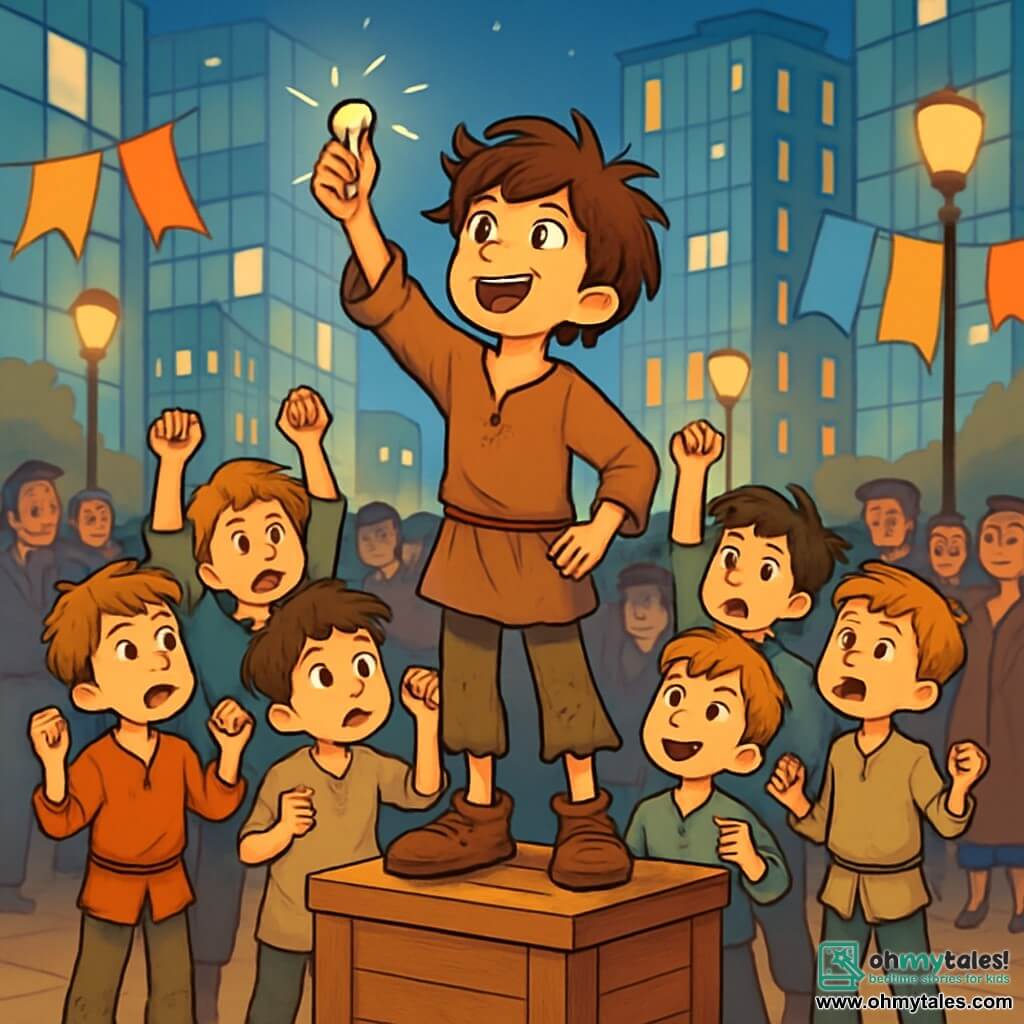
Determined, Little Thumb led his brothers to the city square. There, standing on a crate beside a fountain, he spoke. His voice, quiet but clear, fluttered through the crowd like a songbird in winter.
“This city is not a maze for us to wander lost, nor a castle for ogres to hoard,” he cried. “It is our home, too. We are many, and we are here!”
Others gathered—a patchwork of faces, old and young, tired and bright-eyed. The crowd grew, filling the square like water in a dry well.
Little Thumb held up his last pebble, small and shining. “When we speak together, each voice is a pebble. Alone, we are easy to overlook. But pile them high, and even an ogre must listen.”
The people cheered, their voices weaving together, rising above the city noise. They painted signs and sang songs. They marched, pebble by pebble, street by street, until the Ogre and his council could no longer ignore them.
The media came, flashing cameras like lightning. The Ogre appeared on a balcony, a smile painted on his face, but the people saw through it now. They demanded fairer wages, open parks, shelters for those without homes, and a city that remembered everyone—even little boys with pockets full of pebbles.
Slowly, brick by brick, things began to change. The Ogre's doors opened. The feast became real. Parks were planted. Schools grew bright again. The city, once a cold forest of stone, began to bloom.
Chapter 5: The Path Home
At last, Little Thumb and his brothers walked home beneath a sky blushing with sunrise. The pebbles they'd dropped, once tokens of their journey, now marked a path others could follow. Their family welcomed them with laughter at the door, their home warmed by hope and the promise of a fairer city.
“Never forget,” Little Thumb told his brothers, “that even the smallest voice can echo through towers and crowds, if joined with others. We all have pebbles in our pockets—ideas, dreams, kindness. If we share them, we can find our way, and help others find theirs, too.”
And so, in the heart of the ever-whispering city, Little Thumb learned that being small did not mean being powerless. For in a world of giants and ogres, a pebble of truth could tip the scales and let light bloom where once there was only shadow.
And the city, no longer just a place of stone and glass, became a home for all its children, bright with laughter and hope, forever and ever.