Ticket to Trouble
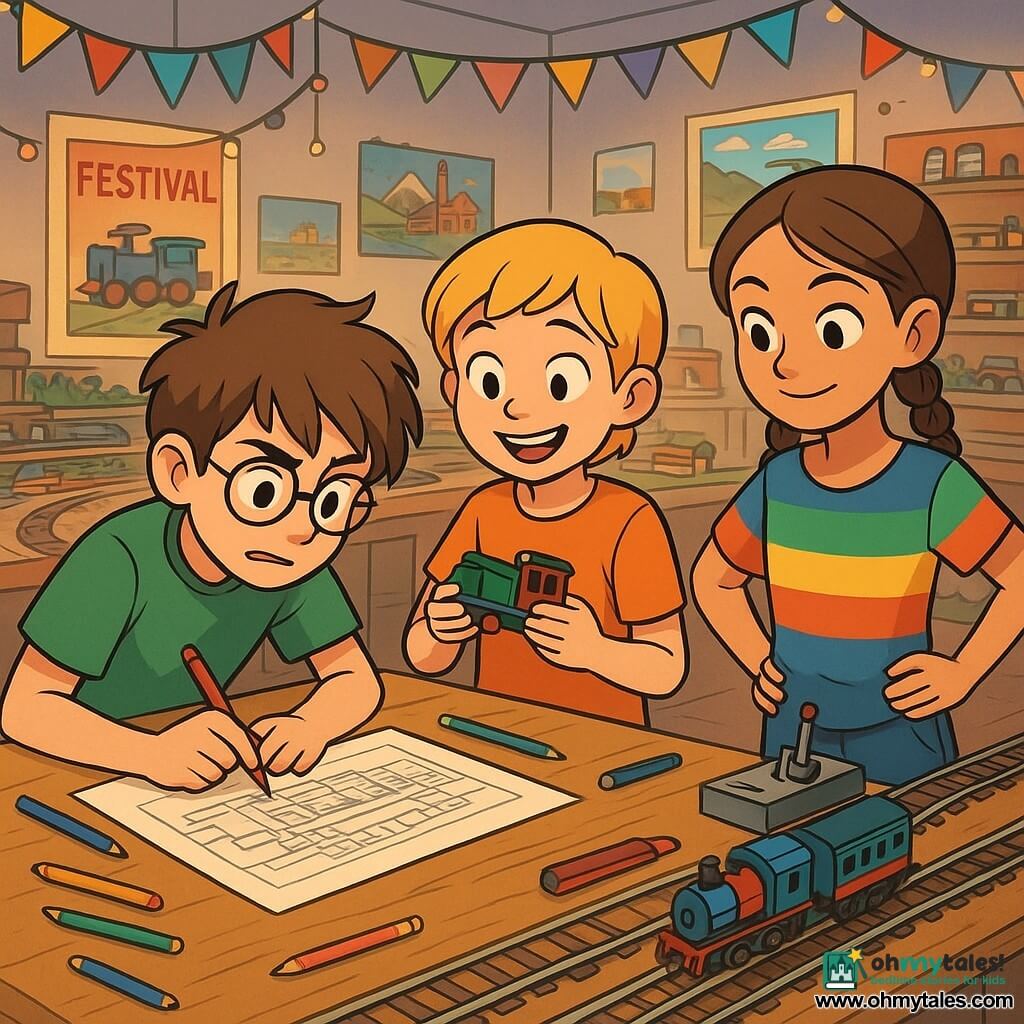
Oliver loved lists. He liked them the way some people liked chocolate—neat, satisfying and excellent for solving problems. Saturday mornings at the Whistlewick Model Station were his favorite time: tiny platforms, blue-tinged semaphore arms, and a forest of rails that looked like a city for ants. Oliver measured the switches with the same careful eye he used for pencil sharpening: precise, focused and a little proud.
That morning a poster trembled on the club noticeboard: GRAND PARADE—IMPOSSIBLE TIMETABLE CHALLENGE. Twelve trains. Twelve stops. One perfect order. The prize was a golden whistle and the knowledge that every parcel in Mrs. Patel's post box would be delivered to town for the Feather Festival.
“The switches have been acting odd,” warned Mr. Kemp, the station steward. “They slip, flip, and sometimes they just sulk.”
Capricious switches. Oliver's fingers itched. Capricious things were exactly the kind of thing his lists had been made to tame.
“You'll need more than lists, Ollie,” Maya said, peering over his shoulder. She was all sneakers and quick smiles. “You'll need tricks.”
Oliver loved tricks almost as much as lists, provided the tricks followed rules. He nodded, wrote a quick plan on the back of an envelope, and tucked it into his pocket. The impossible timetable had just met its match: methodical, slightly mischievous Oliver.
Blueprints and Bubblegum
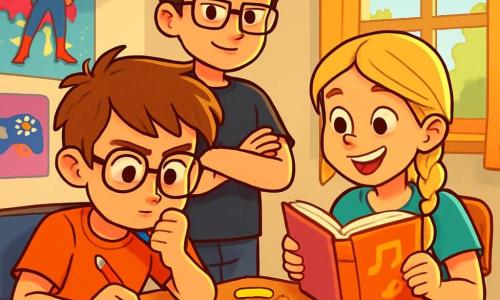
Oliver started with a blueprint. He sketched the model station across three pages, annotating every switch with tiny numbers and smiley faces where he felt optimistic. He pressed a stopwatch to his ear like a drum, timing how long it took for a switch to move from left to right. The capricious ones were particularly interesting: they flipped without any obvious cause, sometimes when a cat mewed in the alley, sometimes when someone sneezed.
“Look!” Jo announced, holding a tiny rubber duck. “This one flips when you say its name.”
Oliver tilted his head. “Say its name?” He tried it. “Switchy.”
Click. The lever slid. The team burst into laughter. The station, which should have been a calm city of precise clicks, had preferences.
They practised gentle experiments. A puff of breath on a lever made it quiver. Bright sunlight seemed to soothe one switch, while another only agreed to stay put if a sock was draped over its base. They taped down sticky notes with arrows, tied threads to levers, and once, because it seemed like a sensible emergency measure, used a wad of bubblegum to stop a switch from shimmying.
“You're not gluing the switches,” Mr. Kemp said, though he laughed as he said it. “We trust you, despite the gum.”
Oliver made a second list: test, rehearse, note, repeat. He wrote the word REHEARSAL in big letters and practiced saying it like a drumbeat—each rehearsal would teach them the station's secrets. He scheduled the first full run for Saturday afternoon.
First Rehearsal: Chaos with Confetti
The first rehearsal was gloriously messy. Fingers flew, whistles blew, and confetti—why anyone had confetti in a model club was a mystery—rained like micro-snow when a celebratory train passed the festival platform. The capricious switches loved celebrations and turned somersaults.
“Train three, platform seven—and go!” Oliver counted.
Seventeen seconds later the first flip happened, not in the place they expected but somewhere at the far curve, sending a tiny caboose airborne and making Maya gasp.
“That's not on my list!” Jo yelled, juggling a switch lever with her elbow while steering a carriage with her knee.
Oliver's calm cataloguing face appeared. He clicked his tongue and wrote down exact moments: laughter, puff of the heater, Timmy dropping his sandwich—each event that seemed to precede a switch flip. After the rehearsal they gathered in a circle, tired and happy.
“What did we learn?” Oliver asked, tapping his pen.
“That blow-drying the station makes the switches sulk,” Maya said.
“That the confetti confuses them,” Jo added.
“And that we need someone to watch the older visitors' parcels,” observed Mr. Kemp. “Mrs. Patel worries when her postbox is unattended.”
Oliver added: ATTENTION TO OTHERS—make sure no one's parcels are forgotten. He scratched the note in a fresh color, because it mattered more than golden whistles.
They ran the rehearsal three times more, repeating the sequence like a chorus until the chaos felt almost ordered. Each time they repeated, the station answered differently, but their timing grew sharper. Oliver's pen ran out of ink and he replaced it without losing a beat. Repetition was not boring; it was tuning.
Plan B: The Clever Contraption
On the Sunday afternoon before the parade, Oliver unveiled Plan B. He had been awake late, inventing. He presented a contraption as odd-looking as a contraption had a right to be: a line of clothespins padded with foam, tiny pulleys, a metronome, and a string of beads painted in festival colors. It looked like someone had mixed a sewing kit with a clockwork toy.
“We won't imprison the switches,” Oliver said crisply. “We'll persuade them.”
Maya squinted. “Persuade?”
“Yes. Gentle clamps—soft as marshmallows—won't hurt the mechanisms, only guide them for fifteen seconds, the exact window we need to pass a train. The metronome will set a beat. Everything that happens on the beat is expected. Surprise flips hate rhythm.”
Jo laughed. “You are really making a train orchestra.”
They practised clipping, unclipping and passing the beads along the string to signal each other. Oliver taught them a counting rhythm: “One-two-three—glide.” They rehearsed the sequence with the clamped switches and then without. Each rehearsal Iiked like tightening screws on a simple machine until it hummed.
Oliver also assigned helpers to people. “If Mrs. Patel looks worried, Jo and I will handle her parcels. Maya will watch platform nine because Timmy loves to place his toy soldier there.” Attention to others threaded through every move.
They repeated the full run seven times, because repetition turned oddities into predictions. The station began to seem less capricious and more like a friend who needed a little coaxing.
The Impossible Run
Festival day dawned bright and indecisive. Families arrived, noses pink with cold. The club room filled with the warm hum of anticipation. Oliver's stomach made a tiny, principled flutter—excitement with a spreadsheet of tasks.
“Ready?” he asked, voice small and steady.
“Ready,” the team replied.
They slipped the marshmallow-padded clothespins onto levers, clamped the metronome in place and set the beads to the first color. The first train chugged away, perfectly on schedule. The second, third and fourth trains followed in a rhythm that made everyone breathe easier.
Halfway through, a hiccup. A pigeon had found its way onto the roof and cooed, which made old Mr. Hargreaves laugh so loudly his cane tapped the floor right beneath a key control table. One switch did what capricious switches do: it sulked and slid.
“Oh no!” Timmy whispered, because his toy soldier was on that platform.
Oliver didn't panic. He counted softly, “One-two-three—glide,” and gave the bead a gentle flick. The metronome's tick steadied the room like a heartbeat. Maya clipped a foam clothespin in a fraction of a second, and the train squeaked through as if the switch had been waiting only for that rhythm.
A smaller emergency followed when someone's sandwich parachuted into the tracks with a heroic flop. The club erupted, and just as they bent to retrieve it, a tiny girl cried because her plush rabbit had rolled under the station. Without thinking twice, Oliver left his list and crawled underneath, rescued the rabbit and handed it back, dusting imaginary crumbs from its ears.
“You okay?” he asked the girl.
She nodded, eyes bright. “Thanks.”
“Couldn't let a rabbit miss the parade,” he said, and felt his chest swell in the nice way that helping people does.
They finished the run with a prickle of applause. Each train had landed where it belonged. Mrs. Patel found her parcels—none lost. Children clapped for the rescued rabbit, and even the pigeon seemed to bob its head in approval.
All Aboard—and a Wink
At the end, Mr. Kemp stood with the golden whistle between his hands. He smiled at Oliver's careful lists and at the team who had learned rhythm, patience and the importance of watching out for others.
“You did it,” he said. “You and your clever contraption and your attention.”
Oliver's cheeks warmed. He looked at the station, at the little semaphore arms now standing like polite soldiers, and then at his friends who had clapped confetti into their hair.
“We practiced a lot,” he said. “And listened. The station has moods, but also feelings—like everybody.”
Maya elbowed him. “You mean you finally admitted that trains have feelings.”
“I mean we paid attention,” Oliver corrected with a grin. “And helped people.”
As they packed up, a tiny passerby—Timmy with his toy soldier—pressed a hand-wrapped thank-you note into Oliver's palm. The note had a sticker of a rabbit and a fat crayon heart.
Oliver tucked the note into his pocket next to his checklist. He placed the golden whistle on the shelf, where it would jingle during future rehearsals. Then he looked back at the station, at the tiny switches that had been capricious and now seemed a little proud, and gave a small, conspiratorial wink—a secret shared between a boy who loved lists and a station that loved rhythm.