Chapter 1: The Careful One
Milo checked the hallway twice before bed. Once with his desk lamp on, once with it off, just to compare. The hallway looked normal with light: pale walls, family photos, a shoe that didn't belong in the middle of the floor.
With the lamp off, it became a different place. The photos turned into dark rectangles. The shoe became a lump that could trip you if you weren't paying attention. The corners looked deeper, like they were holding their breath.
Milo didn't like that.
He was the kind of kid who packed his backpack the night before and lined up his pencils by size. He set two alarms even if he only needed one. He was responsible, and he liked feeling ready.
The problem was that darkness didn't follow rules.
“Bedtime,” Mom called from downstairs. Her voice floated up like warm toast.
Milo's room was tidy. His blanket was folded neatly at the end of the bed, because he liked starting fresh. He brushed his teeth, counted to sixty the way his dentist suggested, and put his toothbrush back exactly where it belonged.
Then he climbed under the covers and stared at the ceiling.
A tiny shape bounced on his bookshelf, where the novels and science magazines lived. It hopped down, landing on the carpet with a soft thump, and padded closer.
It was about the size of a small cat, but not a cat. It had velvety gray fur, long ears that drooped like commas, and two little horns that looked more like curled thumbs than anything scary. Its eyes were round and golden, like coins warmed in the sun.
Milo whispered, “You're late.”
The creature blinked slowly, as if it had all the time in the world. It made a sound like a gentle “hmph,” then tucked itself into the beanbag chair.
It had been around for months, ever since Milo had left a window open one evening and found his desk lamp flickering in an odd rhythm, as if it were talking. He never told anyone. Not because he was embarrassed, but because he wasn't sure how you explained something that looked like a comforting mistake.
Milo called it Nib.
“You don't have to stay,” Milo said, trying to sound casual.
Nib yawned wide enough to show tiny square teeth. Then it pointed one soft paw at the lamp switch.
Milo's stomach tightened. “I know. Lights out.”
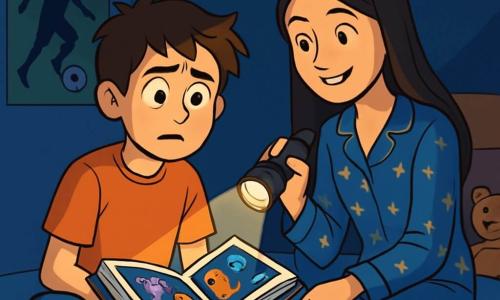
Mom came in a minute later and sat on the edge of the bed. She smelled like dish soap and lavender hand cream.
“Big day tomorrow,” she said. “You're helping with the library's evening event, right?”
Milo nodded. He had signed up as a junior volunteer. He liked jobs with checklists.
Mom kissed his forehead. “Proud of you. You're always so steady.”
Milo wanted to stay steady. But when Mom reached for the lamp, his hands started to sweat.
“Can you leave it on a bit?” he asked, and hated how small his voice sounded.
Mom paused. She didn't tease. She didn't sigh. She just looked at him like she was listening with her whole face.
“Sure,” she said. “But we can practice, too. Little steps.”
Milo nodded again, but he didn't feel brave. He felt like a person holding a tray full of glasses, trying not to wobble.
Mom stood up. “Goodnight, Milo.”
When she left, Nib hopped onto the bed and sat near Milo's knees, as if it was guarding a campfire.
Milo whispered, “I'm supposed to be responsible. Responsible people aren't scared of… shadows.”
Nib tilted its head, ears drooping farther. Then it nudged Milo's hand with its nose, warm and insistent.
It was like Nib was saying: You can be responsible and still be scared. Let's work with that.
Chapter 2: The Library After Hours
The next evening, Milo arrived at the library early, wearing his cleanest sneakers and a lanyard that said JUNIOR VOLUNTEER. The building smelled like paper, dust, and quiet excitement.
Ms. Patel, the librarian, handed Milo a stack of flyers. “You can place these near the entrance. And later, could you help guide families to the story corner?”
Milo straightened. “Yes, ma'am.”
The event was called “Night at the Library,” but it wasn't spooky. It was meant to be cozy. There would be a short talk about constellations, then a bedtime-story reading with dimmed lights.
Dimmed lights.
Milo's throat went tight, but he nodded anyway. He had promised.
He was taping a flyer to the front desk when his friend Tessa slid in beside him. She had messy braids and always seemed like she was in a hurry to laugh.
“Look at you,” she said. “Official and everything.”
Milo tried to grin. “It's a lanyard. I'm basically in charge of the entire building.”
Tessa snorted. “Then I demand free bookmarks.”
Milo handed her one. “I'll allow it. But only because I'm kind.”
As the library filled with families, Milo guided people toward the chairs. He was good at it. He liked being useful. Every “Thank you” felt like a small brick in a strong wall.
Then Ms. Patel announced, “In ten minutes, we'll dim the lights to help our eyes adjust for the stargazing presentation.”
Milo's wall wobbled.
Tessa leaned close. “You okay?”
“Yeah,” Milo lied. He kept moving so he wouldn't have to answer.
When the lights lowered, the library changed. The corners softened. The tall bookshelves turned into dark cliffs. The ceiling lights became quiet moons.
A little kid whispered, “It's like a cave!”
Milo swallowed. A cave was exactly what it felt like.
He found himself walking toward the window where the streetlights shone in. He didn't want to run. He wasn't a runner. But his feet wanted distance from the dark.
Then a familiar soft thump sounded behind him.
Nib.
Nib sat between two armchairs, almost invisible in the dimness. Its golden eyes glowed gently. It didn't jump or squeal. It just looked at Milo like a calm teacher.
Milo blinked hard. “Are you following me now?” he whispered.
Nib lifted one paw and pointed—toward the darker part of the room.
Milo's heart protested. But Ms. Patel's voice carried through the dim light. “We're going to learn a trick astronomers use. They don't fight the dark. They let their eyes learn it.”
Nib's ears wiggled, like it approved.
Milo took a careful breath. He tried to notice facts, not fears.
There were exit signs, bright green. There were people, murmuring. There were chairs, carpet, the smell of old books. The dark hadn't removed anything. It had only changed the way things looked.
Tessa appeared, holding two cups of water. “Hydration break,” she said. “You look like you're about to faint dramatically onto the nonfiction section.”
“I would never,” Milo said, taking the cup. “If I faint, it will be near fiction. For style.”
Tessa laughed, and the sound made Milo feel lighter.
Nib's eyes seemed to say: Humor counts as a tool.
When the stargazing talk began, Milo stayed. His hands still felt tense, but he didn't flee. He listened to the speaker explain how our pupils widen, how our eyes can adjust, how darkness isn't a monster—it's a condition.
Milo leaned toward Tessa and whispered, “I'm… not loving this. But I'm staying.”
Tessa nodded seriously. “That's actually pretty impressive.”
Nib blinked once, slow and proud.
Chapter 3: A Flashlight Plan
Back home, Milo stood in the bathroom, staring at his own face in the mirror. Under the bright light, he looked ordinary: brown hair, sleepy eyes, a tiny freckle near his chin.
In the doorway, Nib sat like a fuzzy statue.
Milo brushed his teeth, then rinsed. “Okay,” he said to his reflection, “we're making a plan. Responsible people make plans.”
Nib made its soft “hmph” sound, as if it agreed.
Milo walked to his desk and pulled out a small notebook. He wrote at the top: NIGHT TOOLS.
1) Flashlight on nightstand
2) Glass of water
3) Breathing trick (in 4, hold 2, out 6)
4) Name five things I can hear
5) Check the room once (ONLY once)
Nib hopped up and pressed its nose to the notebook, then sneezed in a tiny puff. It was almost like a laugh.
“What?” Milo said. “It's a good list.”
Nib tapped the last item with a paw, then tapped it again.
Milo frowned. “No? The check is important.”
Nib shook its head, ears flopping. Then it padded to the closet and sat in front of it, very still.
Milo understood. The closet was part of his “checking.” He always checked it. He didn't even know why. It had never contained anything except hoodies, a vacuum cleaner, and a box of cables nobody understood.
But at night, the closet door looked like a mouth.
Milo swallowed. “I should check it less,” he admitted. “Because checking makes me feel better for ten seconds. Then I need to check again.”
Nib's eyes softened.
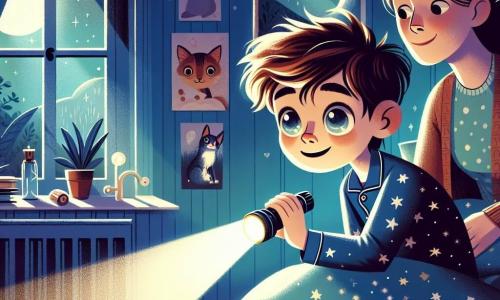
Milo turned off the bedroom lamp and immediately clicked on his flashlight. A white circle appeared on the wall. He aimed it at his bookshelf: familiar shapes. He aimed it at the chair: just a chair.
He aimed it at the closet.
His chest tightened.
“Okay,” he told himself. “Fact time. The closet is full of sweaters. The door is shut. Nothing has changed since this afternoon.”
Nib sat beside him and leaned its warm side against Milo's leg.
Milo tried the breathing trick. In for four. Hold for two. Out for six. The exhale felt like letting air out of a balloon slowly, so it didn't squeal.
He said out loud, “Five things I can hear.”
He listened.
1) The refrigerator humming downstairs.
2) A car passing outside.
3) The ticking of his wall clock.
4) His own breath.
5) Nib's tiny, satisfied snuffle.
That last one made him smile, even though he didn't fully mean to.
“See?” Milo whispered to Nib. “It's not silence. It's… normal sounds.”
Nib nudged the flashlight, gently lowering it so the beam wasn't aimed like a weapon. Then Nib lay down, chin on paws.
Milo hesitated, then switched the flashlight off.
Darkness returned. Not complete darkness—there was a strip of light under the door from the hallway nightlight, and the glow of the digital clock.
Milo felt the usual spike of worry. But he tried to treat it like a wave: something that rises and falls, not something that stays forever.
He whispered, “I can do this for one minute.”
Nib's tail flicked, like: Good. One minute is real.
Milo stared into the dim room and waited. His eyes began to adjust. The closet door became a door again, not a mouth. The chair became a chair, not a crouched stranger.
The minute passed.
Milo exhaled. “Okay,” he said. “That wasn't fun. But it wasn't… disaster.”
Nib closed its eyes, looking pleased, as if Milo had just solved a tricky puzzle.
Chapter 4: Letting Go
On Friday, Mom had to work late. Dad was away on a business trip. Milo was in charge of his little sister, Lina, for the evening.
Lina was seven and fearless in a way that made Milo suspicious. She could walk into a dark hallway like it was a sunny park.
Milo heated soup, cut bread, and reminded Lina to do her spelling practice. He even checked the stove knobs twice, because responsibility was serious business.
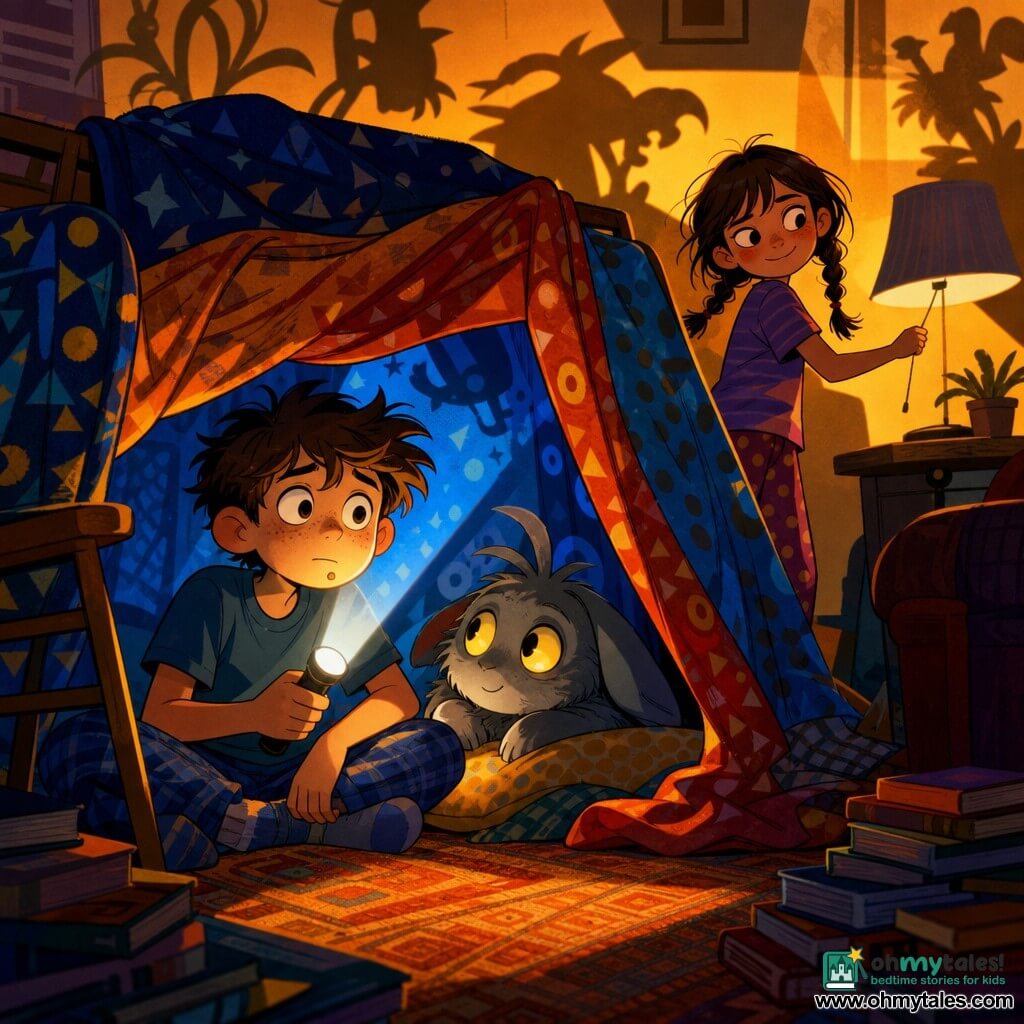
After dinner, Lina built a blanket fort in the living room.
“Come in!” she called. “It's a secret base.”
Milo crawled inside. The fort smelled like laundry detergent and couch cushions. The light from the lamp outside made the blankets glow like soft clouds.
Lina whispered, “Let's turn off the lamp. Then it's a real base.”
Milo froze. “Maybe we keep the lamp. Real bases need… electricity.”
Lina rolled her eyes with dramatic patience. “Milo. It's a blanket. Not a spaceship.”
She reached out toward the lamp cord.
Milo caught her wrist—not hard, just quick. “Wait.”
Lina looked at his hand on her wrist. Then she looked up at him, quiet now.
Milo felt heat rush to his face. He released her immediately. His fingers tingled as if they had been gripping something too tightly for too long.
“I'm sorry,” he said. “I didn't mean to grab you. I just—”
“I know,” Lina said, surprising him with her calm. “You don't like the dark.”
Milo swallowed. Saying it out loud made it real. But it also made it smaller, like a balloon that was losing air.
“I'm working on it,” he said.
From the edge of the fort, Nib peeked in, ears drooping kindly. Lina didn't seem to notice. Or maybe she did and accepted it the way kids accept odd things: as long as they're not mean.
Lina scooted closer. “We can do it together,” she said. “We can make the dark less bossy.”
Milo gave a shaky laugh. “Less bossy. I like that.”
Lina held up her fingers. “We make rules. Rule one: we can turn on the lamp any time. Rule two: we try first.”
Milo breathed in slowly. “Okay. But we do it for… thirty seconds.”
“Deal,” Lina said, and this time Milo didn't stop her.
She clicked the lamp off.
The blanket fort changed instantly. The bright glow vanished. The shadows thickened. Milo's stomach flipped like a page turning too fast.
He wanted to reach out and click the lamp back on. His hand twitched.
Then he remembered the library. He remembered his list.
He whispered, “Five things I can hear.”
Lina whispered too, like it was a game. “I hear the clock.”
“I hear the pipes,” Milo said. “I hear your breathing.”
“I hear… your stomach,” Lina said, and then giggled.
Milo snorted, despite himself. “That's not helpful.”
“It is,” Lina insisted. “Because it means you're alive.”
Nib made its little “hmph,” which in the dark sounded like a tiny motorboat.
Milo's shoulders loosened a fraction. He tried the breathing: in four, hold two, out six. His hands unclenched. His fingers relaxed against the blanket.
He realized something: he had been holding tight all evening—his schedule, his sister, his worry—like his palms were keeping the world together. Letting go felt strange. Like stepping onto a bridge and trusting it to hold.
At thirty seconds, Lina whispered, “Want more?”
Milo listened to his body. His heart was still fast, but he wasn't panicking. The fort didn't feel like a trap. It felt like a small, dark room where nothing bad was actually happening.
“Ten more seconds,” Milo said.
“Brave,” Lina whispered, and the word didn't sound like pressure. It sounded like a blanket.
When Lina clicked the lamp back on, Milo didn't feel defeated. He felt like he had trained a tiny muscle.
“Thanks,” he told Lina. “For… not rushing me.”
Lina shrugged. “Thanks for soup. And for not being bossy. Mostly.”
Milo laughed. “Fair.”
Nib blinked slowly, as if to say: This is what letting go looks like.
Chapter 5: A Softer Night
That night, Milo did his bedtime routine without racing. He put his flashlight on the nightstand, but he didn't clutch it. He filled his water glass halfway, because he didn't want to worry about spilling.
Mom checked on him, her hair damp from a shower. “How was it being in charge?”
Milo hesitated, then decided to be honest. Responsible people could be honest too.
“It was okay,” he said. “I got tense. I grabbed Lina's wrist when she tried to turn off the lamp in the fort.”
Mom's eyes widened slightly, but she didn't scold. She waited.
“I let go right away,” Milo said quickly. “And I apologized. Then we tried the dark together. I did the listening thing.”
Mom sat on the bed. “Thank you for telling me. And thank you for letting go. That's not always easy.”
Milo stared at his blanket. “It felt like my hands had their own opinions.”
Mom smiled a little. “Hands can be dramatic. But you noticed. You stopped. That matters.”
She reached for the lamp switch. “Want to try lights out?”
Milo's stomach tightened, but not as sharply as before.
“Yeah,” he said. “But can we leave the door cracked?”
“Of course.”
Mom turned off the lamp.
The room turned quiet and dim. The ceiling disappeared. The corners blurred. Milo felt the first wave of fear rise.
He didn't fight it. He named it, silently: There you are.
He breathed in four, held two, out six.
He listened.
He heard the house settling, a soft creak like a whisper. He heard Mom's footsteps in the hallway, slow and normal. He heard Nib's small snuffle near the foot of the bed.
Milo kept his eyes open and let them adjust. The digital clock glowed. The outline of his desk appeared. His curtain moved slightly in the breeze from the vent.
Nothing lunged. Nothing changed into something else. The dark stayed the dark.
Milo reached for the flashlight, then stopped. He didn't need it yet. Knowing it was there was enough.
His thoughts wandered to the library—how the shelves had seemed like cliffs, then turned back into shelves when his eyes adjusted. He thought about Lina's words: make the dark less bossy.
He whispered into the dimness, “You're not the boss of me.”
Nib made a pleased sound, as if it had been waiting for that line.
Milo smiled. It was a small smile, but it felt real.
Sleep didn't arrive instantly. It rarely did. But Milo lay there with his fear beside him instead of on top of him, like a heavy blanket he couldn't throw off.
Before his eyes closed, Milo whispered, “Thanks.”
Nib didn't answer in words. It simply stayed.
Chapter 6: Thank You for the Patience
The next morning, sunlight poured into Milo's room like someone had opened a faucet of gold. The closet door looked harmless and slightly crooked, as if it had always been more annoying than frightening.
Milo sat up and realized something important: he had slept. Not perfectly. Not all night without waking. But he had slept.
At breakfast, Lina was already talking at full speed about a class project involving poster board and glitter.
Mom poured juice. “How did everyone sleep?”
Lina said, “Fine. Milo fought the Dark Boss and won.”
Milo nearly choked on his cereal. “I didn't win. I negotiated.”
Dad's voice came through on the speakerphone from the counter. “Negotiated with what?”
Milo glanced at Mom, then decided to keep it simple. “Just… bedtime nerves. I'm working on it.”
Dad said, “That's strong. Working on things is strong.”
Milo felt a warm, steady feeling in his chest. Not fireworks. More like a lamp turned low.
After breakfast, Milo helped Lina find her missing shoe (it was under the couch, obviously) and walked her to the bus stop. The sky was bright, but Milo knew night would come again. That was how the world worked.
And he knew something else, too: he didn't have to solve the dark in one day. He could practice. He could use tools. He could laugh. He could breathe. He could let his eyes adjust and let his hands relax.
Back inside, he saw Mom loading the dishwasher.
Milo leaned against the doorway. “Mom?”
“Yes?”
He rubbed the back of his neck, a little embarrassed. “Thanks for… not getting tired of me. With the light stuff. And the worrying.”
Mom looked at him for a long moment, then nodded. “You're welcome.”
Milo took a breath and said the words clearly, the way you should say important things.
“Thank you for the patience.”