The Stiff Suit and the Space Notebook
Mina floated by the round window of the space station and watched Earth turn like a slow blue marble. The station hummed softly, like a sleepy cat. Tiny lights blinked, and tools rested in their clips, as neat as crayons in a box. Mina opened her space notebook. She wrote with a short pencil so it would not float away.
“Today,” she wrote, “I will learn to make my suit bend better.”
Her space suit waited in the airlock. It was white and puffy. It had a big clear helmet and gloves that looked like friendly bear paws. The suit was really a tiny ship for one person. It made air to breathe. It had a straw to drink water. It had a gold shield to keep out bright sunlight. It was strong and safe. It was also stiff.
When the suit was filled with air, it puffed up like a balloon. The arms and legs did not want to bend. The gloves were firm, because they had to hold in the air. Mina tried to curl her fingers. They curled, but they pushed back, like bendy straws with a mind of their own.
She floated next to the suit. She touched the smooth rings at the shoulders, the elbows, and the hips. These rings were special joints that helped her move in the stiff air. They were like round hinges. She wrote, “The suit is not stubborn. It is trying to keep me safe. I will learn to move with it, not against it.”
Mina was an astronaut, and astronauts learn many things. They practice floating and flipping. They learn to read long checklists. They work with a big team on Earth. They do experiments about plants, fire, and how water dances in the air. They learn to be careful, patient, and calm.
Today, Mina would also learn to make her stiff suit feel friendlier. She felt small in the wide dark sky, but she also felt ready. She tucked the pencil into the notebook's elastic band and smiled.
Learning to Move Like Space
First, Mina tried the size. Space suits can change a little. They have hard rings and soft foam pads inside. They have boots that click on and off. She and her teammate, who floated nearby with kind eyes and quick hands, checked the fingers of the gloves and the length of the arms. “Snug is safe,” Mina whispered. “Not tight. Not loose.”
They added a small foam pad at her shoulder, like a tiny pillow. They changed a ring at her waist so she could twist more easily. She wrote, “Adjust: shoulder pad in. Waist ring changed. Try again.”
Next, Mina practiced breathing. Before a spacewalk, astronauts breathe special oxygen to get their bodies ready. She sat in the quiet airlock and breathed slowly. In. Out. In. Out. Her heart beat a steady drum. She wrote, “Slow breath, clear head. Slow is smart.”
When it was time to test, Mina sealed the suit. Air flowed in with a soft rush. The suit became a gentle cloud wrapped around her. It pushed back when she pushed. She remembered her notebook words. She did not fight the suit. She moved like space—soft, slow, and round.
She placed her hand on the wall and gave a tiny push. She floated, gliding like a leaf in a lake. She bent her elbow with a smooth, patient motion. The joint ring turned. It worked better with the new pad. Her glove still felt stiff, so she tried a trick: she used her whole arm to hold the tool, not just her fingers. “Big muscles help little ones,” she wrote.
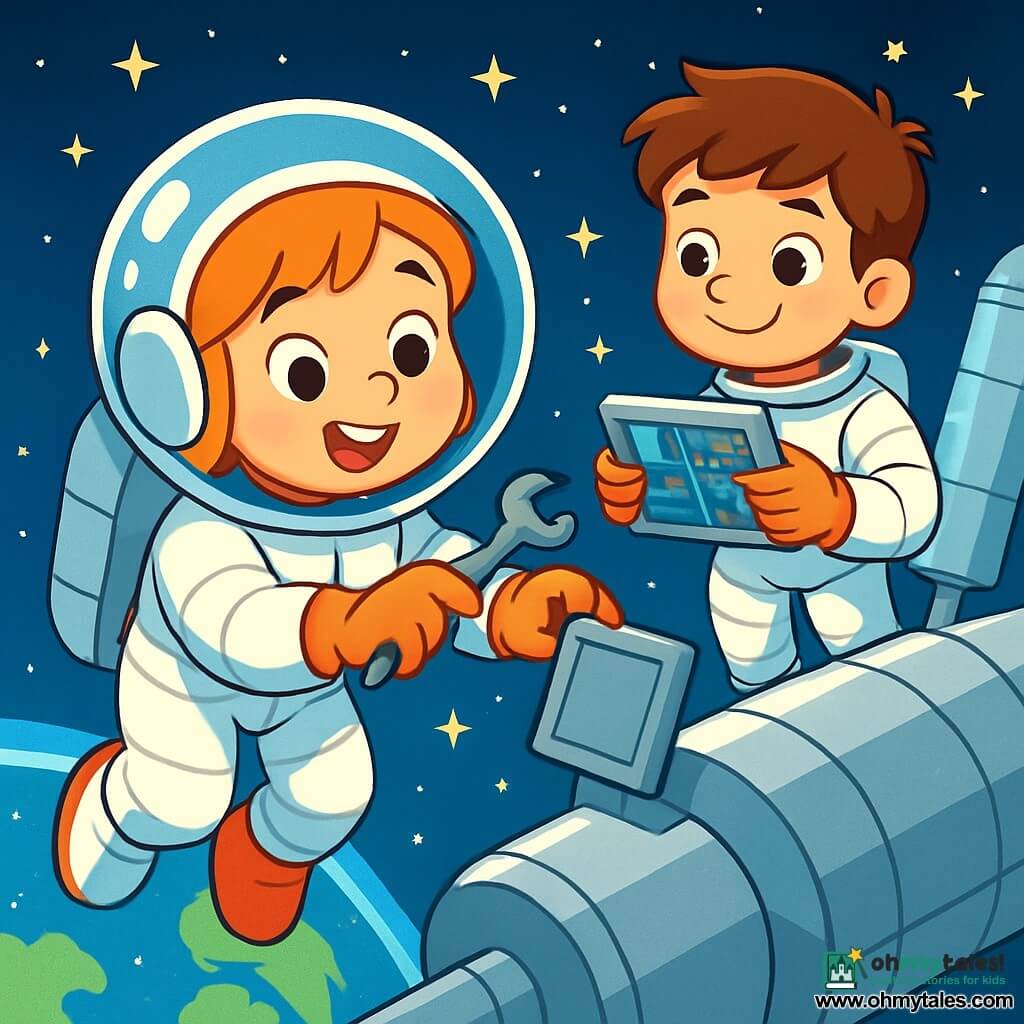
A wrench drifted up. Mina clicked it to a tether clip. In space, everything wants to float away, even tools, even people. Astronauts use tethers—safe strings that say, “Stay with me.” Mina tugged her own safety tether and felt it pull back. Solid and sure. She wrote, “Tether on. Clips are friends.”
In the training bay back on Earth, astronauts practice moving underwater because water slows you down, like a hug. In orbit, space also wants you to be slow. Slow keeps you safe. Slow lets you think. Mina tried a new rhythm: push, float, pause; touch, turn, check. It was like a tiny dance. The suit did not get softer, exactly. Mina got smarter. She learned its song.
The radio crackled in her helmet. A calm voice from the ground said, “We see good movements.” Mina nodded even though they could not see. “Thank you,” she whispered. She wrote, “Listen to the team. They see what I miss.”
A tiny twist surprised her. One glove fingertip rubbed the wrong way. It made a hot spot. Mina stopped, told the team, and changed to a better-fitting glove. No proud hurry. No “I can do it anyway.” Just care. Humble and steady. She wrote, “If something is wrong, say so. Fix it.”
Outside and Home Again
At last, the hatch opened like a slow mouth, and the stars poured in. They were not twinkly pinpricks now. They were sharp and steady, as if someone had painted bright dots on deep velvet. Earth curved below, green and blue and white. The station shone like a silver fish.
Mina clipped her tether and slipped out. The suit hummed all around her. It made warm water move through thin tubes in her cloth under-suit, like tiny rivers that kept her just right. Her boots clicked to a ladder. She moved hand over hand, like climbing on a playground, but softer, slower.
Her job was to adjust a small panel, to make sure it turned the right way when the station changed its face to the Sun. She reached the panel. She checked the bolts. She placed her wrench. She followed her checklist, step by step. Push, float, pause; touch, turn, check.
The suit still felt firm. It still pushed back. But now Mina knew how to lean into the suit's strength. She used her whole body like a careful machine. She did not pull hard. She let the tool do the work. She watched the Earth turn and did not hurry. Above the world, she made the smallest twist at just the right time.
“Panel adjusted,” she said. Her voice sounded small in the big night, but it carried all the way to her friends on Earth. The radio answered, calm and warm. “We copy. Nice work, Mina.”
She smiled. “Thank you, team.” She wrote in her mind, to save for later, “I did not do this alone.”
She checked her tethers again. She cleaned up her tools. She left no wrenches drifting, no caps or covers floating. Astronauts leave space tidy. She glided back to the hatch, boots tapping the ladder. The hatch closed. The air came in. The suit softened. The helmet lifted away.
Back inside, Mina opened her space notebook. She drew a tiny picture of the station and a bright arrow where the panel moved. She drew her suit with little rings at the joints. She wrote:
“The suit is a tiny ship. It keeps me safe with air and water and light. It feels stiff because it holds my world inside. I can learn its ways. I can move like space. Slow is smart. Teamwork is strong. If something rubs, I can stop and change it. I am small in the big sky, and that is okay. I can still do careful work.”
She floated by the window again. Clouds slipped by like soft sheep. The night side of Earth glowed with gentle dots. Mina closed her notebook and tucked the pencil back. The station hummed. Her suit rested in its place, ready for another day.
“Good night, stars,” she whispered. “Thank you for shining while I learn.” She drifted to her sleeping bag and zipped in. The bag did not hang down. It just stayed, and so did she. Her eyes closed. In her dreams, she moved through space easy and kind, with a suit that sang and a heart that listened.