Chapter One — The City That Sings
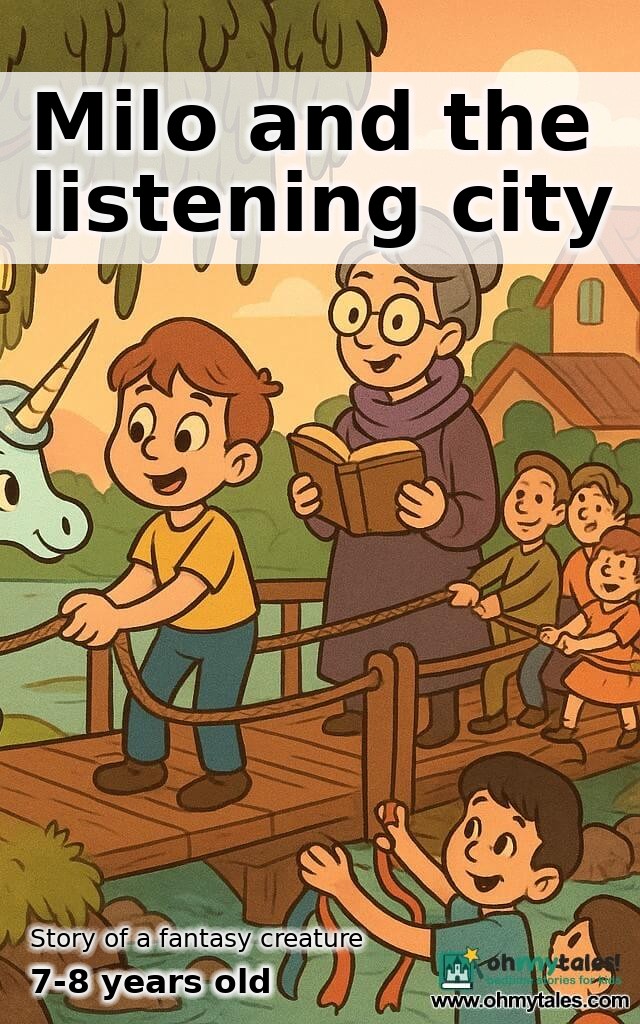
Milo lived in a city of wooden bridges that arched like the backs of gentle whales across an old river. Houses with bright shutters and hanging lanterns leaned together on the walkways. Boats hummed softly underneath, their oars tapping a steady, sleepy beat. The river had been there since long before anyone could count; it remembered rain and sun, songs and footsteps. Some people said the city listened to the river, and the river listened back.
Milo liked to stand at the very edge of the widest bridge and close his eyes. He would press his ear to the warm, worn wood and listen for the city's memory. The wood kept secrets tucked in its knots: the creak of a first kiss, the splash of a lost tin soldier, the laugh of a child who had learned to walk on the ropes. When Milo listened, those murmurs braided into a soft story that only he seemed to hear.
“I want to speak to trees,” Milo told his shoes one morning, which was the same as telling the bridge because the bridge always carried news. “I want to know what the seasons taste like, and why leaves fall so gracefully.”
A pigeon bobbed by and cooed. “Why not ask the bridge?” it seemed to say. Milo grinned. The bridge was old and kind. He pressed his palm again to the wood and said aloud, “Can you teach me to hear the trees?”
Wood warmed under his hand as if pleased. A tiny pulse of memory—like a bell—tapped into Milo's ear: a rustle of leaves, the creak of roots, the steady deep voice of the earth. The bridge remembered the river's first story and it knew the trees that watched the water. It could teach him, maybe, if he promised to listen with his whole heart.
That promise felt like a seed. Milo tucked it into his pocket and went to find the teacher he knew would help: Lira, the librarian who lived where three bridges met like fingers.
Chapter Two — The Listening Lesson
Lira kept a library on stilts with books that smelled of lemon and moss. She wore spectacles that made her eyes look like moons, and she had a scarf knitted from twilight. “You want to talk to trees?” she asked, smiling as if Milo had asked for a story of sugar and starlight. “Trees speak in slow poems. Are you ready to wait for words that come like rain?”
“I am,” Milo said. He took out the seed of promise and showed it to Lira. The little paper glowed when she touched it, and the lamplight leaned closer to read.
“You must learn three ways of listening,” Lira told him. “Listen with your ears, with your heart, and with the place nearby. The city will help. The river will help. But first, you must find a friend who believes with you.”
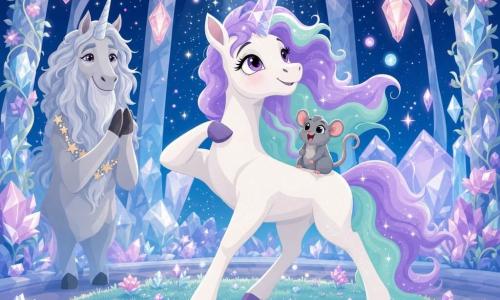
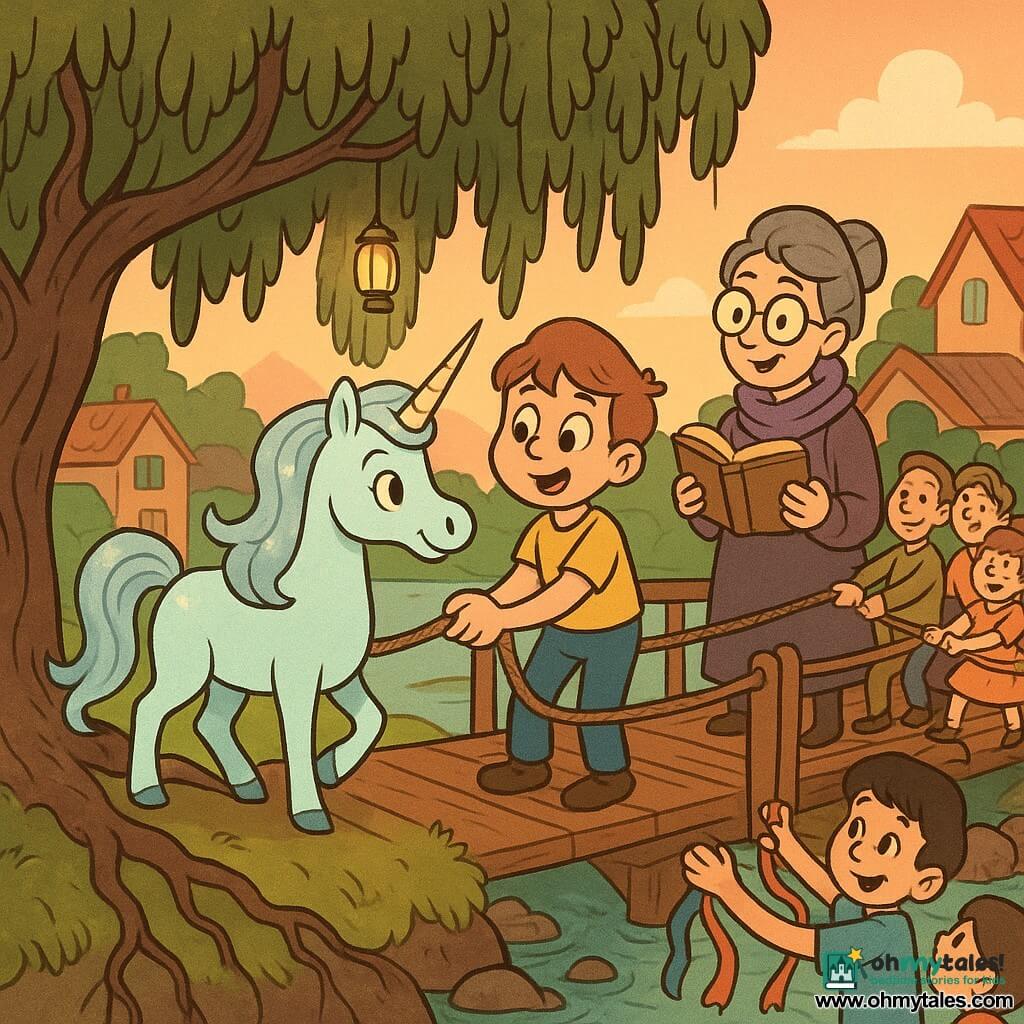
“I know someone,” Milo answered quickly. On the docks, a unicorn named Pebble grazed ribbons of seaweed and hummed to the tide. Pebble's mane shimmered like moonlight on water, and when she smiled, small bells in her tail chimed.
“Pebble?” said Lira, eyebrows up like two soft question marks.
“Yes! She hears colors,” Milo said. “She might practice listening with me.”
Lira laughed a bright laugh. “Then go. Share your promise aloud and the city will listen.”
Milo found Pebble waiting by the skewed pier, a hoof tucked under her belly. When Milo tapped the bridge with his knuckles, Pebble's horn sparkled and clouds of tiny stars drifted off and popped like soap bubbles.
“Will you help me?” Milo asked, and the unicorn blinked slow and thoughtful eyes. “I want to talk to trees.”
Pebble nuzzled his shoulder as if sealing a pact. “We begin with small things,” she said—not with words, but with a sound that Milo felt in his chest. He laughed because it felt a little like music.
Together they walked along the bridges. Milo pressed his ear to lamp posts and pilings. He learned to hear the bridge breathe: slow, steady, like a grandfather's hush. Pebble hummed beside him. When they reached a little courtyard with a single oak in a pot, Milo sat and listened.
At first, nothing happened. A pigeon argued with a squirrel. A baker carried warm rolls past. But slowly the oak sighed. The sigh was not sad; it was full of memory, like a warm blanket unfolding.
“You're listening wrong,” Pebble breathed, and when she did, Milo felt it as a nudge. “Not only with your ears.”
Milo closed his eyes, breathed like the bridge had taught him, and thought of the river's patience. The oak shared images: a winter when children tied ribbons to its branches, a summer when a cat slept under its shade, a spring when a small girl planted a seed and forgot it. The oak's words were not like yours and mine; they were soft pictures and feelings. Milo understood that to speak to trees, he needed to let pictures fill him.
“They are full of stories,” Milo whispered. He promised to remember each one.
Chapter Three — The River Remembers
The next day, the river brought a memory that smelled of pepper and rain. Pebble stepped into the shallows and flicked her mane. “The river also remembers going far, far away,” she hummed, and Milo felt images flow through him like cool silver. He saw a map of the city stitched on the water: narrow bridges like ladders, houses painted like candy, and a deep root network under the stones, where tree roots and boat ropes tangled together.
“We must wake the oldest tree,” Milo decided. “The one that leans over the widest bend. It will know how to teach voices.”
Across the town, children waved from their balconies and the baker tossed Milo a roll that landed on Pebble's nose. “For courage,” the baker called, and Pebble sneezed flour like a confetti cloud. The city hummed encouragement; even the lamps seemed to lean forward.
At the river's widest bend, an ancient willow hung its curtains down to the water, its leaves like green silk. Its trunk was thicker than three doors, and knots in its bark looked like sleepy faces. Milo placed his hand on the willow. He felt the city's memory pooling like warm tea—so many footsteps had circled this tree that its roots had learned to keep time.
The willow's first sound was a ripple of laughter that had been waiting a long, long while. It told of a time when the bridges were new and the river sang louder, of fishermen who mended nets and sang work songs, of lanterns that float like little moons. The willow's voice was slow and round and smelled of moss. When it spoke of solidarity, it showed Milo the day the bridge had almost fallen—how every neighbor, every boat-rower, every child had woven ropes and held hands, and how the city had lifted itself again.
“You listen to the place,” the willow breathed. “The place listens back. That is how our words are true.”
“But how do I answer?” Milo asked, because talking felt like stepping on hidden stones.
“Answer with small things,” said Pebble, whose horn glowed like a friendly lighthouse. “A song, a seed, a helping hand.”
So Milo sang a line he had learned from the bridge: “We keep each other steady.” He laid his warm bread at the willow's roots. He tied a bright ribbon on one of its low branches, and a child who had watched shouted, “For good luck!” The willow rustled, and the soft picture it gave Milo was of the ribbon as a tiny flag, waving over a boat that found its way back home.
That night, Milo slept under the willow's shadow and dreamed that he was a sapling learning to speak.
Chapter Four — The Language of Leaves
Days became a gentle sequence of lessons. Milo practiced listening at dawn, when dew stitched tiny mirrors to leaves; at noon, when shade made cool spots like welcome hands; at dusk, when fireflies stitched their tiny lamps among the branches. Pebble accompanied him everywhere. She would lay her head in Milo's lap and murmur stories she caught from the water.
Slowly, tree-talk began to come not as pictures only, but as little sounds like wind through a comb. Milo heard a creak that meant “remember,” a soft pop that meant “grow,” and a long shushing that meant “wait.” He learned to answer in small acts: he brushed moss from a stone so a root could breathe, he cleared a clogged drain so rain could dance down the street, and he read a story aloud beneath a tree so its roots would hear a human voice praising the day.
People started to notice that something sweet had changed in the city. Roots that had been stubborn loosened; leaves that had wilted leaned up. Children who played by the river often found their lost toys under certain trees as if the trees had kept them safe. Neighbors looked at Milo as if he had a pocket full of good weather.
“Solidarity,” Lira told a crowd one evening, when the city gathered on the bridge to hear Milo and Pebble tell what they had learned. “Solidarity is listening to the place and listening to each other. Milo has learned the first part. Now we learn the second.”
So the city decided to make a circle of listening. Families came with blankets and jars of lemonade. Bakers brought sweet buns. The willow leaned in, and even the river slowed its hurry to watch.
Milo stood in the middle, heart bright as a lantern. He pressed his hands to the bridge and to the willow and to his chest. He felt the city's memory spread like honey through his bones. He spoke a sentence that the trees taught him: “We are the story, and we keep one another.”
The willow hummed a long, round note. A flock of sparrows offered a tune. Pebble stamped a hoof and a bell sang. People began to tell small things they had done for one another: a neighbor had mended a roof, a girl had shared her umbrella, a fisherman had taught a child to tie a knot. Each story dropped like a pebble into the river of memory and made a bright, round ripple.
Chapter Five — The Promise Kept
Winter whispered in thin silver, and snow came as careful as a soft apology. The bridges wore shawls of frost. Milo's seeds of promise, kept in his pocket, had browned and opened like a tiny map. He had learned to listen, to answer, and to weave the city together in small, steady ways.
On the coldest morning, when ice made the river sing like glass, a great gust shook the willow. One of its heavy branches sagged and worried. Milo hurried with Pebble and a line of neighbors who came because they had learned how to be ready. They worked together: children handed ropes, bakers tied knots, Lira read a steadying poem, and Pebble's horn glowed with a gentle light that warmed the air.
Milo pressed his hand to the willow and asked quietly, “What do you need?”
The willow's answer was a soft picture—a boat made of leaves and a lantern of roots. Milo understood. He called out to the people, and together they tied a sling of braided rope. They lifted the branch just enough to let the willow breathe. The city hummed a song of help, and the river carried it like a boat.
When the work was done, the willow drooped no more. Its leaves sighed in contentment like people stretching after a nap. Milo felt the city's memory twine itself into his own. He opened his palm and the seed of promise, now just a faint scrap, fluttered out like a small bird and landed on the willow's roots.
“You kept your promise,” Pebble said, and her voice chimed like crystal.
“No,” Milo answered, smiling up at the gathered faces. “We did.”
That night, the bridge lanterns were brighter than usual. Lira read from a book about listening to the stars, and children fell asleep wrapped in each other's arms. The river told a slow bedtime story, and the trees hummed the chorus. Milo lay on a bench with his head on Pebble's flank and thought of the many small acts that had stitched the city back together.
“You taught us the city's memory,” Lira whispered as she tucked a blanket over Milo's knees, “and the city taught you to teach others. That is what solidarity sounds like.”
Milo pressed his cheek to the wood and listened one last time before sleep. The bridge remembered the day and tucked it under its grain like a ribbon. He felt quieter, kinder, and full of small bright things to share.
Under the willow's watch and the river's lullaby, Milo dreamed in green pictures and river songs. He dreamed of the trees teaching their slow language to anyone who would listen, of neighbors linking hands when the wind became sharp, and of a city that held its stories like a lantern holds light—steady, warm, and shared by all.