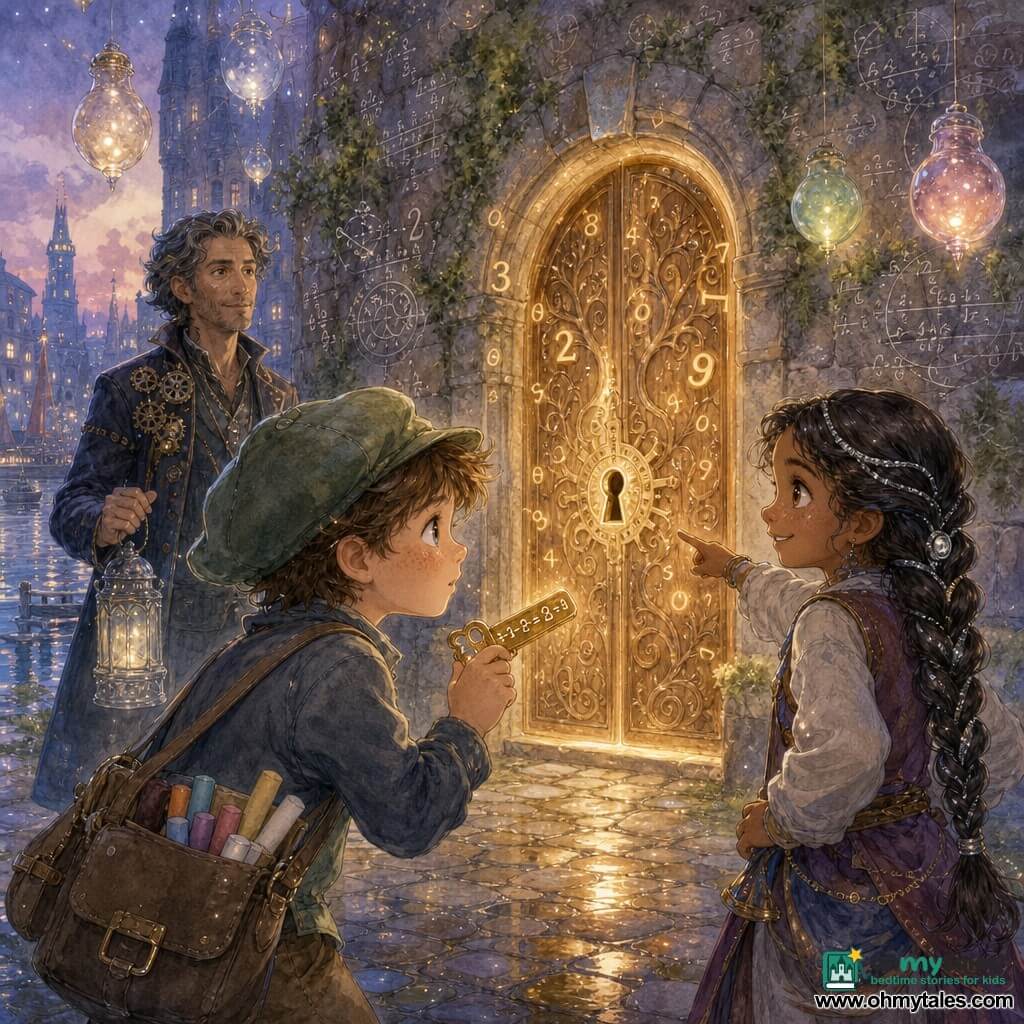
Chapter One: The City of Doorways
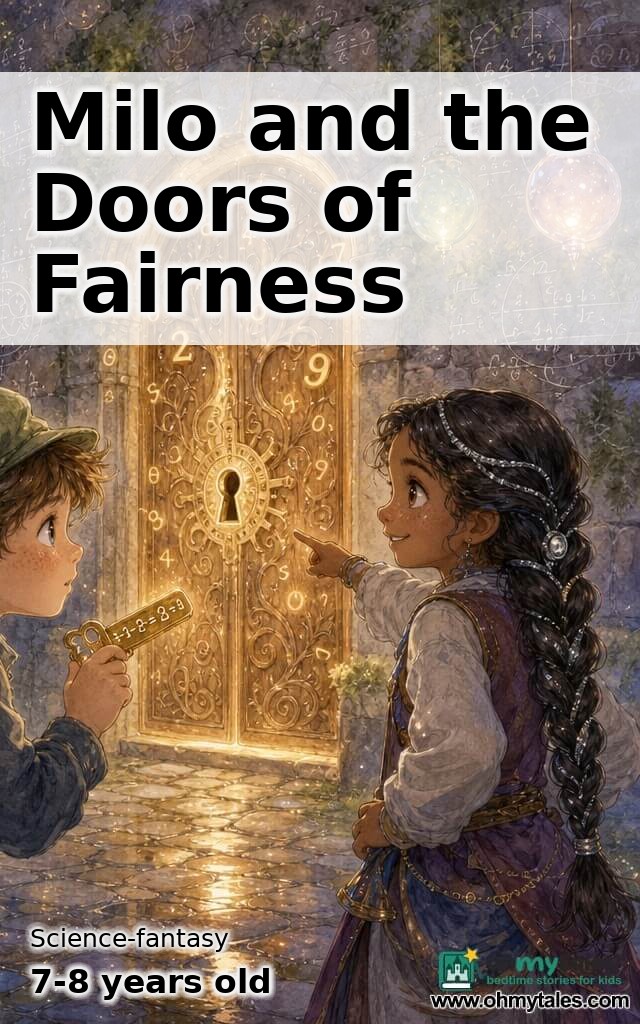
Milo skipped along the cobblestones of Port Numeris, a city that hummed like a clock made of stars. He wore a cap too big for his head and a satchel full of chalk sticks. Around him, doors whispered. Not ordinary doors—each portal had a painted equation on its frame: 3 + 4 = ?, √9 = ?, 2x + 5 = 11. When a door liked your answer, it opened to a new place.
“Which door today?” Milo asked the nearest lamppost. The lamppost blinked back, its glass glassy like an eye.
“You always ask the lamppost,” said a small voice. Milo turned. A girl about his age stepped out from behind a market stall. Her braid had silver thread woven through it.
“I like asking things,” Milo grinned. “They tell me interesting answers.”
The girl laughed. “I'm Kiri. You're Milo the Mischief, aren't you? People say you compare laws and spells.”
Milo puffed his chest. “I do! Laws of numbers and laws of magic. I see how they match. Sometimes a spell is like counting backwards. Sometimes an equation is like a rhyme.”
Kiri pointed to a heavy oak door with an equation carved into the wood: 7 - 2 = ?. “That one looks like subtraction. Or like taking two cookies from a jar.”
Milo's eyes sparkled. “Or like two worries leaving the world.” He tapped the frame. The equation glowed, then the door swung open to a courtyard full of floating lanterns.
“Careful,” Kiri warned. “Portals are polite, but they test you. They like fair answers.”
Milo stuck out his tongue. “I always give fair answers.” Then, softer, “Mostly.”
They stepped through together, and the door sighed shut behind them.
Chapter Two: The Lesson of Equations
Lanterns bobbed like friendly moons. A silver cat with glass whiskers padded across a pattern of numbers on the ground and meowed in a sequence.
“A riddle-cat!” Milo whispered. He knelt and traced a chalk line along the pattern. Each number in the pattern sang when touched: one, two, three—like stepping stones.
A tall figure emerged: Professor Talon, who taught at the Academy of Gates. He wore a cloak dotted with tiny gears and stars. “Milo, Kiri,” he said with a bow, which made one of his gears click. “You should not wander the Courtyard of Lanterns without a purpose.”
“We have a purpose!” Milo announced. “We're going to match laws and spells.”
The professor's eyes twinkled. “Then you are lucky. The Lanterns test fairness. For a city to be just, every door must be used with responsibility.” He held up a palm that shone like polished brass. “Today's test: balance. Help one lantern find its number so the courtyard can glow evenly.”
“How do we help?” Kiri asked.
“Each lantern hides an equation. Solve it kindly. But remember: answers affect doors. If you rush, a door may open at the wrong time.” The professor tapped his chest. “Responsibility keeps the city safe.”
Milo nodded solemnly. “I won't rush. Mostly.”
They walked to the first lantern. A ribbon around it read: x + 3 = 8. Milo chewed his lip and said, “So x must be five.” The lantern brightened with a laugh.
“Nice!” Kiri clapped. “That was like giving a cookie back.”
They moved from lantern to lantern. Some equations were simple, some curved like rivers. At the square of lanterns near the fountain, Milo found a lantern with no numbers—only a small, trembling voice.
“I forgot my number,” it whispered. “I used to be a prime, but now I'm tangled.”
Milo sat cross-legged. “What do you feel like?” he asked. Lanterns felt with light, he decided.
“I feel like… like a friend who needs to be fair,” the lantern said.
“Then fairness will help,” said Kiri.
Milo hummed. He thought of laws—how numbers must keep promises: when you add, you don't sneak away. He thought of spells—if you promise a charm, it must do what it promises. He scribbled a neat little equation: 2 + 2 = 4.
The lantern glowed steady. “That feels right,” it purred. “I am simple and kind.” It floated higher and joined the others until the courtyard was balanced like a scale.
Professor Talon clapped softly. “Justice and responsibility. You see how numbers and magic agree?” he asked.
Milo answered proudly, “Laws keep promises, and so do good spells.”
Kiri laughed. “You sound like a tiny professor.”
Milo stuck out his tongue. “I like tiny titles.”
Chapter Three: The Door That Wouldn't Listen
After the courtyard, they followed a map that lived in Milo's satchel. The map rustled like a bird and pointed to a gateway covered in moss. Its equation was strange: (4 × ?) + 1 = 13.
Milo frowned. He liked to race through puzzles, but something about this door felt heavy. “Maybe ? is three,” Milo guessed. He wrote it in the air. The door did not budge.
Kiri bit her lip. “Maybe you must think differently. When laws multiply, maybe magic multiplies feelings.”
A tiny wind carried a scrap of paper to Kiri's feet. It had a note in looping ink: Responsible choices grow. Milo looked at the equation again. “If ? is three, four times three plus one is thirteen. That works.”
He said it aloud, and the numbers in the wood shimmered. The door chimed, but a voice rumbled from inside. “I will not open to winners who only count for themselves.”
Milo blinked. “We didn't cheat!”
“No,” the door sighed, “but numbers must care for everyone. Who will you choose to share the thirteen with?”
Kiri swallowed. “Share? But the door wanted an answer, not a pie.”
Milo rubbed his chin. “Maybe equations can be shared, too.” He thought of justice—the rule that everyone gets a fair turn—and of responsibility—choosing to think of others.
“We could split,” Milo said slowly. “If we think of thirteen as twelve plus one, we can share twelve and set aside one for someone who needs it.”
Kiri's eyes lit up. “Or four groups of three, and one for the lamppost who listens to everything.”
Milo grinned. “Yes! We'll give three to the lamppost's neighborhood, three to the market, three to the harbor kids, three to the Academy, and keep one for anyone who is lonely.”
They spoke the sharing aloud. The door hummed with approval and opened into a bright hallway strewn with floating numbers that arranged themselves into neat bowls.
A small crowd waited inside: a lamplighter with tired hands, a market baker, harbor mice who were helpful rather than naughty, and Professor Talon with a kindly smile. Each received a bowl of glowing tokens—the city's way of making sure resources were fair.
“You chose to share,” Professor Talon said. “That is responsibility.”
Milo felt proud and a little surprised. Sharing numbers felt warm, like bread.
Chapter Four: The Equation of Courage
Word of their sharing rippled through Port Numeris. Doors hummed gentler when Milo passed. But not all puzzles were gentle. At the top of the Spiral Steps, a door loomed whose equation looked like a storm: ∑ (n=1 to 4) n = ?.
Kiri's braid quivered. “That sigma means sum. But it looks big.”
Milo took a deep breath. “One plus two plus three plus four.” He counted on his fingers, then aloud: “One, three, six, ten. Ten!”
The door answered with a low groan. “Courage is not loud counting,” it said. “Courage is small hands holding tight when winds howl.”
A wind puffed through the steps, lifting a loose scarf from a passerby and tossing it down the spiral. A little boy chased after it and slipped. He did not fall far, but he looked frightened.
Milo ran down. “Hey! Are you okay?” he asked, helping the boy to his feet.
The boy sniffed and nodded. “I'm Tom. My scarf flew away. I wanted to catch it, but I tumbled.”
Kiri knelt and handed Tom a chalk star from Milo's satchel. “This is a token of courage,” she said. “It's not for falling or never being scared. It's for getting up.”
Tom gripped the star and smiled. The door's voice softened. “You showed courage, Milo. Not because you were brave without fear, but because you helped someone up. Tell me why you count.”
Milo thought of the city—of doors, lanterns, lampposts, and the way numbers could promise warmth if people kept their side. “I count so fairness has a name,” he said. “I count so magic needs rules for good. If numbers and spells both keep their promises, the city stays bright.”
The door swung open to a chamber filled with mirrors. Each mirror showed a different Milo: one with chalk on his cheek, one with a lantern in his hands, one with a crown of tiny gears.
“Responsibility and justice are like mirrors,” Professor Talon's voice echoed from nowhere. “Look in each and you will see what to do.”
Milo peered into a mirror where he saw himself helping a small group fix a broken math map. He remembered the lamppost, the children at the harbor, the way sharing felt like a warm tide. His chest felt like a drum.
“I will be responsible,” he promised, speaking as much to himself as to the door. “I will make fair choices.”
The mirror glowed, and the chamber filled with the soft music of solved equations. The door closed behind them, content.
Chapter Five: Homeport and New Promises
As the sun of Port Numeris settled between the towers, Milo and Kiri walked back through streets that hummed like quiet instruments. The city felt different—fuller. People waved from windows, and doors blinked in greeting.
“You were very brave,” Kiri said as they reached the bridge over the harbor. “Not because you fought dragons, but because you shared and chose for others.”
Milo kicked at a pebble. “I wasn't always brave. Once I answered wrongly and a door spit out a dozen frogs into the bakery.”
Kiri laughed until she hiccuped. “That sounds like you.”
“True!” Milo admitted. “But I learned. Sharing numbers felt better than winning.”
A lamppost nearby chimed and a small crowd gathered. Professor Talon stood with a wooden box tied by twine. “Milo, Kiri,” he said, “the Academy of Gates thanks you for showing Port Numeris how laws and spells can walk together.”
He handed Milo a tiny brass key. It had an equation etched on its side: 1 + 1 = 2. “This key opens a practice door at the Academy,” the professor explained. “Use it to learn, and remember: keys open doors, and doors open ways to help others.”
Milo took the key with trembling fingers. “I promise to use it with care,” he said. The words felt like chalk warming in his palm.
“You must write your own equation sometimes,” Kiri added. “Not every answer is in the door. Sometimes it's in your heart.”
Milo nodded. He held the key up so the sunset painted it gold. “Then I will make equations that mean kindness.”
They walked to Milo's favorite spot by the harbor, where the water reflected gates like stars. Milo opened his satchel and rearranged his chalk into a neat row. “One rule I like best,” he said, tracing a circle, “is to make sure numbers help people, not confuse them.”
A small voice float-echoed from the water. It was the lamplighter, who had been watching. “You have done well,” he said. “Justice is not always loud. Sometimes it is a quiet hand. Responsibility is not always heavy. Sometimes it is choosing to share.”
Milo smiled until his eyes squinted. “Then I'll be a small hand and a quiet chooser.”
Kiri bumped his shoulder. “And I'll help you write grand spells that are fair.”
They laughed together. The city's doors chimed like lullabies, and one small door by the harbor, with the equation 0 + 1 = 1, glowed warmly. Milo felt the key in his pocket and the chalk in his satchel and knew he would return to learn more.
“Tomorrow,” Milo said softly, “I'll compare another law and another spell.”
Professor Talon's voice drifted like wind in a bell. “Remember, Milo: every answer changes a door, and every choice changes people. Let justice be your compass and responsibility your map.”
Milo looked at the harbor, at the doors, at the people who had laughed and helped and shared. He placed his hand over his heart, where a warm, small light lived. “I will,” he promised. “I will count fairly, choose kindly, and open doors for others.”
Kiri squeezed his hand. “And I'll be there when you forget the numbers.”
“You always are,” Milo said.
They sat until the stars of Port Numeris blinked awake—doors in the sky—and Milo drew a small equation in the air with his chalk: 8 = 8. It meant balance to him, and the city liked balance. The harbor hummed a soft answer, and for a moment the whole place felt like a friendly sum—small parts added up to something wonderfully whole.