Chapter 1: The Quiet Alarm
Maya was twelve, and she had ADHD. For her, thoughts didn't walk—they sprinted, hopped fences, and sometimes did cartwheels. People expected that to look like chaos, but Maya had learned something surprising: the busy part of her brain could also be a quiet alarm. It noticed tiny changes before anyone else did.
On Monday morning, the hallway at Cedar Grove Middle smelled like lemon cleaner, sharper than usual. A new poster hung by the office—bright blue letters saying: ASSEMBLY TODAY. Maya slowed down, listening. The building felt different, like a song played one key higher.
She opened her locker and froze. Her binder wasn't where she always kept it. She checked the top shelf. No binder.
“Please don't do this,” she whispered, then took a steady breath the way her counselor had taught her: in for four, out for six. Her fingers stopped buzzing.
Across the lockers, her friend Noor swung her backpack off one shoulder. “Morning, Maya. You look like you just saw a pop quiz.”
“I might have,” Maya said, then tried to smile. “My binder's missing.”
Noor leaned in. “Did you… lend it to anyone?”
Maya pictured yesterday like a fast-forward video: math homework, a snack, the couch, her little brother asking to borrow a pencil. Her mind offered ten memories at once, none of them lined up.
“I don't know,” she admitted. “But I can fix it.”
Noor nodded like that was obvious. “Okay. What's Plan A?”
Maya liked that Noor asked. Not “Why did you lose it?” Not “Again?” Just: What now?
Maya opened the small pocket of her backpack. Inside was her “backup kit”: two pens, a pencil, sticky notes, a tiny stapler, and one thin notebook. She had put it together after losing her planner last month and deciding she hated panicking.
“Plan A is: I don't melt,” Maya said. “Plan B is: I write what I need and ask for copies later.”
Noor grinned. “Solid plans. Also, I have extra paper. Always.”
They started walking to homeroom, and Maya's eyes kept flicking around—new poster, cleaner smell, a different bell tone. Something was changing today. She didn't know what, but her quiet alarm was humming.
Chapter 2: A Surprise Switch
In homeroom, Mr. Dalloway cleared his throat in the way that meant news.
“Good morning, everyone. We have a schedule adjustment. The cafeteria is being repaired, so lunch will be in the gym. Also—” he paused, waiting for the groans to rise and fall, “—this afternoon's assembly is about our Community Project Week. You'll be assigned to mixed-grade groups.”
Chairs squeaked. Someone muttered, “Mixed grades? That's weird.”
Maya's quiet alarm went from humming to flashing. New space. New people. New noise. A whole pile of “unexpected.”
Noor whispered, “You okay?”
Maya pressed her palm flat on the desk, feeling the smooth wood. “I'm okay,” she whispered back. “I just… want to see the plan.”
Mr. Dalloway handed out printed sheets. Maya loved printed sheets. They stayed still. They didn't change their minds.
At the top it said: COMMUNITY PROJECT WEEK—GROUP ASSIGNMENTS.
Maya scanned down and found her name: Maya Patel—Group 7.
Below it: Noor Khan—Group 7.
Relief, warm as toast, spread through her chest.
Then she read the rest.
Group 7 included two sixth graders she didn't know, and one eighth grader: Jaden Price.
Maya had seen Jaden in the library sometimes, always at the same table, always with headphones and a careful pile of books stacked like a miniature wall. People said he was “stuck-up” because he didn't talk much.
Noor made a face. “Jaden?”
Maya shrugged, trying to sound calm. “Maybe he's just… quiet.”
Noor leaned closer. “If this project involves a lot of loud brainstorming, he might hate it. Or he might be secretly hilarious.”
Maya snorted. “Secretly hilarious is my favorite kind.”
The day kept shifting. In math, the substitute teacher erased the board with such squeaky enthusiasm that Maya's shoulders climbed toward her ears. In English, the classroom fan stopped, and the air felt thick. At lunch, the gym echoed like a drum.
Maya's mind did its usual ping-ponging. But she used her strategies like stepping-stones: write the next task, drink water, chew mint gum, ask one clear question, repeat.
She survived the morning without her binder, which felt like winning a tiny marathon.
By the time the assembly began, she was ready for anything.
Almost anything.
Chapter 3: The Group Begins
After the assembly, Group 7 met in the library. The librarian, Ms. Eaves, pointed them to a corner table near the windows.
Maya arrived with Noor and her backup notebook. The two sixth graders were already there: Lila, who wore a hoodie with a cartoon frog, and Carter, who was bouncing his knee so fast the table trembled.
Then Jaden showed up.
He moved like someone trying not to disturb air. His headphones rested around his neck, and he carried a folder so neat it looked ironed.
He sat, glanced at everyone, then looked down at the assignment sheet.
Noor broke the silence. “Hi. I'm Noor. This is Maya.”
“Maya,” Maya added, keeping her voice steady. “Hi.”
Jaden nodded once. “Jaden.”
Carter blurted, “So what are we doing? Do we pick something cool? Like building a robot? Please say robot.”
Lila raised a hand halfway. “I like posters. Posters are cool.”
Maya flipped to a clean page. The library smelled like paper and faint cinnamon from someone's tea. It helped her breathe.
“The project is to improve something at school,” Maya read aloud. “Something realistic. We have five days to plan and present.”
Jaden spoke, voice low but clear. “It says we need a problem, a solution, and a way to measure if it works.”
Carter groaned. “Measure? Like… math?”
“No,” Noor said. “Like, ‘Did it help?' We can count something.”
Maya's thoughts sprinted ahead: noisy gym lunch, confused schedules, kids getting lost, teachers repeating instructions, forgotten binders. She felt ideas stacking up like blocks.
“We could improve the lunch situation,” she said. “The gym is loud. People are overwhelmed.”
Jaden's eyes lifted. “That's true.”
Lila nodded. “My ears hurt today.”
Carter stopped bouncing for a second. “The gym echoes like a cave.”
Maya surprised herself with a small laugh. “Exactly. A cave full of chips.”
Noor tapped the table. “So the problem is: lunch is too loud and confusing.”
Jaden tilted his head. “Not for everyone. Some kids like it loud.”
Maya appreciated that. He wasn't shutting the idea down; he was making it better.
“Right,” Maya said. “So maybe the goal is options.”
“Options!” Carter repeated, suddenly excited. “Like, a quiet zone? With beanbags?”
Lila's eyes lit up. “And signs. Clear signs.”
Noor looked at Maya. “You're good at noticing what changes. What would help you?”
Maya thought about how her mind could race, especially when noise and surprises piled up. She didn't want to be treated like a problem. She wanted tools.
“A simple map,” she said. “And a routine. Like: ‘Line up here, sit there, trash goes there.' And a quiet corner where talking is optional.”
Jaden opened his neat folder and slid out a page already divided into sections. “I made a template,” he said. “We can write the plan and roles.”
Carter leaned in. “You just… had that?”
Jaden's mouth twitched. Almost a smile. “I like templates.”
Maya felt something soften inside her. Maybe Jaden wasn't stuck-up. Maybe he was careful.
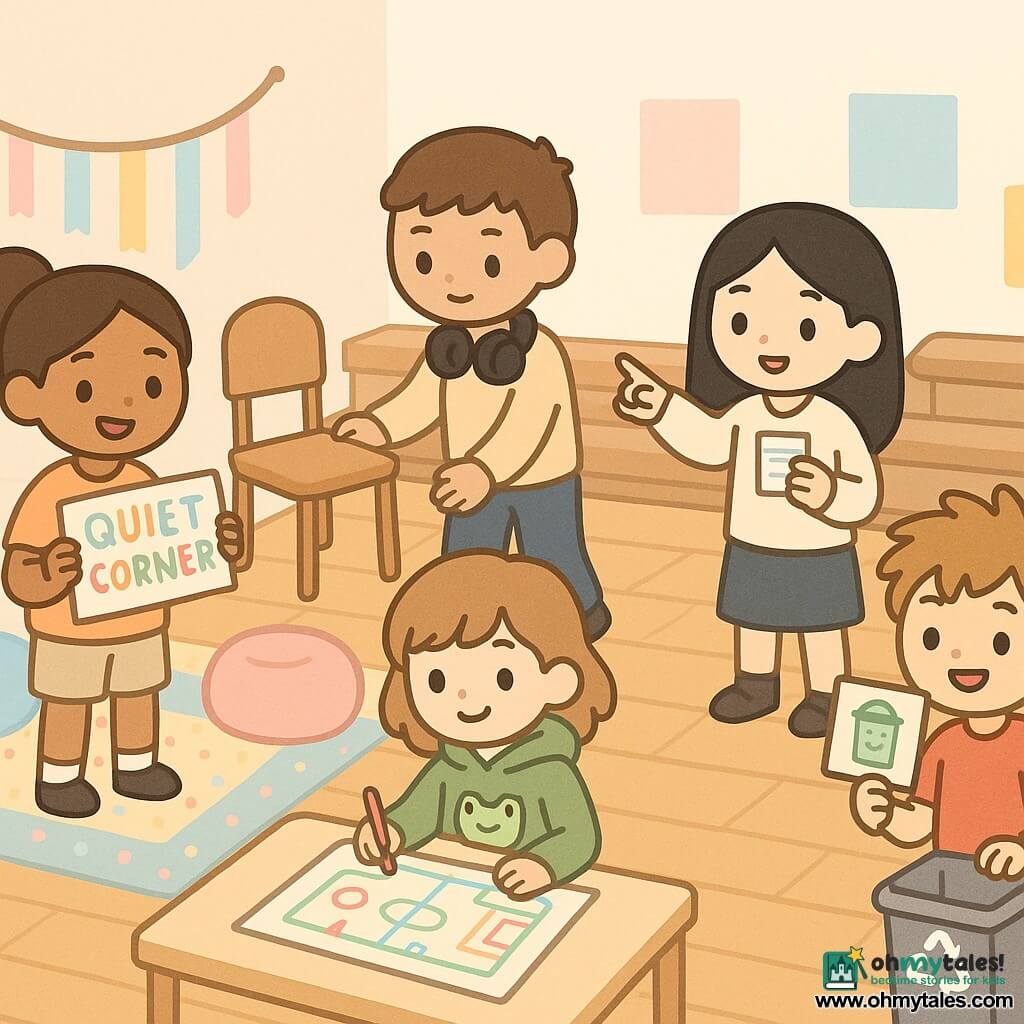
They filled in the template together: The Lunch Landing Plan—clear signs, a simple layout, and a “Quiet Corner” with rules that weren't scary: Use inside voices. No teasing. If someone wears headphones, let them be.
When Ms. Eaves passed by, she paused. “I like that name,” she said. “Lunch Landing. Sounds like a place to arrive safely.”
Maya wrote that down too. Safely. It mattered.
Chapter 4: The Ripple Brain and the Wall of Sound
On Tuesday, the gym at lunch was even louder. Someone dropped a tray, and the crash skated across the floor like thunder. Maya's shoulders tensed.
Her quiet alarm—her fast, watchful mind—spotted patterns: kids bunching at one door, teachers waving arms, trash cans hidden behind bleachers. It was like watching water swirl down a drain. If you wanted to help, you had to understand the swirl.
Noor nudged her. “You're doing that scanning thing.”
Maya swallowed. “Yeah. My brain's… like a ripple. It spreads out and touches everything.”
Noor smiled. “Ripple brain. I like that.”
Maya did too. Ripple sounded useful. It sounded like strength.
At their table, Carter shouted jokes. Lila giggled, then winced when another class ran by, sneakers squealing.
Jaden sat slightly sideways, one ear turned away from the center of the gym. He pulled his headphones up, then hesitated, like he wasn't sure if it would seem rude.
Maya leaned closer and kept her voice normal. “You can wear them. It's okay.”
Jaden glanced at her, surprised. “People think I'm ignoring them.”
“You can still listen,” Maya said. “Just in a different way.”
Jaden nodded and put them on. His shoulders dropped, just a little.
After lunch, Group 7 met again. They had permission to observe the lunch flow for ten minutes with clipboards. Maya's clipboards were imaginary—she had sticky notes—but she felt official anyway.
They stood by the gym doors. Noor counted how many kids asked where to go. Carter tallied how many times someone bumped into someone else. Lila sketched a map of the gym.
Jaden watched the trash area. He murmured, “People hesitate. They don't know where to put things.”
Maya's ripple brain picked up another detail: the teachers were trying their best, but they were using different instructions. One pointed left, one pointed right. Kids followed whichever teacher was louder.
Back in the library, Maya spread her sticky notes across the table. “Okay. We need a simple layout and signs that match.”
Noor added, “And we should ask a teacher if we can test it. Like a mini pilot.”
Carter said, “Pilot sounds like we're flying the gym.”
Lila grinned. “Lunch plane landing.”
Jaden, very serious, said, “A pilot test means we try it for one lunch and collect data.”
Carter blinked. “Oh. That kind of pilot. Still cool.”
Maya assigned tasks carefully, the way her counselor called “measured autonomy”: do what you can handle, ask for help when you need it.
“Carter, you're good at talking to people,” she said. “Can you ask kids what would help them?”
Carter puffed up with pride. “Interview mission. Done.”
“Lila, your map is great,” Maya said. “Can you make a cleaner version for our presentation?”
Lila nodded quickly. “Yes. With colors.”
“Noor,” Maya said, “can you draft the sign wording? Short and friendly.”
Noor saluted. “Captain Friendly Words.”
Maya turned to Jaden. “Could you help me write the measurement part? Like what we'll count.”
Jaden's eyes met hers. “Yes. Thank you.”
Maya felt the group clicking together, like gears. Different shapes, same machine.
Chapter 5: The Test Run
By Thursday, they had a plan and a folder full of materials: hand-drawn signs, a printed map, a short script for teachers, and a one-page survey with three questions.
The assistant principal, Ms. Rios, agreed to let them do a test run during Friday lunch. “You can't rearrange the whole gym,” she warned, “but you can add signs and a quiet corner near the far wall.”
Friday arrived with gray clouds and a damp smell in the air. Maya's ripple brain noticed it immediately: rainy-day energy meant louder lunch.
At 11:55, Group 7 arrived early. They taped signs at eye level: LINE STARTS HERE, TRASH & RECYCLING, QUIET CORNER—OPTIONAL.
Noor's wording was gentle and clear. Carter had added a small drawing of a smiling trash can. It was ridiculous. It was perfect.
Jaden lined up chairs to mark the quiet corner boundary. He placed a sign with the rules written like reminders, not orders:
1) Soft voices.
2) No comments about headphones or fidgeting.
3) If someone wants space, give it.
Maya's chest tightened, not from worry—this time from responsibility. She liked that feeling. It meant she cared.
When the first wave of students entered, Maya stood by the main door with Ms. Rios. She tried to keep her voice steady and friendly.
“Hi! Line starts here,” she said, pointing. “Quiet corner is over there if you want it.”
Some kids ignored her. Some followed. Some stared at the signs like they were magic.
A seventh grader scoffed. “Quiet corner? For babies.”
Before Maya could answer, Carter stepped up. “Not for babies. For humans. Also, it's closer to the vending machine, so… smart choice.”
The seventh grader hesitated, then shrugged and walked that way like he'd planned it all along.
Noor whispered to Maya, “Carter just used diplomacy.”
Maya whispered back, “Carter is a chaos diplomat.”
Halfway through lunch, someone yelled, and the echo punched the air. Maya flinched. Her ripple brain wanted to sprint, to fix everything at once.
Instead, she did one thing. One thing, then the next.
She checked the line. It was moving. She glanced at the quiet corner. Three kids sat there, talking softly. Jaden sat at the edge, watching, calm behind his headphones.
A sixth grader approached Maya, twisting a strap on her lunch bag. “Is it okay if I sit there even if I'm not… like… quiet all the time?”
Maya smiled. “It's okay if you try. And it's okay to leave if you need to.”
The girl nodded, relieved, and walked toward the corner like she'd been offered a small, safe door.
After lunch, they gathered their tally marks.
Noor said, “Fewer people asked where to line up.”
Jaden added, “Trash hesitation went down. People used the bins faster.”
Lila bounced in her seat. “And nobody fought in the quiet corner!”
Carter said, “I interviewed ten kids. Eight liked the signs. Two said the quiet corner was ‘kinda nice' which is middle school code for ‘amazing.'”
Maya laughed, the tension in her shoulders finally melting. “We did it.”
Not perfectly. Not for everyone. But it helped. It was real.
Chapter 6: The Presentation and the Calm After
On Monday, each group presented in the auditorium. Maya stood backstage with her notes, feeling the familiar buzz under her skin. Big room, big sound, big eyes watching.
Her ripple brain was awake, noticing everything: the microphone squeal, the bright stage lights, the rustle of programs. It could have overwhelmed her.
But she had her plan. Notes on paper. Water bottle. Noor beside her. And a promise to herself: slow is allowed.
When Group 7 was called, they walked onstage together.
Noor began. “Our project is called Lunch Landing. We noticed lunch in the gym can be loud and confusing, especially during changes like repairs.”
Lila held up the map. It was colorful, clear, and honestly better than some adult diagrams Maya had seen.
Carter spoke next, confident as a game show host. “We asked students what they needed. The top answers were: ‘I don't know where to go,' and ‘It's too loud.' Also someone wrote, ‘I want a calm corner but not a weird corner,' which is fair.”
A few kids laughed. Not meanly—just recognizing themselves.
Then Maya stepped to the microphone. She looked out and found Ms. Rios nodding, and Ms. Eaves smiling like a proud aunt.
“Our solution is simple,” Maya said. “Clear signs, a consistent layout, and a quiet corner that's optional. It's not a punishment. It's a choice. Some people recharge by talking. Some people recharge by taking a break from noise. Both are normal.”
She paused, then added, “We measured our test run. Fewer students asked for directions. The line moved faster. More students said lunch felt manageable.”
Jaden finished, voice steady. “We recommend keeping the signs during repairs and using the quiet corner during other high-noise days. It's low-cost and helps more students participate in lunch in their own way.”
They left the stage to applause that sounded, to Maya, like rain on a roof—loud but gentle.
Afterward, in the hallway, a kid from another class approached Jaden. “Hey. The quiet corner was actually… good. Thanks.”
Jaden blinked, then said, “You're welcome.”
Noor nudged Maya. “Your ripple brain saved lunch.”
Maya shook her head. “Our group did. My brain just… noticed the puddles before everyone stepped in them.”
As they walked to their lockers, Maya saw the blue ASSEMBLY poster still up, now curling at the corners. The lemon-cleaner smell had faded. The building felt like itself again.
Maya opened her locker—and there was her missing binder, wedged behind her gym shoes like it had been hiding for fun.
Noor burst out laughing. “It was in your locker the whole time!”
Maya lifted the binder and held it up like a trophy. “My binder has trust issues.”
They laughed together, and Maya felt the week settle into something warm and steady.
Change would happen again. Noise would echo again. Maya's ripple brain would keep noticing. But now she knew something important: noticing wasn't a burden. It was a gift—especially when shared with people who listened, adjusted, and made room for everyone to land safely.
And as the final bell rang, the hallway filled with the ordinary music of school: footsteps, chatter, lockers clicking shut—busy, real, and, somehow, calm.