Chapter 1: The Lunchbox and the Whisper
Maya sat at the small round table in the school cafeteria, her lunchbox open. Inside, her mom had packed a warm pita with hummus, a little apple, and a bright pink yogurt cup with a smiling cow on it. Maya loved the pita. She loved the hummus. She also loved how her mother had tucked a tiny paper heart under the yogurt.
"Look, everyone!" chirped Tom, across the table. "What's that weird bread? Is that… hummus?"
A few kids turned their heads. Maya felt the cheerful bubble inside her stomach shrink a bit. She smiled and held up a corner of the pita. "It's pita. It's like flat bread. We eat it with hummus."
"Why would you eat that? My mom packs a sandwich and chips," said Ben in a voice that was loud enough for the whole table. Some kids giggled.
Maya's cheeks warmed. She kept eating. She liked her food, and she liked her mom's heart under the yogurt even more. Still, the giggles made her feel small.
At recess, Maya sat under the big maple tree to brush her hair. Her hair was thick and curly, and this morning she had decided to try two tiny braids on the sides, tied with green ribbons. It made her feel neat and happy.
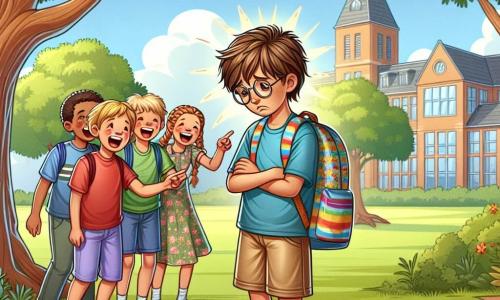
"Who are you trying to be, a pirate?" called Eric, tossing a pebble. "Those braids are weird."
Maya's fingers froze on the comb. "They're not weird," she said, trying to sound calm. "They're just braids."
"Your hair looks like a mop," Eric said. A couple of kids snorted.
Maya wanted to run. She wanted to laugh it off like it was nothing. But inside she felt a hollow ache. She remembered the paper heart and put it in her pocket. The heart felt warm as if reminding her of home.
"Are you okay?" asked Lila, sitting beside her. Lila had freckles and a loud, friendly voice.
Maya nodded slowly. "I guess so."
Lila leaned in. "Don't let them bother you. Ben said my lunch looked like a frog sandwich once. I told my mom, and she packed me a note. It helped."
Maya smiled. "Thanks."
That night, at dinner, Maya told her parents what happened. "They laughed at my lunch and my braids," she said.
Her mother reached across the table and held her hand. "It hurts to be laughed at," she said gently. "But you did nothing wrong. You can tell a teacher if it happens again. And we can think of ways to feel braver."
Her father added, "Sometimes kids tease because they want to be noticed. That doesn't make it right. We'll help you make a plan."
Maya held her parents' hands and felt a steady strength. She decided she would try to be brave.
Chapter 2: A Small Seed of Courage
The next morning, Maya zipped up her backpack and tucked the tiny paper heart in a front pocket where she could feel it. At school, she found Lila, and the two walked to class together.
During morning circle, Ms. Rivera noticed Maya seemed quieter than usual. "Maya, would you like to share something today?" she asked.
Maya's heart thumped. She remembered her parents and the paper heart. "Um, my brother gave me a drawing at home," she said. "It's of a big tree." She showed the drawing. The class clapped politely.
After class, Maya stayed a little longer. "Ms. Rivera?" she said. "Some kids made fun of my lunch and my hair."
Ms. Rivera sat on the tiny chair opposite Maya. "Thank you for telling me," she said. "That must have felt awful. I'm glad you told me. Would you like me to help?"
Maya looked at her teacher and felt a small burst of hope. "Yes, please."
Ms. Rivera smiled. "We will work on this together. And we can make a Kindness Plan."
"A what?" whispered Maya.
"A Kindness Plan is a list of things we will all do to make our class kinder and safer," Ms. Rivera explained. "It will help everyone know how to act when someone feels left out or hurt."
That afternoon, the whole class gathered in a circle. Ms. Rivera wrote "Our Kindness Plan" on the board. The children took turns suggesting ideas. Maya listened as ideas tumbled out like stones in a river.
"If someone makes fun, we say, 'That's not okay,'" suggested Tom, surprised at how firm he sounded.
"If we see someone alone, we invite them to play," Lila added.
"If someone is sad, we ask if they want to talk to a teacher," Ben said, blushing because he remembered making fun of lunch yesterday.
"I can remind people to use kind words," said Sana, who loved stickers and always had a bright idea.
Maya felt her cheeks warm. She put up her hand, voice a little shaky. "Can we include telling each other when we are being mean? Like, if I say something that hurts, tell me. I don't want to hurt others by accident."
Ms. Rivera's eyes shone. "That's a brave thing to suggest, Maya. Being honest helps us grow."
They wrote the ideas on colorful paper. Ms. Rivera drew a small circle of stars at the bottom and called it the "Kindness Circle." "When someone feels hurt or sees something wrong, we step into the circle to support them," she explained. "We can also use a kind word 'pause' like 'I can help' to get someone's attention."
The class practiced. Maya stood and said, "If someone makes fun of your lunch or your hair, say, 'I don't like that. Can you stop?'" The class repeated after her. It sounded powerful and gentle at the same time.
When school ended, Ms. Rivera asked Maya to help her hang the Kindness Plan by the door. Maya felt proud as if she had planted a small seed.
Chapter 3: The Test at Recess
A few days later, lunch was again a little noisy. Maya sat with Lila and Sana. The paper heart in Maya's pocket wobbled with her breathing.
Eric walked by and, grinning, made a face at Maya's braids. "Hey, pirate hair!" he called.
Maya felt the old hollow ache. She remembered the Kindness Circle and the words they had practiced. She took a breath, felt her mother's hand in her memory, and stood up.
"Please stop," she said, not shouting but firm. "It's not kind."
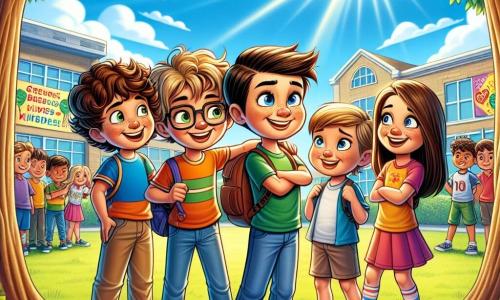
A hush rippled across the table. Eric blinked. Ben looked away. A boy named Raj, who often sat silently, crossed his arms and said, "Yeah, that's not cool, Eric."
Eric scowled. "Why are you being so serious?"
"Because it hurts her," Raj said simply. "We don't make fun."
Tom, who had laughed once, looked at Maya and felt a tug. He stood and added, "If you're going to say something, say something kind."
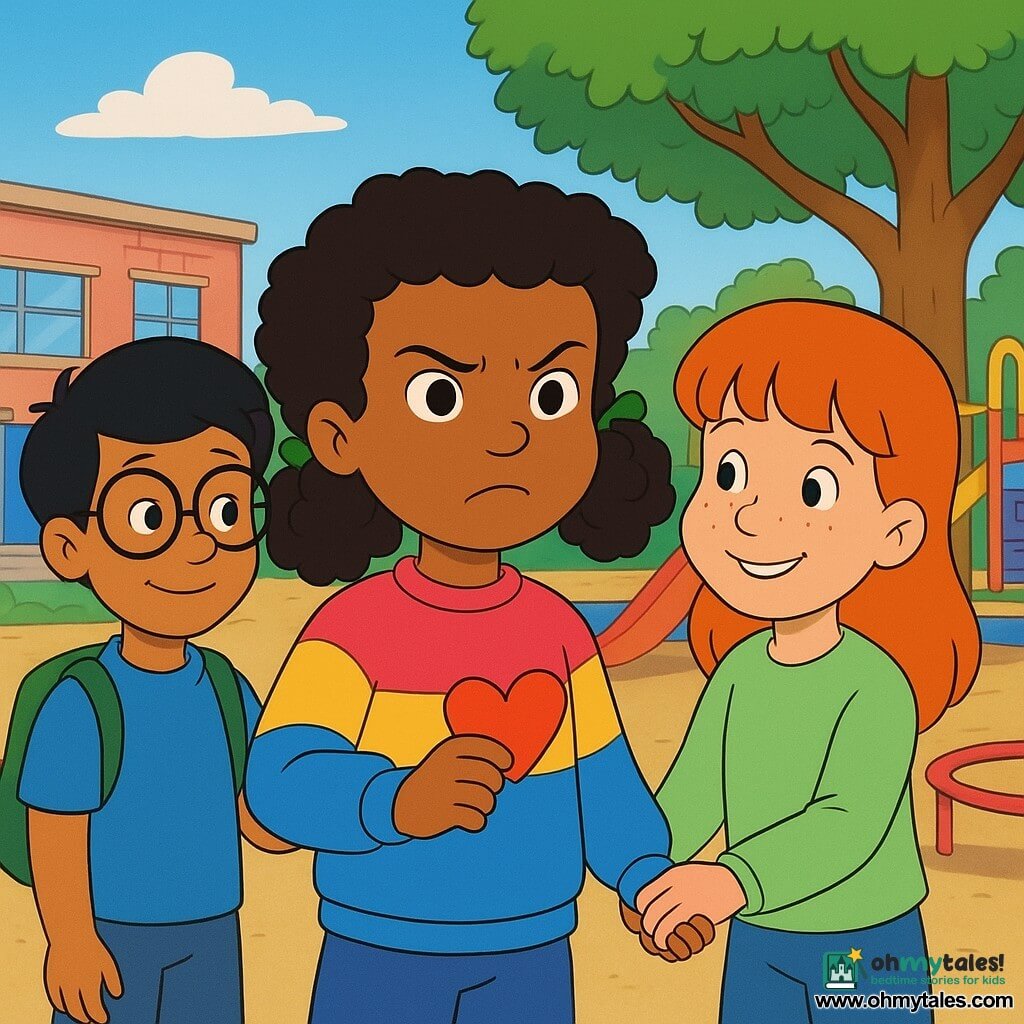
Now a small circle of children gathered. Maya felt the warmth of support like a light wrapping around her. She sat down and smiled at Lila, who squeezed her hand.
"Thanks," Maya whispered.
Later that day, Ms. Rivera called a short meeting. "I saw something nice today," she told the class. "Some students stood up for someone being teased. That is courage. Let's remember the Kindness Plan."
Eric's face was quiet. He didn't mock Maya anymore that day. He swung on a tire at recess and kept his eyes on his feet.
At home, Maya told her parents what happened. "Raj spoke up. Tom spoke up," she said. "It felt like a shield."
Her mother hugged her. "Those friends are brave and kind," she said. "It takes courage to stand up. You did too."
Maya thought about the Kindness Plan and felt happy that it had worked, even in a small way. But she also knew that not every moment would be easy. She wanted to keep helping the plan grow.
Chapter 4: Making the Circle Stronger
Over the next week, the Kindness Plan became part of daily life. Ms. Rivera started each morning with a two-minute "kindness check" where kids could share a feeling or a small problem. "If anyone needs help, raise their kindness pebble," she explained. The pebbles were painted small stones in a jar; when someone raised a pebble, classmates knew a gentle helper was needed.
One morning, Maya noticed Sana looking withdrawn. Sana's hands fiddled with a pencil. Maya tapped the jar and lifted a green kindness pebble.
"Can I help?" Maya asked quietly.
Sana looked at her and blinked. "My batik scarf went missing," she said. "Someone took it from my desk."
"That's not okay," Maya said. She remembered Ben's embarrassed face from the first day he admitted he had laughed. "Do you want us to check the cubbies and ask the teacher?"
Sana nodded. Together, Maya, Lila, Raj, and Tom looked around the classroom. They checked the cubbies, asked gently at the art table, and listened to anyone who might have seen. Mr. Harris from the hallway helped by checking the lost-and-found.
Ben came up, looking uneasy. "I didn't take it," he said. "But I heard some kids talking near the bin."
"Let's go together," Raj suggested. They found the scarf folded under some library books. Sana's face lit up. "Thank you," she whispered.
"That's what the Kindness Circle is for," said Maya, feeling proud. "We help each other."
Ms. Rivera praised the class. "You all acted kindly and bravely," she said. "Remember, noticing and helping makes our circle stronger."
That afternoon, Eric sat alone during craft time. Maya remembered how he had called names. She thought about how being mean sometimes comes from being lonely or wanting attention. She walked over, sat down across from him, and started cutting a green paper leaf for a class tree project.
"Do you want to help?" she asked.
Eric looked surprised. "Why?"
"Because this tree is for our Kindness Plan," Maya said. "Everyone adds a leaf with something kind they did."
Eric hesitated, then took a leaf. "I can... I can say sorry for teasing," he said quietly. "I didn't mean to make you feel bad."
Maya nodded. "Thank you."
He wrote "I'm sorry" shaky at first and then steadier. When he glued his leaf to the paper tree, his shoulders relaxed. It wasn't a big magical change, but it was real.
Chapter 5: A Circle That Grows
Weeks passed. The Kindness Plan hung by the door with new ideas added. The class had learned to speak up, to listen, and to ask for help. Maya still had days when the hollow ache returned for a moment, but now it was met quickly with kindness.
One rainy day, Ms. Rivera announced a writing assignment: "Write about a time you helped someone, or someone helped you." Maya thought of the paper heart, the small braids, the pebble jar, Raj and Tom standing by her side, and Eric's leaf on the tree.
When Maya read her story aloud, she paused at the part where she felt small. "I learned to say, 'Please stop,'" she said. "And my friends learned to say, 'I can help.' That made me brave."
The class clapped. Ben raised his hand. "I used to laugh without thinking," he said. "But then I remembered how it felt when someone laughed at me. Now I try to ask if someone wants to play instead."
Maya smiled. "That helps a lot," she told him.
That evening, Maya's parents hung her drawing of the big tree on the kitchen wall. Under it, they placed the paper heart. "Your kindness tree is growing," her father said.
"Sometimes I think it will take one person to make it fall," Maya said quietly. "But we have so many people now."
Her mother kissed her forehead. "A circle is strong because it includes many hands," she said. "You helped make it that way."
On the last day before the holidays, Ms. Rivera passed small blank cards around. "Write a kind note to someone in the class," she instructed. "It can be anything—'You made my day,' or 'Thank you for helping me.'"
Maya wrote, "Thank you for being my friend when I needed it." She folded the card and slipped it into Lila's desk. Lila's face lit up when she found it. "I'm keeping this in my pocket," she whispered.
When the teacher rang a soft bell, the class joined hands in a circle just like the Kindness Plan. "We promise to watch out for each other," Ms. Rivera said. "We promise to use kind words, to help, and to tell an adult when needed."
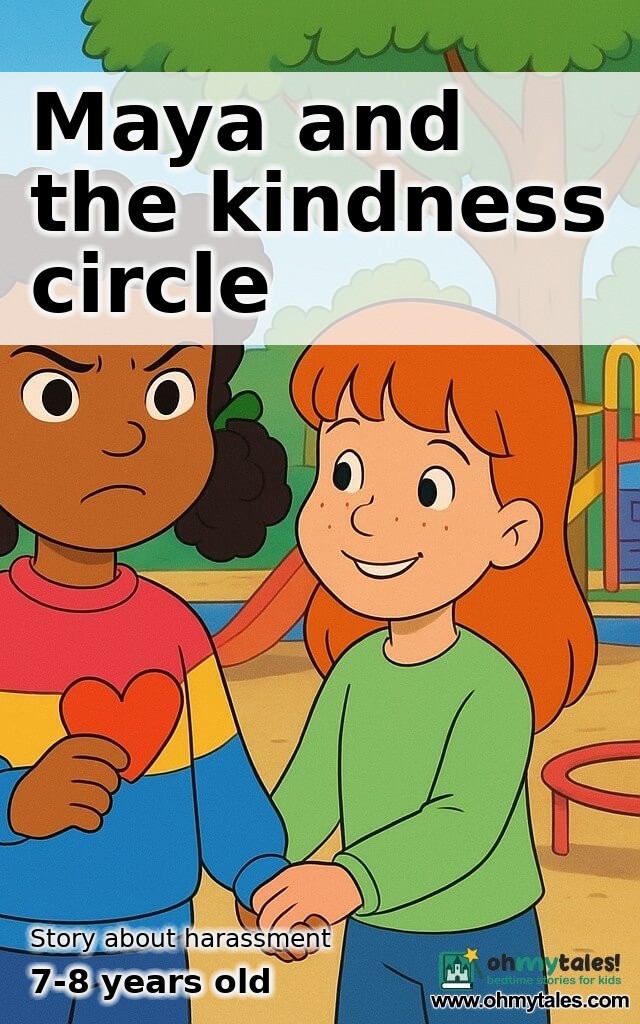
Maya squeezed Lila's hand. The circle felt warm. The paper heart in her pocket seemed to glow.
That afternoon on the playground, Eric and Maya worked together building a tall tower of bricks. Eric laughed when it tumbled and didn't shout a mean word. He apologized when he bumped another child, and the child forgave him. It was not perfect, but it was kinder.
Maya thought about scary things she had been afraid of before—being laughed at, feeling alone. Those things still existed, but they were smaller now because words could stop them, because children's hands could link, and because teachers listened.
That night, Maya put the little paper heart next to her pillow. Before she closed her eyes, she whispered a thank you—thank you for her friends, thank you for the Kindness Plan, and thank you for the bravery she found in her own voice.
If anyone asked her the next day, she would say that being brave isn't just standing alone. It's using your words, asking for help, and letting others help you. It's making a plan with people who care. And sometimes, it is as small as a paper heart or a pebble in a jar—a quiet promise that you will be kind, and that you will be kind to each other.