Chapter 1: The Train to Bramblebay
Maya and Ella had been planning this trip for weeks. They were both nine, carried simple backpacks, and shared a map folded into tiny squares. Ella wheeled his bright blue wheelchair into the train carriage with a careful push from Maya. It was an ordinary Tuesday for the others on the platform, but for them it felt like the start of a secret.
The countryside rushed past—green fields stitched with hedgerows, cows grazing like sleepy clouds. They read the map aloud, pointing to the little curve where Bramblebay sat, a crescent of sand and a white lighthouse on a rocky headland. “We'll find rock pools and sea glass,” Maya said. “And maybe a secret,” Ella added, grinning.
When they arrived, the air smelled of salt and bread from the bakery by the harbor. Seagulls argued above; children raced kites; fishermen mended nets like complicated bracelets. The boys rolled toward the shore, the lighthouse keeping watch, a tall white finger tapping the sky.
Chapter 2: Rock Pools and a Missing Postcard
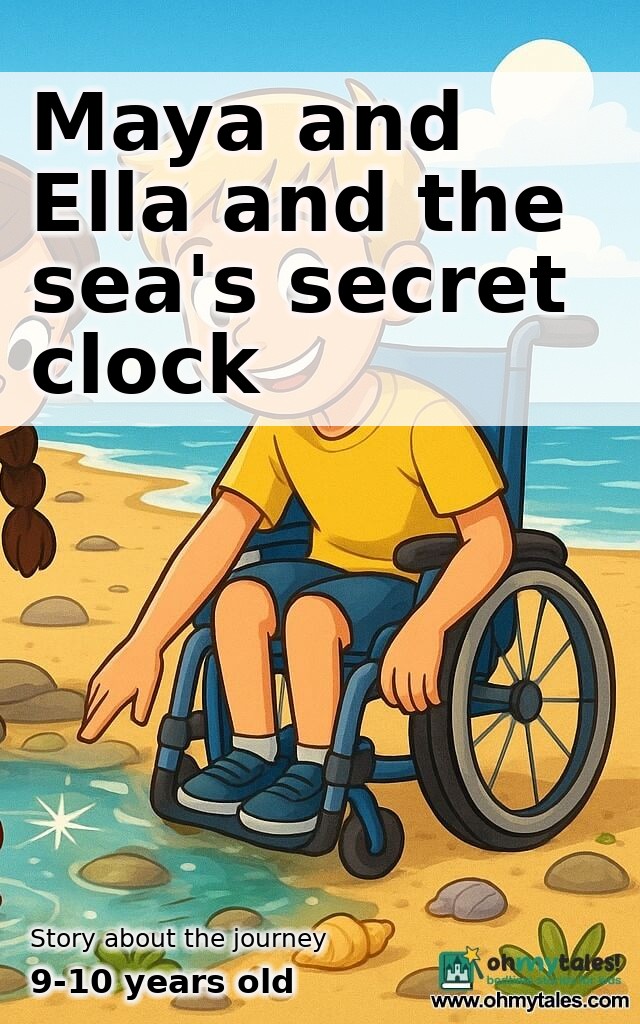
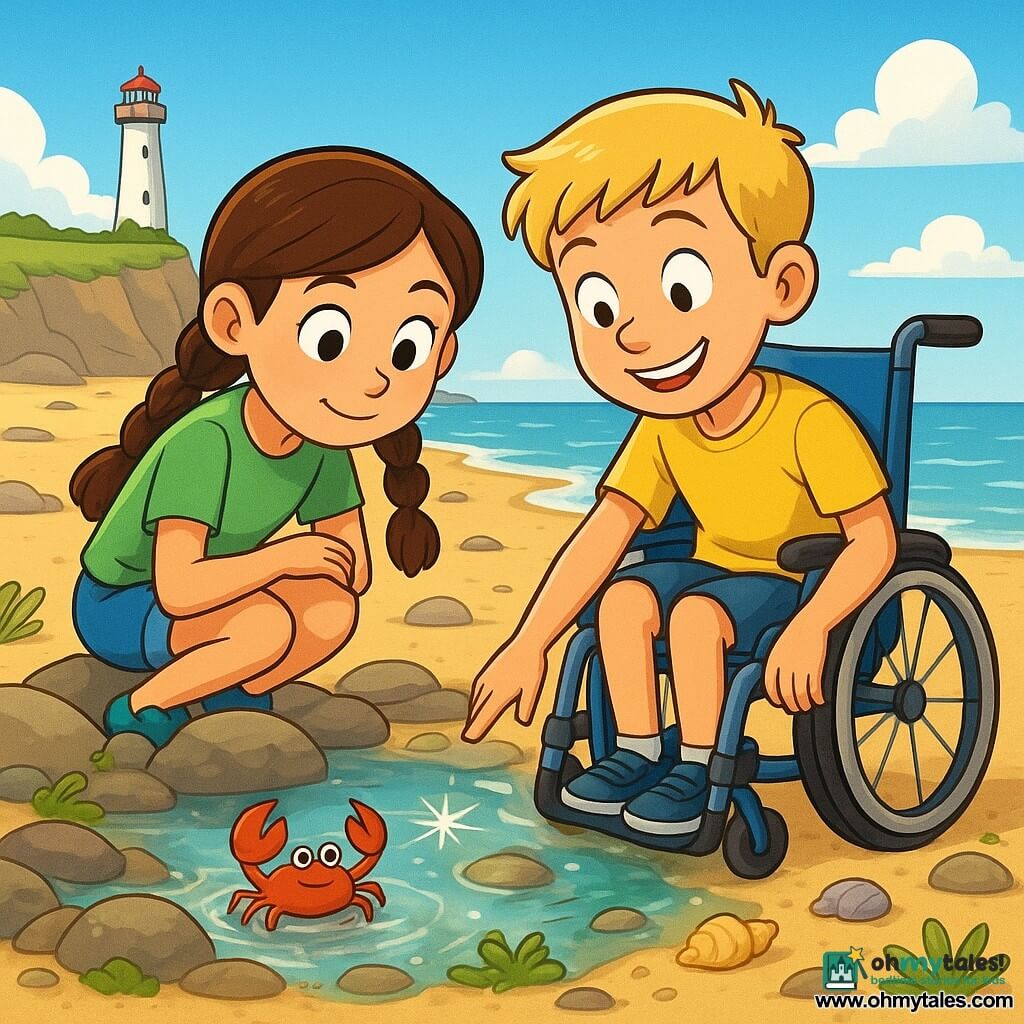
The tide was low, leaving a quilt of rock pools glittering like little glass bowls. Crabs scuttled sideways, anemones clung like bellflowers, and tiny fish darted through the seaweed. Maya crouched to look closely while Ella leaned on the rim of his wheelchair, reaching into a pool to gently lift a stranded shrimp and set it back into deeper water.
Near the rocks they found something unexpected: a soggy postcard half-buried in sand. The picture was faded—an old drawing of the lighthouse with a family waving—but the message on the back was smudged from salt. They could just make out a name: “Mrs. Larkin, Thatch Cottage.” The stamp had an anchor and a small, stubborn stamp cancellation. Someone had sent a note and the sea had taken it away.
“It must be lost,” Maya said. “Maybe it was meant for someone who lives here.” Ella's eyes shone with curiosity. Helping find the postcard's home became their new plan. They imagined the smile that would follow if they reunited message and owner.
Chapter 3: The Lighthouse Keeper's Clock
They pushed and rolled toward the row of cottages. A narrow lane, hedged with bright nasturtiums, led up to a tall house with a garden full of wind chimes. An old man leaned on the gate—he was the lighthouse keeper, Mr. Hobb, with soft, silver hair and a coat smelling faintly of oil and mint. He listened patiently as they explained the postcard.
“Young ones,” he said, his voice like gravel rubbed smooth, “Bramblebay keeps its secrets like shells, and sometimes the sea borrows what it likes. Follow the path to the top of the headland; you'll see the clock that listens to the waves.” He pointed to the lighthouse; the bronze clock above its door had no hands, only tiny dents like the pips of a comb.
Curious and a little puzzled, they climbed. The steps up inside were painted spirals and smelled of lemon oil. At the top, the view swallowed them—the whole bay, the boats like toys, the rippled sandbars, and the little town that sat as if it had been carefully placed there for a model set. They noticed the clock again. It had a small inscription: “Time is tide.” Nearby, a young woman in a yellow sweater hung shells on a line. She turned and smiled; on the bench behind her sat a tin box labeled “Lost and Found—Bramblebay.”
Inside were tickets, ribbons, and a folded map—plus a neat envelope labeled “Mrs. Larkin.” Their hearts leaped. The address matched the postcard. Somehow the sea had not swallowed the message after all. They took the envelope and the postcard and rolled back down to find Thatch Cottage.
Chapter 4: Homecomings and Small Wonders
Thatch Cottage sat behind a hedge of roses, its windows like kind eyes. Mrs. Larkin opened the door before they could ring. Her hair was piled in a loose bun, and her hands smelled of tea. When Maya and Ella showed her the postcard, her face unfurled into a map of gentle lines.
“Oh my stars,” she whispered. “This is from my sister. She wanted me to come and see the sunset from the lighthouse.” Tears winked at the corner of her eyes. She invited them in for a cup of lemonade. While they sat, she told them about the time she and her sister used to race down to the rock pools and collect shiny pebbles. Listening made the boys feel like they were sitting inside a storybook.
Mrs. Larkin led them back outside and gave them each a shell she said was from the same beach where the postcard had been written. “Words come back if you look for them,” she said. “And people remember kindness.” The boys felt warm, like bread fresh from the oven.
Before they left, Mr. Hobb walked up with the tin box. “You found what you were meant to find,” he said. “The clock at the lighthouse doesn't tell hours. It listens. When folks do small, steady things—like helping a postcard, or opening a door—the sea seems to agree and returns a little treasure.”
Chapter 5: Evening Tide and New Maps
As the sun dipped, the boys returned to the rock pools. The tide came in like a slow, gentle hand, smoothing footsteps. They watched the light on the water turn gold, then pink. Ella placed his shell on the map between Bramblebay and home. Maya added the postcard there, too, as if pinning a memory.
They rolled back toward the station, both quieter now, full of the bright kind of thinking that feels like the start of a promise. On the train, they compared notes and sketched the lighthouse clock without hands. “It's okay,” Maya said. “Some clocks don't need hands to tell time. They tell us about things we do.”
Ella nodded. “And about the people we meet. We helped someone. We saw small lives and big seas.” He smiled at his wheelchair's blue rim and at Maya's freckled nose.
When they arrived home, the map was smudged with salt and sand, but it held new marks—wavy lines for rock pools, a little heart where Thatch Cottage sat, and a tiny lighthouse where the clock listened. They had come to Bramblebay for adventure and found something softer: a quiet proof that curiosity and kindness always make room for each other.
That night, as stars pricked the sky, they tucked the postcard safely into a drawer. The boys dreamed of more trips, more lost things found, and of secret clocks that counted moments by the number of smiles shared.