Chapter 1: The Pop-Up Smile Workshop
Max was twelve, stubborn, and absolutely certain of one thing: smiles could be fixed. Any smile. All smiles. He said it the way a superhero says “I've got this,” then he proved it with a toolbox the size of a lunchbox.
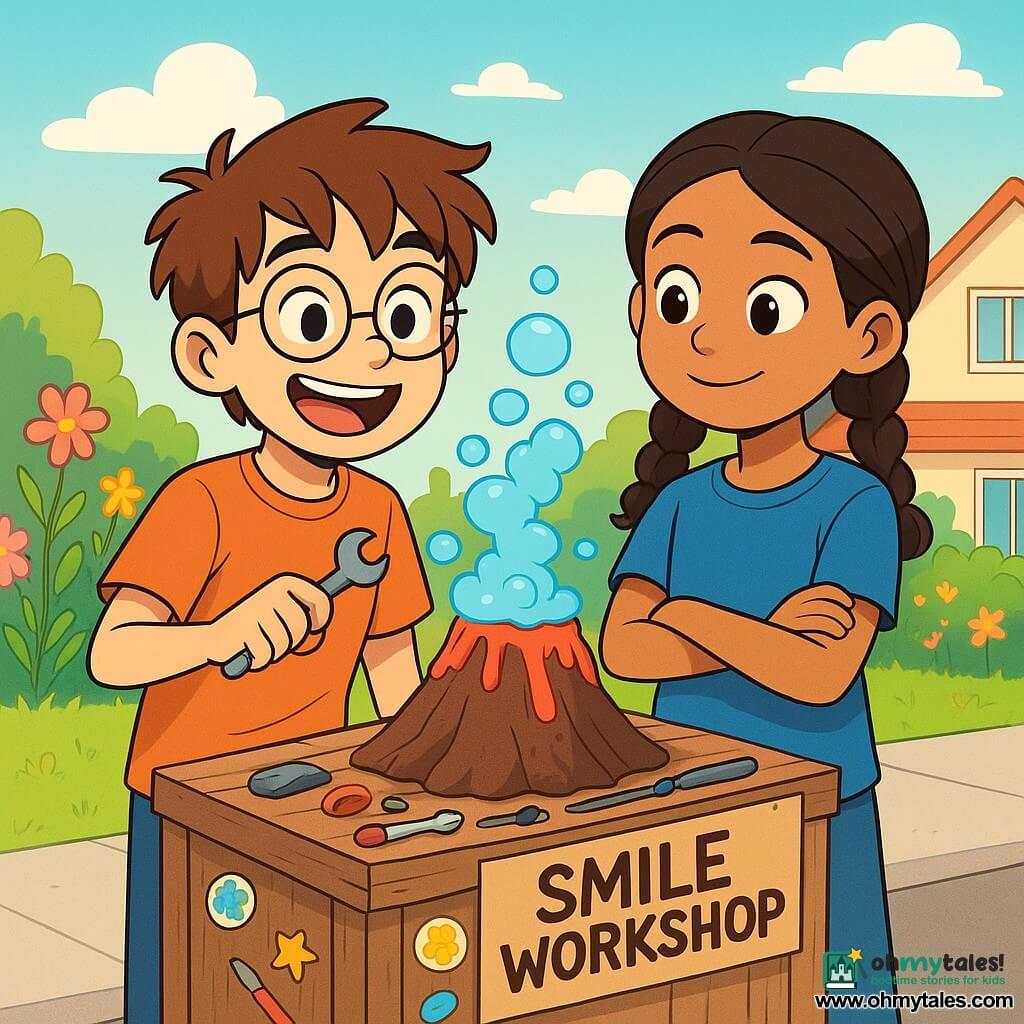
He called it the Pop-Up Smile Workshop. It had stickers that said things like “Mind the Giggle” and “No Frowns Beyond This Point.” Inside were tools no one else had: a grin spanner, a bottle of giggle grease, a roll of compliment tape, patience pliers, a tangled-thought comb, and a tiny bubble level to check if a smile was straight. He even carried a pocket mirror shaped like a sun.
“Tonight,” he told the cat who lived three houses down and answered to the name Turnip, “I'm going to tune up three tricky smiles before bed.” The cat blinked like a slow promise.
Max set his workshop on an old milk crate by the sidewalk. It was evening. The sky was turning the color of blueberry tea, and windows were lighting up, one small, warm square at a time. You could hear someone practicing trumpet, someone watering plants, someone laughing as pans clinked in a kitchen. The air smelled like grass and toast.
He propped a cardboard sign up front. FREE SMILE REPAIRS — GENTLE AND GUARANTEED. He got out his bubble level and checked his own smile. Left side a bit higher. He nudged it with his thumb and nodded. Perfect.
“First customer,” he announced, “step right up!” Nobody was there yet, but Max was stubborn, so he said it again. Turnip meowed like a drum roll.
A door creaked open two houses away. Mr. Crinkle leaned out, the neighbor with a yard full of pink flamingos and a frown that could slice an orange. He was holding an armful of laundry and a sock that wasn't like the others.
“Is this for real?” Mr. Crinkle asked. “You fix smiles?”
“Guaranteed,” Max said. “Or your frown back free.”
Mr. Crinkle snorted. But he stepped closer.
Out came the grin spanner. The evening got interesting.
Chapter 2: Mr. Crinkle's Crooked Monday
Mr. Crinkle put the strange sock on the milk crate. “I've been in a mood all day,” he muttered. “It started with this pair. One red, one very un-red. I can't stand being uneven. Now my smile's all crooked.”
Max set the bubble level under Mr. Crinkle's mouth. The little bubble slid to the left. “Uh-huh,” Max said, touching his chin like a detective. “We have a Tilted Monday.”
“I knew it,” Mr. Crinkle said. “Terrible. Awful. Wobbly.”
Max pulled out the tangled-thought comb and combed the air around the man's head, very gently, like he was untangling invisible knots. “Tell me everything from the top,” he said. “We'll tighten, brighten, and lighten.”
Mr. Crinkle sighed. “I stepped in cold water. I poured orange juice into the cat's bowl instead of the cat into a bowl—no, that's not right. I mean, I poured orange juice where milk should go. And then the socks. This sock is red. Its partner is shy. Hiding. My smile tried to show up, but it tripped.”
Max looked at the sock. He picked up compliment tape and stuck a piece to it. “Brave sock,” he read. “Doing its best.”
The man blinked. His frown flickered.
“Maybe the missing sock is just somewhere weird,” Max said. “Where do lost socks go?”
“Everywhere but the drawer,” Mr. Crinkle groaned.
Max popped open the toolbox. “Operation: Sock Quest.” He stood up. “I'm stubborn about kindness,” he added. “Let's go.”
They searched. Under the porch. Behind a flamingo. In a flowerpot. They peered into Mr. Crinkle's mailbox (empty except for a catalog full of quilts). They dared the laundry basket. Max kept up a running report: “No sock here. But a paperclip shaped like a star. Very fashionable.”
Turnip followed like a furry supervisor, tail high.
Finally, Max checked the sleeve of Mr. Crinkle's bathrobe.
“There,” Max said, triumphant. He pulled out the shy partner sock, tangled in the cuff. “A rescue.”
Mr. Crinkle stared, then snorted. Then snorted again, bigger. “Well I'll be,” he said. “I was about to call the Sock Police.”
“Good thing you got a Smile Tinkerer instead,” Max said, sticking the bubble level under the man's mouth again. The bubble moved center.
“Hold still,” Max whispered. He dabbed a finger of giggle grease at the corner of the man's mouth. Just enough to make it slide into place.
Mr. Crinkle's mouth lifted. His eyes softened. “I suppose this is a tiny bit ridiculous,” he said.
“It is,” Max agreed.
They both laughed. It wasn't a huge laugh. It was a neat, tidy, well-folded laugh that fit in a pocket.
Mr. Crinkle handed Max a quarter. “For the workshop,” he said.
“Free repairs,” Max reminded him, pushing the coin back. “But I will accept a high-five.”
They high-fived. Mr. Crinkle's smile held steady as a shelf. “Go fix the rest,” he said. “I'll cheer from my porch.”
“On it,” Max said, and he meant it.
Chapter 3: The Bubble Volcano Blues
The trumpet down the street squeaked into silence. A screen door whapped shut. Jaya, who lived on the corner and wore her hair in braids, walked over with a face like a raincloud that couldn't decide if it wanted to pour.
“You fix smiles?” she asked.
Max nodded. “What happened to yours?”
“My volcano didn't erupt,” Jaya said, shoulders drooping. “I practiced all week for the science fair. Nothing. It hissed like a bored snake. People watched. I had a plastic dinosaur. It was supposed to be dramatic. It wasn't. It was… bleh.”
“Tricky,” Max said. He sat her on the milk crate. “This calls for the emergency fizz kit.”
“I didn't know that was a thing,” Jaya said, eyebrows tipping up.
“It is now.” Max opened the toolbox. Out came a tiny paper cup, a packet of baking soda, a bottle of vinegar, and a napkin that said TA-DA.
“I already tried that,” Jaya mumbled.
“You tried it for them,” Max said. “Let's try it for you.”
They set the paper cup on the sidewalk. Max poured a sprinkle of baking soda. He added a few drops of blue food coloring from the “wonder bottle.” Jaya held the vinegar like it might bite.
“Ready?” Max asked.
Jaya made a face. “What if I mess up again?”
“You can't mess up an experiment,” Max said, with stubborn calm. “You just get a different answer.”
Jaya poured.
The fizz was small at first. Then it made a sound like a tiny crowd saying “ooh.” Blue foam bubbled up and over, sliding like a pillow, puddling into the napkin. It was funny. A brave little volcano doing its best. Jaya's mouth twitched. The blue foam tickled her fingers.
“You gave it too much blue,” she told Max.
“There is no such thing as too much blue,” Max said, dead serious.
She laughed. The laugh surprised her. It shook loose the raincloud and rolled it away. Max checked the bubble level. Straight.
Jaya's eyes went soft. “I think my smile just needed to practice,” she said.
“Smiles are like volcanoes,” Max said. “Sometimes quiet, sometimes loud. Either way, they're there.”
Jaya took the TA-DA napkin and wiped her hands. “I'm keeping this,” she announced.
“Payment accepted,” Max said.
They made a tiny dinosaur parade in the blue river, because the evening was kind, and there was time.
Chapter 4: A Wag That Wouldn't
Mrs. Bloom arrived next, pulled along by something that was technically a small dog but moved like a loaf of bread with legs. Its ears were floppy curtains. Its name, according to its tag, was Pickles. Pickles' mouth drooped.
“Pickles is mopish,” Mrs. Bloom said. “He usually prances. Today he is a mope.”
Pickles stood there with the saddest wag you ever saw. Like he had a tail but had forgotten what it was for.
Max crouched down. “Sir Pickles,” he said. “On a scale from one to banana, how glum are we?”
Pickles blinked. He placed a solemn paw on Max's knee.
Mrs. Bloom sighed. “He lost his squeaky carrot under the couch. The couch is… dramatic. We decided to abandon the carrot. His feelings are bruised.”
“Bruised feelings,” Max said, opening the toolbox. “Okay. We'll do a gentle tune-up.”
Out came patience pliers. Out came a ribbon. Out came a pocket-sized book called A Small Manual For Slightly Sad Dogs. Max tied the ribbon to Pickles' collar with a careful bow. He showed Pickles his sun-shaped mirror. “Look at this splendid creature,” Max said in a grand voice. “What a handsome potato.”
Pickles' ears lifted. A little. Not a lot. Just enough.
Max rolled compliment tape onto the ribbon. Brave. Good. Loyal. Friend.
He dabbed one fingertip of giggle grease and tapped the tip of Pickles' nose. “Boop,” he said.
Pickles sneezed. It sounded like a bicycle bell. The tail gave a test wag. A micro-wiggle. Then a bigger one. Then a full sweep like a broom made of happiness.
“There it is,” Mrs. Bloom breathed.
“Sometimes,” Max explained, “you have to start at the wag and work up to the smile.”
Pickles leaned into Max with a grateful oof.
“Also,” Max added, “let's not forget the squeaky carrot.” He dragged the milk crate over to Mrs. Bloom's porch, climbed on, and peered under the couch through the window. “I see something orange and stubborn.”
Max used the apology wrench, which looked suspiciously like a coat hanger. He wiggled it. He coaxed. He muttered, “I'm not giving up, carrot.” He didn't. The carrot popped free with a squeak that could startle a cloud.
Pickles heard it, ears pointing north. He sprang. For a loaf of bread with legs, he seemed to fly. Mrs. Bloom laughed like bells in a bakery.
Pickles squeaked his carrot so many times it became a song. People walking by smiled without knowing why. Max packed his tools. He put the bubble level under Mrs. Bloom's mouth just for fun. Centered.
“You, young man,” Mrs. Bloom said, patting Max's shoulder, “have inventions that work.”
“They're mostly made of trying,” Max said.
“And trying,” she said softly, “is a kind thing.”
He tucked that away. It gleamed like a new screw in his pocket.
Chapter 5: The Quiet Fix
The street lights flicked on like friendly fireflies that forgot how to fly. Kitchen windows turned golden. Max's sign leaned, his milk crate creaked under him, and a sleepy breeze nudged his hair.
Then his mother stepped out.
She had her sweater on inside out. A smear of flour on her cheek. A spoon in her hair like a very confused bird. Her smile was there, but it was thin, stretched across a long day.
“Max,” she said, and there was warmth, and also a little sigh. “It's time to pack up, honey.”
“I have one more smile to fix,” Max said, stubborn as a brick. “Yours.”
“Oh,” she said, surprised. “Mine?”
Max grabbed the grin spanner.
“Sweetheart,” she said, touching his wrist, gentle but firm, “please don't use tools on my face.”
“Sorry,” he whispered. The stubborn part of him wanted to fix it fast, to twist and polish and beam, to show he could. The kind part of him stepped in front and held up a hand.
“Okay,” Max said, softer. “New plan.”
He closed the toolbox with a click. He looked at the living room. Dishes stacked like leaning towers. Shoes on a chair. Sock on a lamp. A sort of small domestic storm had blown in and left snacks everywhere.
“Wait here,” he told his mother.
Max moved like a ninja no one could see. Shoes to the mat. Plates to the sink. Tap running, water sighing. He hummed. Not loud, just a ribbon of sound. He wiped the table. He put the spoon from his mother's hair in the drawer. He folded the blanket on the couch into a neat square that looked like a soft book. He filled a kettle, which began to murmur.
“Mission: Quiet Fix,” he said under his breath.
His mother watched. Her shoulders lowered, inch by inch. Something unclenched.
Max poured water into two mugs. Hot chocolate. The kind that coats your insides like a winter scarf. He stirred with the careful patience you use when rain is gentle on the window and time is kind. He handed her a mug. He kept his own.
They sat. Steam went up like tiny ghosts learning to dance.
“Tell me about your day,” Max said.
His mother's eyes warmed. “Would you listen?” she asked.
“I'm stubborn about listening,” he said, and they both smiled, small and real.
She told him. Nothing dramatic. Just a lot. Too much laundry. Bread that didn't rise. A meeting. A phone call. A moment where she couldn't find her keys because they were in the fridge. She laughed at that part, and the laugh sounded like a puzzle piece snapping into place.
When she finished, she held Max's hand. “You fixed it,” she said.
“I didn't even use the giggle grease,” he said.
“No,” she said. “You used kindness. That's the best tool.”
Max checked the bubble level under her smile, just to be silly. The bubble stood steady. He counted to three and tucked the level back, satisfied.
“Bedtime,” she said, the word soft and easy now. “Pack up your workshop, Mr. Tinkerer.”
“I'll do one last check,” Max said. He was stubborn. But his stubborn had turned into something quiet and steady, like a candle that didn't flicker.
He stepped onto the porch and looked up.
Chapter 6: The Last Smile
The sky was navy, smooth and deep. The moon was a silver comma, pausing between sentences. A few stars were shy and peeking. The street hummed with night noises: a far-off car, a moth tapping a porch light, the soft clink of a cooling pan in a sink.
Max looked at the moon. He tilted his head. “Your smile is sideways,” he told it.
Turnip's tail curled around Max's ankle. The cat purred like a tiny motorboat. Max laughed. “Okay,” he said. “I can't fix the moon tonight. That's a tomorrow job.”
He gathered his tools. The grin spanner. The giggle grease. The compliment tape. He tucked the tangled-thought comb into his pocket. He folded the sign and slid it behind the fridge magnet shaped like a lemon. He put the milk crate back where the recycling lived.
Then he checked his own smile in the sun-shaped mirror.
It was a good smile. A little tired at the edges, like a book that has been read a lot. A little proud, like a kite after a long flight. Max's stubbornness leaned in, ready to fuss with it. But the kind part of him said, “Leave it. It's perfect for bedtime.”
He went to his room. He put the toolbox on his desk, under the lamp with the shade that looked like a tiny hat. He lined up his tools, not because they needed to be lined up, but because sometimes doing things neatly smooths the mind. He straightened the pillow. He smoothed the blanket like he was frosting a cake.
His mother stood in the doorway and watched him. “You're good at this,” she whispered.
“Fixing smiles?” Max asked.
“Tucking in the house,” she said. “And tucking in yourself.”
Max climbed into bed. The sheets were cool, then warm. He nestled in. He could still hear the cat's purr, sliding under the door like a friendly breeze. He could still smell chocolate, faint and sweet.
“Night,” he said.
“Night,” his mother answered.
Max stared at the ceiling and let his breath be slow. In. Out. He pictured Mr. Crinkle's socks, reunited like twins. He pictured Jaya's tiny blue volcano, bubbling brave. He pictured Pickles with his squeaky carrot and his bow, tail wagging like a metronome that had learned a happy beat. He pictured his mother's smile, strong and quiet. He pictured the moon and decided it wasn't sideways; it was just taking a thoughtful pause.
His thoughts stretched like cats waking up from naps, then curled again. The room softened. The house breathed.
He imagined hanging up a sign on the moon. CLOSED FOR KINDNESS. OPEN AT DAWN. He smiled at his own silliness.
His breath got longer. His eyes got heavier. The edges of everything blurred into friendly shapes: the chair became a gentle mountain, the lamp a small lighthouse, the toolbox a treasure chest full of the day's bright coins. Max's stubbornness, which had marched all afternoon, sat down and put its feet up. His kindness tucked a blanket around it, neat and snug.
The last thing he felt before sleep arrived was Turnip's soft nudge at the door, as if the cat was a night guard making a round, approving the quiet. His smile rested where it belonged, easy and warm, like a folded kite at the end of flying, like a silver comma in a sentence that would continue in the morning, with laughter waiting, gentle and sure.