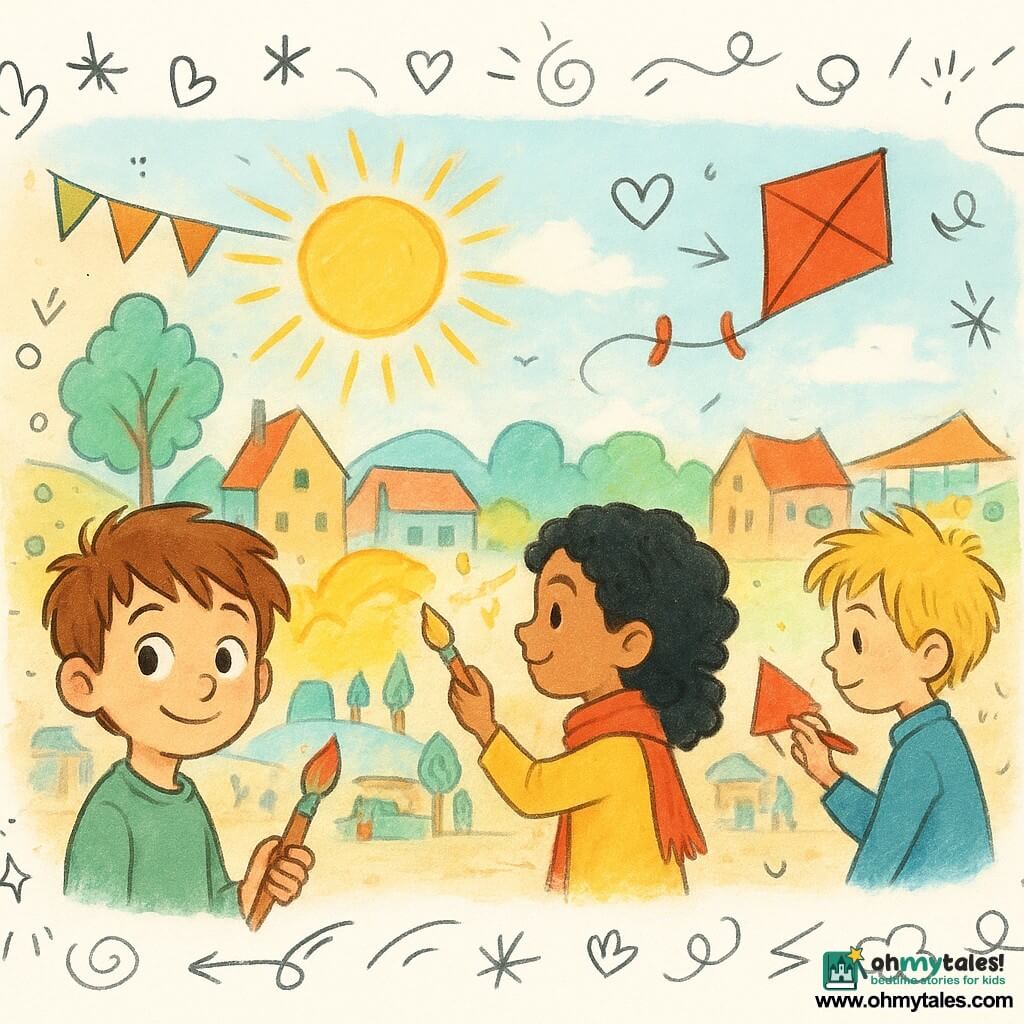
Morning at the Fair
Max woke early the day of the village fair. Light came through his curtains in soft stripes, like the bars of a golden ladder. He pressed his hands to the window and watched the street below where bunting fluttered between lamp posts. His stomach buzzed with a small excitement and a bigger wobble—Max liked quiet corners and simple plans. Fairs felt loud and full of surprises.
Downstairs, his mother packed sandwiches and sticky jars of lemonade. She smiled at Max in a way that made him feel steady. "You can take your sketchbook," she said. "Maybe you'll draw something today."
Max tucked the small book into his backpack. He loved to draw the houses on his street, the ducks on the pond, and the way the clouds looked like slow ships. He walked with small steps to the village square, where people were setting up stalls. The air smelled of fresh bread and sugar. Musicians tuned fiddles and a man gave balloons to a toddler who ran laughing.
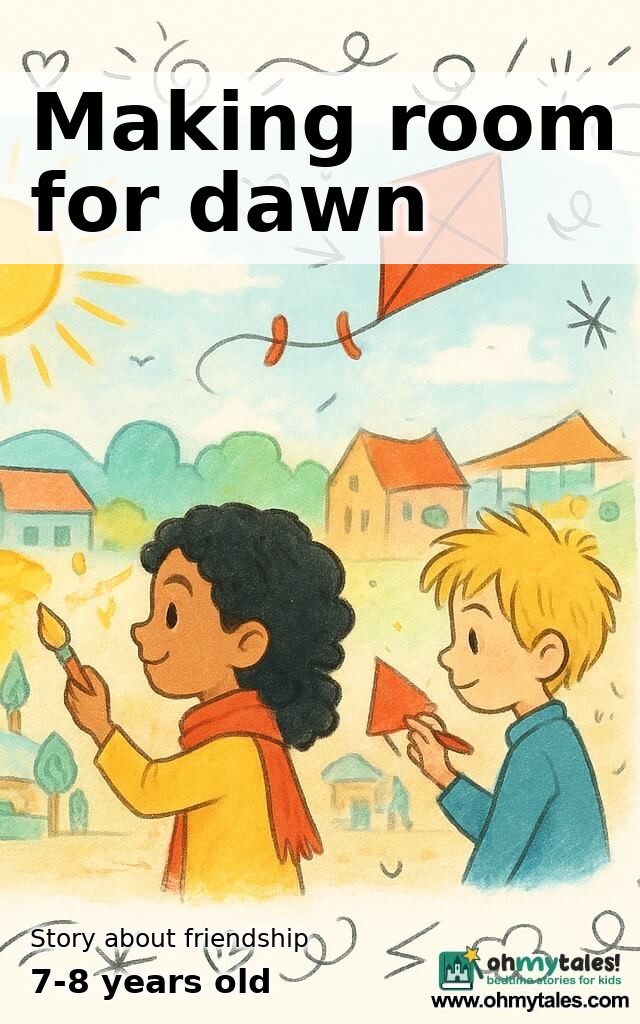
Max stayed at the edge, looking at colors and sounds like a bird watching from a branch. Then he saw Nina. Nina had a red scarf and quick hands and a laugh that made other children's faces light up. Nina was seven too. She could build tall towers from blocks and draw big friendly tigers with only three lines. She waved at Max like she had found a treasure.
"Max!" she called. She bounced over, carrying a little paint pot. "They're making a mural for the fair. Do you want to help?"
Max felt his throat tighten in a familiar way. Helping in the middle of everything felt huge. But Nina's eyes were bright and kind. He nodded, almost without thinking. He set his backpack on the ground and opened his sketchbook.
They walked to the wall behind the library where a long canvas hung, waiting for color. Other children were there, some splashing paint, some sticking paper flowers. The mural looked like a plain sky, a wide empty blue waiting to be filled. On a small table lay brushes, buckets, ribbons, and a pot of black paint with a thin brush for fine lines.
Nina pointed at an empty corner. "We could paint the sunrise," she said. "Like the fair is waking up."
Max loved sunrises. He had drawn them in his sketchbook many times. His hand lifted before his worry did. He took a brush, dipped it in a soft pink, and added a small sweep of light at the bottom of the blue.
Nina smiled. "Perfect," she said. She filled her corner with gentle yellow strokes that warmed Max's pink into a small glow. Their colors touched gently in the middle, like two hands meeting. Max felt something open inside him, a tiny space that made room for the bright color and for Nina's laugh.
Making Space
As the morning grew, more children came. Some painted big flowers, some painted houses, and some wrote words. Max kept drawing small things: a cat on a rooftop, a bicycle leaning on a tree, two birds sitting together. Nina painted waves and a picnic blanket and a small kite. They kept looking at each other's work, adding small details where they could.
At one point, a boy named Leo arrived. He liked bold lines and loud colors. He pulled a large brush and painted a stripe across the mural where Max and Nina had been working. Max felt his heart clench. He stepped back and his hands grew tight.
"Hey," Leo said, wiping his hands. "This needs bright colors. I'm fixing it."
Nina tilted her head. "You can add colors," she said. Her voice was smooth like calm water. "But maybe you can add them next to us. We were putting a sunrise here."
Leo looked at the stripe, then at Max, and then at Nina. For a second, Max thought Leo would frown or say something sharp. Instead, Leo scratched his head and smiled small. "Okay," he said. He set his brush down and moved a few feet away. He painted a bright red kite that seemed to fly over the sunrise.
Max breathed out. He realized his fingers had been holding tight to a small corner of the canvas. The mural had room for more than one idea. Nina added a thin white line between the sunrise and the red kite so the colors could sit next to each other without bumping. Max watched how two colors could sit side by side, each keeping its brightness because they had a little space.
They continued painting. Max learned to step back and look, to let the mural breathe. Sometimes he painted a bird, then Nina painted a leaf near it. Sometimes he drew a small house, and Leo painted a big tree beside it. The mural began to tell a story of a village waking up together.
When lunch came, the children sat under a tree and shared sandwiches. Max noticed how Nina tore her bread in little pieces and handed them out. Leo told a joke that made everyone laugh. Max laughed softly too, and felt like his shoulders were lighter. He realized sharing food had been a tiny way of sharing the morning.
Small Steps, Bigger Friends
After lunch, Mrs. Alvarez, the art teacher, walked by. She had a gentle voice that made people listen. "Remember," she said, "this mural is for everyone. Think of the village—what makes the village kind?"
Max thought of his neighbor Mrs. Patel handing him cookies when he delivered her mail. He thought of the librarian who always kept a small lamp on so readers could find a chair. He thought of the ducks at the pond who always seemed to forgive noisy children. He pulled out his pencil and sketched a small bench beside a lamppost. Nina saw him and painted the bench brown, with a warm orange cushion on it.
"Let's add people," Nina said. "People who do kind things."
They painted a woman with a tray of bread, a boy helping a stranger with his bag, and an elderly man watering flowers. As they worked, Max realized that the mural was full of small actions—holding a door, offering a smile, sharing an umbrella. Each small act was like a brush stroke that made the whole picture kinder.
People from the village walked by and pointed at the mural. Some stopped and added a tiny color. A teacher added a paint dot for each student, and a baker painted a loaf of bread that smelled like sunshine. The mural hummed with small kindnesses.
Once, Max wanted to add a quiet corner with a cat curled under a tree. But he hesitated. Would there be room? Nina leaned over and said, "Make it small. We can fit it under the tree." Max smiled and painted the quiet cat. Later, a child he did not know painted a tiny mouse near the cat and wrote in neat letters, "Friends can be different." Max liked that sentence. He traced over it with a fine brush, making the letters bold and steady.
Throughout the day, Max and Nina learned to ask and to listen. If someone wanted to use a color they were using, they offered it or suggested sharing. When someone was shy, they handed them a small brush and said, "Try a dot right here." These tiny offers made a lot of difference. Max found that when he made room for others, those others made room for him too.
Finishing the Picture
By the late afternoon, the mural looked like a long, bright story. The sunrise glowed where Max and Nina had begun. Houses peeped from behind trees, children played, a cat dozed in the shade, and Aunt Mira's bakery steamed a golden bread. People stopped, took photos, and smiled.
Mrs. Alvarez stood back and nodded. "It's beautiful," she said softly. "You all made room for each other. That is what a community does."
Max felt warm all over. He had been shy in the morning and full of small worries, but by now he felt proud. He remembered the tight flutter in his chest when Leo painted the stripe across their sunrise, and how that tightness had eased. He thought of the bench he had drawn and how other people had added cushions and a person reading a book. The bench wasn't only a bench anymore; it was a place where many people might sit and feel welcome.
Nina squeezed his shoulder. "We did it together," she said. Her voice was soft and bright. Max nodded. He was glad that he had said yes when she invited him, even if his hands had felt shaky at first.
The mural had more than paint. It held stories. A little boy pointed out the loaf of bread his mother bought that morning. An old man wiped his eye when he saw a tiny dog painted to look like his dog who had passed away. Max watched how one painting could hold many memories and many people's kindness. He understood that making room meant more than adding space—it meant listening to other stories, letting different shapes come together, and making something bigger than one person's idea.
As the sun leaned toward the trees, the fair's lights began to twinkle. Children painted a string of lanterns across the top of the mural. Max painted the last lantern, a small warm circle, and signed his name under the sunrise in careful letters. Nina signed her name beside his, and then Leo, and then many more names in a neat line like tiny footsteps.
Home and Morning
When the fair closed, Max walked home with his mother. He carried the memory of the mural like a small pebble in his pocket. He told her about the sunrise, the bench, the cat, and the way Leo had made a kite. His voice was bright and steady. His mother listened and smiled as if each detail was a treasure.
That night, Max opened his sketchbook. He drew the mural from memory—big sky, cozy houses, kind people. He tried to draw the way the colors had touched each other. He left a little space on the page, a blank corner for something else to come. He wrote, in small letters, "Make room for dawn," the phrase that had settled into his heart. It felt like a promise.
In bed, Max thought about mornings. Instead of feeling a flutter of worry about new things, he imagined making room. He imagined sharing crayons, offering a seat, listening to a friend who had a quiet worry. He imagined that small acts could change a whole day, like a brush stroke that brightens a painting.
The next morning, Max woke to light like a ladder again. He walked to the window, and in his mind he saw the mural one more time, the sunrise smiling at him. He felt ready for small kindnesses and gentle steps. He remembered how he had learned to let colors meet and how everyone had made room for each other's stories. The world felt a little wider and a little warmer.
Max hugged his sketchbook and thought of Nina and the village. He felt grateful for the small courage that had let him share a wall with friends. He learned that making room was not a one-time thing but something you could always do—at breakfast, on the playground, when someone felt alone—an open place in your day and in your heart.
Outside, the sky looked like the mural they had painted: a calm blue with a hint of morning gold. Max smiled, feeling that tomorrow would be another chance to make room.