Morning Music
Little Lupa woke to the sound of the kettle singing. To her, the kettle's whistle was bright yellow with a tiny dot of giggling turquoise. She padded out of her den with soft paws and a sleepy yawn, and the sun turned the sleeping leaves into warm gold confetti.
“Good morning, Lupa,” said Mum, stirring porridge that hummed like a low orange drum.
“Good morning,” Lupa replied, listening. Every sound had a color for her. Birds were flurries of purple sparkles, the wind was a long blue ribbon, and footsteps could be pink or gray depending on the shoes. Lupa had always noticed things this way. Sometimes it made her laugh; sometimes she felt a little different from friends who only heard sounds.
Today was the day of the Forest Fair, a gentle celebration where everyone shared stories and tasty treats. Lupa had a plan. She would bring her painted stones to trade. Each stone had a sound-color painted on it: a yellow for the kettle's whistle, a purple shimmer for the bird's chitter, a blue streak for the wind. She wanted to show how sounds could look, and make a little rainbow of friendship.
Mum knelt to tuck a scarf around Lupa's neck. “Remember to ask when you need help, love,” she said. Her voice was a soft green, like a leafy hug.
Lupa nodded. “I will,” she whispered, feeling her heart tingle with a bright, hopeful orange. She tucked the stones carefully into her bag and set off, song and color dancing inside her.
At the Fair
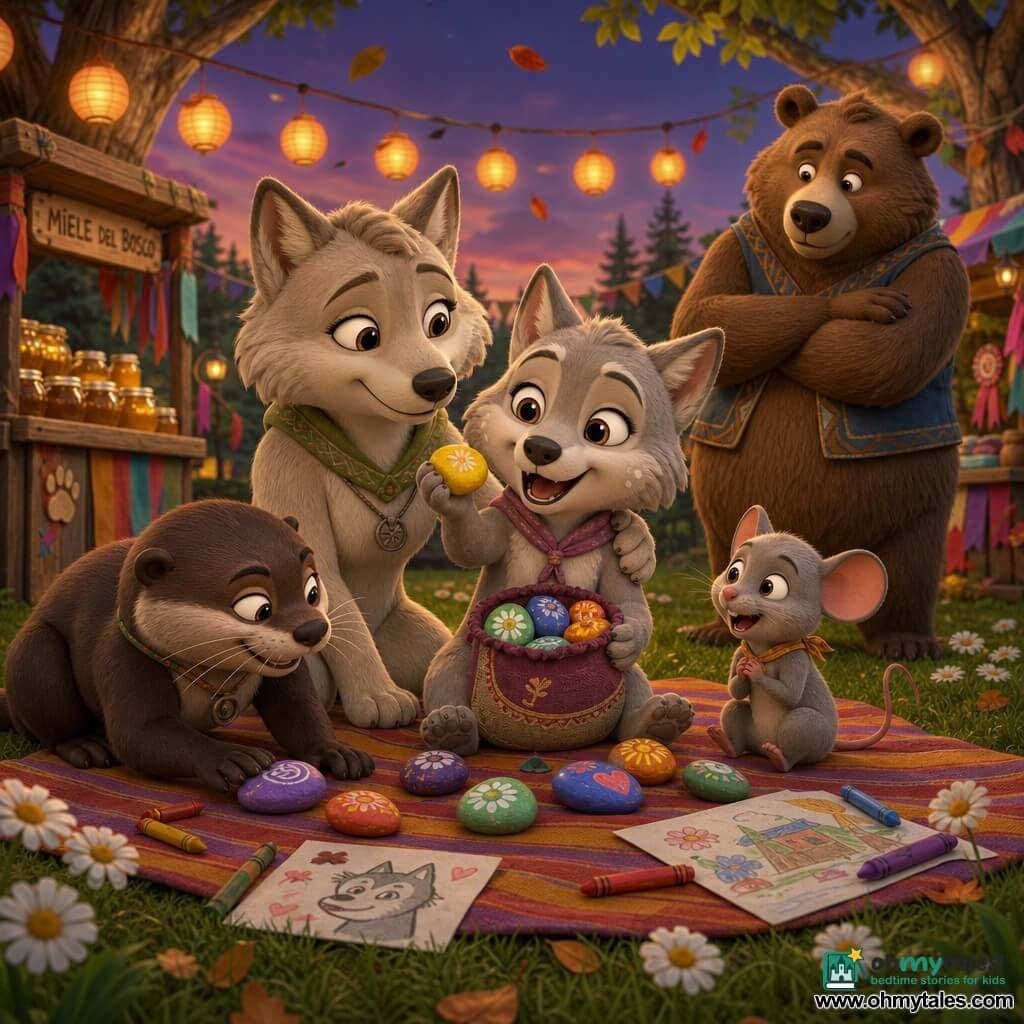
The meadow buzzed like a happy drum when Lupa arrived. Stalls were set with spinning ribbons and jars full of glittering honey. The air smelled of warm bread and daisies. Friends waved: Olli Otter, with muddy brown shoes and a laugh that sounded cinnamon-colored; Mina Mouse, whose tiny chuckle was a shiny silver bell.
“Lupa!” Mina cheered. “Show us your stones!”
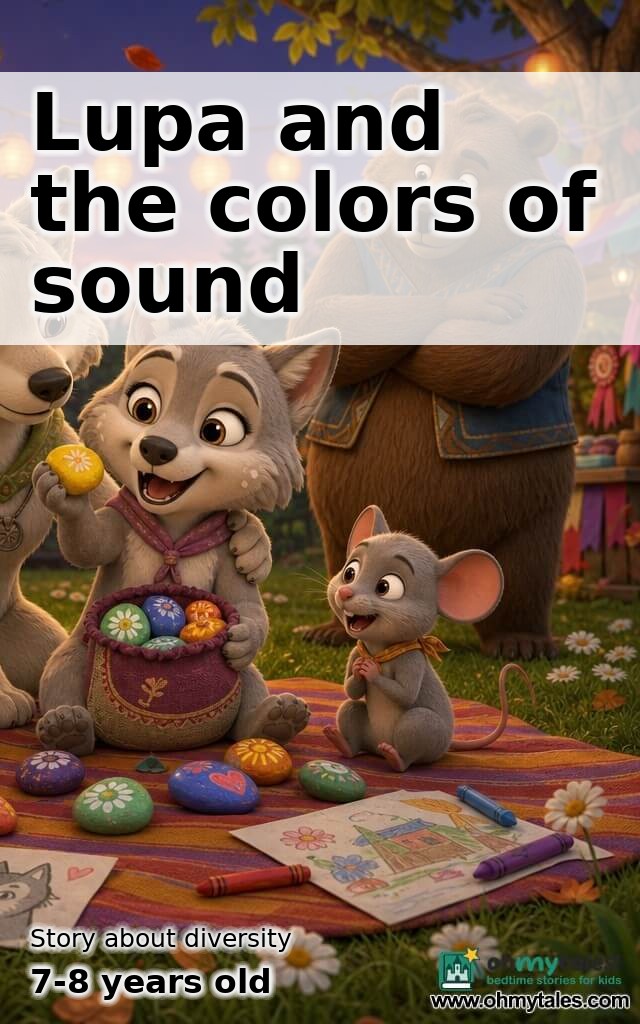
Lupa spread the stones on a blanket. Each one shimmered in the sunlight, and when she tapped them gently, she said, “This one is the kettle.” To her, the word made a blip of happy yellow across the stones.
Some friends listened with wide eyes. Mina picked up the purple bird-stone and tilted her head. “What do you hear when you tap it?” she asked.
Lupa tapped again. “It's a soft chitter. For me, it looks purple.”
Olli grinned. “I hear chitter,” he said. “But I don't see any purple.”
“That's okay,” Lupa said, smiling. “Maybe we can make purple together.” She passed the stone to him, and he touched it and closed his eyes. He pretended to hear purple and then giggled. “It's warm,” he whispered.
Nearby, Mrs. Badger, who painted leaves for the fair, listened with careful eyes. She enjoyed how everyone tried to understand one another. “Sometimes things feel different in each of us,” she said, rubbing her paws thoughtfully. Her voice looked like smooth brown paint.
But not everyone was sure. A few animals scratched their heads. “So the sound of the stream could be blue for you but green for me?” asked Boris Bear, who liked plain facts and tidy lists. His voice rumbled like a dark mossy green.
“Yes!” Lupa said, bright as a newly opened tulip. “They can be different. That's what makes it fun.”
Some animals exchanged puzzled looks. A little fox whispered to her sister that Lupa was strange. Lupa felt a prick of sadness, like a small gray pebble in her shoe. Her colors dulled for a moment. She wanted to run away and hide where sounds didn't paint the air.
“Lupa?” Olli nudged her with a friendly paw. “Come help with the music circle. We could use your color stones.”
Lupa blinked. The stones in her bag seemed to hum a cheerful blue. She sat with the circle where a drum tapped steady, a flute fluttered softly, and a choir of voices swelled in a gentle rainbow. Lupa closed her eyes and let the sounds paint the meadow: the drum was deep red, the flute a pale silver leaf, and the voices a soft carnival of pastels.
“Why don't we each draw the color of what we hear?” suggested Mrs. Badger. She had set out crayons and big sheets of paper. “No rules—just what you feel.”
Hesitation shimmered across a few faces, but one by one, animals dipped crayons to paper and made shapes that matched their listening. A beetle made tiny black dots for the beetle-buzz he felt. A squirrel drew quick tan strokes for the scurry of paws. Lupa chose a bright sweep of many colors and added little painted stones to her drawing.
The meadow filled with colors that did not match but looked lovely together. “Look!” Mina said, delighted. “Your purple is different from mine, but it makes mine sparkle.”
“Yes,” Boris Bear said more quietly than before, “and my green makes yours glow.” He smiled, surprised by the warmth in his chest.
The Little Mix-Up
Later, a game of music statues started. When the music stopped, everyone had to freeze. The music's sound was a soft silver bell for Lupa, a pale lemon for Olli, and a gentle brown for Mrs. Badger. Lupa listened to the bell and thought of floating pom-poms of silver. She loved how everyone's stillness looked different in her mind.
During the game, a little mishap happened. A basket of painted leaves toppled, and bright slips fluttered everywhere—reds, blues, greens, and a few of Lupa's stones scattered under a log. Lupa darted to fetch them, but a hedgehog named Hattie had already scooped up a stone in her spiky paws.
Hattie looked puzzled. “This stone looks like a tiny sun,” she said, holding up one of Lupa's yellow stones. Her voice sounded sunflower-gold.
“That's my kettle-stone,” Lupa said, cheeks turning a soft rosy pink. “It looks yellow to me because the kettle sings that way.”
Hattie frowned gently. “But when I touch it, I hear a bell. Bells are silver.”
Lupa felt a swirl of colors: curiosity tangled with worry. “Sometimes sounds wear different colors on different days,” Lupa explained, hoping not to stumble over her words.
A small crowd gathered. Some were curious, some unsure. Mum edged closer from the crowd, her green voice steadying Lupa like a warm blanket. “Would you like to tell them how you hear?” she asked.
Lupa took a breath. “I hear sounds as colors,” she said, voice small but steady. “Like the kettle is yellow for me. But I know you don't see colors when you hear. That's okay. We can share our ways.”
Hattie gave the stone back and looked thoughtful. “So when you hear a bell, it might be yellow, but when I hear it, it is silver. We both hear the bell, but our eyes of sound paint it differently.”
“That's right!” Lupa's heart stretched with relief into a new bright turquoise. “And sometimes, if you close your eyes and imagine, you can make the bell yellow with me.”
“Shall we try?” suggested Olli, bouncing on his toes.
One by one, the animals closed their eyes. Lupa tapped a stone gently; the bell's sound popped into the air. The animals imagined colors and laughed as their pictures grew. Some pictures were very different—Boris imagined a giant green bell, Mina saw a tiny shining silver bead, and Hattie pictured a warm sun. No one was wrong. The meadow hummed with many beautiful answers.
Evening Harmony
As the sun slid toward the horizon, the fair grew quieter. Lanterns glowed like sleepy orange moons. Lupa sat on a log, watching friends pair up to trade recipes and recipes of stories. She felt full of colors that swirled like a soft watercolor wash.
“Mum,” she said, tucking a stone into her pocket. “Did I do okay today?”
“You did wonderfully,” Mum replied, her voice a comforting sage green. “You shared your colors softly and invited others to imagine. You helped us all see how difference can make things better.”
Lupa thought about the way Mina and Boris had added their colors to the drawing, and how Hattie had learned to imagine the yellow bell. She thought about the moment she had felt small and gray and how friends had reached out. Pride warmed her like a sunbeam.
“Different can be bright,” Mum said, as if reading Lupa's thoughts. “Different can be cozy. We all have our music, our colors, and when we share, the world sings.”
They packed up the blanket with a gentle wriggle and walked home through the dusky trees. Night sounds painted the air in deep indigo and silver: the owl was a soft velvet indigo, crickets were tiny diamond ticks. Lupa hummed a tune that looked like a string of little green buttons.
At the den, Lupa laid the stones by her bed. She closed her eyes and pictured the day: a meadow of mismatched colors that fit together like puzzle pieces. She remembered Hattie's sun-stone and Boris's green bell. She remembered laughter and the warmth of friends who tried.
“Can I draw my sounds tomorrow?” she asked, already half-asleep.
“Yes,” Mum said, tucking the blanket up to Lupa's chin. “And I will draw with you. Tomorrow we will make new colors together.”
Lupa smiled. Her last thoughts were a soft ribbon of teal and gold: different, yes, but together. Different, yes, and bright.
Before sleep took her, she whispered to the stones, “Thank you for helping me share.” The stones did not answer in words, but in her mind a tiny chorus of colors shimmered: yellow for the kettle, purple for the bird, blue for the wind, and many new shades she had not yet named.
As the den grew quiet, Lupa learned one more thing. Differences can make a picture more beautiful. When people share what makes them who they are, others can listen, imagine, and grow a bigger, friendlier world.
And so Lupa drifted off with sounds and colors twining like soft ribbons around her dreams—safe, proud, and excited for another day of music and many new hues.
Brief recap: Lupa learned that people experience things differently, that sharing those differences brings joy, and that being oneself helps create a brighter, kinder world.