Chapter 1: A Quiet Morning
Lio was a small wolf with soft gray fur and careful paws. He lived with his mom in a cozy house near the edge of the forest, where the trees stood like friendly neighbors.
That morning, the kitchen smelled like warm toast. Lio sat at the table, swinging his legs under the chair. His mom spread jam in neat circles.
On the wall, there was a photo of Lio and Grandma Wren. Grandma Wren was not a bird, even if her name sounded like one. She was Lio's grandmother—an old wolf with gentle eyes and a laugh that jumped out like bubbles in a stream.
Lio looked at the photo. Grandma Wren had her paw around his shoulder, and Lio's ears were sticking up like two little triangles.
Mom noticed. “You're looking at Grandma,” she said softly.
Lio nodded. “We were at the park. She bought me a honey bun.”
Mom smiled, but her smile was a little tired. “She loved doing small things that made you happy.”
Lio held his toast and asked the question that had been floating in his chest like a leaf in water. “When is Grandma coming back?”
Mom put down her knife. She took a slow breath, the kind grown-ups take when they want to say something carefully.
“Lio,” she said, “Grandma died last night.”
The word died sounded hard, like a pebble dropped on the table. Lio blinked. His tail went still.
“Died?” he repeated.
Mom reached across and covered his paw with hers. “It means her body stopped working. She isn't breathing, and she can't talk or eat or hug anymore.”
Lio tried to imagine that. Grandma Wren not hugging. Grandma Wren not laughing. It felt like trying to picture the forest with no trees.
“But… where is she?” he whispered.
Mom's voice stayed warm. “Her body is at the hospital right now. Later, the grown-ups will take care of it in a respectful way. And we can remember her in our hearts and in the stories we tell.”
Lio's ears dipped. “Did she feel scared?”
Mom shook her head. “The nurse said she was peaceful. She was very tired, and she rested.”
Lio looked at the toast in his paw. Suddenly it didn't taste like anything. He slid off the chair and walked to the window. Outside, the sky was pale blue. A few clouds moved slowly, like they had all the time in the world.
Mom came beside him. “Whatever you feel,” she said, “it's okay. Some feelings come fast, and some come later.”
Lio didn't know what he felt. He only knew something important had changed, like a familiar path was gone.
He whispered, “I miss her already.”
Mom nodded. “Me too.”
They stood quietly. The house didn't feel scary. It felt different—like a room after the music stops, when everyone is still listening for the last note.
Chapter 2: The Day of Many Feelings
After breakfast, Mom called Aunt Sable. Then she called Grandpa Moss. Voices came through the phone—soft, serious, sometimes sniffly.
Lio sat on the rug with his toy truck. He rolled it forward, then backward, then forward again. He wasn't really playing. He was just making his paws do something.
Later, Mom knelt beside him. “Today we're going to Grandma's house,” she said. “We'll help Aunt Sable with a few things.”
Lio's stomach made a small twist. “Will Grandma be there?”
Mom shook her head. “Not in the way she used to be. But her home will still feel like her, and we can be gentle with it.”
On the drive, Lio watched the familiar streets. The bakery where Grandma bought honey buns. The crosswalk where she always waited for the green sign, even when no cars were coming.
At Grandma's house, Aunt Sable opened the door. Her eyes were red, but she smiled when she saw Lio. “Hello, little wolf,” she said, and gave him a careful hug, like she was holding something easy to break.
Inside, the house smelled like tea and old books. Grandma's knitted blanket lay on the sofa, folded in a perfect square, as if she might come back and unfold it any minute.
Lio walked slowly. He touched the edge of a chair. “Her chair,” he said.
“Yes,” Aunt Sable answered. “She liked that spot because she could see the window.”
Grandpa Moss arrived with a bag of apples. He set them on the counter and cleared his throat. “I brought snacks,” he said, as if snacks could fix everything. Then he looked at Lio and added, “It's okay if you don't feel hungry. Apples can wait.”
The grown-ups talked in the kitchen about plans and phone calls. Lio sat on the floor by Grandma's bookshelf. He pulled out a book with a torn corner.
Grandma had read that one to him. She did funny voices, even when her voice got shaky near the end. Lio remembered asking, “Why do you cough so much?” Grandma had patted his paw and said, “My body is just an old wagon, creaking a bit.”
Now the wagon had stopped.
Lio looked around. He saw Aunt Sable holding a sweater and pressing it to her face. He heard Grandpa Moss say, “People grieve in different ways.” He heard Mom answer, “Yes. No judging.”
No judging. Lio liked that. It sounded like a rule that made space for everyone.
Aunt Sable came to him and sat down. “Lio,” she said, “would you like to help me choose a photo of Grandma for the service tomorrow? One that feels like her.”
Lio's ears lifted a little. “A photo?”
“Yes,” Aunt Sable said. “A smiling one, if we can find it.”
They opened a drawer full of pictures. Some were in frames. Some were in envelopes. Some had bent corners.
Lio saw Grandma in a garden, holding a watering can. Grandma at the beach, wearing a silly hat. Grandma with baby Lio, her eyes shiny with joy.
Then he saw one where Grandma was laughing so hard her eyes were almost closed. She was holding a spoon like a microphone, pretending to sing. Lio remembered that day. She had made pancake batter and said, “Welcome to the Breakfast Concert!”
Lio pointed. “That one.”
Aunt Sable looked and made a soft sound that was half laugh and half cry. “Yes,” she said. “That's her.”
Mom leaned over their shoulders. “It's perfect,” she said.
Lio felt a small warmth in his chest. It didn't erase the heavy feeling, but it sat beside it like a gentle lamp.
After that, Aunt Sable asked, “Would you like to draw something for Grandma? We can place it near the photo.”
Lio nodded. He drew Grandma Wren with a big smile and a huge honey bun in her paw. He drew himself too, with pointy ears and an even bigger smile.
When he finished, he stared at the paper. “But she can't see it,” he said, and his voice wobbled.
Mom sat close. “You're right,” she said. “She can't see with her eyes anymore. But drawing can still help your heart say what it wants to say.”
Lio held the drawing against his chest for a moment. His heart did have something to say. He just didn't know how to say it yet.
Chapter 3: The Postcard Never Sent
That evening, back at home, Mom made soup. The house filled with the smell of carrots and herbs. Lio sat at the table and watched the steam rise.
After dinner, Mom said, “Sometimes it helps to write. Not to be perfect—just to be honest.”
“Write what?” Lio asked.
“A letter,” Mom said. “Or a postcard. Something you might have wanted to tell Grandma.”
Lio thought of Grandma's postcards. She used to send them even when she traveled only to the next town. The front always had something cheerful: a lighthouse, a mountain, a funny cat.
Mom opened a drawer and pulled out a small stack of blank postcards. The front of one showed a drawing of a calm lake with a bright yellow canoe.
“I choose this one,” Lio said. “It looks quiet.”
Mom gave him a pencil and sat nearby, not too close, not too far. “You can take your time,” she said.
Lio stared at the empty lines. His paw felt heavy. Then he started, slowly.
“Dear Grandma Wren,
I miss you.”
He stopped. That was true, but it felt too small, like a tiny pebble for a big mountain.
He wrote again.
“I miss your honey buns and your laughs.
I miss when you called me ‘little captain' and made my spoon into a microphone.”
He paused and sniffed. His eyes were wet. He didn't like crying at the table. It made him feel messy.
Mom spoke softly. “Crying is just your body's way of letting feelings out. It's not bad. It's like rain. Rain helps things grow.”
Lio gave a small, shaky laugh. “I don't want to grow mushrooms on my face.”
Mom chuckled gently. “No mushrooms. Just feelings.”
Lio wiped his cheeks with his sleeve and kept writing.
“I was worried you were scared, but Mom said you were peaceful.
I hope it was like falling asleep after a long day.”
He thought about Grandma's last months. She moved more slowly. She napped more. Sometimes she forgot words and made up funny ones instead. Once she called the refrigerator “the cold cupboard” and everyone laughed.
Lio wrote:
“I remember when you said ‘cold cupboard' and Grandpa laughed so hard he snorted.
I'm not judging Grandpa for snorting.
It was kind of funny.”
Lio smiled a little through his tears.
He kept going.
“I am mad that you can't come to the park anymore.
I am also glad you don't hurt anymore.”
He stopped again. Mad and glad at the same time. That seemed impossible, but it was true.
Mom nodded as if she could hear the thoughts behind the pencil. “Two feelings can live together,” she said. “They can hold paws.”
Lio wrote the last lines carefully.
“I will keep your stories.
I will try to be kind, like you.
Love,
Lio.”
He put down the pencil and stared at the postcard. His chest felt tired, like he had carried a heavy backpack and finally set it down.
“Are we going to send it?” he asked.
Mom shook her head. “We don't have to. It can be a postcard that stays with you. Some messages are meant for your heart, not the mailbox.”
Lio turned the postcard over. The lake and canoe looked peaceful. He imagined the canoe drifting slowly, with no rush.
He slid the postcard into his bedside drawer. “It can sleep there,” he said.
Mom kissed the top of his head. “That sounds just right.”
Chapter 4: The Smiling Photo
The next day, there was a small service for Grandma Wren. It wasn't loud or fancy. It was quiet, like a gentle song.
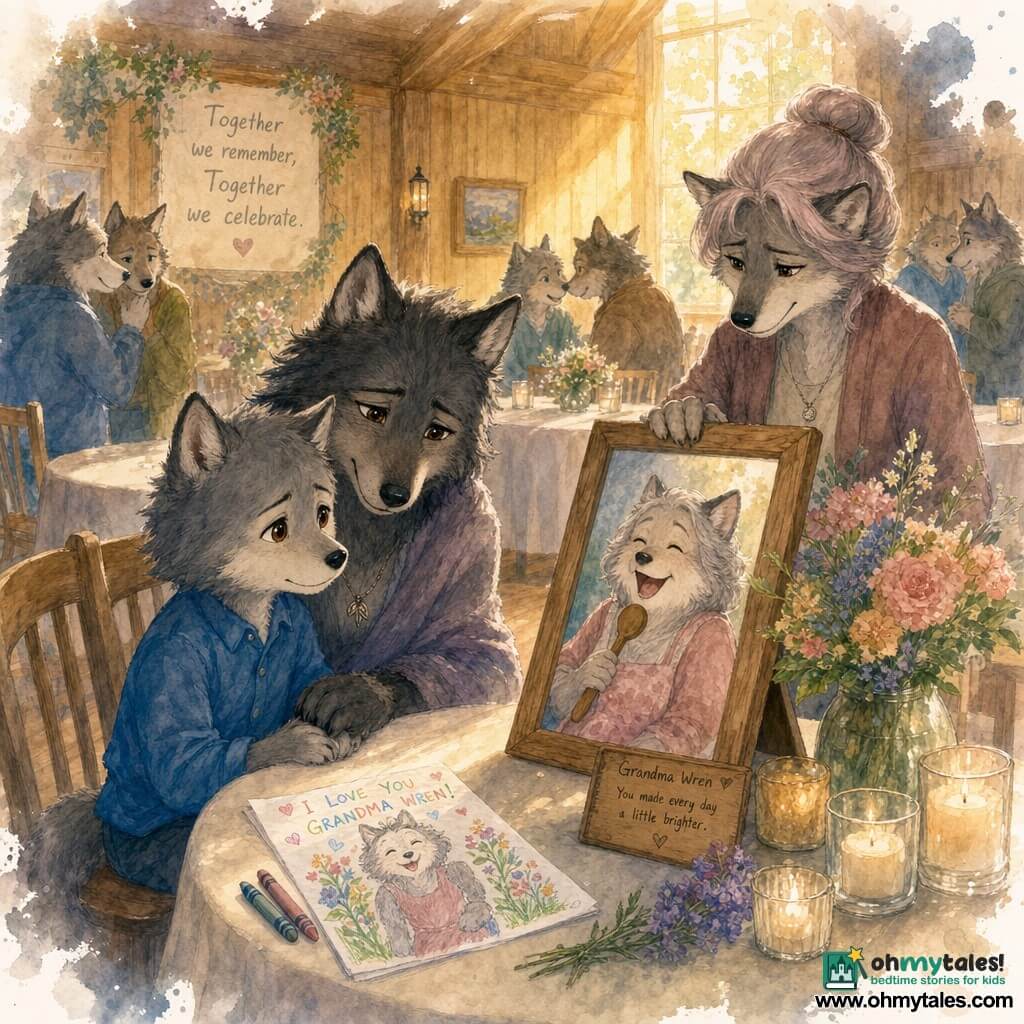
Lio wore his clean blue shirt. Mom brushed his fur so his cheeks looked extra fluffy. “You look like a very brave wolf,” she said.
Lio didn't feel brave. He felt like a wolf with a wiggly stomach. Still, he held Mom's paw tightly and walked inside the community hall.
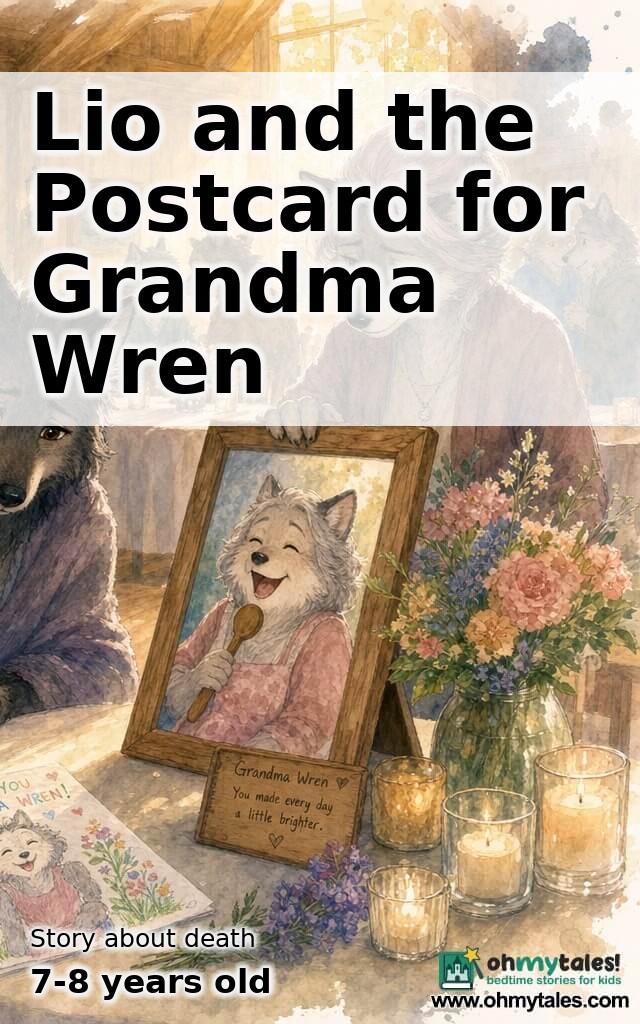
On a table near the front, Aunt Sable had placed the chosen photo: Grandma laughing with the spoon microphone. Beside it were flowers, Lio's drawing, and a few candles with safe glass covers.
Lio stared at the photo. Grandma's smile looked so real that for one second his heart jumped and thought, She's right there.
Then the jump settled. The photo was a reminder, not a doorway.
People came up to the table quietly. Some smiled. Some cried. Some did both at once.
A neighbor wolf, Mr. Alder, patted Lio's shoulder. “Your grandma was the best pancake singer I ever met,” he said.
Lio gave a small smile. “She practiced a lot.”
Mr. Alder nodded seriously. “It showed.”
During the service, Grandpa Moss shared a memory. “Wren believed in being gentle,” he said. “She said, ‘We never know what someone carries inside, so we can be kind on the outside.'”
Lio liked that. It sounded like Grandma's voice.
Aunt Sable spoke too. “If you feel quiet today, that's okay,” she told everyone. “If you feel talkative, that's okay. If you don't cry, that's okay. We won't judge each other's hearts.”
Mom squeezed Lio's paw when she heard that. Lio squeezed back.
Afterward, there was tea and simple cookies. Some grown-ups stood in circles and told stories. Lio listened. He heard about Grandma helping a lost puppy find his home. Grandma giving extra apples to a neighbor. Grandma learning to knit even though she dropped the needles a hundred times.
Lio walked to the photo again. This time he didn't feel the jump. He felt a steady warmth, like holding a mug of cocoa.
Mom crouched beside him. “How are you doing?” she asked.
Lio thought carefully. “Sad,” he said. “But also… safe. Because everyone is being nice.”
Mom nodded. “That makes sense.”
Lio looked at Grandma's smiling face. “I think she would like this picture,” he said.
“I think so too,” Mom replied.
On the way home, Lio watched the trees roll by outside the car window. The forest looked the same as yesterday. The world hadn't stopped. It had just made room for a new kind of missing.
That night, Mom tucked him into bed. The house was quiet again, but not empty. It felt like it was holding him.
Lio opened his bedside drawer and touched the postcard. He didn't take it out. He just rested his paw on it, like a promise.
“Mom?” he whispered.
“Yes, little wolf?”
“Will I stop missing her?”
Mom thought for a moment. “You might always miss her in some way,” she said. “But it won't always hurt like this. The missing can change. It can become a soft place inside you where love lives.”
Lio pictured that: a soft place, like Grandma's knitted blanket.
He closed his eyes. Before sleep took him, he saw the smiling photo in his mind. Grandma Wren, laughing, spoon in paw, as if she were singing the gentleest breakfast song.
And Lio let himself smile too, because love could stay, even when a life had ended.