Chapter 1: The Three Bins Mystery
On a fresh Saturday morning, Leo bounced out of bed, his mind buzzing with excitement. Today was the day he and his three best friends, Oscar, Max, and Sam, would visit the Sunny Paws Animal Shelter. Leo pulled on his favorite green t-shirt—the one with a smiling leaf on it—and hurried down to breakfast.
“Ready for your big day, Leo?” asked his dad, flipping pancakes.
“Definitely!” Leo grinned. “We're going to help the animals and maybe learn something new.”
When Leo reached Oscar's house, his friends were already waiting, backpacks slung over their shoulders.
“Race you to the shelter!” shouted Max, and they all took off, feet thumping softly on the dew-covered grass.
At the entrance, Mrs. Bloom, the shelter manager, greeted them with a wide smile. “Welcome, boys! The animals are excited to meet you. But before that, I need some smart helpers for a little challenge.”
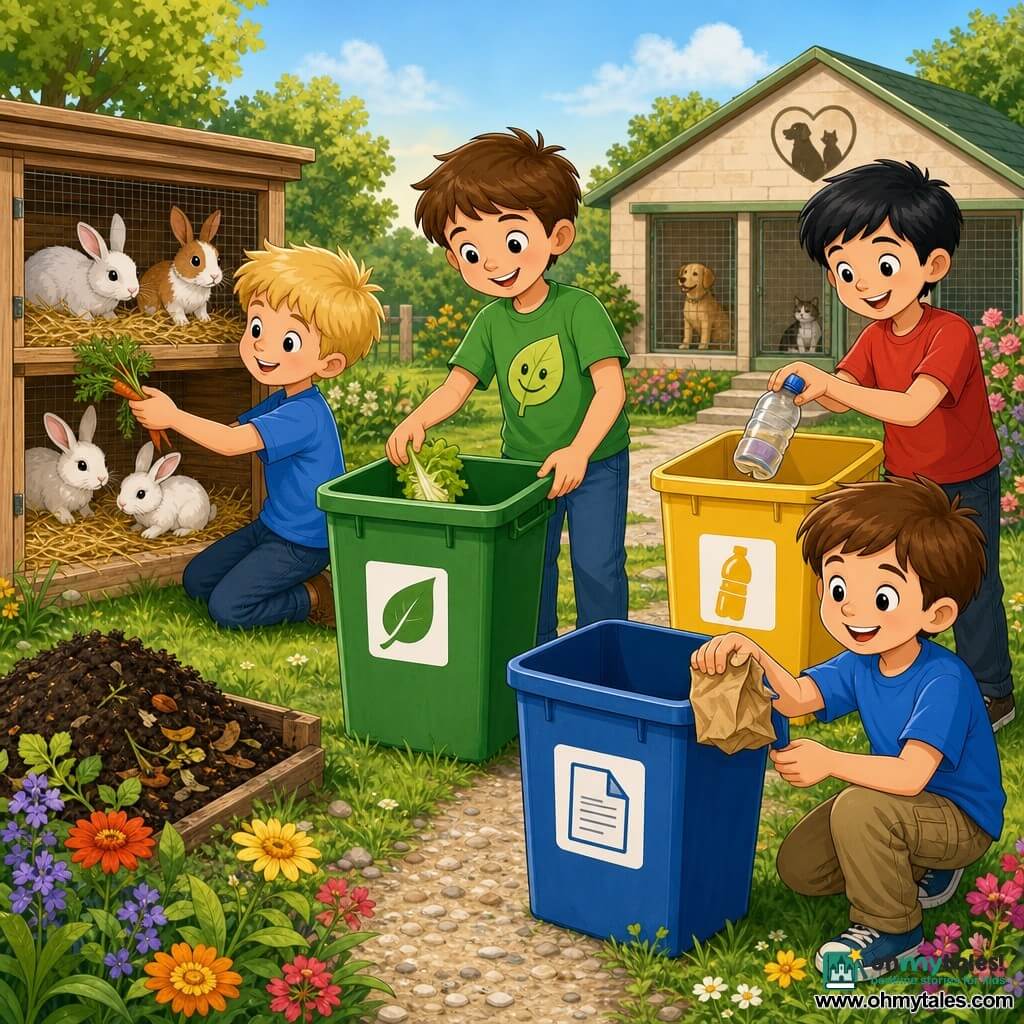
She led them behind the shelter, where three big bins stood, each a different color: green, yellow, and blue.
“These are our sorting bins—can you guess what goes in each?” Mrs. Bloom asked.
Leo's eyes sparkled. He loved puzzles. “Green must be for plants and food scraps,” he said after a moment.
Oscar nodded. “Like apple cores and carrot peels!”
“Blue is for paper and cardboard, right?” guessed Sam, thinking of his school recycling box.
“And yellow?” Max asked, scratching his head.
Mrs. Bloom chuckled. “Yellow is for plastics and cans. All these bins help us recycle and keep the shelter clean.”
Leo stepped closer, curious. “Why do we have to sort things? Isn't it all just trash?”
Mrs. Bloom knelt down. “Not all trash is the same. When we sort it correctly, we can recycle and reuse things. That way, we take care of animals, people, and the planet.”
Leo smiled. “Like giving old things a new life.”
Mrs. Bloom nodded. “Exactly. Now, would you like to help me feed the rabbits and sort the scraps into the right bins?”
The boys cheered, eager to begin.
Chapter 2: Rabbits, Sunshine, and Scraps
The rabbit enclosure was bright and airy, with soft hay and dappled sunlight. The rabbits hopped around, their noses twitching with curiosity. Max, who loved animals, knelt beside a fluffy brown bunny.
“Hello, Mr. Whiskers!” he whispered.
Mrs. Bloom handed out bowls of carrot tops and lettuce leaves. “When you're done, check which bin the leftovers should go in.”
Leo carefully placed fresh lettuce in each pen. He watched as a small white rabbit munched happily, wiggling its ears.
Oscar, holding a bunch of wilted carrot tops, looked at Leo. “So, these go in the green bin, right? Because they're food scraps?”
Leo nodded, feeling proud. “Yes, and it'll turn into compost for the garden.”
Sam walked over, holding a crumpled paper bag. “This must go in the blue bin.”
They each took turns, sorting food scraps into green, paper into blue, and a plastic bag into yellow. The bins clattered as they dropped things in, and the boys giggled.
Mrs. Bloom clapped. “Great job! You're natural recyclers. Every time you sort waste, you help us grow food for the animals and keep the earth clean.”
Leo looked at the bins, imagining seeds sprouting from compost, new paper made from old, and bottles turned into something useful. Everything was connected, like puzzle pieces fitting together.
Chapter 3: Little Steps, Big Changes
After helping with the rabbits, Mrs. Bloom invited the boys to plant flowers by the shelter fence. The sun was warm, and the earth smelled rich and alive. As they dug small holes and tucked in seeds, Oscar asked, “Leo, do you do this at home too?”
Leo nodded. “We have a compost bin. It makes the garden plants grow strong. And we recycle our paper and plastic. It's easy once you get used to it.”
Max leaned on his shovel. “But what if people forget? Does it really matter?”
Mrs. Bloom joined them, her hands covered in soil. “Every little action matters. If everyone helps, the world becomes a better place, one step at a time.”
“I guess it's like a team,” said Sam. “If we all do our part, we can win.”
The boys laughed, feeling proud and hopeful.
Once the flowers were planted, Sam spotted a plastic bottle on the grass. He picked it up and threw it in the yellow bin. “I'm getting the hang of this!”
Mrs. Bloom smiled. “You boys are setting a great example for everyone who visits.”
Leo felt a warm glow in his chest. Maybe small actions really could make a difference.
Chapter 4: A Promise Among Friends
After a picnic lunch of sandwiches and apple slices (with all the peels saved for the green bin, of course), the boys sat on the grass, looking at the shelter's garden.
Oscar lay back and watched the clouds drift by. “I think I'll ask my parents if we can recycle more at home,” he said.
Max grinned. “I'm going to teach my little sister about the bins.”
Sam nodded. “And I'll make signs for our classroom bins, so everyone knows what goes where.”
Leo looked at his friends, feeling proud. He had shared what he knew, and now they wanted to help too.
As the sun dipped lower, Mrs. Bloom gathered the boys for a goodbye.
“You did wonderful work today,” she said. “Not just for the animals, but for the whole planet. Remember, every good habit makes a difference, even if it's small.”
The boys joined hands in a circle.
“Let's promise to take care of the planet together,” Leo said.
“Promise!” the others replied, their voices bright as birdsong.
They laughed and ran down the path, their hearts light and hopeful.
As Leo glanced back at the shelter, the colors of the bins stood out against the green grass: green, blue, yellow. He smiled, knowing that even small hands could help the world grow a little greener every day.