Part 1: The New Words on Her Tongue
Mina was five, and brave in a small-but-strong way, like a button that never pops off. On the first morning of Ramadan, she stood by the kitchen window and watched the street wake up.
The neighborhood was full of friendly sounds. A rolling suitcase clicked over the sidewalk. A bicycle bell sang. The bakery door went ding, and warm bread smell floated out like a soft blanket.
Mina's mom tied Mina's shoelaces into neat bows. “Today is a good day to learn something new,” Mom said.
Mina nodded. She liked new things. New crayons. New songs. New words.
At the corner shop, Mr. Hasan handed Mom a paper bag with dates. Mina saw the shiny brown fruit and thought they looked like tiny sleepy moons.
Mom smiled at Mr. Hasan. “Bon appétit,” she said, because they were talking about food.
Mina's ears perked up. “Bon… ap… pee… tee,” she tried, slowly, tasting the sounds. It felt funny and fancy.
Mr. Hasan chuckled kindly. “That's French,” he said.
Mina looked down at her shoes, then up again, brave as her button-self. “How do I say it in your language?” she asked.
Mr. Hasan said, “In Arabic, people say, ‘Sahtain.' It means something like, ‘To your health.'”
Mina repeated it. “Sah-tayn.” Her mouth made a new shape, like it was learning a tiny dance.
Next, they walked to Mrs. Rossi's small grocery with the bright lemons stacked like sunshine. Mrs. Rossi always smelled like soap and oranges. She leaned over the counter and gave Mina a sticker with a smiling tomato.
Mom bought pasta. Mrs. Rossi waved her hand as if she was brushing the air. “Buon appetito,” she said.
Mina's eyes grew wide. “That sounds like the French one!”
“It's Italian,” Mom said.
Mina tried it, too. “Bwoon… ah-peh-tee-toh.” The words bounced in her cheeks like bubbles.
Outside, the wind carried a whisper of rain. Mina spotted Mrs. Chen watering the little plants by her doorway. Their leaves were shiny and green, like they had been polished.
Mina trotted over, brave and polite. “I'm learning how to say ‘enjoy your meal' in many languages,” she explained, very seriously, as if she was collecting treasures for a museum.
Mrs. Chen smiled. “In Mandarin, you can say, ‘Qǐng màn yòng,'” she said slowly, so Mina could hear each piece.
Mina copied her. “Ching… man… yong.” It sounded like gentle wind chimes.
By the time Mina walked home, her pockets were full of sounds: Bon appétit. Sahtain. Buon appetito. Qǐng màn yòng. They felt like colorful beads on a string inside her head.
In the afternoon, Mina helped Mom carry a bowl of soup to their neighbor, Mrs. Patel, whose baby had been crying all night.
Mina held the bowl with both hands. It was warm, and the steam tickled her nose. “This is for you,” Mina said. “It's… for sharing.”
Mrs. Patel's tired face softened into a smile. “That is very kind,” she said.
Mina walked back home taller than before. Not taller like a giraffe, but taller in her heart.
When the sky began to turn peach and purple, Mom lit a small lantern near the window. The lantern had tiny stars punched into it. Specks of light sprinkled the wall like a secret sky.
“This month is about many things,” Mom said gently. “Patience, gratitude, and generosity. And being together.”
Mina watched the star-specks dance. She did not understand every big word, but she understood the feeling. It felt like a warm room where everyone fit.
That night, Mina fell asleep thinking about all the ways to wish someone joy at the table. Her dreams were full of spoons that sang and bread that glowed.
Part 2: The Stories Under the Table
The next day, Mina carried her “language beads” with her again. She practiced while she brushed her teeth. She practiced while she put socks on the wrong feet, then fixed them.
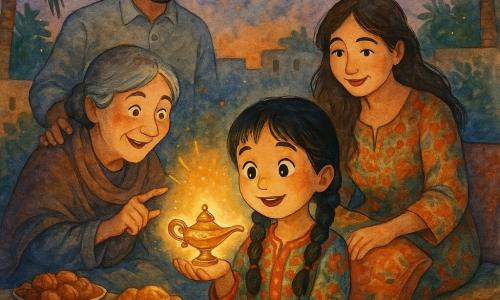
After school, Mom took Mina to visit Grandma. Grandma lived in a flat that smelled like cinnamon and old books. Her hands were soft and wrinkly, like folded paper that had been loved a lot.
On Grandma's table sat a bowl of dates, a jug of water, and a plate covered with a cloth. The cloth had tiny embroidered moons.
Mina climbed onto a chair. “I learned ‘bon appétit' in French,” she announced, proud.
Grandma's eyes twinkled. “Did you now? When I was little, I learned it too,” she said. “From a neighbor who used to share apricot jam.”
Mina leaned forward. “Did you share things in Ramadan when you were little?”
Grandma nodded. “Yes. We shared what we had. Some days it was a lot. Some days it was only a little. But sharing made it feel like plenty.”
Grandma lifted the cloth from the plate. Under it were little pastries shaped like half-moons. They were golden and sprinkled with sugar. Mina's stomach made a small happy hop.
Mina whispered her new words to the pastries, as if they could hear. “Sahtain… Buon appetito… Qǐng màn yòng…”
Grandma laughed softly. “The pastries are blushing.”
Mina giggled, because she could almost imagine it. She looked closely. Maybe the sugar sparkled a bit more.
While Grandma poured tea, Mina slid under the table to find her dropped sticker tomato. Under there, the table legs made a cozy forest. Dust bunnies rested like tiny gray sheep.
Mina found the sticker, but she also saw something else: a small tin box taped beneath the table, hidden like a secret.
Her brave heart thumped. Mina crawled out and pointed. “Grandma, there is a box under your table.”
Grandma looked surprised, then amused. “Ah,” she said. “That old thing. I forgot it was there.”
Mom helped Grandma reach under and pull it out. The tin box was painted blue, with faded flowers. It made a little clink sound when Grandma shook it.
Inside were postcards and photographs, tied with a ribbon. The photos were black-and-white, but the smiles in them looked bright anyway.
Grandma spread them on the table, careful as if they were feathers. Mina saw a picture of a young Grandma, with hair in two braids, holding a tray.
“What's that?” Mina asked.
“A tray for iftar,” Grandma said. “The evening meal. We would bring food to our neighbors. Not only to family. Everyone.”
Mina traced the edge of the photo with one finger. “You look brave,” she said.
Grandma nodded, slow and honest. “I was shy. But I carried the tray anyway. Courage can be quiet.”
Then Grandma showed Mina a postcard with neat writing. “This is from my friend Lucia,” Grandma said. “She moved far away. She wrote me every Ramadan, because she remembered the lanterns and the sweet soup.”
Mina tried to read the loops and lines. “It's like a drawing.”
“In a way, it is,” Grandma said. “A drawing made of words.”
Mina's mind filled with a tiny wonder: stories could travel. They could go over streets, over years, from one hand to another.
At home that evening, Mina asked Mom if they could share something, like Grandma did.
Mom looked pleased. “What would you like to share?”
Mina thought about it. She was only five. She did not have money or a big kitchen. But she had hands, and time, and bright ideas.
“I can share words,” Mina said. “And smiles. And maybe… we can share dates.”
So they washed a bowl and filled it with dates. Mina arranged them in a circle, like a tiny brown flower.
Then Mina drew little cards. On each card she wrote one phrase, with Mom's help:
Bon appétit.
Sahtain.
Buon appetito.
Qǐng màn yòng.
Mina added drawings: a spoon, a star, a moon, and a smiling tomato.
They walked through the building and left a small bowl and a card at three doors. Mina tiptoed as if she was delivering a secret mission.
On the last door, the elevator pinged behind them. Mina jumped, startled.
A tall boy stepped out with a bag of groceries. He looked about eight. His eyebrows were serious, like two small caterpillars.
Mina froze. Then she remembered her brave button-heart.
She held up the card. “This says ‘enjoy your meal' in different languages,” she explained.
The boy's serious face cracked into a grin. “Cool,” he said. “My grandma says ‘bon appétit' all the time.”
Mina felt proud and warm, like a cup of cocoa. Words really were for sharing.
Part 3: Lantern Light and the “See You Tomorrow” Poster
As the days of Ramadan moved along, Mina began to notice little threads connecting people, like invisible ribbon.
Mr. Hasan gave extra dates to a new family who had just moved in.
Mrs. Rossi handed a bag of lemons to Mrs. Patel “for the soup,” she said.
Mrs. Chen taped a small paper moon in her window, and Mina waved at it every morning.
Mina kept collecting tiny stories. Grandma told her about a neighbor who once shared a single orange, cut into careful slices so everyone had a piece. Mom told Mina about a teacher who used to bring warm bread to the school guard at sunset. Even Dad shared a story about getting lost as a kid and being guided home by the smell of someone's cooking.
Mina listened and held these stories like soft stones in her pocket.
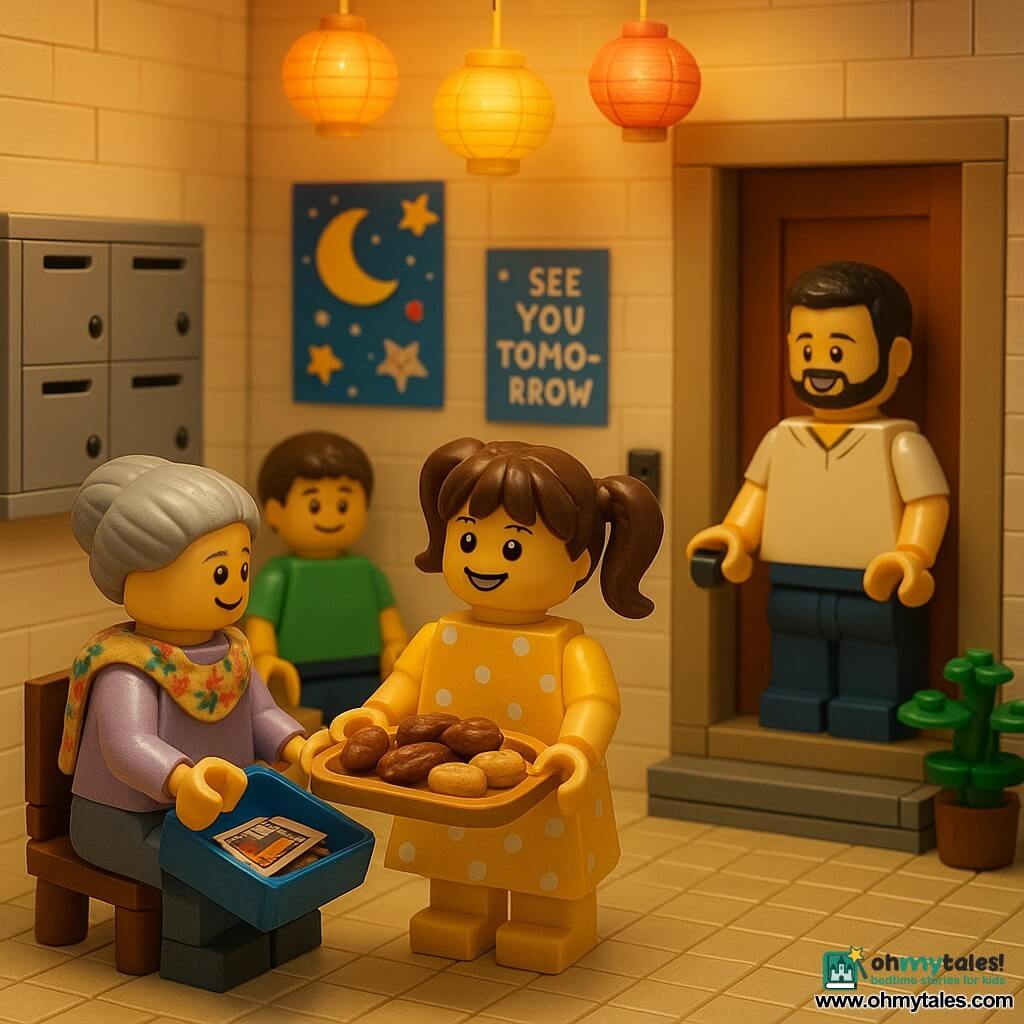
One evening, Mom and Mina prepared a simple tray: soup, bread, and a few pastries from Grandma. Mina carried the tray with both hands, just like the photo. The tray felt heavy, but her courage felt stronger.
They brought it to the new family down the hall. Their door had no decorations yet, only a small welcome mat.
Mina set the tray down and placed a card on top. This time, Mom had helped her write one more phrase: “Bon appétit” and “Sahtain” on the same line, like two friends holding hands.
The door opened. A woman with kind eyes thanked them. A little boy peeked from behind her leg, curious.
Mina smiled at him. She did not say much, because sometimes kindness does not need many words. But she pointed to the drawings on the card.
The boy's face lit up. He pointed back at the moon drawing and made a small “ooo” sound, like he had found treasure.
Walking back, Mina's feet felt bouncy. The hallway lights looked softer than usual. Even the elevator seemed nicer, as if it was humming a gentle song.
At home, Mom set out the evening meal. The lantern by the window sprinkled stars on the wall again. Mina sat at the table and looked at the specks of light.
She thought of Grandma's tin box. She thought of postcards traveling far. She thought of trays carried by shy people who were brave anyway.
After they ate, Mina asked for paper and markers.
Mom raised an eyebrow. “A new project?”
“A very important one,” Mina said.
Mina drew a big poster. At the top she drew a smiling moon wearing a tiny hat. Under it she drew a table with many plates, and above the plates she drew little speech bubbles with her favorite words.
Then, in the middle, she wrote carefully, with Mom helping her spell: “SEE YOU TOMORROW.”
Mina added sparkles and stars and a tomato sticker in the corner, because the tomato had been with her from the beginning.
They taped the poster on the building's notice board near the entrance, where everyone passed. Mina stood back and looked at it.
The words felt like a soft promise. Not a loud promise, not a bossy one. Just a gentle one.
People came by and smiled at the moon in the tiny hat. Mr. Hasan read the words and nodded. Mrs. Rossi chuckled at the tomato sticker. Mrs. Chen tilted her head and traced the stars with her eyes. The serious-eyebrow boy gave Mina a quick thumbs-up as he walked past.
Mina's cheeks warmed. She had shared something that could not spill and could not break. She had shared welcome.
That night, Mina fell asleep feeling steady and safe. Ramadan was still moving forward, day by day, like a calm river. Mina did not have to understand everything at once.
She only had to keep learning, keep noticing, and keep sharing.
And on the wall of her mind, she could see it clearly, like a lantern's glow:
“See you tomorrow.”