Part One: The Nomad Camp and the Dream of Leaves
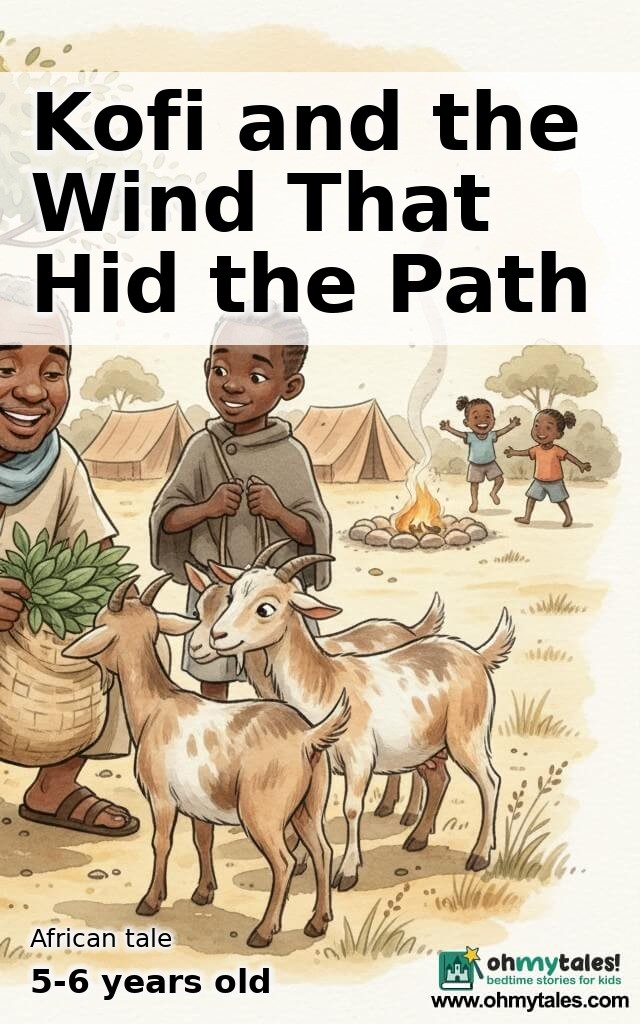
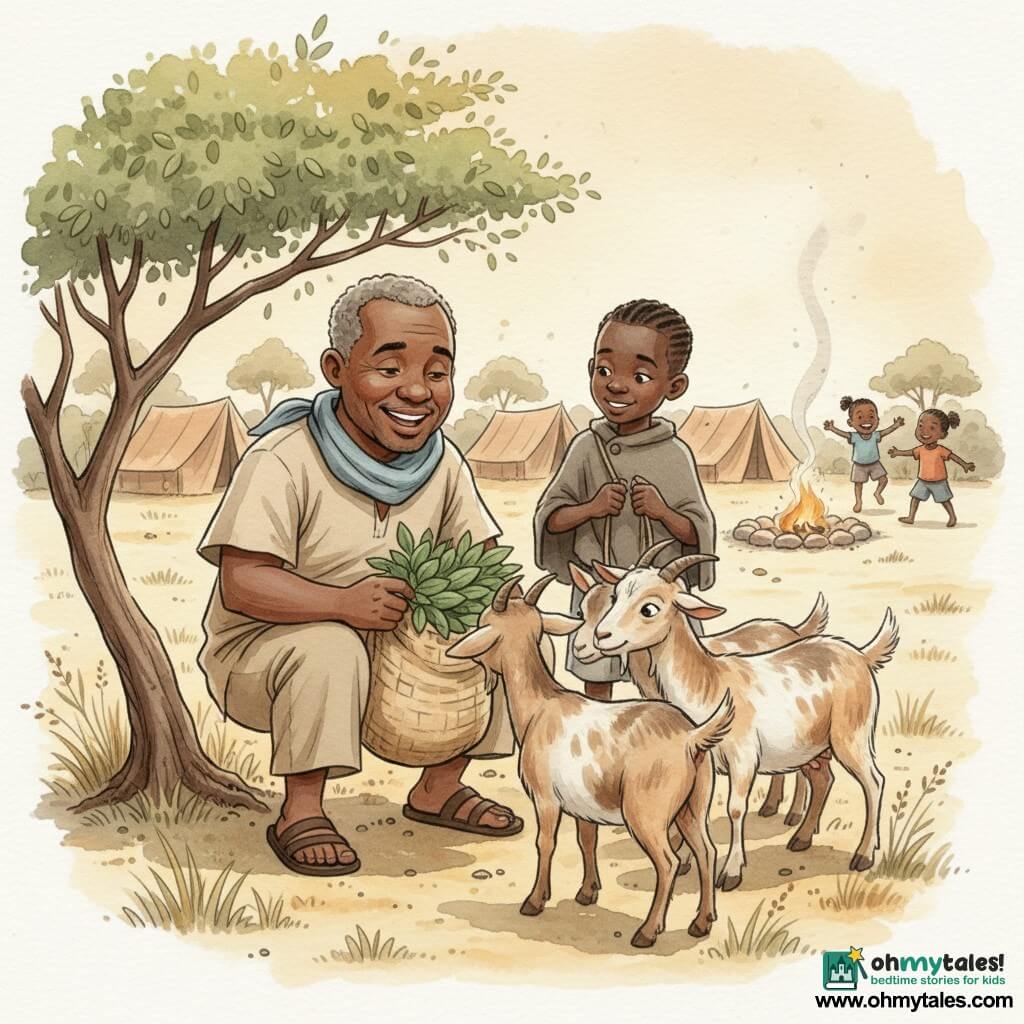
In the wide land where the sun walks proudly and the wind speaks in soft drums, there was a nomad camp stitched together from cloth, rope, and patience. The tents sat like sleepy camels around a small fire circle. Cooking pots shone like dark moons. Water skins hung like heavy fruits. And everywhere, the sand lay smooth as a calabash bowl, waiting to be filled with footsteps.
Among the people lived a man named Kofi. He was not a chief, not a hunter of lions, not a famous singer. But Kofi had a bright dream, a dream as clear as morning: he wanted to pick leaves for herbal tea.
Not just any leaves. Leaves from the far acacia trees, the kind that smelled of clean rain even in the dry season. In the evening, elders would steep such leaves in hot water, and the steam would rise like a gentle spirit. The tea warmed bellies, softened coughs, and made tired hearts feel less heavy. Kofi had tasted it once, and the taste had stayed on his tongue like a good story.
So Kofi said to himself, again and again, as if the words were a song: “Leaves for tea, leaves for calm, leaves for care.”
The camp was preparing to move soon. Nomads move the way rivers move—quietly, surely, not because they are chased, but because life has legs. Before the next journey, Kofi wished to bring a bundle of leaves, tied neatly, like a gift wrapped in green.
At dawn, the sky was painted with pale pink, like a shy smile. Kofi took a small woven bag and a short knife. He also took a gourd of water. The elders had taught him: “Measure your steps, measure your wants, measure your hands. Too much breaks the basket.”
Kofi nodded when he remembered. He nodded, but his excitement bounced inside him like a lively goat.
He walked beyond the last tent. The camp behind him grew small, like a seed in the sand. In front of him, the land opened wide. Tall grass whispered. A few thorn trees stood like watchmen. Somewhere, a bird called out, repeating its own name, as if practicing.
Kofi followed an old path. It was not a road made of stones. It was a road made of memory. It curved and curled, and in places it nearly disappeared. But Kofi believed in it. He believed in paths the way children believe in lullabies.
Soon he saw the acacia grove. The trees lifted their arms and shook their leaves in the wind. The leaves were small, many, and bright, like tiny green coins. Kofi's eyes shone.
He began to pick.
He picked gently at first, leaf by leaf, like counting beads. He filled the bottom of his woven bag. The leaves smelled sharp and sweet. The smell made him feel wise already, as if he carried a little bit of elderhood.
But then his excitement grew bigger than his measure.
He looked up and saw more trees. “More leaves, more tea,” he thought. He imagined many cups, many smiles. He imagined the whole camp saying, “Ah, Kofi has brought comfort.”
His hands moved faster. His bag grew heavier. He climbed onto a low branch to reach higher leaves. The acacia tree did not complain, but it did bend a little, like a grandmother who is tired.
Kofi did not notice the bending. He noticed only the leaves.
And so, as the sun climbed, Kofi climbed too—into wanting, into rushing, into forgetting the elder's words.
Part Two: The Wind's Lesson and the Little Twist
When Kofi's bag was almost full, the wind changed its voice. It stopped singing softly and began to hum low, like a drum that warns.
A thin cloud slid across the sun. The light turned dull, like a calabash covered with ash. Kofi felt a shiver, though the day was warm.
He looked down. The ground beneath the tree was not as smooth as before. The sand had begun to shift. Small lines ran across it, like snakes drawn by an invisible finger. The wind was teaching the sand to dance.
Kofi remembered the camp. He remembered the elders. He remembered the moving day that would come soon. He decided it was time to go.
He stepped down from the branch. The bag tugged at his shoulder. It was heavier than he expected, heavy like a secret. He walked back toward the path.
But the path, that road made of memory, had changed its face.
The wind had brushed it. The wind had swept it. The wind had made it shy.
Kofi stopped. He turned his head left, then right. The grass moved. The thorn trees stood still. The sky was wide and calm again, as if nothing had happened. Yet the path looked like plain sand.
Kofi felt his excitement turn into a small worry. Worry is a tiny ant, but it can bite the heart.
He took a sip from his gourd. He tried to think carefully. The elders always said, “When the world becomes confusing, slow your feet. Measure your breath.”
So Kofi slowed. He looked for signs: a stone shaped like a goat's ear, a bush leaning like an old man, a patch of ground darker than the rest. He saw many things, but he did not know which ones were friends and which ones were strangers.
Then came a small twist, the kind that makes a tale lean forward.
Kofi heard a faint bell sound—ting-ting, ting-ting—soft as laughter. He walked toward it and found a small herd of goats grazing near a low hill. The goats belonged to a young herder, a boy who was watching the sky more than the ground.
Kofi did not speak much. He did not want to fill the air with panic. Instead, he lifted his bag a little and let the leaves' smell drift out. The smell was strong, like a green promise.
The goats noticed. Goats are curious. They trotted closer, noses twitching, ears wiggling. They began to follow Kofi, not because they loved him, but because they loved the idea of eating what he carried.
Kofi smiled, even in worry. “Ah,” he thought, “even trouble can bring a small joke.”
He walked slowly, letting the goats trail behind like a fuzzy tail. He watched their hooves. Goats know the land the way a pot knows fire. They step where it is safe. They step where people often step. Their feet remember paths even when sand forgets.
Kofi followed the goats' careful choices. He noticed that they angled toward a line of familiar bushes. He recognized one bush with a broken branch, shaped like a pointing finger. His heart lifted.
Soon, he saw far off the pale shapes of tents, low as shells on a beach. Smoke curled up in a thin ribbon, waving hello.
Kofi's worry softened. His steps became lighter. He thanked the quiet lesson of the goats and the steady lesson of slowing down.
Yet his bag still pulled at his shoulder. And the goats still followed, more eager now. Their noses pushed closer. One goat tried to nibble at the bag.
Kofi shooed it gently. But the goat was bold. Another goat joined. The herd gathered, a circle of hungry curiosity.
Kofi understood then: he had picked too much. Too much leaf, too much smell, too much temptation. He had made his own burden, and he had invited trouble to walk with him.
He stopped under a thorn tree and sat on the ground.
He opened the bag and looked inside. The leaves were many. They were beautiful. But they were more than he could carry safely, more than he could guard from eager mouths, more than he needed.
He began to remove some leaves and spread them on the sand, making a small green pile. The goats leaned in, but Kofi lifted his hand slowly, not in anger, but in calm. He allowed them a little, just a little.
The goats ate, crunch-crunch, happy and noisy. Kofi watched and measured. He let them have enough to satisfy their noses, not so much that his gift would vanish. He kept a neat bundle for the camp, tied with a strip of cloth.
The herd settled. Their hunger became quiet. Their bell sound turned gentle again.
Kofi stood, his bag now lighter, his shoulder grateful. And he continued toward the camp with steadier steps.
Part Three: Tea Steam, Gentle Pride, and the Erased Trace
When Kofi reached the nomad camp, the sun was leaning west, resting on its invisible elbow. People were busy. Some rolled sleeping mats. Some tied ropes. Some checked water skins. Children ran in looping circles, like little winds of their own.
Kofi walked to the fire circle and placed his bundle of leaves beside the pot. The leaves looked fresh and clean, like they had been washed by the sky.
An elder woman noticed. Her eyes, small and bright, crinkled like dried leaves in a friendly way. She touched the bundle and nodded. In that nod was a whole sentence: You did well, and you learned.
Later, when the water warmed, the leaves were steeped. The steam rose, curling and twirling, like a pale storyteller dancing above the pot. The smell floated through the camp, and people breathed it in. It smelled of shade, of careful hands, of a good return.
Kofi sat near the fire. He felt a warm pride, but not the proud pride that swells like a drum too tight. He felt the proud pride that sits like a calm stone in the palm—steady, useful, not noisy.
He remembered the moment he had wanted to pick and pick and pick. He remembered the path that disappeared. He remembered the goats, the funny followers with their hungry noses. He remembered how he had stopped and chosen measure.
The elders said, not in a lecture but in a rhythm, the way a griot folds wisdom into the day: “A basket that is too full tears. A mouth that is too full chokes. A heart that is too full forgets to see.”
Kofi listened. He did not need many words. The lesson had already walked inside him.
The next morning, the camp moved. Tents folded like big cloth birds. Ropes coiled like sleeping snakes. Loads were balanced on backs and carts. The people set off in a long line, a living necklace across the land.
Kofi walked with them. He carried water. He carried small tools. He carried, most of all, a lighter kind of knowing.
As the day warmed, the wind rose again. It blew across the sand with soft, brushing hands. It smoothed the ground. It erased sharp edges. It whispered, hush-hush-hush, like a mother soothing a child.
Kofi looked back once.
Behind the traveling camp, there were tracks at first—footprints, hoofprints, the mark of a dragged branch, the print of a wheel. They showed where everyone had been, like writing on the earth.
But the wind kept working. It swept and swept, a patient broom. It rubbed the marks until they faded. The line of the journey grew faint, then fainter, then almost gone.
Soon, the trace was erased.
The sand looked new again, as if no one had passed.
Kofi felt a small mystery in that, a friendly one. The land did not hold tight to the past. It let go. It made space for the next step, the next story.
And Kofi understood, as clearly as he understood the smell of tea: it is good to dream, good to gather, good to bring comfort. But it is also good to stop before “more” becomes “too much.”
Measure makes the journey gentle. Measure makes the gift sweeter. Measure makes the heart light enough to follow the path—even when the path tries to hide.
So the nomad camp moved on under the wide, watching sky, and Kofi walked with steady feet, carrying his dream the right way: not overflowing, not empty, but just enough.