Chapter One: The Little Bear and the Sparkling Idea
Winter had wrapped the whole valley in a soft white blanket. Snowflakes danced like tiny stars as they fell, and every roof wore a hat of snow. In a small cottage by the silver river lived a gentle bear named Bram. Bram was not a noisy bear; he was the kind who hummed under his breath and left little paw prints by the kettle. He loved warm tea, knitted mittens, and the way the moon looked like a button on a dark coat.
One flurry-spark morning, while Bram decorated a tiny tree with popcorn and paper stars, he thought of something new. He wanted to make a game—no, a gentle game of memories—to play with his friends at Christmas. "A game of memories," he said aloud, testing the words. "A game that collects small lights of what we've done, like catching tiny fireflies of the heart."
The idea felt like a warm wink. Bram imagined friends sitting in a circle, sharing soft stories and smiling at the same kind recollections. He wanted it to be curious and kind, a way to discover small surprises about each other. He would call it the Memory Game—not too flashy, just a ribbon of recollection tied with laughter.
He began to prepare. He wrote little tickets from thick, cream paper and tied them with red thread. On each ticket he glued a seed of lavender or a crumb of gingerbread. He whispered a tiny wish into every ribbon: "May this memory be bright and gentle." Then he placed the tickets in a wooden hat on the table, near the tree, where the twinkle lights blinked like tiny lighthouse eyes.
Chapter Two: Visitors with Mittens and Mirth
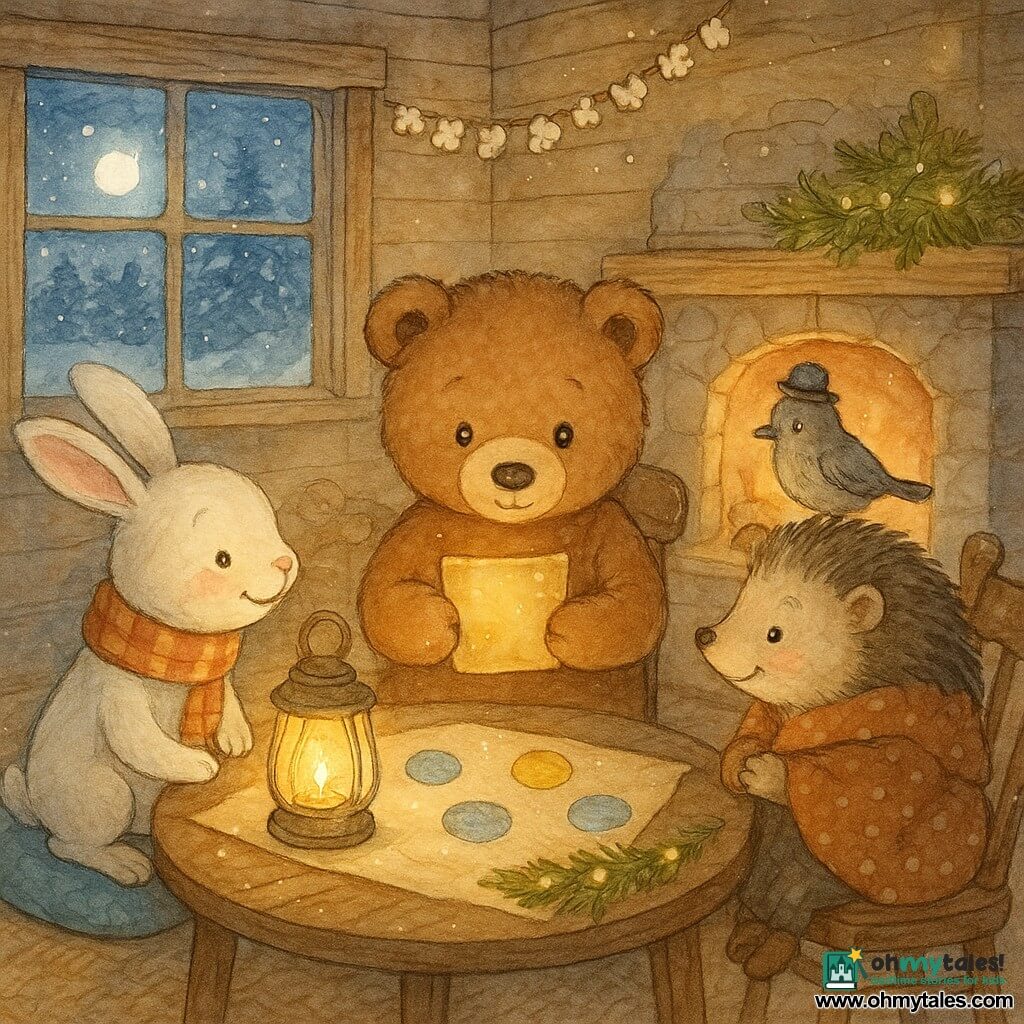
On the eve of the game, Bram knocked three times on his own wooden floor—this was his polite way of saying, "Come in, world." One by one, friends arrived: Poppy the rabbit with a carrot scarf, Mr. Finch who had a tiny hat on one wing, and old Mrs. Hedge, who smelled of warm berries and carried a basket of spiced buns. Each friend exchanged warm hugs and mittens and took a seat around Bram's glowing fire.
"You are sure this will be a game?" asked Poppy, bouncing a little.
"It is a game of memory," Bram said softly, passing the hat. "We each draw a ticket, read it, and tell a small memory that it asks for. But not a heavy memory—only the kind that fits on a mitten."
They all laughed, and contentment settled like a cat in Bram's lap. When Mr. Finch drew his ticket, it asked for "a sound that makes you smile." He thought, then fluttered his wings and said, "The sound of my grandmother's kettle whistling on a snowy morning. It told me the day was safe." Poppy giggled as she recalled a memory of sliding down a hill and landing in a cabbage patch with a hero's pride. Each tale was like a little lantern opening.
Bram watched his friends glow with the telling. The game felt like knitting stories into a warm blanket. They learned things that surprised them—a shy secret about Mrs. Hedge's first garden, a tiny dance Mr. Finch had done on a rooftop, Poppy's fear of puddles that she had turned into a puddle-conquering ballet. Curiosity hummed among them, light and sweet, as each friend leaned closer to hear the next small treasure.
At one point, Bram's paws trembled. He had placed a special golden ticket in the hat but had not yet drawn it. The golden one asked for "a memory you have kept like a little snowflake." Bram touched it with care. He did not like to be the centre of attention, but his heart wanted to share. "I will draw it last," he decided, smiling like the moon hiding behind a cloud.
Chapter Three: The Map of Tiny Wonders
After several rounds, Mrs. Hedge brought out a dusty map. It was not a map of places but of feelings—little dots stitched with invisible thread. "I thought," she said with a wink, "that perhaps we could make our own map. Every memory we tell places a dot. At the end, we can see all the dots together."
They spread the map on the table, and each memory added a dot with a color: blue for quiet joys, yellow for surprises, green for learned things, and silver for secrets kept with love. Bram's heart hummed as dots multiplied like constellations of small, personal stars.
As they placed dots, the game changed. It was still gentle, but it became a curious hunt. Poppy wanted to know where Mr. Finch's blue dot came from; Mr. Finch wanted to see the secret that made Poppy giggle so much. Friendships felt like lanterns being passed along, and curiosity led each of them to listen with wide, kind ears.
When Bram finally reached for the golden ticket, he cleared his throat like a little drum. He read, "a memory you have kept like a little snowflake." He closed his eyes and pictured a very small, very bright moment: a night when, as a cub, he had sat on a windowsill watching his father tuck a star into the stocking. He remembered the careful hands, the hush of the house, and the way the star seemed to hum. Bram had kept that memory wrapped in a small piece of wool all his life.
"I was small," Bram said. "I thought the star was magic because it made my father smile. I wanted to keep that smile safe, so I wrapped it in a memory like a snowflake—delicate and quiet."
His friends listened with wide eyes. A hush fell like powdered sugar. Mrs. Hedge placed a silver dot on the map, and the glow of the fireplace felt like a warm promise. Curiosity had not only made them laugh; it had made them tender.
Chapter Four: The Little Surprises under the Tree
As the night got deeper, Bram suggested one more part to the game: a treasure-finding walk in the garden. Outside, the snow had turned the world into a hush-park where even the footprints seemed polite. They wrapped in mufflers and mittens and went out, carrying lanterns that smelled faintly of cinnamon.
The garden was a place of small wonders. They found icicles that looked like crystal pencils, and a berry bush wearing a dusting of white. Poppy found a mitten stuck in a snowdrift, which turned out to belong to Mrs. Hedge's granddaughter. Mr. Finch found a bell with a soft tinkle, and he said, "This sounds like a memory I have not yet met." Bram found something small and round tucked under a holly leaf—a marble of blue glass that held a tiny swirl like a distant winter sky.
"Let's leave a secret gift where it belongs," Bram whispered. "A memory can travel home."
So each of them left a small offering: a warm bun under the oak for a fox who sometimes watched them from afar, a ribbon around the birdhouse, and the blue marble on the highest step of the garden fence, where the moon could see it. These were not grand treasures, but they were chosen with the careful hands of people who understood the value of small, bright things.
On the way back, Bram thought of the map inside. It had turned into a chart of their hearts, full of tiny different lights. They followed their footprints, which glowed faintly in the lantern light, like a secret road telling them where they'd been and where they could go.
Chapter Five: The Soft Staircase Home
Back in the cottage, with mittens warm and cheeks the color of rosy apples, they sat by the twinkling tree and looked at the map. The dots seemed to hum, and Bram felt like a careful gardener who had planted little seeds of curiosity and watched them bloom.
"Tonight," said Mrs. Hedge, "we played a gentle game and found out small things that make us bright. I think curiosity is a little Christmas light. It shows us what we didn't know was lovely."
They agreed, and Bram felt a glow that was quieter than a bonfire but deeper than a single candle. He had wanted to make a game of memories to bring friends together, and it had done just that. Laughter and soft stories rose and fell, like a lullaby.
When it was time to go, friends hugged and promised to return soon. Poppy hopped out, Mr. Finch flew to his nest, and Mrs. Hedge put on her berry-scented muffler. Bram tidied the table and placed the map carefully in a drawer, like a secret that might be opened again another Christmas.
Then Bram climbed the little staircase to his bedroom. The stairs were narrow and wooden, each one creaking a tiny complaint whenever someone trod upon it. Bram loved those creaks; they were the house's way of telling its stories. But tonight, as he stepped, something gentle had happened to the house. The magic of shared memories, the careful leaving of small surprises, and the quiet of a winter night had somehow wrapped the stairs in a soft hush.
Bram walked up, his paws light, and the stairs did not creak. They seemed to sigh with satisfaction instead. He reached the top, placed the blue marble on his windowsill where the moon could keep watch, and slipped under his quilt. Through the window, the stars looked like paper confetti.
As the house breathed quietly around him and the map sat snug in the drawer, Bram whispered, "Good night." The gentle hush at the top of the stairs felt like the last note of a lullaby—soft, content, and very kind. In the morning there would be new small things to discover, but for now, Bram closed his eyes, held a memory like a tiny sparkling flake, and listened to an old friend at the heart of the house: an staircase without sound.