The Wish in the Morning Mist
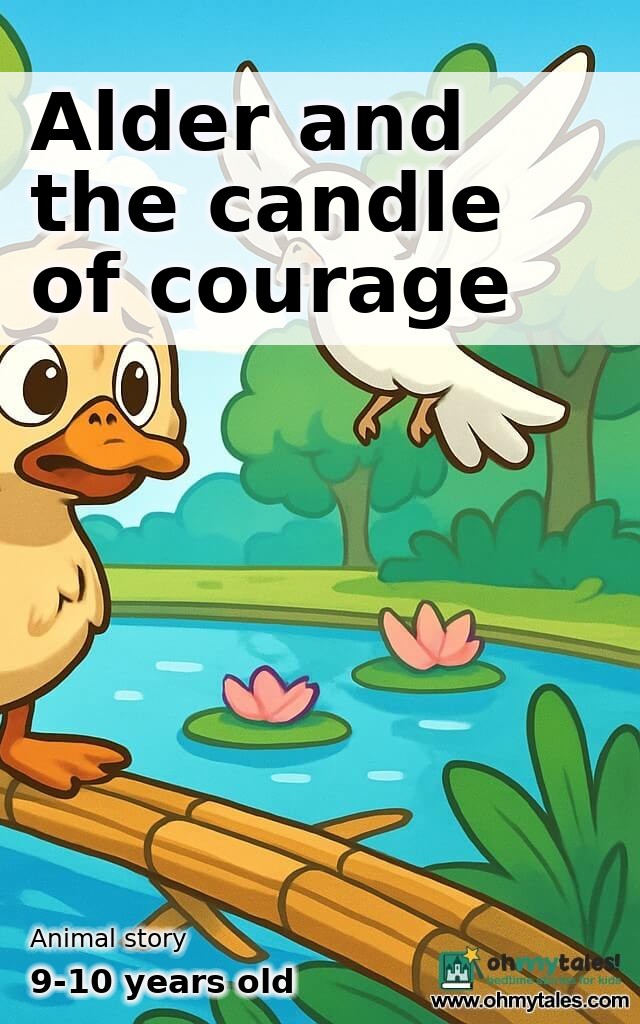
Alder the duck lived at the edge of the Willowmere, a pond that hummed like a soft harp when the wind brushed its surface. He had feathers the colour of old parchment and eyes that shone with the careful light of someone who had lived many quiet seasons. Everyone in the marsh came to Alder for advice. Frogs asked him where the ripest lily pads would bloom, snails asked him when the rain would fall, and the young sparrows sat on his back to hear stories of the stars. Wisdom sat like a warm cloak on his broad shoulders, but there was a small hollow in Alder's heart—a hollow that whispered at dawn.
“I wish I could learn courage,” he told the dawn one morning, watching the mist lift like a pale curtain. “Wisdom is a map, but courage is the feet that walk the path.”
The morning answered with nothing but the gentle ripple of reeds. Alder had seen courage many times—he'd watched the heron stand like a spear in the cold dusk, the otter plunge into icy currents for a shining fish, and the field mice edge along the barn roof when the moon leaned down. Yet when he thought of doing something brave himself, his wings trembled inside him like a bell that would not ring.
A soft flutter came from above. A dove descended with the ease of a paper boat drifting on a slow stream. Her feathers were the colour of moonlight; her name, embroidered upon the breeze once she had introduced herself, was Colombe.
“You speak to the morning as if it will teach you to be bold,” she said, perching on a reed beside him. Her voice was as gentle as spilled milk, but it carried a steel undertone—a hint of winds that had flown over distant hills. “One cannot borrow courage from the dawn. One must grow it.”
Alder blinked. “And how does one grow courage?” he asked.
Colombe tilted her head. “Will you come with me to the Hill of Quiet? There the Mirror Lake shows what the heart already knows. But to get there, you must follow the reed road through the reed-wind and past where shadows play tricks. I do not go alone. I go with friends.”
And so, with the soft sound of water humming around their feet and the marsh stretching like an embroidered blanket, Alder and Colombe set a small plan: they would travel together. The wish that had been a hollow now felt like a seed pressing in the dark soil of Alder's chest.
The Crossing of the Silver Reeds
The path out of Willowmere unrolled like a pale ribbon through the reeds. Under the reeds, wheel-track beetles scuffed little arcs. Dragonflies cut the air into tiny knives of blue and green. Colombe flew just above the reed-tops, while Alder waddled carefully, feeling the earth and water beneath his webbed feet.
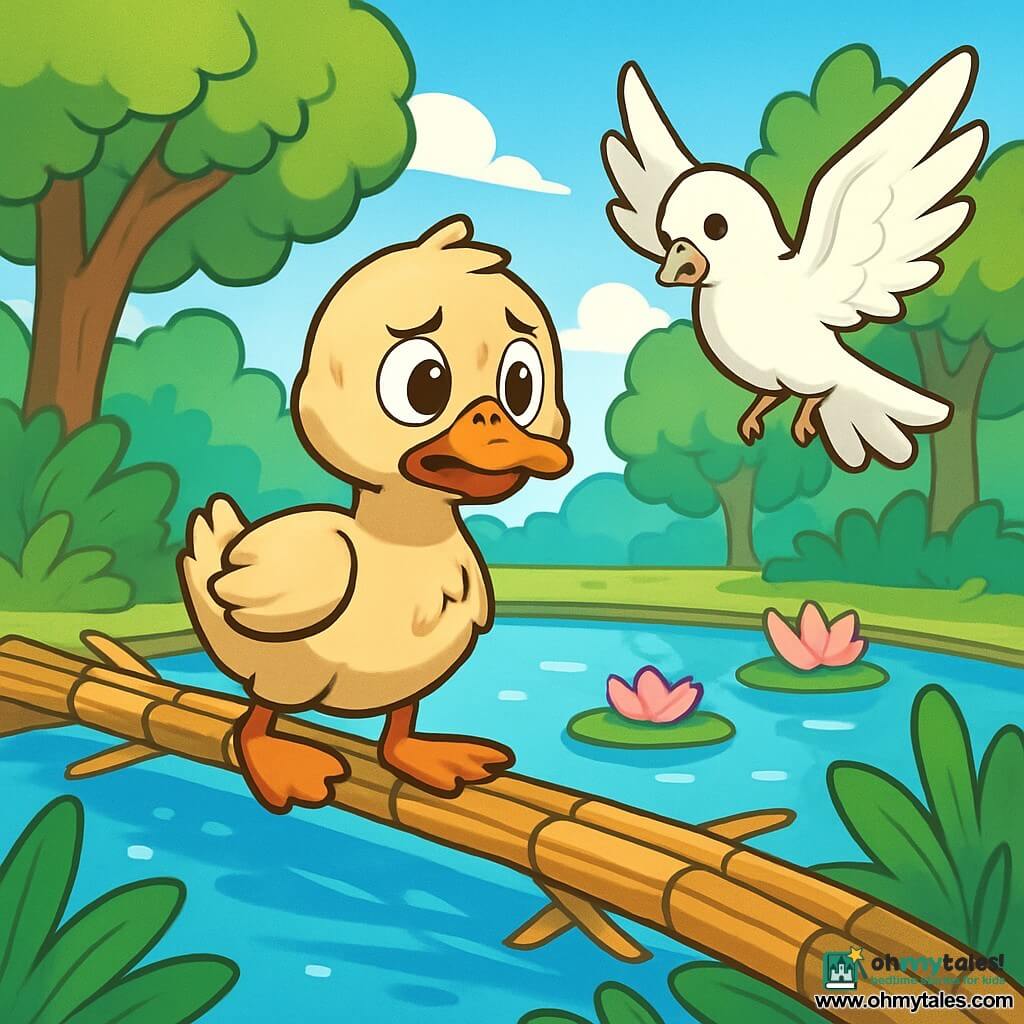
They reached a place where the water split and the reeds bowed like an audience. A bridge of silver reeds crossed the stream, thin and trembling. The water below sang of quick currents and hidden stones. Alder peered at the bridge and felt the old cold in his chest—the cold of uncertain steps.
“It looks fragile,” he said.
“It looks like a promise,” Colombe corrected. “Bridges are made of footsteps, not of wood.”
Alder put one foot on the reed. It bent with his weight, whispering. He remembered every time he had stepped forward in life: leading the ducklings across a busy path, finding the warmest mud for the winter, speaking to the sparrows when they quarreled. Each small action had been like a nail hammered into some invisible beam. Now, with his heart like a drum, he placed his second foot.
Halfway across, the wind lifted and the bridge swayed. Alder felt the reed wobble, and his breath caught in his throat like a trapped bird. He wanted to retreat, to crawl back to the safety of the bank. Colombe dipped down to him, brushing his ear with a wing.
“Think of each step as a feather,” she said. “Feathers do not argue with the wind. They fly.”
Alder breathed. He imagined his steps as feathers, light and part of something that flowed. He moved forward. The reeds shivered and sighed, but they held. When he reached the other side, he felt his heart do something he had only felt at the end of a good story: a pleased, small thrill.
On the far bank, a willow whispered that the crossing had been brave. Alder smiled at Colombe. “It was not a grand thing,” he said. “Just…a step.”
“Grandness hides in little things,” Colombe replied. “We will meet greater winds soon, Alder. Will you trust me when they come?”
“I will try,” he said. The word was a small knot of bright thread.
The Night of the Fox's Riddle
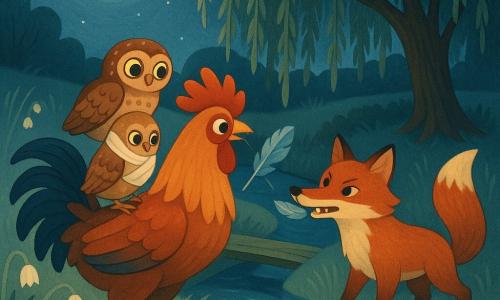
They camped beneath an elder tree whose leaves smelled like stories. The moon hung like a white coin, and the stars were a scattering of pinpricks in navy velvet. As they shared a supper of waterlily bulbs and toasted seeds, a rustle in the brush sharpened the air. From the shadows stepped a fox—red as fallen autumn, eyes clever and thin.
“You two are a curious pair,” the fox said, voice like a sly violin. “A duck who wishes to be bold and a dove called Colombe. The Night Court will be interested.”
“We travel to the Hill of Quiet,” said Colombe. Her feathers fluttered in a way that said she did not fear being seen.
“Ah,” replied the fox, licking his lips. “The Hill of Quiet. Many come seeking courage there, only to find reflections that mock them. Tell me, Alder the wise—why should courage choose you?”
Alder felt the old hush at the edge of his thoughts. When someone asked him such a direct thing, all the small doubts lined up like geese. He could have let the fox's words curve into fear. Instead, he remembered the reed-step and Colombe's bright thread of trust.
“I want courage because I want to help when it matters,” Alder said. His voice wavered but stayed. “I want to be someone others can lean on, like the willow leans on earth.”
The fox circled them, whiskers twitching. “How noble. But courage is not just kind words. It is action and risk.” He reached down, picked up a smooth river pebble in his mouth and put it at Alder's feet. “This is my riddle. Take the pebble across the bramble field, to the other side, and place it upon the old stump. If you refuse, the pebble returns to me, and the Night Court will laugh. If you succeed, I will give you a clue.”
Alder looked at the bramble field. Thorns like tiny spears jutted up, catching the moonlight. The path through them was narrow and jagged. His first thought was to refuse, to duck behind the willow where the moss made a comfortable bed. But the wish in his chest had become a small tree. It did not want to bend and break. It wanted to grow.
“Will you stay with me?” he asked Colombe.
“Always,” she said, and she fluttered down so her shadow touched his.
They moved toward the brambles. The thorns tugged at their feathers and fur and skin. Colombe darted with quick strokes, guiding Alder to softer gaps. When a thorn snagged on Alderswing he flapped, and a thorn pricked his webbed foot. Pain, sharp and sudden, filled him like a cold cup. He wanted to call out, to stop. But he thought of the pebbles he had already carried in life—small, useful things—and he remembered the bridge of reeds. The harshness of the thorn taught him to choose his steps with care.
“Trust me,” Colombe whispered when Alder faltered. “I see the path between the thorns.”
Alder trusted her. He felt how trust is like a warm band around the heart—soft, but holding. Guided by her eyes and the tilt of her wing, he placed the pebble upon the stump. The fox watched, his grin like a crooked sunrise. He picked up the pebble and, much to Alder's surprise, placed it in its mouth, but did not run away.
“Alder,” the fox said softly, surprising them both. “You did this not because you are without fear, but because you were willing to move through it. That is a kind of courage.”
Alder felt the words sink like gentle rain. The fox bowed slightly, a fox's bow, and with a flick of his tail melted back into the night. They had not fought dragons or climbed towers, but the riddle had given Alder the knowledge that courage and fear could walk together, and that trust can lead through sharp places.
The Long Wind to the Mirror Lake
When dawn came, the sky was a sheet of pale silk. The path up the Hill of Quiet coiled like a sleeping snake. It rose and rose, and the air grew thin and tasted of distant seas. The wind here had a voice that tugged on feathers and asked questions of bones. Alder looked up and felt the old fear—this climb felt like someone asking him to jump into the sky.
“You do not have to fly, Alder,” Colombe said kindly. “Bravery wears many hats. What hat do you choose?”
Alder thought of his wise friends in the marsh, of the reed bridge, and of the thorn that pricked like a tiny bell. He chose neither the hat nor the no-hat—he chose to go forward, foot by quiet foot.
The wind pressed against them like a hand. At one point, a gust tried to lift Colombe and send her spinning like a leaf. Alder, who was heavier than his wings, felt the wind push his feathers backward and his beak to the cold sky. He could have stopped, turned back, but he saw a babe of a cloud trying to hide behind a hill and he thought, I will not let the sky hold me still.
“Hold on to what is true,” Colombe cried over the noise. “Your heart, your steps, the friends who walk with you.”
They climbed until they reached a crown of stones. Below, the world looked like a patchwork quilt: the marsh a green square, the hedgerows a stitch, the pond a silver button. At the center, there lay Mirror Lake—a small pool of water so smooth it did not know it was water. It held the sky like a secret.
Alder had imagined a test of great deeds, but the lake's trial was softer and stranger. He approached and saw himself not as the duck everyone asked advice from, but as a layered creature of doubts and small glories. In the water, his reflection looked back, and in its eyes Alder saw the thin bright thread of courage he had been stitching. He saw Colombe behind him, and the fox's sly grin as a lesson, and the step across the reeds.
“Why do you look like a small candle?” he asked his reflection, feeling foolish.
“Because you are a flame made of many tiny lights,” said Colombe, who had come to stand beside him. She spoke to the water as if it were an old friend. “Courage is never a roaring bonfire at first. It begins as a candle, and each kind act adds wax.”
Alder watched the candle-flame in the water. In the lake's depth he saw not only himself but the faces of those he loved—the sparrows who listened to his stories, the otters who tumbled like laughter, the willow who had watched him across countless seasons. A gentle understanding passed over him, like a shawl warmed by the sun.
“You have learned to trust small steps,” said a voice, which might have been the lake itself or the hush of the hill. “Now learn to act when the heart calls.”
Alder realized that courage would return for him when it was needed. It was not a thing to be fetched and kept on a shelf; it was like spring continuing each time a seed pushes up.
He dipped his beak in the water, tasted the cool truth, and felt the hush inside him change into a steady drum. He would not be a fearless storm, but he would be a steady presence when others needed steadiness.
The Morning of Peace
They descended the hill softly, as if walking down a slow song. The marsh welcomed them with the smell of wet earth and the soft chorus of waking birds. Alder felt lighter, not because fear had left him, but because it had a place on his path now and did not command his steps.
When they returned, the creatures of Willowmere gathered like a flocked audience. Stories travel fast in small places, and news that Alder had climbed the Hill of Quiet and stood before Mirror Lake had come like the morning wind.
“You look different,” said a young heron, who blinked like a sleepy flag.
Alder smiled. He told them of the reed bridge, of the thorn, of the fox's riddle, and of the Mirror Lake. He did not boast of great feats, only of the small things that had built his courage—the trust in Colombe's eyes, the weight of his own steps, the time he had chosen to help. “Courage,” he said, “is a habit of the heart. Each time you step, it grows. Each time someone guides you, it becomes stronger.”
Colombe perched on his back for a moment, and the young ones cheered. Even the fox, who had come to listen from a distance, sat with his tail curled and his face more thoughtful than when they had first met.
That evening, as the sun dipped and set the reeds on fire with gold, the marsh settled. Lanternflies blinked awake, painting the dusk with tiny suns. Alder and Colombe walked to the water's edge together. The pond held the evening like a cradle. Alder leaned his cheek against Colombe's soft wing and felt the steady, soft beat of her heart.
“You have learned much,” she murmured.
“I have learned that courage is not being without fear,” Alder said. “It is stepping forward even when your webbed feet want to turn back. It is trusting someone enough to let them light the path.”
“And you have taught me too,” Colombe answered. “You showed me that courage can be quiet and kind. It does not always need wings that beat loud; sometimes it needs feet that go steady.”
The night wrapped them like a warm quilt. Stars rose like distant lanterns, and the willow bent low to listen. A peace settled over Willowmere—the kind that comes after storm and after work; a peace born of small, honest steps and the warmth of trust.
Alder let out a soft sigh. His wish had not bloomed into a great thunder of bravery, but into something finer: a calm courage that could hold a frightened duckling, walk across a reed bridge, answer the fox's riddle, and stand by a friend. He felt the hollow in his heart fill, not all at once, but like the dawn filling the marsh—one gentle, bright breath at a time.
And beneath the hush of the night, in a world that had taught itself to listen, three things rested close together: wisdom like an evergreen tree, courage like a quiet candle, and trust like a bridge woven from many small, golden threads. The pond reflected them, and the moon kept watch, and the marsh slept in a peace that had the taste of soft bread and warm tea.