Chapter One: The Little Street of Wishes
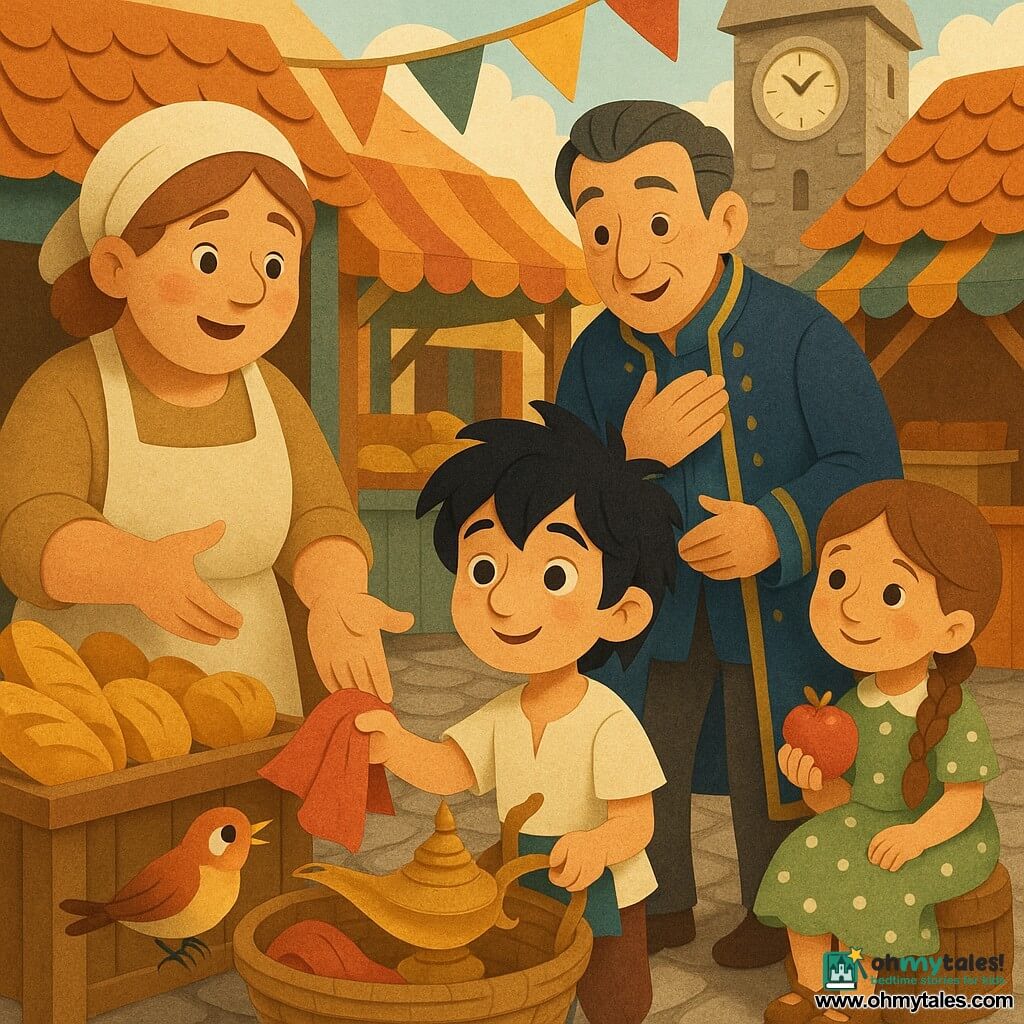
In a warm city of winding lanes and sun-bright roofs, Aladdin lived in a small room above a bakery. He had hands that could fix a broken toy and a heart that loved a singing sparrow. The alleys smelled of sugar and spice. The people there walked like the slow dance of a ribbon.
One morning, Aladdin found a lamp tucked under a pile of old rugs. It looked like a quiet moon, smooth and shy. He polished it with his sleeve. A soft sigh slipped out, like the rustle of leaves. The lamp did not shout. It waited with the patience of a sleeping cat.
Aladdin felt the lamp tremble in his fingers. He thought of small wishes: bread for an old neighbour, a blanket for a baby, a flower for the bakeress who smiled with flour on her cheek. He wanted to help. His chest felt warm. He kept the lamp close, like a secret friend.
Not far away, in a high house with tall mirrors, lived a group known as the Proud Market. They wore bright coats and fast shoes. They had polished belts and long lists of what they liked. When they walked, the sun seemed to step aside. Their heads were like tall towers. The Proud Market loved to be noticed. Their laughter rolled like coins.
Aladdin sometimes watched them from the bakery roof. He saw how their smiles made other faces small. He felt a quiet tug inside him. Some mornings, he would wake with a little ache when he thought of proud eyes that forgot to notice a lost glove or a thirsty plant. He wanted to teach them something soft and true. He wanted to melt a little of their pride with kindness.
Chapter Two: The Lamp's Gentle Magic
The lamp knew how to listen. When Aladdin touched it again that night, a gentle light came out. It shimmered like a pond under the moon. A voice came, not loud but as clear as a bell under water. It did not demand. It offered.
Aladdin did not wish for gold or silk. He wished for courage to show feelings and a way to make pride listen. The lamp hummed, like a lullaby. A small wind of stars twinkled and swept over the city. It carried a little map made of whispers and a promise like warm bread.
The map led Aladdin to the heart of the market, where the Proud Market gathered beneath a tall clock. They stood very straight, and their smiles had sharp edges. Aladdin felt his stomach flutter. He tucked the lamp under his arm and walked forward slowly. Inside, his emotions were bright birds. He felt fear like a grey pigeon, hope like a goldfinch, and a spark of joy like a newborn firefly.
At the clock, the lamp's light touched the faces of the Proud Market. Tiny lights, like dust motes, wrapped around them. The lights were gentle. They showed small things: a child's lost mitten, a tired horse's drooping eye, a neighbour's empty bowl. The lights made pictures on the proud faces, and for a moment, the towers of their heads dipped like flowers bending to rain.
Aladdin did not shout. He carried a basket. Inside were little gifts: a warm scarf for the baker, a painted pebble for the shoemaker, a ribbon for the little girl who sold apples. He placed them here and there without fanfare. His hands moved like moonlight. He smiled with a kindness that was like a soft tide.
The Proud Market felt something happen inside. It was new and strange. A tiny wind of feeling uncoiled in their chests. Some felt a prickling like the first raindrop. Some felt their cheeks grow warm, as if someone had put a sunbeam there. They looked at each other, and for the first time, they saw the small shadows behind their polished boots.
One of them, a merchant with a coat the colour of a gull, felt a memory unfold. He remembered a time when his mother held his hand and taught him to tie a simple knot. He felt small and tender. Another, who owned many mirrors, saw his reflection with dust in the corner. He blinked and felt a smile that was not loud but honest.
The lights from the lamp did not scold. They only showed. The Proud Market watched pictures of gentle things — a mother feeding a bird, a child offering bread. These pictures opened their chests like little doors. Emotions poured out. Shame felt like cool water. Pride felt like a heavy stone. Empathy shone like a lamp inside a cave.
Aladdin moved among them quietly. He looked at each face with the softness of a pond. He put his hand on a shoulder. He did not say much. His presence was like a balm. His courage was not loud. It was gentle. The group felt the pull of being kind, like the pull of a tide to the shore.
Then a small surprise came. The proudest among them, with the tallest tower-head, tried to keep his smile like a lid. But he had a small memory show: a time he had been called small and had learned to stand very tall. He felt sadness and then a wish to be kinder. His hands trembled like leaves. He looked at a little girl selling apples and saw her eyes were tired but brave. He took off his bright scarf and placed it over her shoulders. It was a small act, but it glowed like a beacon.
The group felt their hearts loosen. They realized that pride had been a cold cloak. They began to trade the cloak for warm scarves and handshakes. Tiny changes grew. A laugh lost its sharp edge and became round and warm. A nod changed from a curt tilt to a bowing of respect.
Aladdin watched. He felt joy like a spring that bubbles up. Tears, small and happy, gathered behind his eyes. He did not hide them. He felt proud in a different way — pride that comes from helping others grow, a proud that is soft and gentle.
Chapter Three: A New Morning
The city woke with a softer sound. The sun rose like a honeyed coin. The Proud Market walked more slowly, as if tasting each step. They helped a child tie his shoe. They shared bread that smelled of butter and sunrise. They learned names and little stories. The tall mirrors reflected kinder faces.
Aladdin wandered through the lanes. The lamp sat quiet now, smiling like a small moon. He felt a calm in his chest. The sparrow sang for him again, and he whistled back. The baker gave him a warm roll, and Aladdin thought of the scarves he had placed, and of the lights that had shown pictures. He felt a gentle glow like embers in a hearth.
People began to tell a new story in the city. It was not about who was the brightest or the tallest. It was about who could notice a tear and soak it up with a friendly hand. The Proud Market learned that strength could be soft. They learned that showing feelings did not make one small; it made one brave in a different, kinder way.
Sometimes, a proud one would catch himself before lifting his chin too high. He would remember the lamp's soft lights and the small pictures. He would think of Aladdin's quiet hands and the way the city had listened. He learned to say sorry with the same care he once used to polish his shoes.
The lamp had given no gold. It gave something finer: the sight to see, and the courage to feel. It taught the city that pride could be reshaped like clay into something warm and useful. The people learned to wear pride like a scarf that keeps someone warm, not like a crown that keeps others cold.
At night, the city glowed with many small lights in windows. Aladdin climbed to his little room above the bakery. He placed the lamp on his windowsill. The lamp shone softly, like a promise kept. Aladdin looked at the sky. He felt a small, bright thing grow inside him. He was happy because he had helped others feel.
The moral of this gentle tale is a candle in the dark. When people share their feelings, they do not fall. They stand taller in a kinder way. Pride that listens becomes pride that cares. A heart that shows tears can also show courage. Small kindnesses can melt big cold cloaks, and one child with a brave, giving heart can stir a whole city to be softer.
And so the city kept a new song. It was a song of small hands helping small hands, of eyes that see, and of hearts that feel. Aladdin slept that night with a smile. The lamp sighed, happy to have been useful. Outside, the stars leaned close, like friends listening to an old, warm story.