Room of Lists
Noah kept his wishes in a battered blue notebook that smelled faintly of pine and old crayons. He had scribbled them there all year—small promises, secret plans, a stubborn hope that he might finally learn to skateboard without crashing into the hedge. The notebook lived under his bed like a faithful pet. On the last afternoon of the year, while the house hummed with the sound of his mother's kettle and the clatter of plates, Noah slid open the drawer that held the notebook and found it slightly warmer than usual, as if it had been thinking about something.
"You're late," he whispered to the blue cover, because talking to inanimate objects was a useful rehearsal for bravery.
He wrote his last line for the year in a careful, looping hand: This year I will try new things without worrying too much about failing. He folded the paper and tucked it into his pocket. The ritual had started with his grandmother years ago: every New Year's Eve the family wrote one wish and one memory on a slip of paper. The memory was to remind them where they'd come from; the wish was to point the way forward.
Noah's sister, Lila, burst into his room with two socks on her hands and a flashlight glued to her forehead. "Do you think the neighbors will set off real fireworks again?" she demanded, eyes shining.
"No idea," Noah said. He felt a quake of excitement—he loved the bright claps of fireworks, the way they rolled across the sky like paint thrown by giants—but also the softer part of the night: the way the house smelled of cinnamon, the way everyone gathered in the living room as if to hold the year's warmth together.
Downstairs, their grandfather was arranging a tiny wooden boat on the mantel. "We put the memory in the boat this year," he announced when they came into the kitchen. "So it sails into the new year."
Noah peered at the boat. A scrap of paper lay in its hull, edges curled like a smile. The house was already full of tiny trades of ritual: a bowl of coins beside the sugar bowl, a single orange by the window, candles waiting in mugs. Each piece had a story and each story made the ordinary evening feel like something stitched together with light.
Making the Spark
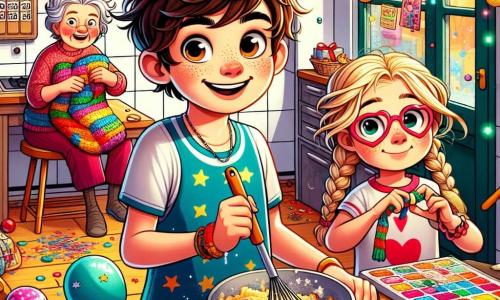
They spent the evening dressing the house with small superstitions. Lila insisted on sprinkling rice by the front door "for luck" while humming tunelessly. Audrey, their mother, baked honey cookies shaped like stars and let Noah and Lila press their thumbs in the centers to make little valleys for the icing.
"Don't press too hard," warned Audrey, whose apron carried the same steady calm as a lighthouse. "Make a wish into the thumbprint. The press traps it."
Noah did, and for a moment the kitchen was a collective swath of quiet wishes. Across the table their grandfather told a story about the time he had beaten the winter storm by taking a different path home and discovering a little bookshop with a bell that smelled of lemon. Lila added sound effects—whooshing winds and the dramatic "twang" of the bookshop's bell. Noah loved that the story bent like taffy between truth and invention.
He made a card for each person he loved and tucked them into a shoebox labeled "Bright Things." Inside were marigold petals, song lyrics scribbled on napkins, a blue marble, and a photograph from the park last summer where his sister had been mid-splash and frozen in a perfect moment of joy. Noah's own card contained a tiny sketch of a skateboard and the words Try and it will be less scary.
Father came into the kitchen smelling faintly of engine oil and peppermint—he'd been fixing the neighbor's snowblower as a favor. "Are you ready for the countdown?" he asked, ruffling Noah's hair.
Noah nodded, but a small knot of anxiety curled at the edge of him. What if the wish didn't come true? What if the luck fell through a hole in his pocket? He thought of letting go—of sending his memory and wish into something bigger—and his heart felt like a tight fist that might open as soon as he learned the right way to release it.
The Promise Fold
Before dinner the family gathered around the mantel to fold their papers. Each fold felt ceremonial, as if creasing paper could crease the future into a better shape. Noah wrote his memory—how he had finally fed the stray cat behind the bakery and how its ribs had faded like pencil lines—and his wish again, this time with the words less nervous and more determined: I will try new things even if I'm scared.
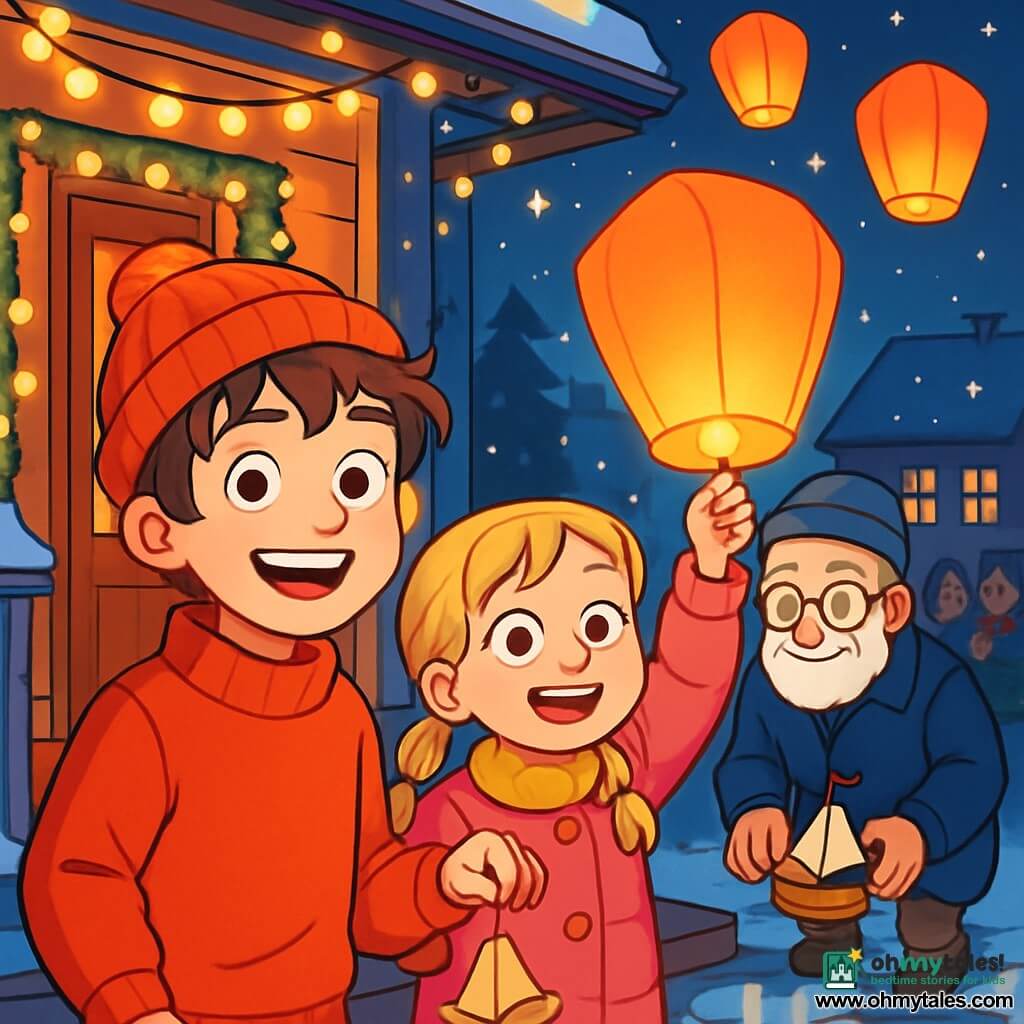
Grandfather stood up with the little wooden boat and tapped the bottom. "You put the memory in," he said. "You tuck the wish into the lantern. Then at midnight we set both free."
"A lantern?" Lila clapped. "Like those floating ones?"
Audrey smiled and shook her head. "No, indoor lanterns. Paper bags with tea lights inside. We have them on the porch. The real ones might be canceled if it's windy. But indoors, they are cozy."
They folded wishes into tiny paper stars and tucked memories into the boat. Noah's hands trembled slightly when he pushed his memory into the hull. It fit like a secret. Then he sealed his wish inside a paper lantern—he had written it in tiny letters so the lantern would be full of a quiet, personal glow.
Outside, the sky had become the color of old coins. Snow threatened, a light misting dust, but the streetlights painted the droplets in gold. The neighborhood smelled of smoke from distant chimneys and the sweetness of the bakery's last batches.
Just then a shout came from the window. Mrs. Gow, the elderly woman who lived two doors down, had hung a string of blue lights across her porch and was singing off-key about sparklers. "It's the only way to do it," she called, waving a mitten. "Music, lights, and soup!"
Noah pressed his forehead to the cold glass. He loved how people made the night a patchwork of rituals. He felt like a thread pulling the home's square into something brighter.
Trouble on the Porch
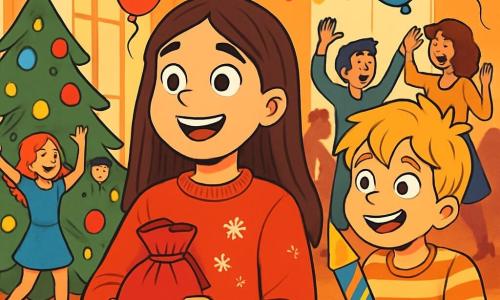
They stepped onto the porch at nine, clutching mugs of cocoa and the lanterns that smelled faintly of citrus. Lila bounced like a rubber ball, carrying her lantern as if it contained butterflies. The wooden boat sat on the mantel, tiny and vulnerable.
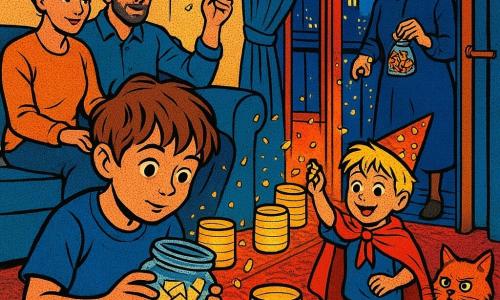
Noah's friend Sam arrived with a cardboard box filled with folded confetti—bright loops of tissue paper they'd made during art class. "Do we get to throw it at midnight?" Sam asked.
"Only after the countdown," their father said. "We don't want to scare the neighbors' cat."
They arranged chairs and blankets, creating a circle that felt like a safe island against the wet cold. Then the wind picked up. It came in sudden gusts that made the lanterns tremble and the paper stars rustle. One gust was sharp enough to flip a lantern sideways and blow out its tea light.
"Oh no," Lila wailed, eyes huge. "My wish!"
Noah lunged to relight it, but the wind snatched the match from his hand and sent a shower of tiny sparks onto the porch. Father cupped their hands together and shielded the flame. They laughed when the sparks sizzled out like tiny fireflies.
"We can take them inside," Audrey suggested, voice calm. "Safety first. We'll have the wishes by the window."
They moved the lanterns to the living room, which felt suddenly like a cathedral of warmth. Candles lined the mantle, throwing shadows across the walls that looked like people dancing. The weather had canceled the outdoor show, but inside the lights seemed to grow stronger, more determined.
Noah looked at the boat. It sat on the mantel like a tiny ship waiting for a sea that wouldn't arrive. He felt a little disappointed, but Grandfather stood and tapped the boat with a grin.
"If the sea won't come to the boat," he said, "then the boat will come to the sea."
He carried the boat to the kitchen sink, where they'd run water and let it float for a moment under the warm running faucet. So it was the new ritual: a small, safe voyage across the warm kitchen basin. Noah placed his memory in the hull and watched it bob. It spun and then steadied, as if it had decided on its course.
"You can make the river strong," Sam said, filling the sink with more water. He blew across the surface and Noah laughed as the boat skittered like a tiny sailor.
The mishap had changed the plan but not the spirit. The night reassembled itself, seam by seam, into something new.
Counting Down
The television chirped with other countdowns. One by one, faces from around the city appeared—cheerful, cold, hopeful. The family made a list of small things to do before midnight: call Aunt Rosa, put on the silly hats, make the confetti cones. Each task was a little drumbeat toward midnight.
"Ten," the television chimed, voices from other living rooms spilling into their own. They began the ritual count, each number a footstep on a stair toward a new floor of the house of time.
"Ten... nine... eight..." They held hands for most of it. Lila clenched her sister's and Noah's fingers so tight he thought he might not be able to breathe, but he liked the pressure—a reminder of belonging.
At five, a distant sound rolled across the neighborhood. It was not the fireworks he'd expected but a trumpet from the corner of Maple Street. Somebody's band had decided to brave the weather. The notes rose like bread dough, warm and expansive.
"Three... two... one!"
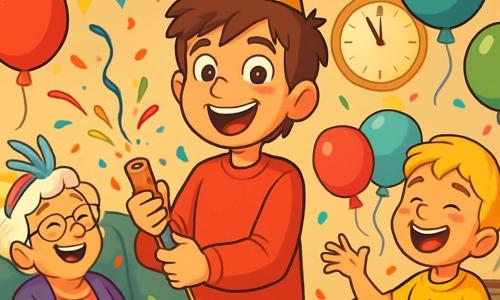
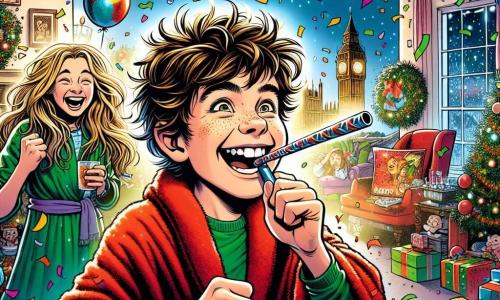
They cheered. They hugged. They popped the confetti and tiny paper stars rained down, sticking to hair and eyebrows. The living room exploded into sound and motion, and Noah's heart felt like something that might take off.
Then they opened the windows despite the cold and set the little lanterns on the sill. Candles safe in glass jars, they lined the windows like a string of small moons. Noah pressed his palm to the glass and felt the chill on the other side. He thought of his wish tucked into its star, of the boat bobbing quietly in the sink, of the rough little list in his notebook.
Something soft happened at that very instant—small and impossible to catch, like a scent you only notice after it's gone. A single snowflake traced across the sill and landed on the paper star, making a glitter like sugar. It did not dissolve at once. For a slow breath it held shape, a tiny six-pointed promise, and then it melted into a dot that made the paper darker. Noah would have sworn it looked like a star smiling.
"Look," Lila whispered. "It's smiling."
Noah smiled back, feeling as if the universe had winked at him.
New Light
In the small hours, they moved the little boat outside beneath the porch, where the rain had stayed light. Grandfather cupped his hands and set the boat onto a puddle at the end of the walkway. It bobbed over the concrete like a brave little explorer. For the first time, Noah felt the memory lighten inside him, less a weight and more a map. He had carried something heavy all year—fear and worry about trying and failing—and as the boat drifted he felt the edges of it soften.
They poured hot cocoa into thermoses and wandered the block with flashlights, saying hello to neighbors. Mrs. Gow handed out bowls of stew and made them promise to return the bowl tomorrow. An elderly couple two doors down hugged them and declared that the year would be "properly lucky now."
Noah walked with Sam to the end of the street. The sky had opened into a tidy wash of stars, and the trumpet player on Maple Street had moved on to a slower song. On the lamppost by the corner someone had taped a photograph of fireworks from last year, edges curled and slightly damp. Noah ran his thumb over one of the bright explosions and felt the paper give.
"Do you think wishes really work?" Sam asked.
Noah thought of the blue notebook and the little star of paper, of the feeling that something inside him had become less tight. He thought of his grandfather's story about the bookshop bell and how he had found new things by taking a different path. Noah remembered the skateboard sketch and the way his stomach had fluttered at the thought of trying again.
"They're a kind of way marker," he said finally. "Like a map. They don't make things happen by themselves, but they help you find the path."
Sam grinned. "So they're like a compass that needs a push."
"Exactly. And sometimes the compass is a little glittery snowflake."
They laughed and shuffled back toward home. The lanterns on the sill winked from the windows like tiny lighthouses. Lila was asleep on the couch when they returned, head pillowed against a mountain of blankets, confetti in her hair. Noah leaned over and smoothed her brow, feeling an odd mixture of solemnity and giddy relief. The house felt like a held breath finally let out.
In the morning the world looked new. The rain had stopped and the street had an early-summer smell after a summer storm—fresh and luminous. The little boat had vanished from the puddle overnight, but when Noah checked the sink he found a small coin beneath the plughole—bright and unexpected, as if the toy river had paid a toll of luck. He slid the coin into his pocket and felt its cool circle, a tiny weight of possibility.
He opened the blue notebook and wrote a new line at the top of the next page: I will fall and get up and try again. He folded it carefully and put it into the shoebox of Bright Things, right beside the photograph from the park. The world felt like a book with a new page turned.
At breakfast his father clinked a spoon against the mug and said, "To small things that make big changes."
Noah raised his mug and thought about the lanterns, the boat, the paper stars, and the coin. He thought about how the neighborhood had hummed together in the same key and how he had learned that rituals were not magic for the sake of magic, but tools—soft ones—that steadied people so they could be braver.
Outside, a child down the street released a kite into the sky. It tugged on its string like a hand reaching. Noah smiled and let his fingers curl around the coin in his pocket as if holding a secret. The year ahead might still be full of bumps and the old hedge might still be a formidable opponent for his skateboard, but the night's small wonders had shifted something. He felt lighter, like the boat after the sink, ready to float.