Chapter 1: The Idea in the Playground
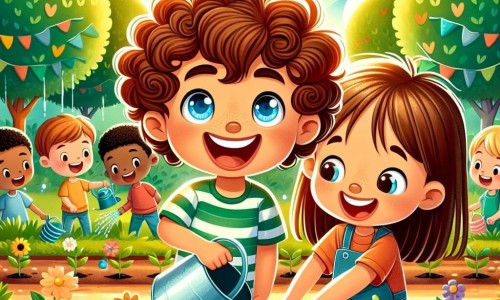
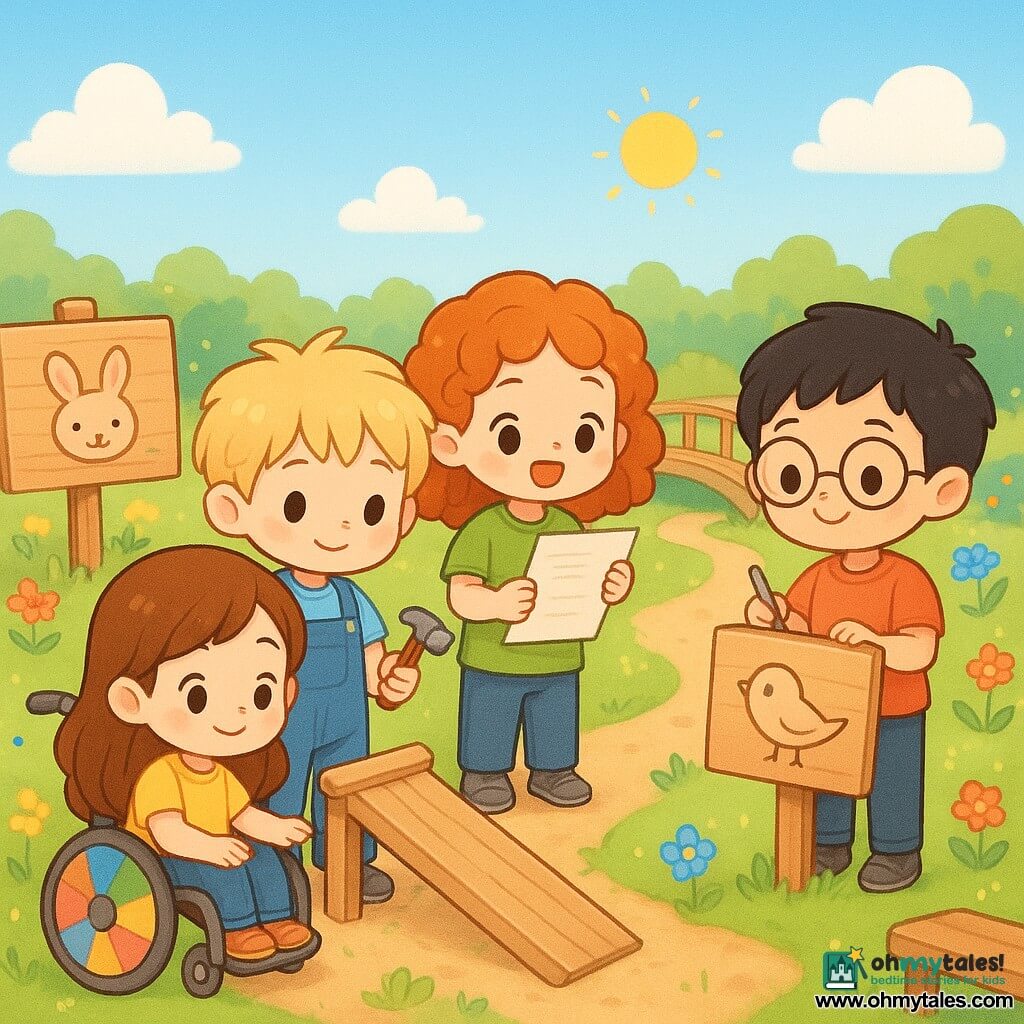
On a bright Monday, four friends sat on the low wall outside their classroom and watched their school garden wake up. Little bees buzzed in the lavender, and the sun warmed the stones. Maya, Theo, Sam, and Lina were seven years old and loved the garden. They liked the smell of wet earth, the crunchy leaves in autumn, and the tiny frogs by the pond.
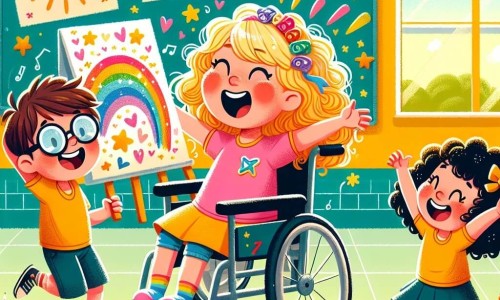
Maya rolled her wheelchair slowly to the edge of the flower bed and smiled. She loved feeling the breeze on her face. Theo had a loud laugh that made everyone join in. Sam kept a notebook with drawings of birds. Lina always noticed small things, like a ladybug on a shoe or a seed stuck in a pocket.
"This place could be for everyone," Maya said. Her voice was calm and steady. "Not just pretty, but helpful."
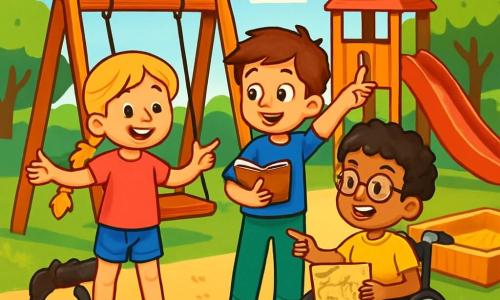
Theo leaned forward. "We could make a trail," he said, eyes bright. "A Friendship Nature Trail! With signs and spots where everyone can play and learn."
Sam opened his notebook. He drew a winding path, little benches, and a low ramp. Lina clapped softly. "And quiet places for listening," she added. "So we can hear the birds."
They imagined a trail with soft ground for walking, wide paths for wheelchairs, braille on some signs, audio boxes with bird calls, and cozy corners for reading. They wanted a place where no one felt left out.
That week their teacher, Mrs. Patel, gave the class time to work on a project for Open Day. The four friends looked at each other and knew this was the chance. They would make the Friendship Nature Trail.
Chapter 2: Plans and Small First Steps
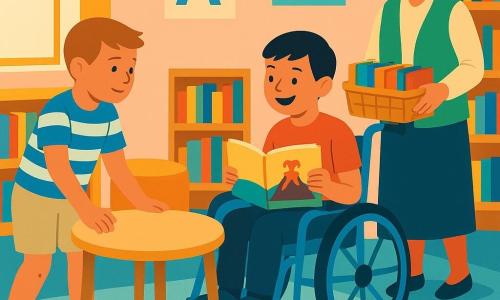
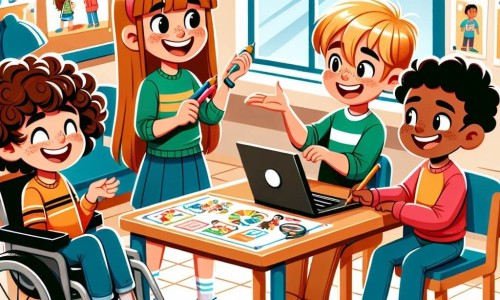
The friends gathered in the library after school. They drew maps and made lists. Everyone had something to do.
Maya tested the slope of the school ramp and measured it with a tape measure she used like a pro. "This part needs to be gentle," she said, tapping the paper. "Wheels should move without bumps."
Theo loved tools and carried a small box of toy hammers. He practiced safe hammering with wooden blocks and promised to learn more about real tools with an adult. Sam sketched sign ideas with neat letters. Lina wrote little poems to go on the signs, gentle lines about listening and sharing.
They decided to ask for help. The head gardener, Mr. Ramos, knew about soil and plants. Mrs. Patel would talk to the principal. The Friends of the School would lend some tools. The children felt proud and also a little nervous. Big projects can feel like big mountains, but they were together.
At recess, they tested a simple idea. They placed a low wooden plank over a small patch of grass to make a smoother path. Maya rolled across it with ease and grinned. Other children watched and tried it too. Some bumped into the plank at first, then figured it out. Lina helped people find the best way to step on it.
One boy, Jake, who had always been a bit shy around Maya's wheelchair, tried to push the plank with his foot. He looked surprised when Maya asked him to guide her wheels gently instead. Jake's face went warm. "I didn't know how to help," he said. Maya squeezed his hand. "Just ask," she said. "I like when people tell me what they can do."
The friends learned their first lesson: inclusion is also about asking and listening.
Chapter 3: Building with Care
Work began on a Saturday. Parents and teachers arrived with rakes and gloves. Mr. Ramos showed them how to make soil soft and how to place stepping stones so rainwater wouldn't puddle. The children had roles. Theo helped mark where benches should go. Sam painted the first wooden sign with big friendly letters. Lina read her poems aloud while people worked, making everyone smile.
Maya had an idea for a listening corner with a low bench and a small box that played bird songs. She explained how sound boxes should be at a height where everyone could reach the button. "If it's too high, some friends can't press it," she said. The grown-ups adjusted the box. Maya tested the sound and closed her eyes, nodding.
One part of the trail needed a small bridge over a muddy dip. Theo climbed up the ladder to check it, and Sam and Lina tied a bright ribbon so children would notice the step. The bridge turned out to be wider than expected. Mr. Ramos lowered a plank to make a ramp on one side. Maya rolled across the new bridge like it was a stage and laughed.
Sometimes the friends disagreed. Sam liked neat signs with perfect letters, but Lina wanted bright colors and playful shapes. "Can we do both?" Maya asked. They found a way: neat letters for the words and colorful borders for fun. Theo suggested painting small footprints that were not only his but everyone's footprint, mixed in color and size.
They also thought about quiet space rules. Signs would remind people to whisper in the listening corner and to take turns on sensory stations. The friends practiced asking for turns kindly. "After you," said Theo when Sam wanted the drum box. "Thanks," Sam replied, and waited patiently. It felt good to share.
As days passed, small problems were solved with small kindnesses. A bench got wobbly; Lina tightened screws with a grown-up's help. A bird feeder hung too low and worried the garden birds; Sam raised it a little higher. The trail grew because the friends listened to each other and to others who used it.
Chapter 4: Open Day and Gentle Celebrations
Open Day arrived with fluffy clouds and a bright sun. Children wore bright badges that said "Trail Helper." Parents walked slowly along the path, reading signs and smiling. Maya, Theo, Sam, and Lina stood near the entrance and watched people notice the small things they had planned.
The listening corner became a favorite. A little girl pressed the audio button and heard a robin's song. She tilted her head and whispered, "It's like a tiny violin." An older man touched the sign with braille and said it made him remember how his grandmother used to read to him. Someone else said the ramp made it easy to push a stroller.
A boy from another class used a white cane and paused at the first sign. Maya stepped forward and gently described the path with simple words. "There are benches and a soft patch for resting. The sound box is to your left." The boy's face softened. "Thank you," he said. He walked with care. Maya felt happy; she knew the trail could welcome many ways of being.
At the ribbon-cutting, the principal praised the children. He did not use fancy words but said he had seen kindness and good thinking. The friends felt proud. Parents thanked them, not for the flowers or the signs, but for thinking of people who were usually forgotten. "You thought about everyone," a parent said. Theo's cheeks turned red.
Not everything went perfectly. A rain shower made some gravel sink, and a sign got a little muddy. But families cleaned the path together, laughing as they splashed. Fixing things together felt part of the project. It showed how a community works — not because everything is perfect, but because people care.
In the afternoon, the friends sat on the wide bench and shared cookies. They watched children play, sit quietly, and find places to talk. Sam opened his notebook and drew a tiny bird. Lina read one of her poems softly. "Small choices make a big place," she said.
Maya looked at her friends and thought about all the moments that had felt difficult at first. When she had to explain how she liked things arranged. When she showed how a ramp should be gentle. When Theo had to learn not to rush things and to listen. They had grown step by step, and so had the trail.
Before they left, the friends planted a small tree near the listening corner. Each of them put their hand in the soil and pushed the roots in gently. "We planted more than a tree," Sam said. "We planted a promise."
They wrote a short note on a small board by the tree. It said, in Sam's tidy letters: For every friend. For every way. For every day. The words were simple, and anyone could read them.
As the sun went down, parents and children walked back to their cars and houses. The garden looked softer in the evening light. The trail glowed a little, like it had found its place.
Maya rolled to the edge and looked at the path she had helped shape. "It doesn't change who we are," she said, "but it makes room for who we might meet."
Theo put an arm around her shoulder. "And we'll keep fixing it when we need to," he said. "We won't let it break."
Lina whispered, "And we will tell others to listen."
Sam shut his notebook and tucked a small leaf inside. "I think it's a place where being different is like having different flowers in a garden," he said. "They make it nicer."
They walked home together, their hair smelling of dirt and their pockets filled with small things — a ribbon, a painted pebble, a scrap of paper with a new poem. They were tired, but their tired felt warm.
That night, each of them slept with the quiet happiness that comes after a day of good work and kind words. They had built more than a trail. They had built a place that said: we see you, we hear you, and you belong.
And underneath the small tree, the roots wrapped themselves around the soil and the first new leaves folded like tiny hands. The Friendship Nature Trail would grow, like the children, with patience, care, and many gentle steps.